The Builders and the Republic: Independence, Agency, and the American Character
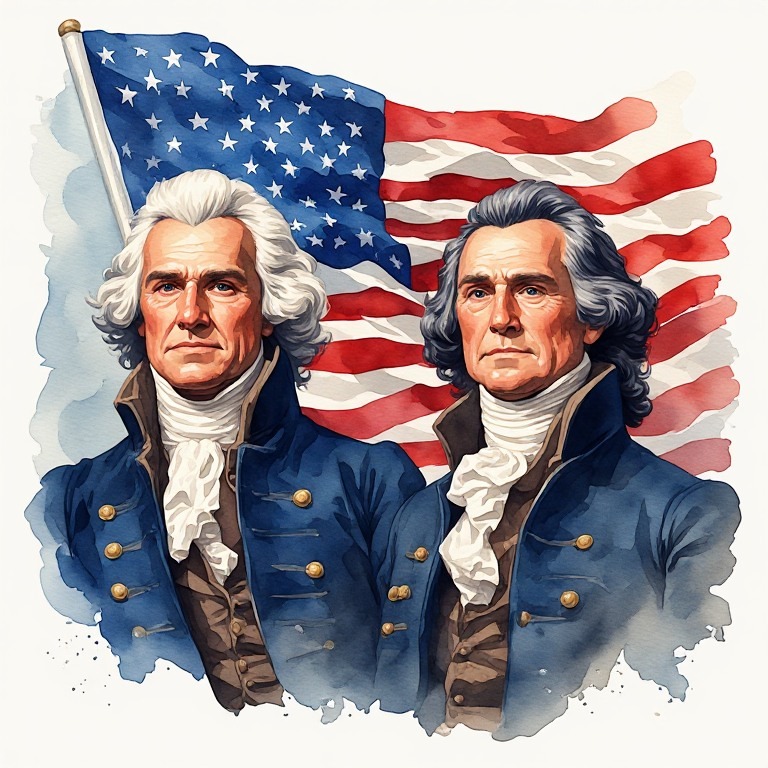
America began as an argument — loud, sharp, and unavoidable. It was a clash of visions among three men who understood that a new nation had to decide what kind of people it intended to form. Thomas Jefferson, James Madison, and Alexander Hamilton were not building a country out of abstractions. They were building it out of human nature itself: the strengths, weaknesses, habits, and hopes of ordinary citizens. Each man saw a different American character, and each believed a different kind of citizen would keep the republic alive. Their disagreement still shapes the nation.
Jefferson and Madison believed that freedom could survive only if citizens were independent — not merely in a political sense, but economically and personally. They imagined a republic sustained by small landowners, craftsmen, and self‑reliant workers capable of standing on their own feet. Independence, to them, was not an ornament of liberty but its engine. A person who owns their labor cannot be controlled; a person who can repair their own life cannot be ruled; a person who depends on no master cannot be bought. This was the agrarian‑republican ethos: the conviction that a free society must rest on people who can take care of themselves.
Jefferson feared that widespread dependency — whether on employers, government, or distant institutions — would hollow out the republic from within. Madison agreed, warning that a dependent population would eventually trade liberty for comfort and responsibility for security. Neither man romanticized farming; they were defending agency, the capacity of individuals to shape their own lives.
Hamilton saw the world through a different lens. He believed the new nation required structure: a strong central government, a national bank, organized industry, and coordinated power. Where Jefferson placed his trust in the independent citizen, Hamilton placed his in the organized state. He feared that without national capacity, the republic would remain fragile in a world dominated by empires. His vision created the financial and institutional backbone of the United States, while Jefferson’s vision shaped its moral and political identity. The country needed both, but the tension between them never disappeared.
As the nation evolved, different movements adopted different pieces of these founding visions. Some embraced Jefferson’s emphasis on local responsibility and personal independence; others leaned toward Hamilton’s belief in national coordination and centralized systems. The labels changed, but the argument did not. Beneath it lies a single, enduring question: Should a free society depend on its citizens, or should its citizens depend on the society?
The founders understood something modern life often forgets: dependency is not merely an economic condition — it is a habit. A dependent person waits instead of acts, reacts instead of builds, demands instead of creates, and relies on others rather than on themselves. Jefferson saw this habit as the quiet enemy of a republic. Madison believed it was the seedbed of factionalism and instability. Even Hamilton, the architect of national power, believed in personal industry and upward mobility through work. A republic cannot survive if too many of its people become spectators in their own lives.
Agency is the opposite of dependency. It is the belief — and the practice — that a person can improve their situation, repair what is broken, build what is missing, and take responsibility for their choices. Jefferson believed agency was the natural state of a free human being. Madison believed it was the glue that held a republic together. More than a century later, Ayn Rand echoed the same principle in a different idiom, arguing that the individual who creates, builds, and thinks is the engine of civilization, and that a society survives only when it honors those who take responsibility for their own lives. Jefferson would not have agreed with Rand on everything, but on this point they stood together: a free person must be the author of their own life.
The founders also believed that work — real work, the kind that builds and repairs — forms character. It teaches discipline, patience, and responsibility. It gives a person a stake in their community and anchors them in reality. Those who build become invested; those who repair become capable; those who create become independent. Those who do none of these inevitably become dependent on those who do. Jefferson feared a society in which people spent more time protesting than producing, more time demanding than doing. He believed a republic survives only when its citizens devote more energy to improving their own lives than to shouting at the world. Time is the one resource no one can replace. It can be spent building something real, or it can be wasted in endless outrage. One path strengthens a republic; the other weakens it.
The founders believed in equality of rights, not equality of habits. Some people build while others wait. Some take responsibility while others look for someone else to carry the load. Jefferson believed a republic survives only when the builders outnumber the dependents. Madison believed liberty requires citizens capable of managing their own affairs. Rand later argued that creators carry the world on their shoulders and that societies collapse when they punish those who produce. Equality of rights was essential; equality of effort was never promised.
The lesson for today is simple and enduring. A nation is only as strong as the people who build it. A community is only as healthy as the people who repair it. A person is only as free as the work they are willing to do. The founders disagreed on many things, but they agreed on this: a republic cannot survive on dependency. It survives on agency, productivity, and responsibility. Protest may be a right, but creation is a duty. Outrage may feel powerful, but building is powerful. Dependency may feel safe, but independence is freedom. The future belongs to those who repair what is broken — in their homes, in their communities, and in themselves.