
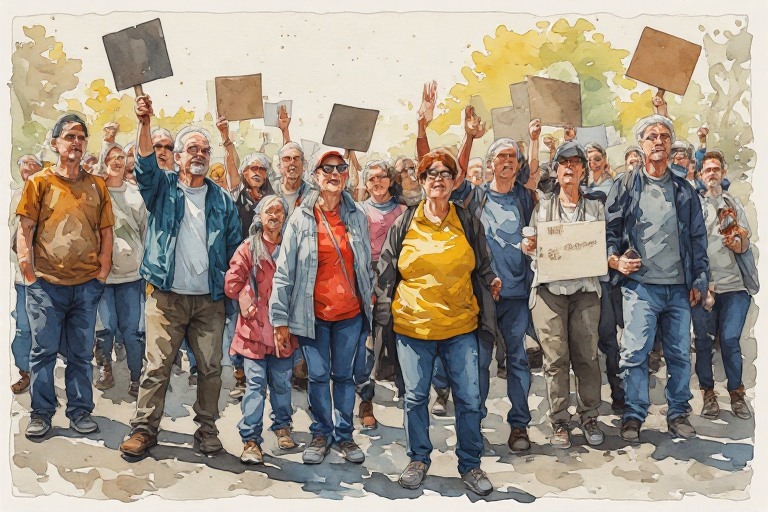
Why So Many Boomers Joined the Weekend Protests — And Why It Matters
The sight of so many Baby Boomers at this weekend’s protests surprised a lot of people. It surprised me too. For decades, Boomers were seen as the dependable center of American civic life: the generation that built institutions, trusted them, worked through them, and believed the country could be improved without tearing it apart. So when they show up marching under slogans and alliances that seem to clash with the values they spent their lives defending, the reaction is understandable. What brought them there?
The answer is not that Baby Boomers suddenly became irrational or eager for chaos. The deeper truth is more unsettling. Many are responding to a profound sense of emotional and cultural disorientation. They are trying to defend the world they remember, but in the process, they may be lending support to narratives that could ultimately weaken that world.
Why Baby Boomers Joined the Weekend Protests
Baby Boomers are not turning out because they are naturally drawn to unrest. In many cases, they are showing up because they are afraid. They see a country that feels less stable, less coherent, and less recognizable than the one they inherited. Their instinct is to protect what they believe is being lost.
That instinct is understandable. The problem is that the moral and political vocabulary they were shaped by no longer maps neatly onto the institutions and movements they encounter today. They hear familiar words like democracy, freedom, authoritarianism, and justice, but those words are often being used in ways that differ sharply from the civic culture of their youth.
This is one reason so many Baby Boomers Joined the Weekend Protests with sincere conviction. They are not necessarily reacting to the present as it is. They are reacting to the present through the memory of a different America.
Baby Boomers Were Formed by a Coherent Civic Story
Boomers grew up in a country where institutions appeared to work, or at least seemed trustworthy enough to hold society together. Schools taught a relatively unified civic narrative. Authority was generally respected. The Cold War shaped public morality with a clear framework: tyranny was the enemy, democracy was worth defending, and strongman politics had to be resisted.
That formation still matters. When Boomers look at political volatility today, they do not just see policy disagreement. They see loss:
– loss of national unity
– loss of institutional legitimacy
– loss of cultural coherence
– loss of the America they remember
This loss is not imaginary. It is deeply felt. And that emotional force helps explain why so many Baby Boomers Joined the Weekend Protests in the first place.
Why Baby Boomers Joined the Weekend Protests Out of Fear of Authoritarianism
One of the most important reasons Boomers respond so strongly to protest politics is that they were raised with a powerful fear of authoritarianism. For their generation, the moral reflex was simple: fascism must be defeated, communism must be resisted, democracy must be preserved, and freedom must be protected.
So when modern institutions warn about “authoritarianism,” many Boomers respond instantly. They are not always carefully evaluating the claim. They are responding to the moral training of their youth.
The tragedy is that the institutions making those warnings no longer share the same moral grammar that shaped Boomers in the first place. The words remain familiar, but their meanings have shifted. What once sounded like a defense of liberty can now be used to justify institutions that are themselves increasingly opaque, bureaucratic, or coercive.
They See Real Problems, But Through a Reversed Lens
Boomers are not blind to what is happening around them. Many can clearly see:
– chaos at the border
– rising disorder
– collapsing civic norms
– speech suppression
– institutional drift
But instead of reading these developments as failures of constitutional order, they often interpret them as signs of looming tyranny. That is the interpretive framework they were given.
So when they hear calls for enforcement, boundaries, or constitutional restraint, they may hear oppression. They have been taught to read structure as danger and disorder as moral urgency. That inversion helps explain why so many Baby Boomers Joined the Weekend Protests with genuine conviction, even when the causes themselves are complicated or confused.
Many Baby Boomers Feel Politically Homeless
Another reason so many Baby Boomers Joined the Weekend Protests is that many feel stranded politically and culturally. They feel blamed for the country’s problems, dismissed by younger generations, and erased from the national conversation. Both major parties often seem to take them for granted or treat them as relics of a past America that no longer matters.
Protests offer something they may not have felt in years:
– belonging
– purpose
– moral clarity
– civic duty
– relevance
This is an important part of the story. For many, the appeal is not ideological sophistication. It is the chance to be part of something that feels meaningful again.
The Moral Authority Baby Boomers Bring — and the Risk
This is the hardest part to say, but it matters: many Boomers are lending their moral authority to movements that do not actually include them.
The movements they support may not share their values. They may not respect their generation. They may not care about the institutions Boomers helped build, or about preserving the civic order Boomers spent their lives trying to maintain. In some cases, these movements are openly hostile to the cultural inheritance Boomers assume they are defending.
That is the central tragedy. Many Boomers think they are protecting the world they built, but they may actually be strengthening a worldview that will erase it.
Why So Many Baby Boomers Joined the Weekend Protests as Pawns in a Larger Narrative
This does not mean Boomers are foolish or malicious. It means they are vulnerable.
A frightened, disoriented population is easy to manipulate, especially when it still trusts institutions that have moved far away from its original values. Many Boomers are following the civic script they were taught decades ago: good citizens show up, protest injustice, and defend democracy. The problem is that the script has changed, and nobody handed them a new map.
That is why so many Baby Boomers Joined the Weekend Protests with genuine good faith while still being pulled into narratives that may ultimately work against them.
The Tragedy of Institutional Drift
Boomers spent their lives supporting the institutions of American civic life:
– schools
– churches
– universities
– newspapers
– government agencies
– civic organizations
Now, in their moment of fear and disorientation, many are unintentionally helping dismantle the values those institutions once upheld.
That does not make them the enemy. It makes them casualties of institutional drift.
This is one of the most important lessons hidden inside the headline that so many Baby Boomers Joined the Weekend Protests. Their participation is not just a political event. It is a sign that the shared assumptions holding civic life together have weakened dramatically.
Why This Matters
This moment matters because Baby Boomers still carry moral and cultural weight. They remember a country with stronger guardrails, a more shared vocabulary, and a clearer sense of national purpose. When they join protests, they are not merely adding numbers. They are lending legitimacy, memory, and authority.
But legitimacy can be misdirected. Memory can be manipulated. Authority can be used in service of outcomes its holders never intended.
That is why the question of why so many Baby Boomers Joined the Weekend Protests is not just a sociological curiosity. It is a warning about what happens when a generation built on duty is asked to defend a political world it no longer fully understands.
Conclusion
Baby Boomers showed up this weekend not because they are radicals, but because they are frightened, disoriented, and desperate to defend a country they feel slipping away. They are acting out of duty, not ideology. But the movements they are supporting do not necessarily share their values, and they may not preserve the world they cherish.
That is why this matters. It is not a story of betrayal. It is a story of confusion, dislocation, and the dangerous gap between intention and outcome. Understanding that gap should lead not to contempt, but to clarity and compassion.
If we want to understand why so many Baby Boomers Joined the Weekend Protests, we have to understand the generation itself: its formation, its fears, and the world it still hopes to save.