
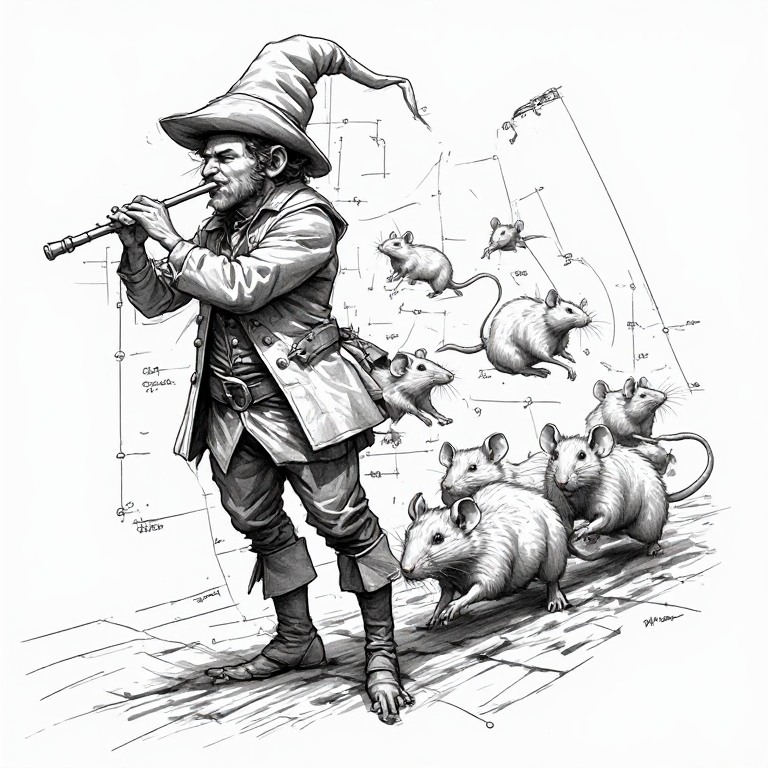
In recent years, a troubling pattern has emerged within the modern Democratic Party: when institutional outcomes fail to align with their preferred ideological goals, the response is not to recalibrate strategy or persuade the electorate, but to challenge the legitimacy of the institutions themselves. Courts become “illegitimate,” constitutional structures become “outdated,” and procedural rules become “obstacles” to be rewritten. This is not merely a political tactic — it is a cultural signal. And like the Pied Piper leading the children of Hamelin, party elites model a posture that their followers quickly adopt.
This dynamic is not new in political history. Political scientists call it elite‑driven norm erosion: when leaders repeatedly frame institutions as corrupt or unjust, their supporters internalize that framing as the default mode of engagement. What begins as rhetoric at the top becomes behavior at the bottom. The Pied Piper analogy captures the top‑down direction of influence, but the more accurate description may be “monkey see, monkey do.” When leaders treat rules as negotiable, followers learn to treat rules as negotiable. When leaders delegitimize courts, followers come to see judicial decisions not as binding but as partisan obstacles. When leaders insist that the system is rigged unless it produces their preferred outcomes, the base absorbs that worldview as common sense.
The examples are not hypothetical. In recent years, Democratic leaders have floated or pursued structural rewrites whenever outcomes disappoint them:
- proposals to expand the Supreme Court,
- calls to eliminate the Senate filibuster,
- pushes for statehood to alter Senate composition,
- efforts to rewrite state constitutions after unfavorable rulings,
- and attempts to reshape election rules in ways that advantage their coalition.
Each of these actions can be defended individually, but the pattern is unmistakable. The underlying message is clear: if the rules do not produce the desired outcome, change the rules.
This mindset does not remain confined to Washington. It filters into everyday political behavior. When a movement’s leaders model rule‑flexibility, its followers adopt rule‑flexibility as a norm. When elites frame institutions as illegitimate, the rank‑and‑file begin to treat institutional constraints as optional. The result is a political culture increasingly defined by win‑at‑all‑costs thinking, where the legitimacy of the system is conditional, and the durability of rules is secondary to the urgency of ideological victory.
The deeper issue is not simply partisan frustration — it is a crisis of legitimacy. A constitutional system depends on shared rules, shared constraints, and shared acceptance of outcomes. When one side treats rules as provisional and institutions as valid only when they deliver preferred results, the system itself becomes fragile. If legitimacy is conditional, then rules become optional. If rules are optional, then power becomes the only currency.
This is the danger of the Pied Piper dynamic: not that followers are mindless, but that they are responsive. When leaders normalize institutional hostility, the movement internalizes it. When leaders teach that the system is rigged, the movement behaves as though the system is rigged. And when leaders model rule‑changing as a legitimate political strategy, the movement learns to treat rule‑changing as the natural solution to any obstacle.
The result is a political culture increasingly comfortable with tearing down guardrails rather than working within them. A culture where “change the rules” becomes the default response to losing. A culture where institutional stability is sacrificed for short‑term advantage. And a culture where the long‑term health of the republic is endangered by the very people who claim to be defending it.
The Pied Piper story ends with the children disappearing into the mountain, following a tune they did not choose but could not resist. The modern political version is less dramatic but no less consequential: a movement led by elites who undermine the very institutions they rely on, and followers who imitate that posture until the system itself begins to erode.
If a republic is to endure, it requires leaders who strengthen institutions, not delegitimize them; followers who value rules, not shortcuts; and a political culture that understands that losing within the rules is healthier than winning by rewriting them. Without that, the tune of the Pied Piper grows louder — and the path it leads down grows darker.