
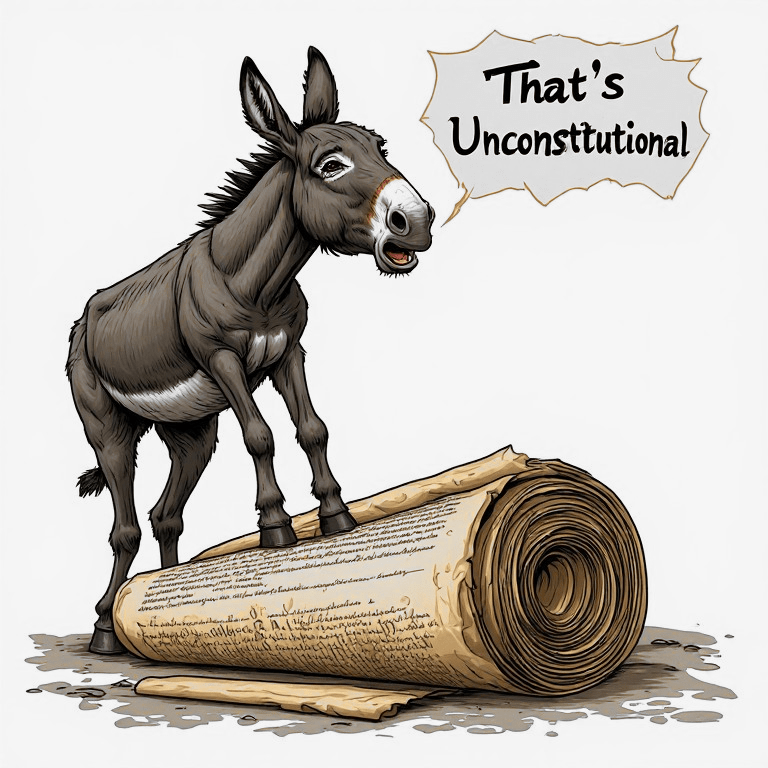
I believe I have identified a recurring pattern in the political behavior of the modern left, but I am wrong. Conservatives have thought and talked about this for a very long time. We have always assumed progressives merely accused conservatives of political folly, incompetence, cheating, ignoring norms, violating the Constitution, and disregarding the rule of law. But the more I observe, the clearer it becomes that these charges function less as descriptions and more as projections. The very principles they charge and claim to defend are the ones they most aggressively manipulate and distort.
Progressive leaders routinely treat the Constitution not as a structural boundary but as a rhetorical instrument — something to be stretched, reinterpreted, or dismissed depending on the political moment. They make a mockery of Federalist principles daily, often with open pride. Many even admit they would prefer to replace the Constitution with a document “more fitting for this century,” meaning one more easily manipulated to achieve preferred outcomes.
What makes this pattern so dangerous is not only the behavior of political elites but the conditioning of their base. Their supporters now march to pack the Supreme Court, demand the elimination of the Electoral College, and confront conservative officials in public spaces. They cheer procedural manipulations such as eliminating the judicial filibuster and altering Senate rules whenever those rules obstruct progressive goals. Lawfare has become the newest tool — a method of financially, legally, and reputationally destroying political opponents or silencing those who possess inconvenient evidence.
In all of this, progressives seem to forget that political power is cyclical. They act as though they will govern forever. Yet when conservatives regain power, only a single individual has been indicted to my knowledge — a stark contrast to the sweeping prosecutorial campaigns waged by the left. Over the last two years, we’ve heard a dozen calls to impeach him or her, over phoney baloney. They’d impeach their own mother if it would ensure them of continued power
Conservatives, for their part, generally attempt to remain within the guardrails of constitutional design. The Senate Majority Leader has thus far resisted eliminating the last major structural protection in the Senate — the legislative filibuster. If that pillar falls, the Senate will cease to function as the cooling chamber the Framers intended and will instead become a second House of Representatives. Should progressives win the 2026 midterms, I fear that final guardrail will collapse, leaving us with a Senate in name only.
But this cannot remain a matter of “right versus left.” We are, all of us — 340 million Americans — bound by a shared civic covenant. By birth or naturalization, we inherit the same constitutional framework. We elect representatives not to rule us, but to represent us. And every one of them swears an oath:
“I will support and defend the Constitution of the United States against all enemies, foreign and domestic… and will well and faithfully discharge the duties of the office…”
Nowhere in that oath is there a clause permitting the distortion, erosion, or replacement of the Constitution for partisan advantage. Nowhere does it authorize the pursuit of power at the expense of constitutional structure. Yet progressives behave as though such a clause exists — as though the Constitution is a living organism whose meaning can be reshaped at will.
Justice Antonin Scalia rejected that notion outright:
“The Constitution is not a living organism. It is a legal document, and it says what it says and doesn’t say what it doesn’t say.”
Restorationist Conclusion
A republic survives only when its governing class accepts limits — especially limits it dislikes. The Constitution was designed not to guarantee outcomes but to restrain power. When one faction treats those restraints as optional, the entire architecture begins to tilt.
The Restorationist position is simple:
A nation cannot preserve liberty if it abandons the structure that makes liberty possible.
If we wish to remain a constitutional republic rather than drift into a system ruled by temporary majorities and permanent bureaucracies, we must restore fidelity to the document that binds us. Not reinterpret it. Not modernize it. Not weaponize it. Restore it.
Because once the guardrails fall, they do not rise again. And once the Constitution becomes a tool of convenience, it ceases to be a Constitution at all.