
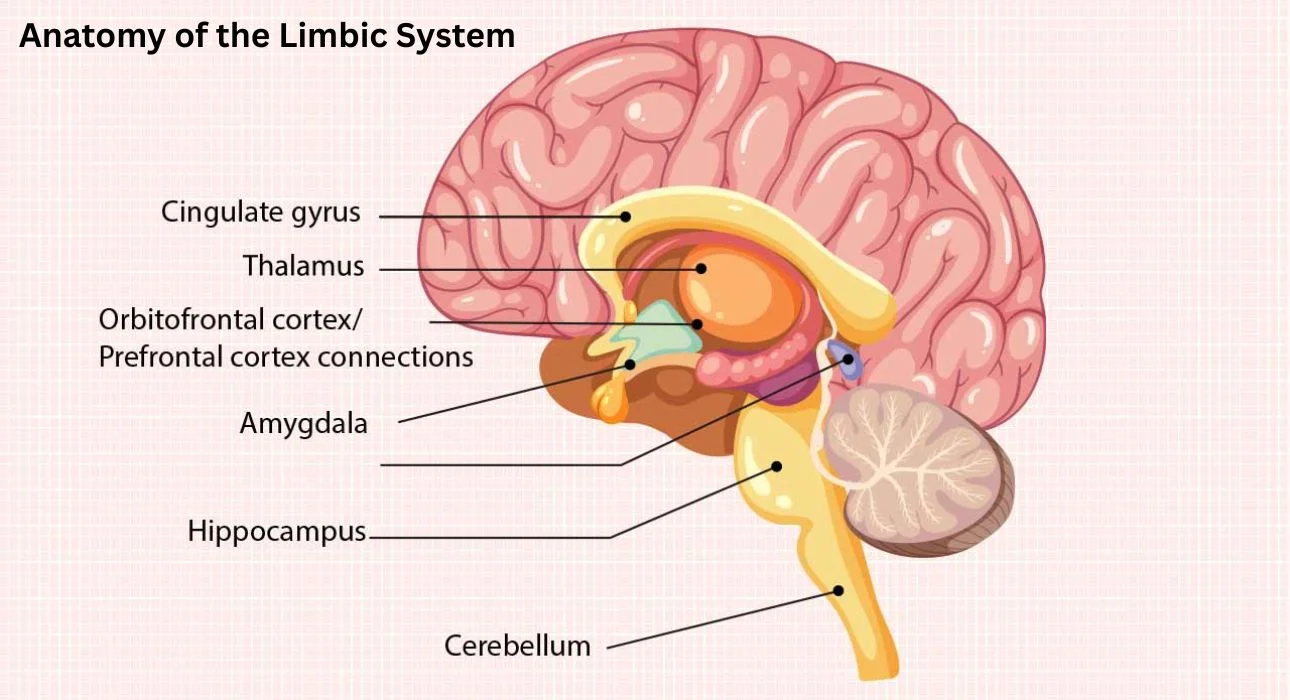
What a VNS device actually does physiologically
A VNS device — whether surgically implanted or the now-dominant transcutaneous auricular (taVNS) form (ear-clip devices like Truvaga, Pulsetto, Apollo Neuro) — delivers electrical or vibrational impulses to vagal nerve fibres, triggering a cascade of effects upstream into the brain. Because roughly 80% of vagal fibres are afferent (body-to-brain), stimulating the nerve is one of the few ways to directly signal the central nervous system from the periphery — bypassing the cortex entirely and speaking directly to the structures driving limbic hyperactivity.
The Two Mechanisms That Matter for Anxious Limbic Systems
Research published in Brain Sciences (2026) identifies two complementary pathways through which taVNS works:MDPI
1. The Ascending Noradrenergic Pathway Vagal afferents project directly to the locus coeruleus (LC) — the brainstem’s primary norepinephrine hub. In people with GAD and high limbic response, the LC-NE system is chronically overactive: it keeps the amygdala on a hair trigger, sustains hypervigilance, and floods the prefrontal cortex with norepinephrine that degrades executive function. taVNS modulates LC-NE activity — not suppressing it entirely, but recalibrating the gain. The result is reduced cortical arousal, less amygdala reactivity, and measurably better mood and stress response.MDPI
2. The Descending Anti-Inflammatory Pathway This one is less discussed in psychology circles and critically important. Chronic limbic hyperactivation is not just a neural problem — it’s an inflammatory one. Persistently elevated LC-NE activity drives systemic inflammation (elevated TNF-α, IL-6, microglial activation in limbic regions). That inflammation then increases sympathetic tone, which increases LC-NE activity — a self-reinforcing vortex of psychoneuroimmunological dysfunction.MDPI taVNS activates the cholinergic anti-inflammatory pathway, directly suppressing pro-inflammatory cytokine production and reducing neuroinflammation in the very brain regions governing emotional regulation. For high limbic responders, this is not a side effect — it is a core mechanism of relief.
What the Clinical Evidence Shows
| Outcome Measured | Finding |
|---|---|
| GAD-7 (anxiety scale) | Mean reduction of −5.90 points after taVNS — statistically significant neuromodulationjournal.org |
| Beck Anxiety Inventory | Mean reduction of −9.40 points neuromodulationjournal.org |
| Hyperarousal / startle response | Significant reduction in autonomic startle reactivity in PTSD/high-limbic patients pmc.ncbi.nlm.nih.gov |
| Vagal tone (HRV) | Measurably improved after even single-session tVNS pmc.ncbi.nlm.nih.gov |
| Fronto-parietal network activity | taVNS activates prefrontal networks — effectively restoring top-down modulation of the amygdala Frontiers |
| Cortisol / inflammatory markers | Reduction in pro-inflammatory cytokines TNF-α and IL-6 with sustained use MDPI |
A 2025 Stanford/inpatient trial found that both single-day and multi-day taVNS protocols produced significant anxiety and depression reductions with no serious adverse events — a meaningful safety signal for a population often sensitive to pharmacological side effects.neuromodulationjournal.org
The Restorationist Read
This is where it gets important for your manuscript. VNS does something that CBT, talk therapy, and most pharmacology cannot do — it addresses the limbic system at its own level, in its own language: physiology.
For a high limbic responder with GAD, the core problem isn’t distorted thinking. It’s a nervous system whose threat-detection threshold has been set chronically too low — an amygdala firing at stimuli that don’t warrant alarm, a locus coeruleus flooding the system with norepinephrine, and an inflammatory feedback loop that makes the whole system self-sustaining. You cannot reason your way out of that architecture. You have to retune it.
VNS is, in Restorationist terms, the most direct form of Physiological Anchoring available — not a breath protocol or a cold plunge, but a direct electrical signal to the parasympathetic highway itself.
Three things that make it particularly relevant to the Restorationist argument:
- It works bottom-up, not top-down. No insight required. No language required. No cooperation from the prefrontal cortex — which, in high limbic states, is exactly what you cannot rely on.
- It improves HRV — which in Restorationist terms means it directly widens the window of tolerance. The nervous system becomes more flexible, not just calmer. The goal isn’t sedation; it’s resilience.
- The anti-inflammatory mechanism is paradigm-shifting. Generalised anxiety is increasingly understood not just as a neural state but as a chronic inflammatory condition. The same VNS signal that calms the amygdala also suppresses the cytokine cascade driving neuroinflammation. This connects limbic dysregulation directly to physical health outcomes — cardiovascular disease, immune function, metabolic health — in ways that a purely psychological model never could.MDPI
Caveats Worth Noting
- Most high-quality trials are still relatively small in sample size. The 2025 Heliyon RCT with 60 GAD participants using fMRI is one of the most rigorous to date, specifically designed to map the neural mechanisms.Cell Press
- Consumer devices (Pulsetto, Truvaga, Apollo Neuro) vary in their stimulation delivery — electrical tVNS vs. vibrational sensory stimulation are not the same mechanism, though both target ANS regulation.AOL
- Effects are cumulative — most protocols show meaningful results after 2–8 weeks of consistent use, not single sessions.
- It is a complementary tool, not a standalone cure. In the Restorationist framework, it belongs alongside breath training, stress inoculation, and recovery architecture — not as a replacement for the full training model.