“In the course of my life, I have often had to eat my words, and I must confess that I have always found it a wholesome diet.”
Winston Churchill
The Courage to Be Wrong
One of the hardest things for any person to do is admit they were wrong. It can feel like a loss of pride, a threat to identity, or even an admission of weakness. Yet history shows that real strength is often found not in defending mistakes, but in correcting them.
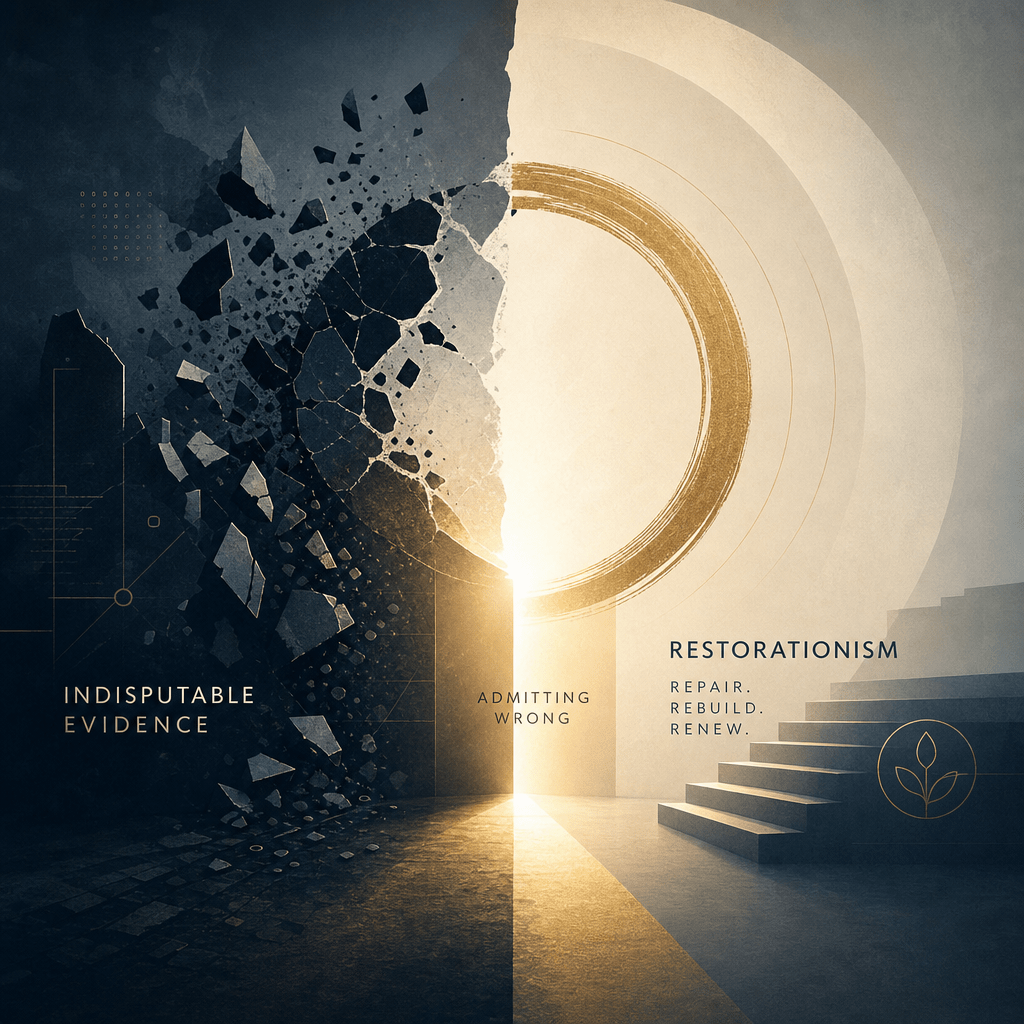
The idea is simple: when Indisputable Evidence appears, a wise person changes course. This is true in science, in daily life, and in matters of belief. It is also at the heart of Restorationism, which values truth over stubbornness and correction over self-protection.
That willingness to turn when the facts demand it is not a sign of instability. It is a sign of integrity. A mind that can revise itself is a mind that remains teachable. In that sense, Indisputable Evidence is not an enemy of conviction; it is the test that separates conviction from vanity.
There is no shame in discovering that an old conclusion no longer fits reality. The shame lies in refusing to see what is plainly there. A person who chooses honesty over appearance is not surrendering dignity. They are protecting it.
When Long-Held Ideas Fall Apart
Throughout history, respected theories have been accepted for decades before being overturned by stronger evidence. Scientists, despite their expertise, are still human. They can be misled by incomplete data, faulty assumptions, or the limits of their era.
That is not a failure of science itself. In fact, it is one of science’s strengths. Good science allows for correction. When new facts emerge, old ideas must make room for better ones. For a clear example of how scientific understanding changes over time, see the Britannica overview of scientific theory.
This same principle applies beyond laboratories. People often cling to beliefs simply because they have held them for a long time. But time does not make an idea true. Only evidence does. When Indisputable Evidence appears, the responsible response is not to preserve a story at all costs, but to let reality correct the story.
That lesson is especially relevant in an age when information spreads quickly and certainty is often rewarded more than accuracy. Long-held assumptions can survive for years because they are familiar, not because they are sound. The willingness to revisit them is one of the clearest marks of maturity.
To see this clearly, imagine how many once-accepted ideas would still stand if no one were willing to challenge them. Progress would stall. Error would become tradition. And truth would be trapped beneath habit. Indisputable Evidence exists to prevent that kind of stagnation.
In practice, this is why careful people test claims against facts instead of consensus alone. A theory may be persuasive, popular, or even useful for a time, yet still prove incomplete. When Indisputable Evidence arrives, the honest response is to update the conclusion, not to defend the old conclusion simply because it is familiar.
That willingness to revise matters in public conversation as much as in private thought. It keeps discussion grounded in reality rather than loyalty to a preferred narrative. When the facts change, the conclusion must change too. That is not instability; it is intellectual health.
Why People Resist Being Wrong
It is easier to defend an idea than to abandon it. Admitting error can feel humiliating, especially when a belief has been repeated publicly or tied to a personal identity. People may gather into groups that reinforce one another’s certainty, even when the facts say otherwise.
This creates a dangerous pattern:
- Evidence is ignored
- Questions are dismissed
- Critics are mocked
- Pride becomes more important than truth
In such a climate, the desire to “be right” can overpower the willingness to learn. But refusing correction does not make a person strong. Often, it only reveals fear. And when fear leads a group, Indisputable Evidence may be present without being accepted.
The problem is not limited to public arguments. It can happen privately, too. A person may know deep down that a belief is flawed, yet still hold on because changing course would require humility. That is why honest self-examination matters. It interrupts the cycle before pride hardens into certainty.
This resistance is often emotional rather than rational. Once an idea becomes attached to belonging, status, or self-image, people may defend it as though their own value depends on it. But truth is not threatened by being examined. Only falsehood needs protection.
That is why conversations about correction should be handled with patience. People are less likely to hear truth if they feel humiliated first. Still, kindness does not require surrendering reality. A fair-minded person can be gracious without pretending that error is acceptable. Indisputable Evidence deserves a fair hearing, even when the hearing is uncomfortable.
Indisputable Evidence and the Strength to Change
When a person encounters Indisputable Evidence, the decisive question is not whether the correction feels comfortable. The question is whether the evidence is true. If it is, then the next step is to respond honestly.
That response takes discipline. It means resisting the urge to explain away facts, shift the blame, or hide behind technicalities. It means allowing what is real to matter more than what is convenient. In practice, that kind of response is one of the clearest signs of maturity.
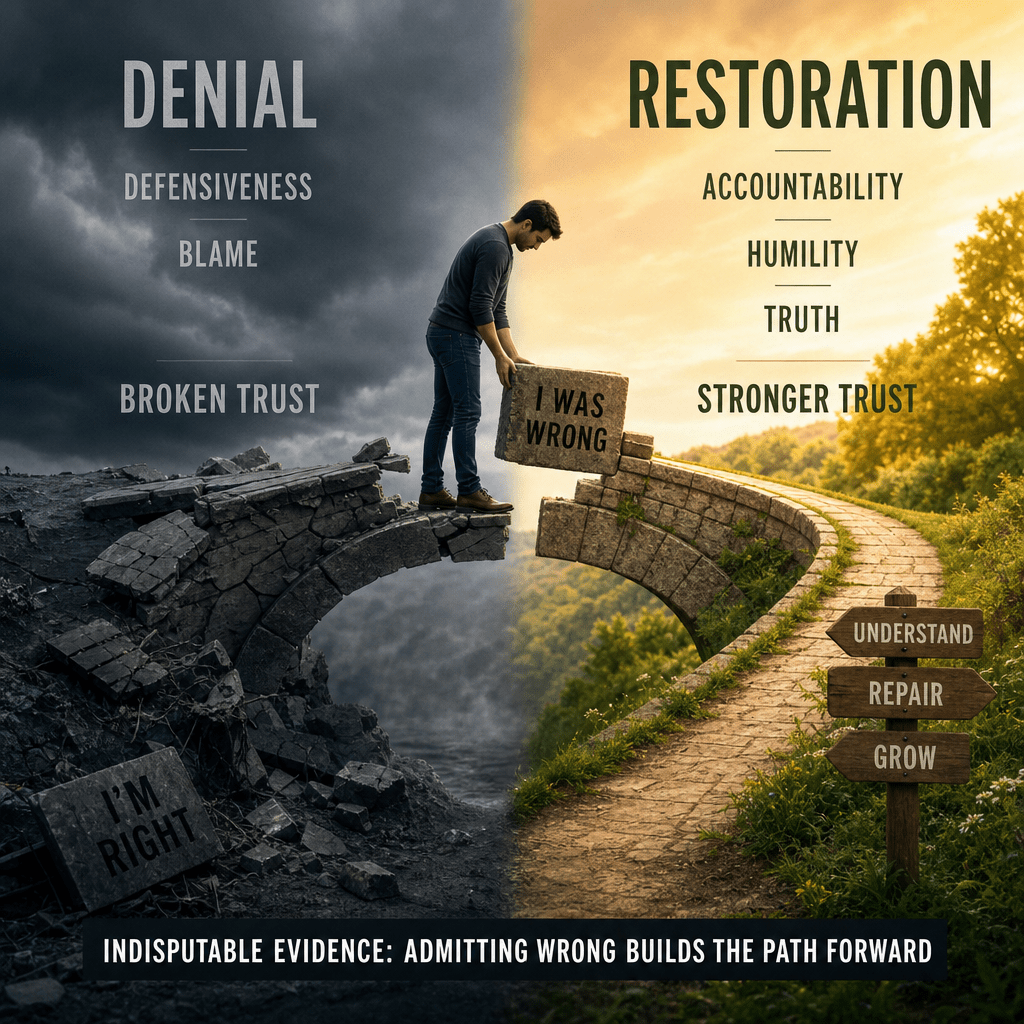
There is nothing weak about changing your mind when the facts demand it. In fact, it takes more courage to say, “I was wrong,” than to keep repeating a proven mistake. People who can do this are not surrendering themselves to confusion; they are submitting themselves to reality.
That kind of honesty requires:
- humility
- discipline
- emotional maturity
- a commitment to truth over ego
Many people think strength means never bending. But real strength is more like a tree that can survive the storm because it can yield without breaking. A person who can admit error is not fragile. They are grounded.
This is where Indisputable Evidence becomes useful in the deepest sense. It does not merely expose what is false; it creates the opportunity for something better to replace it. Correction is not defeat. Correction is the pathway by which wisdom grows.
There is a kind of courage that does not need applause. It is the courage to pause, examine, and change. That courage builds trust because it shows others that truth matters more than ego.
It also protects future judgment. A person who can be corrected once is more likely to be corrected again, and that is a good thing. The ability to revise one’s position is one of the most practical forms of wisdom a person can develop. In that sense, Indisputable Evidence is not only a challenge; it is a gift.
In ordinary life, this often looks like a quiet decision: to admit a misreading, to correct a mistaken assumption, or to let go of a belief that no longer holds up. Those moments may not seem dramatic, but they shape character. Over time, the habit of responding well to Indisputable Evidence produces reliability, patience, and clearer judgment.
Restorationism and the Return to Truth
This is where Restorationism offers a powerful view. Restorationism values the return to what is true, pure, and originally intended. It does not glorify human pride. Instead, it recognizes that people and institutions can drift, become confused, or build beliefs on weak foundations.
When that happens, restoration begins with honesty.
To be restored, one must first be willing to examine what has gone wrong. This means facing Indisputable Evidence without excuses. It means letting truth do its work, even when it unsettles long-held assumptions.
Restoration is not humiliation. It is healing.
The heart of Restorationism is not to shame people for being mistaken. It is to call them back to what is solid, tested, and real. That is why correction is not a capitol offense in any moral or intellectual sense. It is a healthy response to reality. When we accept correction, we make room for restoration to begin.
In that respect, restoration is deeply hopeful. It assumes that people can change, that truth can be welcomed, and that what has been damaged can be repaired. That hope depends on the willingness to confront error honestly.
Restoration does not begin by pretending that the damage never happened. It begins by naming what is true and then taking the next faithful step. That is why Indisputable Evidence matters so much in a restoration-minded worldview: it clears away denial so rebuilding can begin.
For a fuller expression of that same principle, the broader constitutional framework at The Constitution as Covenant: A Restoration of Original Intent shows how returning to first principles can guide correction without losing purpose.
Viewed this way, restoration is not about clinging to a past mistake. It is about returning to a standard that can stand up under examination. When Indisputable Evidence exposes drift, restoration asks what was true from the beginning and how to recover it with clarity.
What This Looks Like in Real Life
Admitting you are wrong is not only for philosophers or scientists. It matters in everyday relationships, leadership, family life, and faith.
Here are a few examples:
- A parent apologizes to a child after reacting unfairly.
- A leader changes policy after new facts emerge.
- A friend admits they misunderstood a situation.
- A believer revises an opinion after careful study and clear evidence.
In each case, correction opens the door to trust. People may respect you more, not less, when you show the courage to be honest.
The same applies when someone encounters Indisputable Evidence that challenges a cherished assumption. A mature response is not to retreat into defensiveness, but to ask what the evidence is saying and what must change. That is how real learning happens.
These moments can be uncomfortable, but they are often the turning points that make growth possible. A relationship becomes healthier. A decision becomes wiser. A belief becomes more stable because it has been tested and refined rather than protected at all costs.
For those who want a broader framework for honest self-correction, the Restorationism covenant perspective offers another way to think about truth, responsibility, and renewal.
In the same spirit, a person may need to step back from a statement they once made publicly and say, in substance, “The facts are stronger than my preference.” That is not a loss. It is growth made visible.
Sometimes the change is not dramatic, but it is still meaningful. A corrected assumption can prevent a harmful decision, repair a damaged trust, or stop a mistake from spreading. Small acts of honesty matter because they keep larger errors from taking root. Indisputable Evidence has value not only when it overturns major theories, but also when it quietly corrects everyday assumptions.
The Real Cost of Refusing the Truth
When people refuse to admit error, the cost grows over time. One wrong assumption leads to another. Defensiveness hardens into habit. Eventually, truth itself becomes a threat.
That is a heavy burden to carry. It forces people to protect appearances instead of pursuing reality. It also makes growth impossible.
By contrast, a person who welcomes correction remains free. They are not trapped by pride. They can learn, improve, and move forward.
There is also a social cost. Communities that punish honesty often reward performance instead of substance. In those settings, people learn to speak in ways that preserve status rather than clarify facts. Over time, that weakens trust. The more Indisputable Evidence is ignored, the more fragile the community becomes.
That is why humility is not just a private virtue. It is a public necessity. Groups that cannot acknowledge error eventually lose their ability to solve problems. By contrast, communities that value correction can endure change without losing their foundation.
History is filled with examples of institutions that became brittle because they could not revise themselves. Once a system begins to treat correction as a threat, it slowly cuts itself off from renewal. That is why a willingness to say “we were mistaken” can be a form of leadership.
There is also a personal cost that is easy to underestimate: the energy required to defend a false position is exhausting. It pulls attention away from learning and toward self-protection. Over time, the habit of resisting Indisputable Evidence can make a person less honest, less adaptable, and less at peace.
A Better Way Forward
The lesson is not that we should doubt everything endlessly. The lesson is that we should never fear truth. When evidence is clear, the wise response is not denial but humility.
Indisputable Evidence should not be met with resistance simply because it is uncomfortable. It should be received with seriousness. And when it proves us wrong, that is not the end of our dignity. It is the beginning of our growth.
That is the beauty of Restorationism: it understands that being corrected is not a capitol offense. It is a sign that we are still capable of learning, changing, and being restored.
There is also a practical lesson here. We should build habits that make correction easier: slow down before reacting, verify claims, listen to criticism, and distinguish between identity and opinion. These habits do not weaken conviction. They strengthen it by making it more accurate.
In a world full of noise, the person who can pause and reconsider is rare. But rarity is not weakness. It is evidence of disciplined character. And when that discipline meets Indisputable Evidence, integrity becomes visible.
Another practical safeguard is to ask whether a belief is being held because it is true or because it is familiar. Familiarity can feel safe, but safety is not the same as soundness. A better way forward is to welcome correction before error becomes entrenched.
That better way is not passive. It requires active reflection, a willingness to ask hard questions, and enough courage to let go of a conclusion that no longer fits. When Indisputable Evidence is treated as a guide rather than a threat, it becomes possible to move from confusion to clarity without losing integrity.
Conclusion
It takes more than intelligence to admit error. It takes character. It takes inner strength to face what is true and surrender what is false.
People who cling to mistakes may seem confident, but confidence without honesty is fragile. The stronger path is the humble one: accept correction, honor the evidence, and let truth reshape your thinking.
In the end, there is no shame in being wrong. The real shame is refusing to be made right.
That is why Indisputable Evidence should never be feared. It is often the very thing that makes restoration possible. And in the view of Restorationism, that willingness to be corrected is not a capitol offense—it is a mark of courage, integrity, and hope.