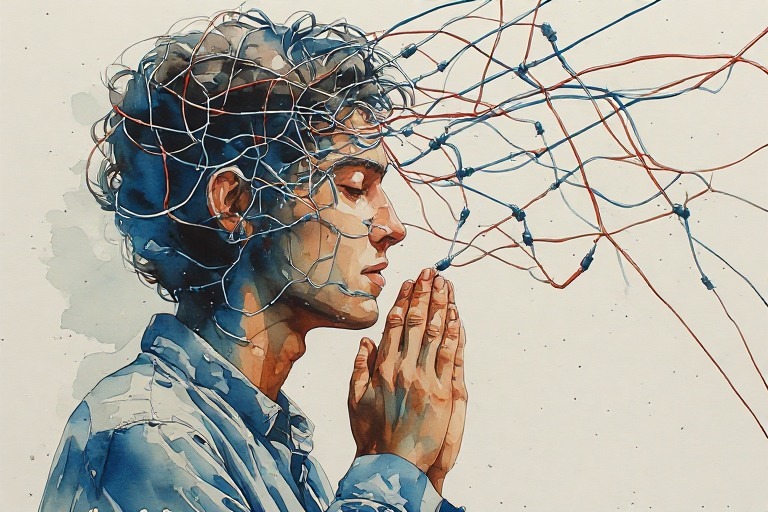
There is a moment familiar to anyone who has prayed with seriousness—the world thins, the noise recedes, and something inside shifts. Your essay describes it as “a sense of contact, of presence, of something shifting inside” . Scripture calls it renewal. Neuroscience now calls it structural change.
A Restorationist reading of the modern evidence leads to a simple but radical claim: prayer is not what we do while waiting for transformation; prayer is the transformation.
I. The Brain God Designed to Change
For most of modern history, science assumed the adult brain was fixed. Your document recounts how this view collapsed: “The brain… retains the capacity to form new neural connections… throughout the entire span of a human life.”
This discovery—neuroplasticity—is not merely a scientific correction. It is a theological unveiling.
Paul’s command in Romans 12:2 to “be transformed by the renewal of your mind” is not metaphor. It is biology. The Greek metamorphoo describes structural change, and your essay makes the connection explicit: “God did not command the renewal of the mind as a metaphor. He designed a brain that could literally renew itself.”
Restorationist theology has long insisted that God’s commands correspond to God’s design. Neuroplasticity is the anatomical confirmation.
II. Prayer as Directed Neurological Work
Your essay states plainly: “Prayer… physically reshapes the architecture of the brain, reroutes its chemistry, and recalibrates its default patterns.”
This is not poetic flourish. It is measurable.
1. The Prefrontal Cortex: Strengthening Agency
Intentional prayer activates the regions responsible for moral reasoning, impulse control, and deliberate choice. This is the neural signature of image-bearing.
2. The Amygdala: Quieting Fear
Prayer downregulates the threat system. Chronic anxiety, trauma reactivity, and anger lose their neurological grip.
3. The Default Mode Network: Dismantling Pride
The DMN—the engine of rumination, grievance rehearsal, and self-preoccupation—is suppressed during prayer. This is the biological correlate of “take every thought captive.”
4. The Neurochemical Cascade
Your essay summarizes the research: prayer elevates serotonin, dopamine, oxytocin, endorphins, and GABA, producing calm, motivation, bonding, and reduced anxiety. “This is not a pharmaceutical cocktail… It is the biochemical consequence of doing precisely what we were designed to do.”
Prayer is not passive spirituality. It is active neurological formation.
III. How Prayer Dismantles Sin
Sin, in its habitual form, is not only moral but structural. Your essay describes it as “a deeply grooved pattern of neural activity.”
Hebb’s law—neurons that fire together wire together—explains both the entrenchment of vice and the pathway out. Synaptic pruning weakens unused circuits. Prayer interrupts the rehearsal of harmful patterns and redirects attention toward life-giving ones.
Confession disrupts automatic narratives. Repentance rewrites circuits. Gratitude encodes peace. Forgiveness releases amygdala-driven resentment.
Philippians 4:8 is not positive thinking. It is a neurological prescription.
IV. Quantum Participation: Prayer and the Fabric of Reality
Your essay moves into frontier territory with care. It cites Keppler’s 2025 model proposing that conscious states arise from the brain’s resonance with the zero‑point field—the quantum substrate permeating all space. “The mind… is a receiver, tuned to the quantum hum of the universe.”
Restorationist theology recognizes the resonance: Scripture describes Christ as the one “in whom all things consist.” The ZPF is not God, but its properties rhyme with divine immanence.
Prayer, then, is not merely internal. It is participatory.
The RAS: Programming Perception
Focused intention sets the brain’s perceptual filters. Prayer aligns expectation with God’s will, tuning the mind to notice what God is already providing.
Heart Coherence: Emotional States as Signal
Gratitude and trust produce measurable electromagnetic changes that broaden perception and improve decision-making.
Your essay summarizes the synthesis: “We are… entering into participatory relationship with the quantum substrate from which physical reality emerges.”
This is not prosperity theology. It is co-laboring with God.
V. The Restorationist Practice of Intentional Prayer
The Restorationist tradition has always insisted that transformation is achieved through disciplined, daily practice. Neuroscience now confirms the architecture behind that wisdom.
Consistency
Neural change is built through repetition, not intensity.
Structured Prayer
Speaking, meditating, silence, and journaling each recruit different neural networks. Together they form a full-brain liturgy.
Specificity
Vague prayer produces vague neural encoding. Jesus prayed with specificity; so must we.
Morning Priority
Your essay notes that the waking brain is uniquely receptive: “The brain in the first hour of waking is in a state of relative neuroplastic openness.”
Morning prayer sets the day’s neural trajectory.
VI. The Sanctified Mind
Your essay ends with a vision of the fully renewed mind: compassion as instinct, peace as baseline, truth as reflex, love as natural emission. “A mind whose neural architecture has been so deeply shaped by the love of God that it cannot help but radiate what it has absorbed.”
This is not mystical elitism. It is available to every believer who practices intentional prayer with seriousness and consistency.
The brain God designed can change. Prayer is the instrument of that change—biological, spiritual, and quantum.
So pray. Pray specifically. Pray consistently. Pray with gratitude and faith. Every word is a neuron firing toward God, and every answer is God rewiring the mind toward Christ.




Leave a Reply