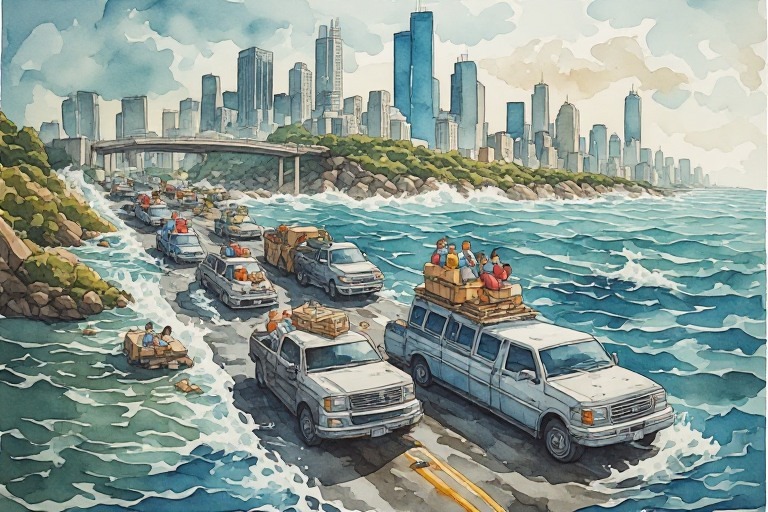
As Earth advances toward the warm peak of its natural interglacial maximum, the demands placed on human civilization will exceed anything experienced in recorded history. The loss of coastal cities, the instability of freshwater systems, the volatility of crop production, and the need to construct new forms of habitat will require a population capable of responding with rational objectivity rather than emotional fragmentation.
Technology will continue to lead the way—fusion energy, large‑scale desalination, engineered irrigation networks, advanced cooling systems, heat‑tolerant crops, controlled‑environment agriculture, and biologically adapted food sources—but technology alone cannot stabilize a civilization under stress. The decisive factor becomes the moral formation of the population: citizens trained to remain calm under pressure, cooperative in scarcity, disciplined in thought, and capable of accepting unavoidable losses without collapsing into factional conflict.
A civilization facing interglacial maximum heat must be morally conditioned to rebuild, reorganize, and participate in the creation of new infrastructure rather than resist it. In this era, reason and mental stability become survival traits, not philosophical luxuries. The Restorationist argument is simple: without moral formation, the technologies required to sustain human life will exist, but the civilization needed to operate them will not.
Infrastructure Mobilization and Citizen Roles
The transition into the interglacial maximum will require a level of infrastructure mobilization comparable to the great civilizational projects of antiquity—except this time, the work will be global, continuous, and essential for survival. Coastal populations will need to relocate inland as sea levels rise. Water systems will need to be rebuilt around desalination, aquifer protection, and long‑distance transport. Agriculture will need to shift toward heat‑tolerant crops, greenhouse cultivation, and biologically engineered food sources capable of thriving under extreme temperatures.
Energy production will undergo a transformation as fusion becomes the backbone of a stable, high‑output grid capable of supporting cooling systems, water processing, and climate‑controlled habitats. Construction will evolve toward materials and designs that can withstand prolonged heat, humidity, and atmospheric instability. Entire regions will need to be redesigned around survivability rather than tradition.
Citizens will play a central role in this mobilization. They must be capable of working cooperatively in large‑scale projects, accepting the necessity of relocation, participating in new forms of agriculture and resource management, and maintaining psychological stability during periods of scarcity or transition. Emotional reaction—fear, denial, factionalism—creates friction that slows the work and destabilizes the population. Rational objectivity, moral discipline, and civic cooperation accelerate it.
The Restorationist position is clear: the interglacial maximum is not a crisis to be prevented but a reality to be prepared for. The civilizations that survive will be those whose citizens are morally formed, mentally stable, technologically literate, and capable of participating in the construction of a world built for heat.

Leave a Reply