
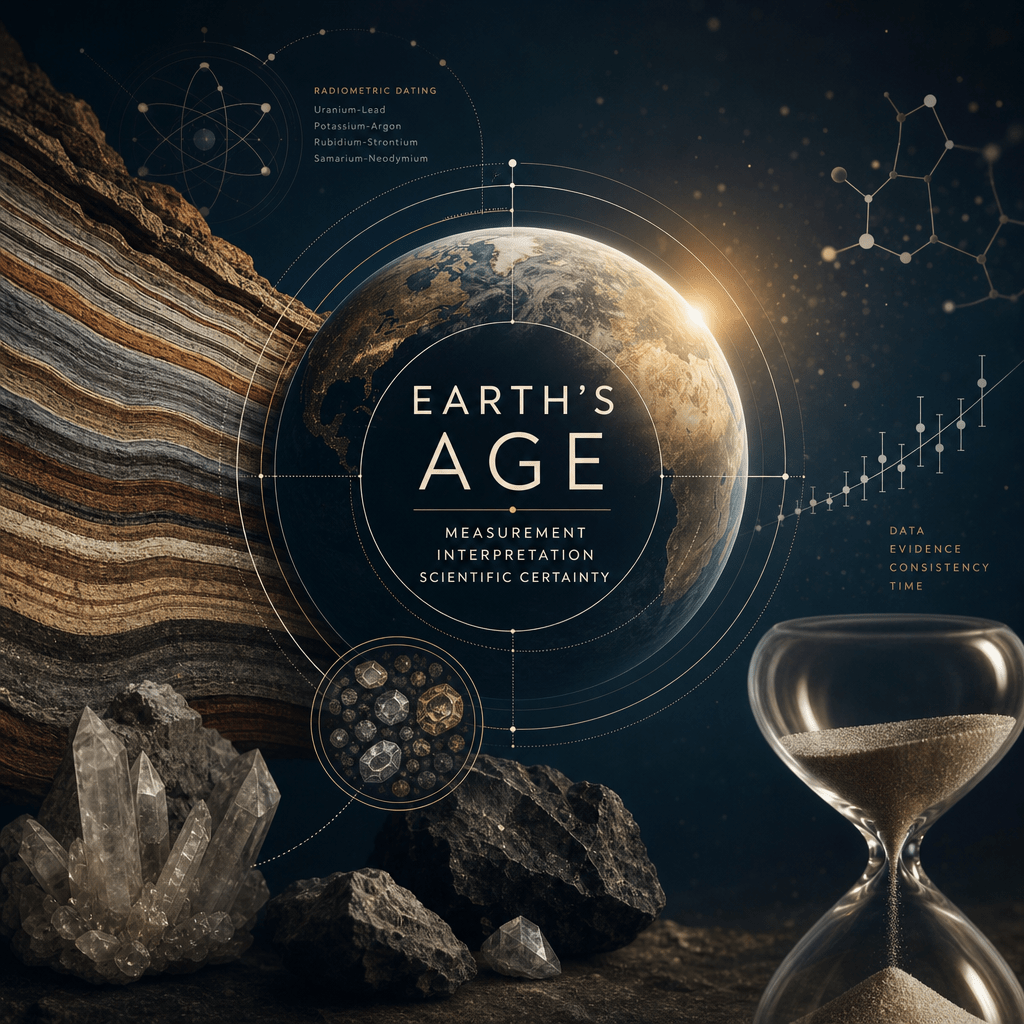
History has a way of humbling certainty. In science, what looks rock-solid in one era can shift in another when the evidence is examined more carefully. That is not a flaw in science. It is one of its greatest strengths. The question of Earth’s Age is a perfect example because it sits at the intersection of hard measurement and human interpretation.
Table of Contents
Science Has Two Layers
A useful way to think about science is to separate it into two layers.
1. The empirical layer
This is the solid part. It includes direct measurement, repeatable observation, and physical facts.
Examples include:
- radioactive decay
- orbital mechanics
- spectroscopy
- thermodynamics
- genetics
- electromagnetism
These do not depend on opinion. Uranium does not care what anyone believes its half-life should be. Light does not negotiate with institutions.
2. The interpretive layer
This is where humans build models to explain the measurements. It is much softer and more vulnerable to change.
It is shaped by:
- consensus
- institutions
- politics
- funding incentives
- professional turf
- inertia
- attachment to existing theories
This is where scientific certainty often becomes fragile. The data may be real, but the story built around it can change dramatically.
That is why Earth’s Age is such a revealing example: it shows the difference between what is measured and what is inferred from the measurement.
Why the Difference Matters
Once you separate data from interpretation, a lot of confusion clears up.
People often hear the word “science” and imagine one single kind of certainty. In reality, science includes both hard measurement and softer inference. The first is durable. The second is revisable.
That distinction matters because not every scientific claim is equally stable. A direct reading from a physical sample is not the same thing as a reconstruction of conditions that no one can revisit directly. One can be tested over and over. The other may depend on a long chain of assumptions.
That is why the question of Earth’s Age is so useful. It puts the boundary between measurement and interpretation in plain view.
It also explains why people sometimes talk past one another. One side may be discussing a physical measurement, while the other is debating the framework used to interpret it. Those are not the same conversation, even when they use the same scientific vocabulary.
Why Earth’s Age Is So Solid
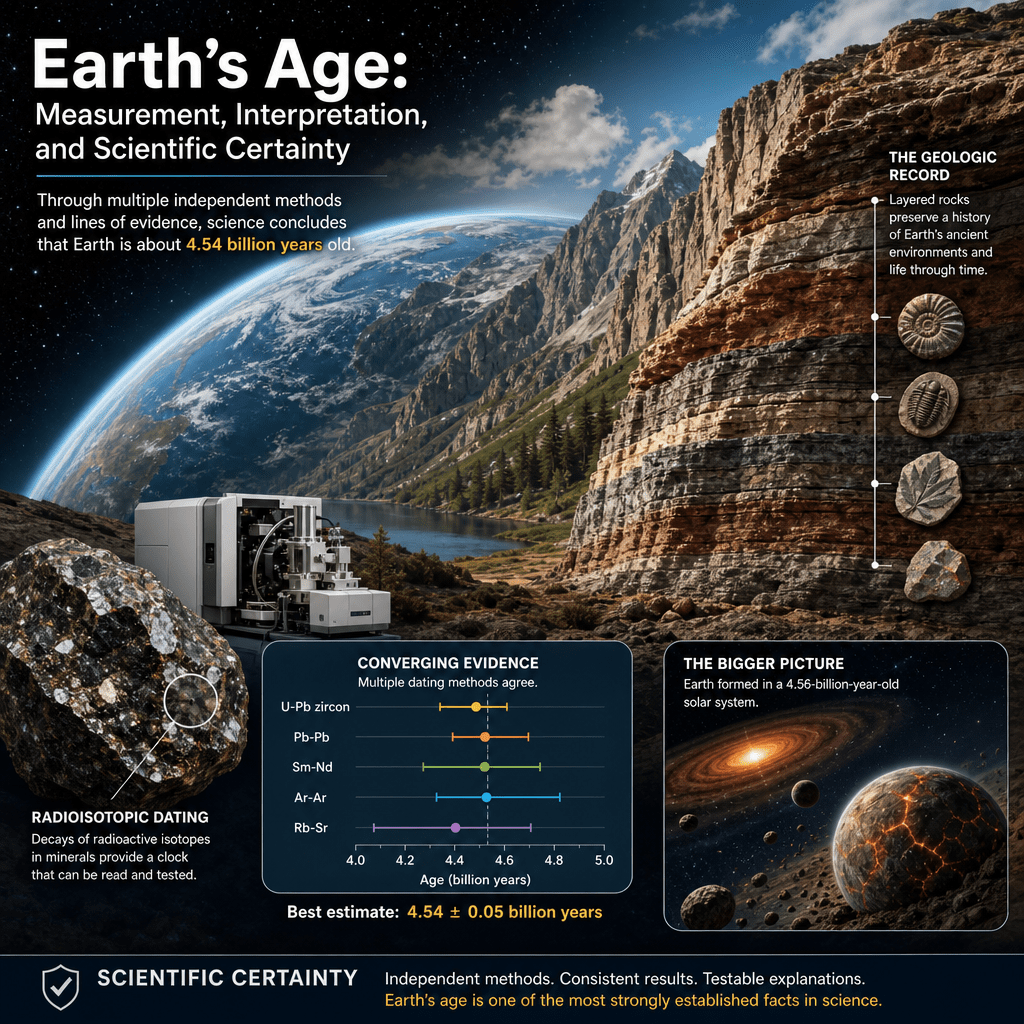
The age of the Earth belongs much closer to the empirical layer than many popular cosmological claims. It is not based on a story or a committee vote. It is based on radiometric decay and multiple independent measurement chains that converge on the same result.
That matters.
The half-life of uranium is not a philosophical preference. It is a measurable physical property. Different decay systems, different isotopes, and different geological samples all reinforce one another.
A few reasons this is so strong:
- multiple decay chains point to the same range
- different minerals can be cross-checked
- laboratory measurements can be repeated
- geology, chemistry, and physics all support the same picture
For a clear overview of radiometric principles, the U.S. Geological Survey’s explanation of Earth’s age is a helpful reference. For a deeper look at how physical evidence and interpretation can diverge, see Earth’s Age: Explained with Stunning and Compelling Evidence.
In other words, Earth’s Age is one of the places where measurement dominates interpretation. The evidence is strong enough that repeated testing produces convergence rather than drift.
That is also why the discussion is more interesting than a simple number on a page. When scientists date rocks, minerals, and meteorites, they are not guessing at a story; they are reading physical signals that can be checked in the present. Earth’s Age therefore remains a useful case study in how multiple lines of evidence can reinforce a single conclusion.
The point is not that every detail in geology is settled forever. The point is that the central estimate of the planet’s age is supported by many converging methods, which makes it far more robust than a headline-level claim built on a single assumption.
Earth Age vs. the Age of the Universe
One of the biggest mistakes people make is treating the age of the Earth and the age of the universe as if they were supported in exactly the same way. They are not.
The age of the Earth is a measurement grounded in physical samples.
The age of the universe is a model output.
There is no cosmic rock sample you can place in a lab and date with a single atomic clock. The commonly cited age of the universe, about 13.8 billion years, comes from a framework applied to observations such as:
- cosmic microwave background data
- the expansion rate of the universe
- matter density estimates
- assumptions about dark matter and dark energy
- general relativity on cosmic scales
That means if the framework shifts, the estimate shifts too.
This is not a criticism. It is just architecture.
When people compare these two questions, they are not comparing like with like. One rests on direct geologic dating; the other rests on cosmological inference. Earth age is anchored in laboratories and strata; the age of the universe is anchored in a chain of reasoning that can be revised if one link changes.
The difference becomes easier to see if you imagine two separate forms of confidence. One confidence comes from holding a rock in your hand and reading what its isotopes say. The other comes from fitting a broad picture together across enormous distances and times. Both can be serious, both can be scientifically responsible, and both can be wrong in different ways. But they are not equally direct, and they should not be treated as if they were.
That is also why Earth’s Age keeps showing up in broader debates about certainty: it is one of the clearest examples of a result that is grounded in present-day physical evidence rather than in remote reconstruction.
Why the Hubble Tension Matters
The Hubble tension shows why cosmological certainty should be handled carefully. Different ways of measuring the universe’s expansion rate do not perfectly agree.
Early-universe estimates tend to imply one value. Local measurements tend to imply another.
That disagreement may sound small, but in cosmology it is huge. A 5% to 10% mismatch is not a rounding error. It is a real challenge to the model.
If the faster expansion rate is correct, the universe may be younger than the standard estimate suggests. That does not automatically overturn current cosmology, but it does show that the confidence is not as bedrock-solid as people often assume.
Scientific progress often begins with a mismatch that refuses to go away. In that sense, Earth’s Age offers a useful contrast: the more direct the evidence, the less room there is for drift in the conclusion.
It is also a reminder that when a field depends on indirect inference, small disagreements can reveal larger uncertainties underneath. That does not make the science worthless. It simply means the interpretation is still doing heavy lifting.
When the measurements themselves begin to disagree, the question is no longer whether scientists are being careful. The question becomes whether the framework needs adjustment. That is a normal and healthy part of science, but it is also a reason to distinguish a measured result from a model-driven estimate.
What Big Scientific Revisions Teach Us
Science has always evolved through correction.
- Pluto was a planet until its label changed.
- Newton gave way to Einstein where Newton failed.
- Einstein gives way to quantum mechanics in the domains where classical physics breaks down.
- The Big Bang singularity has been challenged by inflation, quantum gravity proposals, and bouncing cosmologies.
This pattern is not weakness. It is how science gets better.
But it also teaches a cautionary lesson: a model can remain useful even when parts of it are no longer treated as final truth. Scientists keep what works, revise what breaks, and drop what no longer fits.
That is why the public should be careful when hearing absolute claims. Sometimes the confidence belongs to the institution, not the physical evidence.
The same lesson applies when a scientific field speaks with more certainty than the data can fully justify. The measurements may still be useful, but the surrounding story can become too tidy. Once that happens, revisions are not a failure; they are a correction.
Viewed this way, Earth’s Age is not just a number; it is a reminder that strong conclusions survive because they stay tied to repeatable evidence.
A Better Way to Read Scientific Claims
The smartest approach is not to reject science. It is to ask a better question:
Is this a measurement, or is this a model?
That question cuts through a lot of noise.
For Earth’s Age, the answer begins with rocks, isotopes, and decay chains. For the age of the universe, the answer begins with large-scale models and assumptions. Both can be scientifically serious. Both can be wrong in different ways. But they are not equally direct.
Recognizing that difference does not undermine science. It improves it.
It also gives readers a better way to evaluate headlines. When a claim is rooted in direct physical measurement, it tends to be more stable. When it depends on reconstruction, the conclusion is more sensitive to background assumptions. That is not a reason to distrust all theory. It is a reason to keep theory in its proper place.
For that reason, Earth’s Age works as a practical test case: if the evidence is strong, it should remain strong under repeated checking, even if surrounding theories continue to evolve.
Earth’s Age and the Real Lesson
The deeper lesson of Earth’s Age is simple: strong science is built where the physical world keeps confirming the same result.
That is what makes it such a powerful example. It shows how knowledge becomes reliable when measurement is repeated, cross-checked, and anchored in the real world.
The more carefully we separate evidence from interpretation, the less likely we are to confuse authority with truth. And in science, that distinction makes all the difference.
For readers who want to keep exploring how evidence, interpretation, and scientific certainty interact, the broader discussion in Cosmology Hollowed Out By Guessing offers a useful companion perspective.
That is the enduring value of Earth’s Age: it reminds us that the strongest conclusions are the ones the world itself keeps verifying, not the ones that merely sound certain.