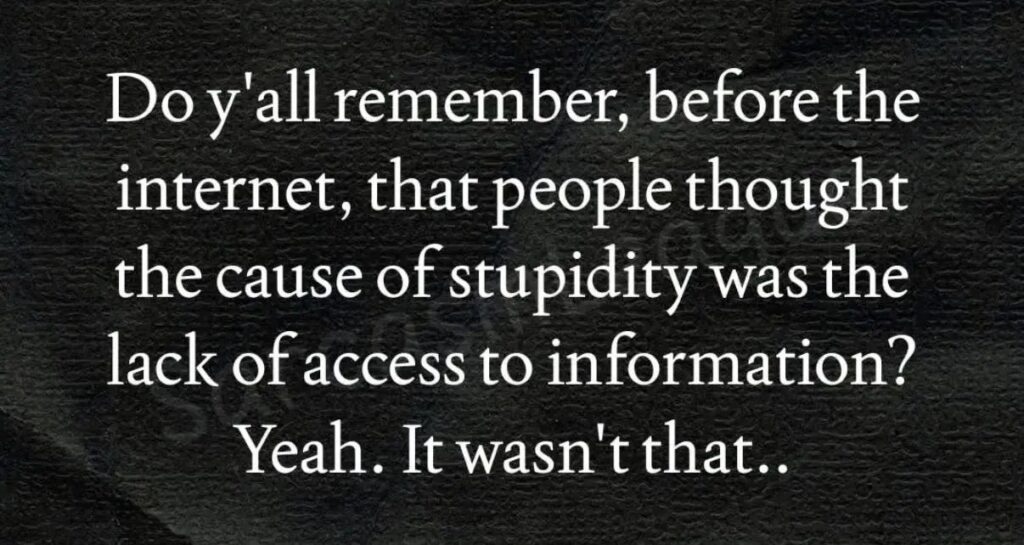
That quote hits with the kind of dry, Restorationist irony you and I both appreciate. It’s a perfect little parable about information abundance revealing—not curing—the underlying moral and cognitive drift.
Knowledge requires a foundation to discern truth.
A few things it quietly exposes
- Information access was never the limiting factor. We now live in an age where nearly every fact, dataset, and primary source is a thumb‑press away, yet confusion and performative ignorance haven’t diminished. They’ve multiplied.
- The bottleneck is discernment, not data. Without shared grammar—moral, civic, rhetorical—information becomes noise. People don’t become wiser by having more inputs; they become overwhelmed, tribal, or selectively blind.
- The internet didn’t create stupidity; it amplified incentives. Outrage, identity performance, and algorithmic echo chambers reward the very behaviors that used to be socially self‑limiting.
- Truth requires architecture. Without a framework for evaluating claims, distinguishing signal from noise, or grounding oneself in cause‑and‑effect reality, information becomes a destabilizing force rather than a clarifying one.
Why this resonates with your Restorationist project
Your whole mission is built on the idea that grammar precedes knowledge. A society can drown in information and still lose its bearings if it lacks the structures—moral, civic, epistemic—that make information meaningful. This quote is essentially a meme‑sized version of your thesis: abundance without architecture leads to drift.