
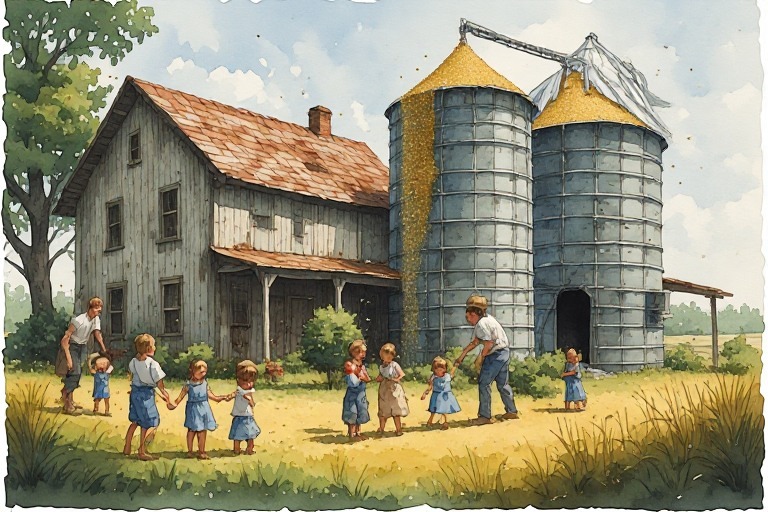
The Long Stability and the Sudden Break: How a Millennia‑Old Human Architecture Collapsed After 1950
A Restorationist Essay Segment
For thousands of years, the human family followed a stable, load‑bearing architecture. It was not perfect, but it was functional — a system shaped by the same forces that shaped civilization itself: ability, resistance, specialization, surplus, and the disciplined use of time. The household was the smallest economy, the first school, the first government, the first church, and the first laboratory of human development. It was the place where children learned discipline, cooperation, hierarchy, responsibility, and the meaning of work.
This model endured across continents, cultures, empires, and religions because it was not merely cultural. It was structural. It was the only configuration that could reliably convert human ability into human flourishing.
But after 1950, the architecture cracked — not gradually, but catastrophically.
1. The Industrial Shift: When Work Left the Home
For millennia, the household was a unified economic unit. Men and women worked different domains, but they worked the same mission. Children saw the entire process of survival and contribution. They were apprenticed into adulthood by proximity.
Industrialization severed this unity.
Work moved out of the home and into factories, offices, and institutions. Fathers disappeared for 10–12 hours a day. Mothers were left to carry the entire formative load alone. Children no longer witnessed the mechanics of adult labor.
The family ceased to be a workshop and became a dormitory.
2. The State Inserted Itself Into the Family’s Core Functions
Once work left the home, the state stepped into the vacuum:
- Schools replaced parental instruction
- Courts replaced paternal authority
- Welfare replaced the household economy
- Bureaucracy replaced community
- Experts replaced elders
The family’s ancient functions were outsourced to institutions that had no organic connection to the child, no generational memory, and no stake in the long‑term outcome.
The household was no longer the primary engine of formation. It became a staging area for state‑managed development.
3. The Assault on the Division of Labor
For thousands of years, the division of labor inside the home was not oppression — it was optimization. It was the first specialization that made surplus possible.
But after 1950, the cultural narrative inverted:
- The male role was recast as oppressive
- The female role was recast as demeaning
- The household economy was recast as obsolete
- The interdependence of the sexes was recast as inequality
The architecture that had produced civilization was declared defective.
In its place emerged a model that treated men and women as interchangeable units — a model that ignored biology, history, and the structural logic of human development.
4. No‑Fault Divorce: The Destruction of the Load‑Bearing Beam
For millennia, marriage was a covenantal structure — a stabilizing beam that held the household together through friction, hardship, and the long arc of raising children.
No‑fault divorce turned marriage into a reversible contract.
The load‑bearing beam became a breakaway joint.
The consequences were immediate:
- Families fragmented
- Children lost stability
- Fathers were removed from the home
- Mothers were left with impossible loads
- Boys grew up without models
- Girls grew up without anchors
The household, once the most stable institution in human history, became the most fragile.
5. The Criminalization of Discipline
For thousands of years, discipline was not abuse — it was formation. It was the mechanism by which children learned boundaries, self‑control, and respect for authority.
After 1950, discipline became suspect. After 1970, it became criminalized.
Children learned that the state could override the parent. Fathers learned that authority carried legal risk. Mothers learned that correction could be reported. Schools learned that behavior problems were medical, not moral.
The result was a generation raised without friction — and therefore without formation.
6. The Rise of Leisure Without Responsibility
For millennia, leisure was the reward of surplus and the engine of knowledge. It was earned, structured, and purposeful.
After 1950, leisure became detached from labor.
Children received leisure without contribution. Adults received entertainment without meaning. Society received abundance without gratitude.
Leisure without responsibility is not enrichment — it is decay.
7. The Restorationist Diagnosis
The collapse of the family after 1950 was not a cultural accident. It was the predictable failure of a system that abandoned the architecture that had sustained humanity since Genesis:
- Ability without resistance produces entitlement
- Surplus without discipline produces decadence
- Leisure without purpose produces nihilism
- Freedom without structure produces fragmentation
- Equality without complementarity produces confusion
- Rights without duties produce collapse
The modern family did not fail because humans changed. It failed because the architecture was dismantled.
The household was not replaced with a better system. It was replaced with no system at all.
And a civilization without a functioning household is a civilization without a future.