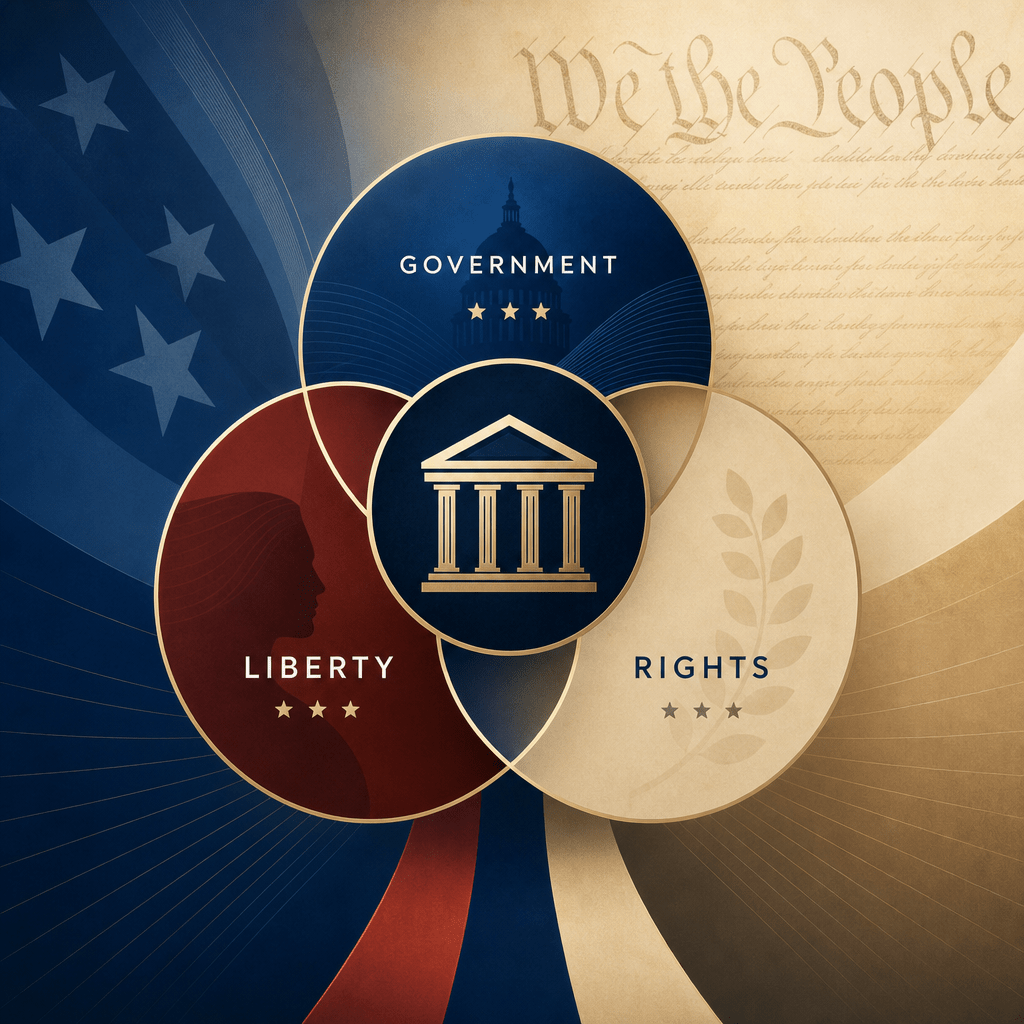
The US Constitution may look complicated at first glance, but its main idea is surprisingly straightforward. It establishes a system of government with separated powers, checks and balances, and clear limits designed to protect the rights of the people.
That single idea explains why the US Constitution matters so much. It is more than a historical artifact from the founding era. It is the blueprint for how the United States governs itself, and it remains the starting point for understanding American law, politics, and civic life.
For readers who want a broader constitutional perspective, see this related one-sentence summary of the U.S. Constitution.
Table of Contents
Why the Constitution Matters
The US Constitution in One Sentence
Breaking Down the Main Ideas
Why a One-Sentence Summary Is Helpful
A Simple Way to Remember It
Final Thoughts
Why the Constitution Matters
The Constitution was written in 1787, after the American Revolution, when the new nation needed a stronger and more stable framework for government. The earlier Articles of Confederation had left the central government too weak to solve serious problems or respond effectively to national challenges.
The delegates who met in Philadelphia wanted a system that could:
– create a stronger national government
– divide power so no one branch became too powerful
– protect individual freedoms
– allow the document to be changed over time
In short, the US Constitution was designed to prevent abuse of power while still making government effective. Its structure reflects the lessons the founders had already learned about weak authority, political instability, and the dangers of concentrated power.
That is also why the Constitution is still studied today. It is not only a founding document; it is a working framework that continues to shape elections, laws, courts, and civil rights. Many later constitutional questions are really questions about how this original framework should be applied in modern life. For a deeper look at how constitutional change works, you can also read How Constitutional Amendments Evolve Over Time.
When people ask what makes the American system different from simple majority rule, the answer usually begins here. The US Constitution limits raw political power and requires government to operate within rules. That is one reason it remains central to civic education, legal interpretation, and public debate.
For a primary-source version of the document itself, you can also review the National Archives transcript of the U.S. Constitution.
The US Constitution also became the starting point for later debates about how far federal authority should reach. Those debates still matter because constitutional structure affects everyday government decisions, from legislation to court rulings. In that sense, the US Constitution is not frozen in the past; it continues to shape the present.
The US Constitution in One Sentence
If you need a one-sentence summary of the US Constitution, this version works well:
The US Constitution sets up the framework for America’s government by dividing power among branches, balancing federal and state authority, and protecting the rights of the people.
That sentence is short, but it includes the most important ideas. It shows that the Constitution is more than a set of laws. It is the structure that shapes the entire U.S. political system.
Some readers prefer slightly different wording, but the meaning stays the same: the Constitution creates a government, limits that government, and secures liberty for the people it governs. In practice, that means the document is both empowering and restraining. It gives authority where authority is needed, but it also draws lines around that authority.
A useful way to understand this summary is to break it into three parts. First, it explains what the government is. Second, it explains how power is shared. Third, it explains why limits matter. Those three ideas cover almost everything a basic summary needs to include.
When educators ask students to explain the US Constitution in plain language, this kind of summary is usually the best place to begin. It is short enough to remember and detailed enough to stay accurate. It also keeps the focus on structure, power, and rights, which are the Constitution’s central themes.
Breaking Down the Main Ideas
1. It creates the framework for government
The Constitution explains how the federal government works. It establishes three branches:
– Legislative: makes laws
– Executive: enforces laws
– Judicial: interprets laws
This structure is important because it keeps power from concentrating in one place. Each branch has a defined role, which helps keep the system organized and accountable.
In other words, the Constitution does not simply say that government should exist. It explains how government should operate. That distinction matters because orderly government depends on predictable roles and responsibilities. The Constitution tells each branch what it may do, what it may not do, and how it must interact with the others.
The legislative branch, Congress, represents the lawmaking side of government. The executive branch, led by the President, carries out and enforces those laws. The judicial branch, headed by the Supreme Court and supported by lower federal courts, interprets laws and resolves disputes about their meaning. Together, they form the basic machinery of the federal system.
If you are trying to understand the US Constitution in a practical way, the three-branch structure is a good place to begin. It explains why no single office or institution is supposed to control the whole nation. It also shows why the Constitution is often described as a framework rather than a code of fixed instructions.
For another perspective on interpretation and constitutional meaning, see Judicial Interpretation in SCOTUS: Trump v. Barbara Analysis.
The US Constitution makes that structure visible in the way it distributes power, assigns duties, and leaves room for later interpretation. That design is one reason the document has remained so influential for more than two centuries.
2. It divides power
One of the most important features of the Constitution is the separation of powers. Each branch of government has its own responsibilities, and no single branch controls everything.
The system also includes checks and balances, which allow each branch to limit the others. For example:
– Congress can pass laws
– The President can veto laws
– The courts can rule laws unconstitutional
This design helps protect freedom by making it harder for any one part of government to dominate the rest.
The point is not to make government weak. The point is to make it controlled. The founders understood that power tends to expand unless it is checked. By dividing authority, the Constitution reduces the risk of tyranny and encourages debate, compromise, and review.
Checks and balances also make government more deliberate. A law often must survive multiple stages before it takes effect. A bill may be passed by Congress, signed by the President, and later reviewed by the courts if there is a constitutional challenge. That layered process can seem slow, but it is part of the system’s protective design.
This is one reason the Constitution remains so important to students of civics and law. It is not just a list of rules. It is a mechanism for keeping political power from gathering in one place. Many later conflicts about rights, executive power, and federal authority are really debates about how these checks should work in specific situations.
For readers interested in how constitutional structure connects to modern political disagreements, Two Constitutional Visions: Conservatives, Progressives, and the Founders’ Warning About Democracy offers a useful companion discussion.
When readers search for a concise US Constitution summary, they are usually looking for exactly this point: power is divided so that freedom has room to exist. That is one of the clearest ways to explain the document without losing its meaning.
3. It balances federal and state authority
The US Constitution also defines the relationship between the national government and the states. Some powers belong to the federal government, some belong to the states, and some are shared.
This balance matters because the United States is both one nation and a collection of individual states. The Constitution helps hold that structure together by giving each level of government a role.
That arrangement is often called federalism. In practice, federalism means that state governments are not simply local offices of the national government. They have their own authority in areas such as education, elections, policing, and many aspects of public administration. At the same time, the federal government has power over national defense, foreign affairs, interstate commerce, and other matters that affect the country as a whole.
This split of authority is one reason constitutional disputes can become complicated. When a law is challenged, the question may not only be whether the law is good policy. It may also be whether the federal government or a state government had the constitutional power to act in the first place.
The balance between federal and state authority also helps explain why constitutional interpretation remains important over time. The country changes, but the underlying allocation of power still matters. Courts, lawmakers, and citizens continue to debate where the boundary should be drawn.
That balance is central to the Constitution’s design because it preserves both unity and local self-government. The national government can address shared problems, while the states retain space to respond to local needs. Together, these two levels of authority create a more flexible and resilient system than a single centralized structure would provide.
The US Constitution also leaves enough room for the system to adapt as national needs evolve. That flexibility is part of what makes the document durable without making it vague.
4. It protects the rights of the people
The Constitution is not only about government power. It is also about protecting individual liberty.
These protections are strengthened by the Bill of Rights, which includes the first ten amendments. Among the rights protected are:
– freedom of speech
– freedom of religion
– freedom of the press
– the right to due process
– protection against unreasonable searches
– the right to a fair trial
These rights exist to make sure government serves the people, not the other way around.
That point is especially important because constitutional government is not just about efficient administration. It is also about dignity, liberty, and legal protection. The Bill of Rights places clear limits on what government may do, even when officials believe they are acting for the public good.
For example, freedom of speech protects open debate, political criticism, and religious expression. Due process protects fair treatment before the law. Protection against unreasonable searches helps safeguard privacy and personal security. Each of these rights contributes to a broader constitutional principle: government must respect the person, not absorb the person into state power.
The Constitution also protects rights through the courts, because rights without enforcement would be only promises on paper. Judicial review and constitutional litigation help ensure that laws and official actions remain within legal limits. That is why constitutional rights are not just abstract ideals. They are practical protections that shape everyday life.
In that sense, the US Constitution is both a system of government and a charter of freedom. It sets up public authority, but it also defines the boundaries of that authority. The result is a constitutional order where rights are part of the structure, not an afterthought.
A strong US Constitution summary should always make this point clear: government power is real, but it is not unlimited. Rights are not decorative language; they are built into the document’s purpose.
Why a One-Sentence Summary Is Helpful
A one-sentence summary of the US Constitution is useful because the document is long and detailed. It includes a preamble, seven articles, and many amendments. For many readers, that can feel overwhelming.
A short summary gives you a starting point. It helps answer basic questions such as:
– What is the Constitution for?
– How does the U.S. government work?
– Why are rights and limits on power so important?
If you can explain the Constitution in one sentence, you show that you understand its central purpose.
This kind of summary is especially helpful for students, teachers, parents, and anyone refreshing their civics knowledge. It can also help when reading court decisions, political commentary, or historical analysis, because many debates assume familiarity with the Constitution’s basic structure. A concise explanation provides a foundation for deeper reading.
It is also useful because the Constitution is often discussed in fragments. One conversation may focus on presidential authority, another on free speech, and another on state rights. A one-sentence summary helps unify those topics by showing that they all belong to the same constitutional framework. If you understand the whole, the individual pieces become easier to place.
That is why a clear summary is not a shortcut in the bad sense. It is a tool for comprehension. It makes the larger document easier to study, easier to remember, and easier to explain to others.
In classrooms and civic discussions, the US Constitution is often introduced through a short summary first and a deeper reading later. That approach works because the basic idea is memorable even before every detail is understood.
A Simple Way to Remember It
One easy way to remember the Constitution’s purpose is to think of three main goals:
– Create government
– Limit government
– Protect the people
That simple structure reflects the heart of the document. It gives government power, but it also puts that power under control.
You can also remember the Constitution as a balance of three things: authority, order, and liberty. Authority is necessary for law and public safety. Order is necessary for stable institutions. Liberty is necessary for a free society. The Constitution tries to preserve all three at once.
That balance is not always easy to maintain, which is why constitutional debate is so common in American life. People disagree about how much power the federal government should have, how much the states should control, and how far individual rights should extend in specific circumstances. But those disagreements happen within the constitutional framework itself, which is part of the document’s enduring strength.
If you are looking for a way to explain the Constitution in a classroom, conversation, or test answer, this three-part memory aid works well because it is simple and accurate. It also mirrors the basic tension at the center of the American system: government must be strong enough to govern, but limited enough to remain free.
For readers who want to connect constitutional structure with the amendment process, Article V Amendment: The Best Constitutional Fix provides a helpful related discussion.
That is why the US Constitution can be summarized so effectively in one sentence. The whole document is built around those same three goals, even though it uses formal legal language to express them.
Final Thoughts
The US Constitution is far more than an old political document. It is the foundation of the American system of government and one of the most influential legal texts in history.
If you need a final one-sentence summary, this version is clear and accurate:
The US Constitution establishes the structure of the U.S. government, divides power among branches and levels of government, and protects the rights of the people.
That sentence captures the essence of the Constitution in a simple, memorable way.
It also explains why the Constitution has lasted so long. By combining structure, limits, and liberty, it creates a system flexible enough to endure and firm enough to guide a nation. That combination is what makes the document not only historically important, but still relevant today.
If you remember only one idea, remember this: the Constitution is the framework that keeps government organized, accountable, and restrained so that freedom can survive within a stable republic.
The US Constitution remains a practical guide to the way American government works. It defines power, protects rights, and gives citizens a clear standard for judging public authority.





Leave a Reply