
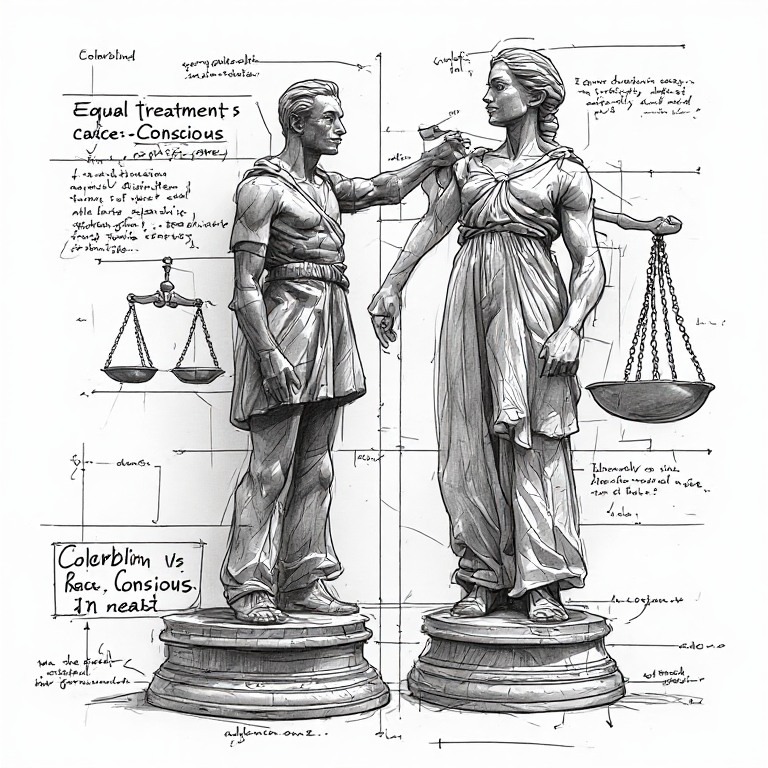
On Selective Repeal of the 1965 VRA
Introduction
If the Supreme Court overturns the VRA of 1965, and in effect determines that race is not used as a measure of influence in voting, the equal protection will be universal in voting?
No—if the Supreme Court eliminates race‑conscious protections in voting, it may reduce equal protection for minority voters, not universalize it. The outcome would likely weaken safeguards against racial discrimination, not extend equal protection equally.
🧭 The Legal Crossroads: Race, Voting, and Equal Protection The Voting Rights Act of 1965 was designed to enforce the 15th Amendment’s promise that voting rights cannot be denied “on account of race.” It specifically targeted discriminatory practices like literacy tests, poll taxes, and racial gerrymandering. Section 2 of the VRA, now under scrutiny in Louisiana v. Callais, prohibits voting practices that dilute minority voting power. Courts have long interpreted this to mean that race must be considered when drawing districts to ensure fair representation.
If the Court rules that race can no longer be considered, it would adopt a “colorblind” interpretation of the Constitution. While this may sound like universal equal protection, it actually removes tools used to remedy historical and ongoing racial discrimination.
⚖️ What “Universal” Equal Protection Would Actually Mean In theory, removing race from redistricting could mean all voters are treated identically under the law. In practice, it would likely entrench inequality:
- Minority communities could be split across districts, diluting their voting power.
- States would no longer be required to create “opportunity districts” where minority voters can elect candidates of their choice.
- Past discrimination would go unaddressed, as courts would lose the ability to consider racial impact in voting maps.
🧩 Philosophical Tension: Colorblind vs. Race‑Conscious Justice. Conservative justices argue that race‑based remedies should have a sunset — that the Constitution guarantees equal protection without racial classifications. Civil rights advocates counter that ignoring race perpetuates inequality, especially in a country where racial disparities in political power persist. Justice Ketanji Brown Jackson emphasized that the VRA derives from the 15th Amendment, which was explicitly about race. Ignoring race, she argued, would undermine the very purpose of the law.
📝 Equal Protection Without Division — A Rebuttal to “VRA‑1965”
Introduction
The original essay argued that eliminating race‑conscious protections in voting would weaken equal protection for minority voters. It claimed that “colorblind” justice entrenches inequality by ignoring historical discrimination. My rebuttal challenges this premise. Equal protection, as guaranteed by the 5th and 14th Amendments, is not diminished by universality — it is fulfilled by it. To perpetuate race as a measure of influence is to sustain division, not repair it.
The Original Argument (from VRA‑1964)
- The Voting Rights Act of 1965 was designed to enforce the 15th Amendment’s promise against racial discrimination in voting.
- Courts have long required race to be considered in redistricting to ensure minority representation.
- Removing race from maps would dilute minority voting power, eliminate “opportunity districts,” and ignore past discrimination.
- Civil‑rights advocates argue that ignoring race perpetuates inequality, while conservative justices argue for a “sunset” on race‑based remedies.
My Rebuttal
- Equality Means Universality
- Equal protection is not conditional. It applies to every citizen, regardless of race.
- To insist that race must remain a factor is to deny the founding principle: all men are created equal.
- Opportunity Districts Entrench Division
- Creating districts based on race sustains the idea that citizens are defined by categories, not by shared civic identity.
- A minority of 13% nationally should not be engineered into disproportionate influence over the other 87%. Representation must flow from merit and geography, not racial arithmetic.
- Past Discrimination Cannot Justify Perpetual Division
- Historical wrongs must be acknowledged, but they cannot serve as permanent justification for unequal treatment.
- To continually redraw maps by race is to keep wounds open, ensuring grievance remains a political economy.
- The Cottage Industry of Division
- Critical Race Theory and projects like 1619 have built careers on sustaining racial grievance.
- This perpetuates division in schools, universities, and law, training the next generation of “race hustlers” instead of citizens bound by equal standards.
Restorationist Vision
- Equal Protection: Preserve the 5th and 14th Amendments as universal guarantees.
- Equal Opportunity: No shortcuts, no arbitrary preferences — every citizen measures up by the same yardstick.
- Equal Accountability: Institutions must serve all, without categories or exceptions.
Conclusion
The original essay warned that “colorblind” justice would entrench inequality. My rebuttal insists the opposite: division entrenches inequality, while universality fulfills the founding promise. To retire race as a political lever is not to abandon equal protection — it is to finally realize it. The Declaration’s words must cease to be rhetoric and become lived reality: equal protection, equal opportunity, equal accountability.
Equal protection cannot truly exist in a society where an entire industry profits from perpetuating racial grievance. From universities to media outlets, careers are built on sustaining division rather than repairing it. The money made by exploiting race — through books, lectures, political campaigns, and endless programs — creates incentives to keep wounds open. Instead of fostering unity under the Constitution’s promise of equal protection, these “race hustlers” thrive on prolonging conflict, ensuring that equality remains rhetoric rather than reality. As long as grievance is monetized, equal protection will remain compromised.
📝 From Hustling to Stewardship — Creative Uses of Displaced Scholarship
Introduction
When grievance politics fades, an entire cottage industry of race hustlers, scholars, and activists will find themselves displaced. For decades, their careers have depended on sustaining division, publishing grievance, and teaching categories instead of universality. But unemployment need not be their fate. Their skills — organizing, writing, teaching, persuading — can be repurposed into constructive stewardship. This essay explores creative uses of displaced scholarship to build a society where equal protection is lived, not debated.
1. Education Without Division
- Redirect teaching into tutoring elementary, junior, and senior high school students in applying themselves to education.
- Replace grievance curricula with civics, STEM, and trades that prepare students for merit‑based achievement.
- Scholars who once taught division can now instill discipline, responsibility, and pride in learning.
2. Civic Responsibility Projects
- Organize neighborhood cleanup campaigns to restore aesthetics and dignity in substandard areas.
- Use mobilization skills to coordinate volunteers, turning grievance energy into civic pride.
- Demonstrate progress visibly — clean streets, repaired homes, and maintained parks raise hopes and prove that effort matters.
3. Moral Ethics Through Clergy Partnerships
- Invite clergy and churches to join in shaping moral ethics that transcend categories.
- Former activists can collaborate with faith leaders to anchor communities in honesty, accountability, and service.
- This partnership restores the moral compass that grievance politics has obscured.
4. Economic Empowerment
- Apply research and writing skills to entrepreneurship training and financial literacy programs.
- Instead of grievance books, publish guides on starting businesses, managing credit, and cooperative ownership.
- Help populations “level up” by teaching practical tools for independence.
5. Conflict Resolution & Mediation
- Redirect organizing skills into community mediation — resolving disputes without inflaming division.
- Train in restorative justice that applies equally to all citizens, not filtered through race.
- Build peace instead of perpetuating grievance.
Conclusion
Equal protection cannot exist in a society where grievance is monetized. But displaced scholars and activists need not be cast aside. Their skills can be redirected into education, civic responsibility, moral ethics, economic empowerment, and mediation. From hustling to stewardship, they can help build a colorless society where equal protection, equal opportunity, and equal accountability are not rhetoric but reality. Repurposing neighborhood economic zones could raise money for neighborhood improvements. Financial expertise would be needed as well as tradesmen local to the neighborhood population.
The more people who are willing to apply themselves would greatly speed up progress and instill neighborhood and civic pride. Truly a grassroots movement.