
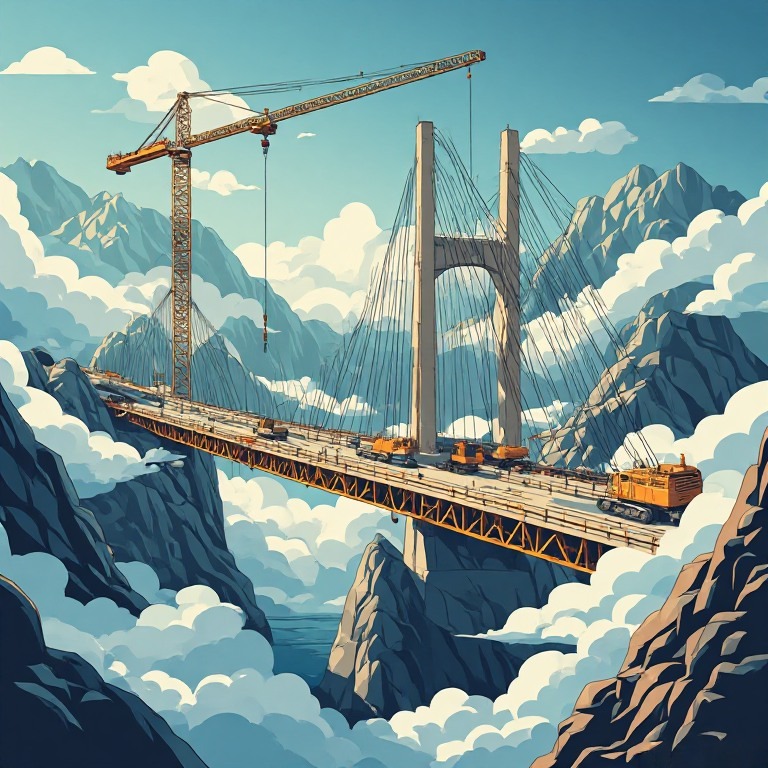
A structural comparison of two national construction systems
Modern China and the United States approach infrastructure as if they belong to different eras of civilization. China treats construction as a strategic instrument of national development, while the United States treats it as a regulated activity to be managed, reviewed, and often litigated. The result is a staggering divergence: China builds high-speed rail networks, megadams, mountain-spanning bridges, and entire new cities, while the U.S. often struggles to repair a highway overpass or construct a municipal building without years of delay and runaway costs.
The difference is not simply ideology. It is system architecture—the way each nation organizes authority, expertise, responsibility, and risk.
China Builds Megaprojects Through Centralized Purpose
In China, infrastructure is conceived as a national mission. The state sets long-term development goals, and construction becomes the physical expression of those goals. Projects are not treated as isolated civic conveniences but as engines of economic transformation. They connect regions, absorb labor, accelerate trade, and signal national capability.
This model works because China’s system is highly coordinated. Engineers, not generalists, dominate the decision-making hierarchy. Ministries, provincial governments, and state-owned construction giants operate in a chain of command that reduces friction once a project is approved. Designs are standardized. Components are prefabricated. Work continues around the clock. Supply chains are mobilized at national scale. The people overseeing these projects are often hydrologists, civil engineers, geologists, or transportation specialists—people who understand terrain, materials, and structural risk.
That technocratic structure allows China to build quickly and at scale. Infrastructure is not merely a public service; it is a development engine. High-speed rail connects inland provinces to coastal markets. New urban districts absorb migration and create housing. Water-transfer projects reshape agricultural possibilities. Ports and logistics hubs turn once-isolated communities into global manufacturing centers. Construction is one of the main tools by which China has lifted hundreds of millions of people into modern economic life.
Why China Builds Megaprojects Faster Than the U.S.
The phrase “why China builds megaprojects” is really a question about institutional design. China’s construction capacity is not the product of magical efficiency or cultural superiority. It is the result of a system that aligns power with execution. When the state decides a project matters, it can concentrate labor, financing, expertise, and political will behind that goal.
The United States, by contrast, operates under a very different logic. Infrastructure is not a national strategy so much as a local responsibility, filtered through a maze of jurisdictions, agencies, and regulatory bodies. A single bridge replacement may require approval from city councils, county boards, state departments of transportation, federal agencies, environmental regulators, historical preservation boards, utility companies, and courts. Each entity can delay, revise, or block the work. The process is designed to prevent harm, not to produce results quickly.
Where China’s system is centralized and technocratic, the U.S. system is fragmented and procedural. American regulators are often lawyers, administrators, or political appointees rather than engineers. Their mandate is compliance, not construction. That creates a culture of risk aversion, endless review cycles, and design-by-committee. Even when engineers propose efficient solutions, they can be overridden by non-experts whose priorities are political, legal, or symbolic rather than technical.
The American Infrastructure Paradox
This bureaucratic architecture inflates costs and stretches timelines to absurd lengths. A subway mile in China may cost a few hundred million dollars; in the United States, it can exceed three billion. A Chinese high-speed rail line can be planned and built in five years; in the U.S., a comparable project may spend a decade in environmental review before a shovel ever touches the ground. The American system is optimized for process, not progress.
The consequences are visible everywhere. China’s infrastructure reshapes landscapes, connects regions, and creates new economic zones. The U.S. infrastructure mostly tries to preserve what was built in the mid-20th century. China builds to expand its future; the U.S. often builds to maintain its past. China’s engineers are empowered to design and execute. America’s engineers are constrained by layers of oversight from people who may know little about concrete curing, load-bearing capacity, or project sequencing.
None of this means China’s system is flawless. Rapid construction can invite corruption, and local projects sometimes suffer from corner-cutting. But at the level of national megaprojects—the bridges, dams, rail networks, and water systems that define a civilization—China’s engineering corps is disciplined, experienced, and backed by a state that treats infrastructure as a strategic asset rather than a political bargaining chip.
Why the U.S. Struggles to Fill Potholes
The United States has not lost the ability to build because Americans are less talented. American engineers remain among the best in the world. The problem is structural. The country has built an institutional environment that gives bureaucrats authority over engineers, process authority over execution, and litigation authority over design.
That matters because even ordinary infrastructure is no longer ordinary to the system. A pothole repair may require budget approvals, procurement reviews, labor negotiations, environmental compliance, and local political coordination. A bridge patch becomes a multi-agency event. Every stage creates opportunity for delay. Every delay raises costs. Every cost increase invites more scrutiny. The cycle repeats.
The irony is painful: the nation that once built the Hoover Dam, the Interstate Highway System, and the Golden Gate Bridge now struggles to maintain airports, roads, and rail systems that should be routine by comparison. The issue is not the absence of talent or resources. It is the absence of a system designed to convert those resources into durable physical outcomes.
Education and the Capacity to Build
The deepest explanation for this gap runs beyond engineering and into education. Infrastructure is never merely concrete and steel. It is the physical expression of a society’s civic formation, its educational standards, its cultural priorities, and its governing competence. Bridges, dams, railways, and power grids are not built by machines alone. They are built by minds.
China’s rise is inseparable from its educational strategy. Over the past forty years, it built a system designed to produce the people required for national development: engineers, technicians, machinists, hydrologists, geologists, and skilled tradespeople. Mathematics is rigorous. Science is emphasized. Engineering is prestigious. Vocational training is respected. Civic education reinforces national cohesion and collective purpose. The result is a population capable of building the physical world the nation envisions.
The United States, by contrast, has allowed its educational system to drift into incoherence. Basic literacy and numeracy have eroded. Civics has faded. Shop classes have disappeared. Practical economics is rarely taught. Many students graduate high school unable to read complex texts or perform multi-step calculations. Many college graduates cannot clearly explain the structure of their own republic. They may speak passionately about social and political issues, but they often lack the civic literacy to understand the systems they are trying to change.
A nation that cannot form its citizens cannot build its civilization.
Structural Decline in American Infrastructure
This educational decay feeds directly into America’s infrastructure paralysis. When a society produces fewer engineers, fewer tradespeople, and fewer technically literate citizens, it becomes dependent on a shrinking elite to design and maintain the systems everyone relies on. At the same time, the regulatory apparatus grows in inverse proportion to competence. Bureaucrats without technical training gain veto power over engineers. Lawyers, activists, and political appointees dictate the terms of construction. Projects are delayed not by physics but by process.
The pattern is consistent across sectors. Schools no longer produce broad technical competence at scale, so the nation compensates with compliance systems, consultants, and legal review. But compliance is not construction. It can prevent errors, yet it cannot create momentum. A country can regulate its way into caution, but it cannot regulate its way into achievement.
China Builds, the U.S. Regulates
China builds because its system is designed to build. The United States struggles because its system is designed to regulate. That is the core difference, and it explains why the comparison feels so stark. China’s infrastructure reflects a national project with a clear destination. America’s infrastructure reflects a fragmented republic in which every improvement must pass through layers of veto points, cultural distrust, and procedural drag.
Until that structural difference changes, the gap will continue to widen. Not because one nation is more virtuous or more intelligent, but because one has aligned its institutions around building, and the other has aligned its institutions around preventing mistakes.
If the United States wants to reclaim its capacity to build, it will need more than funding. It will need a redesign of authority, a restoration of technical expertise, and an educational system that once again produces citizens who can understand, approve, and execute large-scale works. Only then can America move from managing decline to making things again.