
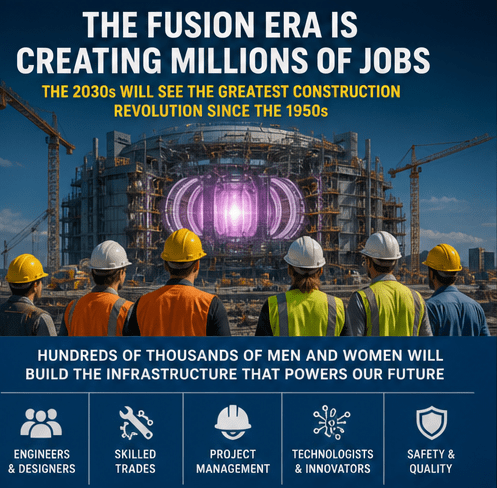
Energy has always shaped civilization. It determines which nations rise, which industries thrive, and which futures are possible. Today, we stand at the edge of another historic shift — one driven by the cost of extracting oil, the depletion of freshwater, and the approaching reality of fusion power. For Generation A, graduating in the mid‑2030s, this shift will define their careers, their economy, and the world they inherit.
This essay traces the structural forces behind that transition: how oil extraction costs differ around the world, how freshwater is quietly becoming a non‑renewable resource, what happens just before and after fusion becomes viable, and which trades and careers Gen A should prepare for as the largest infrastructure boom since the 1950s begins.
1. The True Cost of Extracting Oil Around the World
Oil is not a single commodity with a single cost. Its price hides enormous differences in geology, technology, and national infrastructure.
Middle East: The Cheapest Oil on Earth
Saudi Arabia, Kuwait, and the UAE enjoy the lowest extraction costs globally — often $3–8 per barrel. Their reservoirs are massive, permeable, and naturally pressurized. Wells produce thousands of barrels per day with minimal stimulation. Even when they use desalinated water for drilling or enhanced recovery, their costs remain far below the U.S. or Russia.
Russia: Moderate Costs, Harsh Conditions
Russia’s extraction costs typically fall between $15–20 per barrel, driven by:
- older fields
- harsh climate
- long transport routes
- aging infrastructure
Russia’s geology is easier than U.S. shale but harder than Middle Eastern supergiants.
United States: The Most Expensive Major Producer
U.S. shale oil is fundamentally different. Extraction costs often range from $35–70 per barrel, because:
- shale rock is extremely tight
- wells require massive fracking
- decline rates are steep
- water use is enormous
- constant drilling is required to maintain output
The U.S. is a technological powerhouse, but its geology is unforgiving.
2. Freshwater: The Hidden Cost of Modern Energy
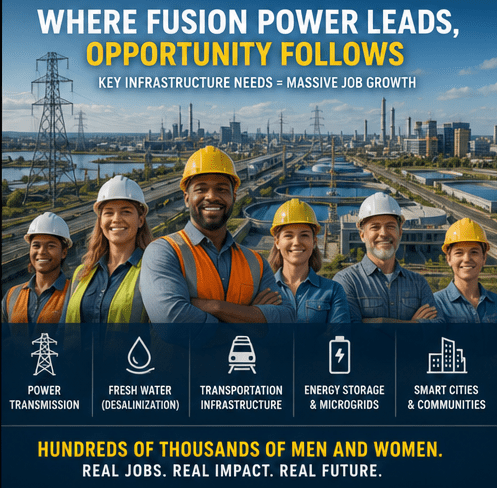
Freshwater is becoming a non‑renewable resource in practice, even if not in theory. Oil extraction is part of that story.
Fracking’s Water Problem
A single shale well uses 3–20 million gallons of freshwater. Most of that water:
- becomes permanently trapped in shale
- returns as toxic brine
- is injected deep underground
This is permanent removal from the hydrologic cycle.
Concrete’s Water Problem
Concrete production uses billions of tons of water annually. Hydration water becomes chemically bound inside the cement matrix and cannot be recovered. The rest evaporates or becomes trapped in pores.
Agriculture, mining, cooling, and urbanization
All remove freshwater faster than rainfall can replenish it. Aquifers are collapsing worldwide. Rivers fail to reach the sea. Lakes shrink. Snowpack declines.
Freshwater scarcity is becoming structural — not temporary.
3. The World Just Before Fusion
The late 2020s and early 2030s are defined by:
- rising energy demand
- declining freshwater supplies
- aging grids
- industrial electrification
- AI expansion
- geopolitical competition over oil and gas
Energy scarcity shapes everything. Nations invest heavily in renewables, nuclear fission, hydrogen, and grid modernization — all while waiting for the next breakthrough.
Fusion demonstration plants begin appearing. Governments and corporations start planning around the assumption that fusion will be real within a decade. Investment accelerates before fusion arrives.
This is the “pressure phase” — the buildup before the release.
4. The World Just After Fusion
When fusion becomes viable — even in small pilot plants — the entire economic architecture shifts.
Fossil fuels decline
Not instantly, but steadily. Oil remains important for petrochemicals, aviation, and heavy transport, but its role as a primary energy source fades.
Energy becomes abundant
Cheap, clean, high‑density power unlocks:
- universal desalination
- electrified industry
- cheap materials
- cheap transportation
- unlimited compute
- robotics at scale
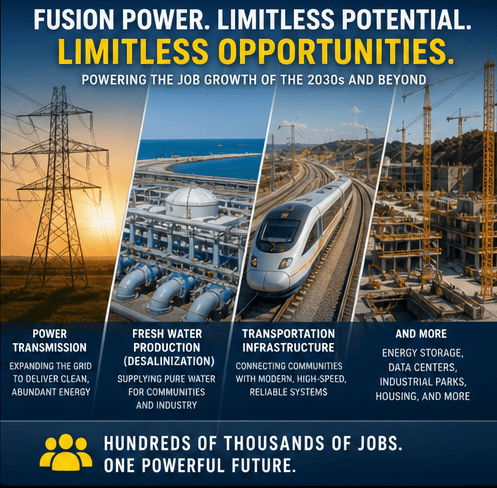
Infrastructure renewal begins
This is the largest build‑out since the 1950s:
- new transmission lines
- superconducting cables
- smart grids
- industrial retrofits
- desalination networks
- electrified transportation
- new materials manufacturing
Fusion doesn’t shrink the economy — it expands it.
5. The Trades and Careers Gen A Should Train For
Gen A graduates into the early fusion era. Their job prospects are shaped by electrification, automation, water expansion, and infrastructure renewal.
Top Trades
- Electricians (massive demand)
- Lineworkers
- Welders
- Industrial mechanics
- HVAC technicians (electrified systems)
- Heavy equipment operators
Trades become high‑status, high‑income careers again.
Top Technical Careers
- Power electronics engineers
- Grid modernization specialists
- Robotics operators
- Mechatronics engineers
- Materials scientists
- Desalination plant operators
- Hydrogen systems technicians
- Battery manufacturing engineers
Top Hybrid Careers
- AI‑assisted engineering
- Smart‑grid cybersecurity
- Fusion plant technicians
- Environmental systems planners
- Industrial automation designers
Gen A’s world is hands‑on, high‑tech, and deeply infrastructure‑driven.
The 2030s are a boom decade.
6. The Career Outlook for the 2030s and Beyond
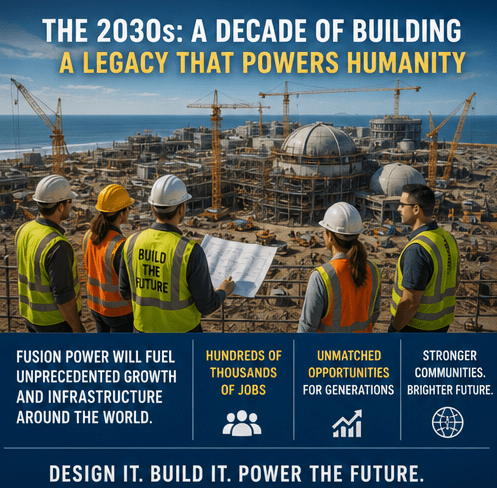
A Second Post‑WWII Construction Era
Cheap energy → cheap materials → massive construction:
- housing
- factories
- water systems
- transportation networks
- energy infrastructure
Industrial Electrification
Factories retool for electric furnaces, boilers, and chemical processes. This creates decades of work.
Water Expansion
Desalination becomes global. Water pipelines, treatment plants, and agricultural systems expand.
AI and Robotics
AI doesn’t eliminate jobs — it eliminates tasks. Robotics doesn’t replace workers — it replaces dangerous, repetitive labor.
Humans shift into:
- oversight
- maintenance
- design
- optimization
- planning
- troubleshooting
The workforce becomes more skilled, not smaller.
7. Will AI and Robotics Reduce Human Employment?
Not in the fusion era.
AI and robotics:
- increase productivity
- reduce physical strain
- eliminate hazardous work
- expand what humans can build
- create new industries
They do not eliminate the need for human workers. They change the nature of work.
The fusion era is not a jobless future — it’s a skilled future.
Conclusion: The Energy Shift That Defines a Generation
Oil extraction costs reveal the uneven geology of the world. Freshwater depletion exposes the hidden cost of modern industry. Fusion promises a future where energy scarcity ends and infrastructure renewal begins.
Gen A will graduate into a world rebuilding itself — grids, factories, water systems, transportation, materials, and cities. Their careers will be shaped by abundance, not scarcity. The 2030s will be the largest employment boom since the 1950s, driven by electrification, construction, desalination, robotics, and fusion.
The energy transition is not just technological. It is generational. And Gen A will be the generation that builds the new world.
Leave a Reply