
Introduction
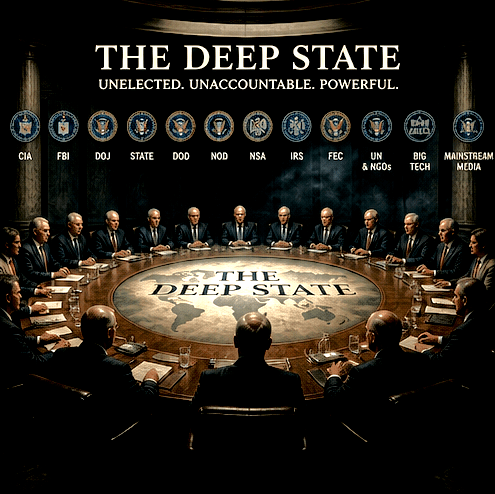
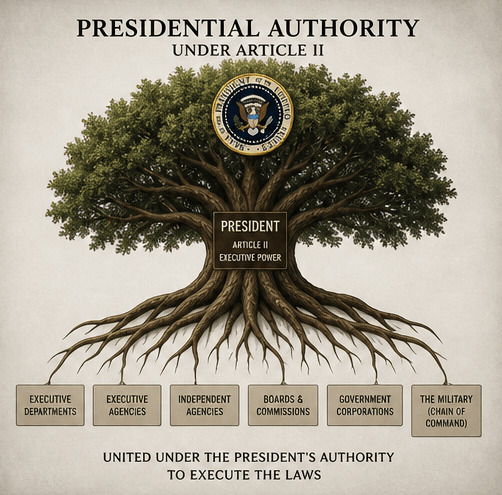
Project 2025 did not emerge in a vacuum. It was the product of a long-building conflict over who actually controls the executive branch in the modern United States. For decades, the administrative state expanded through a combination of agency insulation, judicial deference, and bureaucratic permanence, creating a governing structure that often functioned with significant independence from the elected President. To supporters of Donald Trump, that system became especially visible during his first term, when policy initiatives, personnel decisions, and executive directives were often slowed, challenged, or neutralized by internal resistance. Project 2025 was designed as a corrective to that reality. Its purpose was not merely ideological; it was structural. If the Constitution vests executive power in one President, then supporters argue the President must also have the practical authority to direct, supervise, and, when necessary, replace those who execute the law. From that perspective, Project 2025 represents a response to the administrative state’s accumulated resistance and an effort to restore Article II authority to its constitutional center.
From that perspective, Project 2025 represents an effort to restore the original meaning of Article II: that the executive power is vested in one President, accountable to the people, and empowered to direct the executive departments of government. The constitutional theory behind this effort is not new. It is rooted in the unitary executive tradition, which holds that the President must have control over the officers who execute the law if the Constitution is to function as designed.
First-Term Resistance and the Rise of the Administrative State
During Trump’s first term, supporters saw repeated examples of what they believed to be coordinated resistance from within the federal apparatus. This included investigations, litigation, internal leaks, and agency-level obstruction that, in the eyes of Trump allies, went beyond normal bureaucratic friction. The broader argument is that the President was not merely opposed by political adversaries in Congress, but by a deeply embedded administrative class that acted as a shadow power center.
The file material describes the administrative state as a “self-perpetuating organism” shielded by statutory insulation and judicial deference, wielding power while resisting direct presidential accountability. That view sees the so-called “deep state” not as a conspiracy in the cinematic sense, but as a structural problem: unelected officials exercising executive power without meaningful control by the elected President.
Among the most important forms of resistance perceived by Trump supporters were:
- Investigative and legal campaigns that consumed the first term and helped define it politically.
- Agency independence doctrines that limited the President’s ability to remove or direct executive officers.
- Bureaucratic inertia and internal opposition to major policy initiatives.
- Judicial doctrines, such as Chevron deference, that allowed agencies to interpret law with broad autonomy.
In this view, the first Trump term exposed a constitutional weakness: a President can be elected with a mandate, yet still be hindered by institutions inside the executive branch that do not fully obey him.
Project 2025 as a Constitutional Blueprint
Project 2025 emerged as a blueprint for overcoming that problem. Supporters of the project argue that if the President is responsible for executing federal law, then he must also have the authority to supervise and remove those who carry out that work. The file makes this logic explicit, describing the collapse of Chevron and the pressure on Humphrey’s Executor as part of a “constitutional reckoning” that restores “executive clarity” and “citizen agency.”
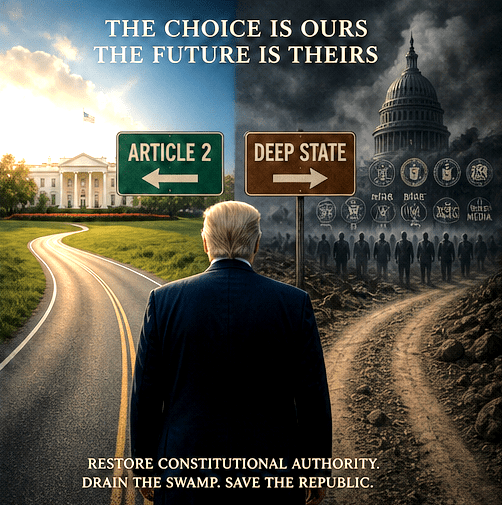
That is why Project 2025 is often described by its supporters as a governance strategy rather than merely a partisan project. Its purpose is to ensure that executive agencies function under presidential direction rather than as independent political enclaves. Under this theory, the administrative state must be re-centered under Article II if constitutional accountability is to mean anything.
Supreme Court Developments Reinforcing Article II
Trump’s second term has been marked by a judicial environment far more favorable to strong executive authority than the one he faced in his first term. The most important recent development is Loper Bright Enterprises v. Raimondo, which ended Chevron deference and limited the ability of administrative agencies to define the scope of their own power through ambiguous statutes. That decision matters because it reduces the autonomy of the bureaucracy and returns interpretive authority to the courts and, indirectly, to elected officials.
The file also identifies a line of cases and emergency orders aimed at weakening the old framework of agency independence, especially the precedent established by Humphrey’s Executor. It describes the Court as staying reinstatement orders in disputes involving FTC Commissioner Rebecca Slaughter and NLRB Member Gwynne Wilcox, signaling a willingness to allow the President to exercise broader removal authority. In this framing, the Court is not merely deciding personnel disputes; it is redefining the constitutional relationship between the President and executive officers.
The significance of these rulings is structural. If the President can remove officers more freely, if agencies cannot rely on expansive judicial deference, and if independent commissions lose their insulation, then the President’s Article II authority becomes more than theoretical. It becomes operational.
The Constitutional Stakes
At the heart of this debate is a basic question: who controls the executive branch? The Madisonian concern was that executive power should be limited and accountable; the Hamiltonian argument was that the President must have unified control over execution to preserve energy, accountability, and clarity. Modern disputes over administrative agencies are really disputes over which of those principles should dominate current governance.
Supporters of Project 2025 argue that the answer is now clearer than ever. The President cannot faithfully execute the law if a web of agencies can resist him, reinterpret his directives, or entrench officers beyond effective supervision. The administrative state may have developed gradually over time, but its growth has created a constitutional mismatch between formal electoral accountability and practical executive power.
Conclusion
Project 2025 should be seen as the institutional answer to a crisis of executive authority. In the eyes of its supporters, Trump’s first term revealed that a President can be elected, yet still be blocked by an entrenched bureaucracy that treats itself as independent from the constitutional chain of command. The response, therefore, was not only political but structural: reassert Article II, restore presidential control over executive officers, and ensure that the executive branch once again operates as an instrument of the elected President rather than as a rival power center.
The Supreme Court’s recent direction has strengthened that project by curbing deference to agencies and by signaling limits on old doctrines of bureaucratic insulation. Whether one welcomes or fears this development depends on one’s view of the administrative state. But on the constitutional theory advanced by Project 2025, the trend is clear: the presidency is being restored to its intended place at the center of executive power.
Leave a Reply