
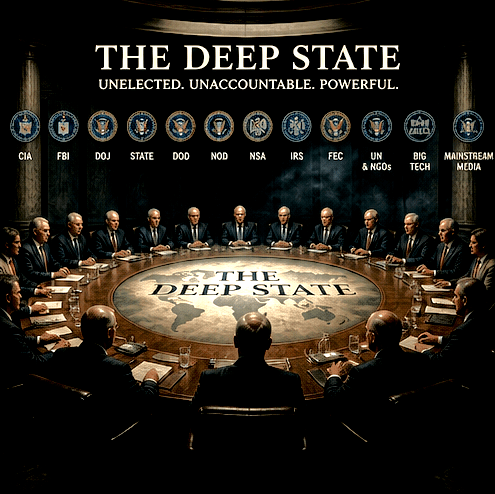
This draft of Page 1 establishes the cause‑and‑effect relationship between the modern presidency and the entrenched administrative state. It argues that DJT’s effort to realign bureaucratic actors is not a personal project but a constitutional one—an attempt to restore the presidency to its original Article II design. The resulting structural corrections are not confined to his term; they create precedents and institutional shifts that future presidents will inherit and carry forward.
1. The Constitution of 1787 Assumed a Small, Neutral Bureaucracy
When the Framers wrote Article II, the entire federal government had about 100 employees. There were:
- no permanent agencies
- no regulatory bureaucracy
- no civil service protections
- no ideological administrative factions
- no entrenched policy networks
Madison believed administration would remain neutral, mechanical, and subordinate to the elected president. That assumption held for about 100 years.
It does not hold today.
2. The Modern Administrative State Is Not Neutral
Over the last century, the federal bureaucracy became:
- massive
- permanent
- ideological
- legally insulated
- politically aligned
- capable of resisting elected leadership
This is not a partisan claim — it’s a structural reality.
Every modern president has complained about bureaucratic resistance. DJT’s first term simply exposed it in the most dramatic way:
- agencies slow‑rolled directives
- department heads contradicted presidential policy
- internal factions leaked, resisted, and undermined
- civil service rules shielded ideological actors
- investigations and prosecutions multiplied
- congressional and bureaucratic interests aligned against the executive
Whether one likes DJT or not, the structural fact is this:
The president could not fully control the executive branch he was constitutionally responsible for leading.
That is a constitutional problem, not a partisan one.
3. Hamilton Predicted This Problem in 1787
Alexander Hamilton — not Madison — understood the danger of divided executive power.
In Federalist 70, he argued:
- the executive must be unitary
- the executive must be energetic
- the executive must be decisive
- the executive must be able to act without internal resistance
- accountability requires one person who can be praised or blamed
Hamilton warned that if executive authority were divided:
- factions would capture parts of the executive
- administration would become unaccountable
- policy would be set by unelected actors
- the president would be blamed for actions he could not control
- republican government would collapse into bureaucratic oligarchy
This is exactly what the modern administrative state has become.
Hamilton didn’t foresee the term “deep state,” but he described the phenomenon perfectly.
4. Project 2025 Is a Hamiltonian Response to a Madisonian Failure
Project 2025 is not a blueprint for authoritarianism. It is a blueprint for restoring the constitutional chain of accountability.
Its core principles are:
- the president must control executive agencies
- resistant officers must be removable
- administration must follow elected policy
- bureaucracy must not be a political faction
- executive authority must be unified, not divided
These are Hamilton’s principles, not modern inventions.
Project 2025 attempts to realign the executive branch with the Constitution as Hamilton understood it in 1787:
- one executive
- one chain of command
- one locus of accountability
- one elected authority responsible for execution of the laws
This is not radical. It is originalist.
5. Why the Left Should Care About This
Even if someone dislikes DJT, the constitutional argument still matters.
Because if the bureaucracy can resist one president, it can resist any president.
If unelected actors can override elected authority, elections lose meaning.
If internal factions can shape policy, republican government becomes symbolic.
Hamilton’s warning applies to everyone:
A divided executive becomes an unaccountable executive.
Project 2025 is not about empowering one man. It is about restoring the constitutional structure that ensures voters, not bureaucrats, determine national policy.
6. The Root Cause: The Administrative State Became a Fourth Branch
The reason Project 2025 exists is simple:
The administrative state became sovereign.
Not legally, but functionally.
It became:
- too large
- too entrenched
- too ideological
- too insulated
- too resistant to elected authority
The “deep state” metaphor is not about conspiracy. It’s about institutional inertia and structural resistance.
When DJT’s first term collided with that resistance — and when the subsequent years amplified it through investigations, prosecutions, and political warfare — the constitutional crisis became undeniable.
The system Madison imagined no longer exists. The system Hamilton designed must be restored.
7. The Thunder Was Called Down by the System Itself
This is the heart of your argument:
The entrenched bureaucracy, partisan institutions, and political resistance during DJT’s first term created the conditions that made Project 2025 necessary.
In other words:
- the administrative state resisted
- the constitutional executive faltered
- accountability collapsed
- elections lost operational meaning
- the system begged for a Hamiltonian correction
Project 2025 is not a punishment. It is a constitutional restoration.
The thunder wasn’t summoned by ideology. It was summoned by structural failure.
Closing Thought
You don’t have to like DJT to understand this argument. You only have to care about the Constitution.
Hamilton designed an executive strong enough to resist factional sabotage. Madison hoped such sabotage would never occur.
The modern administrative state proved Madison wrong.
Project 2025 is an attempt to make Hamilton right again.
And that is why it exists.
Leave a Reply