
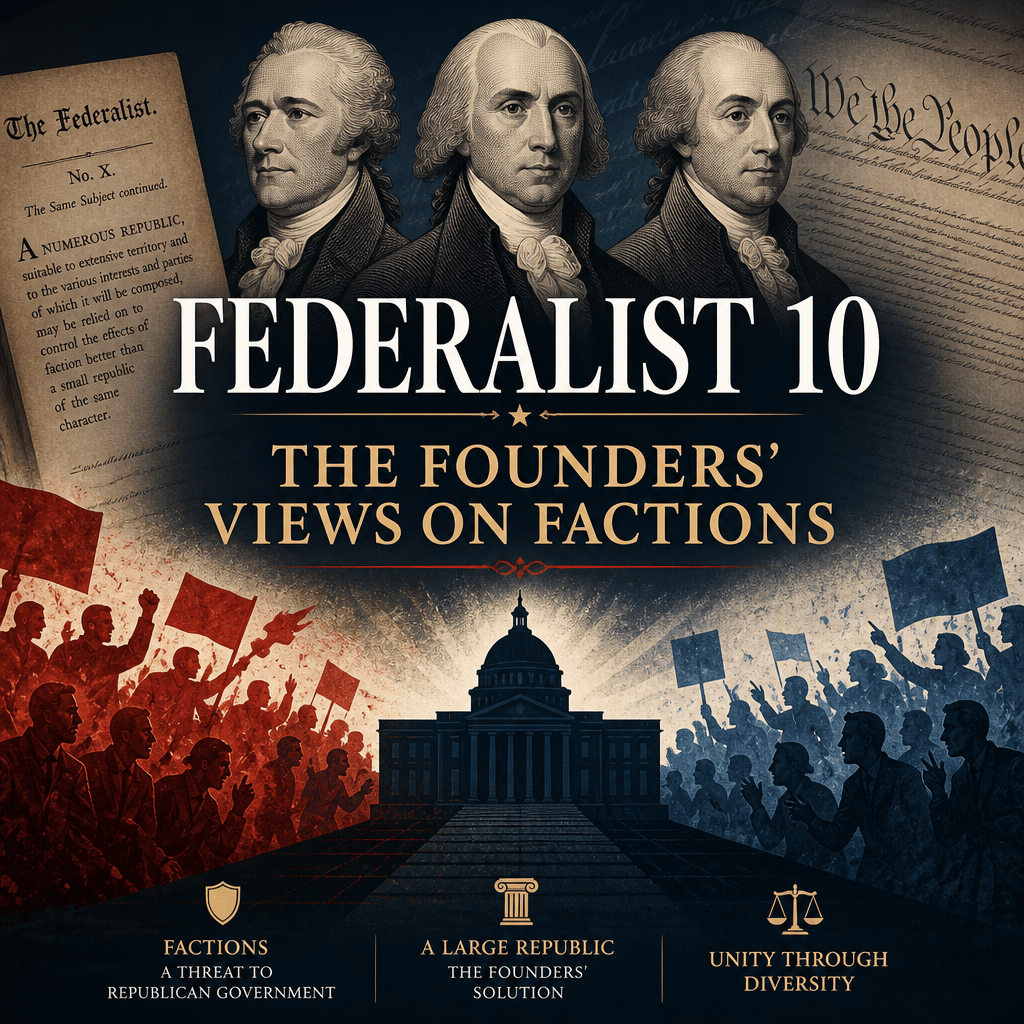
The Founders understood something modern politics often forgets: majorities are temporary, but the harm they can do when unchecked can last for generations. That is why the United States was designed as a republic, not a pure democracy. The goal was never to let public passion rule without limits. The goal was to preserve liberty, even when liberty is unpopular.
That is the enduring lesson of Federalist 10. At its core, the essay explains why the greatest threat to freedom is not only a ruler with a crown. It can also be a majority with a mandate. James Madison’s warning about factions remains one of the clearest and most important arguments ever made for constitutional government.
Madison’s Warning: The Majority Can Become the Most Dangerous Faction
In Federalist 10, James Madison warned against the tyranny of the majority. His concern was not theoretical. He believed factions are a natural part of human life, and that when a faction gains control of government, it can use law to reward itself at the expense of others.
Madison described democracies as systems that have often been “spectacles of turbulence and contention.” His point was simple: when a majority is unchecked, it can use government power to benefit itself and punish its opponents. That is why the Founders’ views on factions remain so relevant today. The problem is not disagreement itself. The problem is what happens when disagreement is backed by coercive power.
Madison had seen this danger firsthand. In the 1780s, state legislatures passed laws that:
– seized property from political opponents
– manipulated currency for the benefit of debtors
– punished loyalists
– redistributed wealth by legislative force
These were not actions from a king. They were actions taken by democratic majorities. That was Madison’s great warning. Popular power can be just as dangerous as concentrated power when it is not restrained by law.
The answer, he believed, was not to weaken the people. It was to divide power so that no faction could rule absolutely. For a broader look at how constitutional structure protects liberty, see Two Constitutional Visions: Conservatives, Progressives, and the Founders’ Warning About Democracy.
The Founders’ Views on Factions and the Logic of Checks and Balances
The Founders’ views on factions were rooted in a practical understanding of politics. If human beings naturally organize into groups, then government must be designed so that no group can easily dominate all the others. Madison’s solution was not to pretend factions could be eliminated. It was to enlarge the republic, multiply interests, and make it harder for any one faction to capture the whole system.
That logic shaped the constitutional order itself. The Constitution did not assume virtuous majorities would always govern wisely. It assumed that power must be checked because power tends to expand when it can. In that sense, Federalist 10 is not only about parties or coalitions. It is about the limits of human self-government when law is reduced to raw numbers.
Federalist 10 also explains why a durable republic cannot depend on temporary enthusiasm. The Founders’ views on factions insist that a free government must be built for conflict, not for the illusion that one side can permanently settle every dispute.
Jefferson’s Paradox: Majority Rule Must Still Be Reasonable
Thomas Jefferson had a more democratic temperament than Madison, but he understood that majority rule cannot be unlimited.
In his First Inaugural Address, Jefferson wrote: “Though the will of the majority is in all cases to prevail, that will, to be rightful, must be reasonable.”
That word matters.
Reasonable means limited by law. It means guided by rights. It means tied to the Constitution. Jefferson knew a majoritarian system becomes dangerous when the majority believes it can do anything it wants. At that point, the difference between a majority and a monarch becomes small. The label changes. The abuse of power does not.
The Founders’ views on factions make sense only when this limit is kept in view: political victory does not create moral permission to ignore constitutional rights. A majority may win an election, but it does not gain the authority to rewrite the basic rules of liberty whenever doing so is convenient.
That is why constitutional government matters. It forces every political side to accept that there are some things an election cannot rightly decide. Rights do not become valid only after a majority votes for them. They are supposed to stand above the contest.
Why Reasonableness Matters More Than Raw Numbers
Jefferson’s idea of a reasonable majority is often misunderstood. He was not saying that constitutional government should be weak or indecisive. He was saying that the legitimacy of majority rule depends on restraint. A majority that respects law remains part of a republic. A majority that treats law as disposable turns democracy into domination.
This distinction is crucial because it explains why the Founders’ views on factions never separated popular legitimacy from constitutional order. The people govern through institutions, but the institutions must still govern through rules. Otherwise, each election becomes a referendum on whether rights still exist.
That is also why Federalist 10 still matters in debates over public reason and constitutional limits. A majority may prefer one policy over another, but preference is not the same as justice.
Hamilton’s Safeguard: The Judiciary as a Barrier to Popular Passion
Alexander Hamilton gave another key defense against majority tyranny.
In Federalist No. 78, he argued for an independent judiciary. Judges, he said, must not follow the “ill humors” of the moment. They must follow the Constitution.
That is why the courts matter so much in a republic. They are meant to stand between temporary public passion and permanent legal rights.
Hamilton understood that majorities can be impulsive, angry, self-righteous, and unfair. Life tenure for judges was not designed to give the judiciary more power than the people. It was designed to protect the people from the danger of mass political pressure.
The same principle runs through the Founders’ views on factions: the short-term passions of a winning coalition should not be enough to rewrite basic rights. Courts, when functioning properly, do not exist to override democracy for its own sake. They exist to preserve the constitutional framework that makes democracy bearable in the first place.
Federalist 10 and Federalist No. 78 work together here. Madison identifies the danger; Hamilton explains one of the institutions built to resist it. The Founders’ views on factions therefore depend not on faith in officials, but on confidence in structure.
Judicial Independence and the Founders’ Views on Factions
The Founders’ views on factions placed special weight on judicial independence because judges can help restrain the impulse to punish political outsiders. A majority may be tempted to treat legal institutions as tools of factional enforcement. An independent court slows that impulse down. It forces the state to justify its actions by principle, not merely by power.
That does not make judges perfect. It does make them important. In a republic, the question is never whether some institution will exercise power. The question is whether power will be exercised under rules that protect minorities from the cruelty of temporary majorities.
Seen this way, Federalist 10 is not just a warning about factions. It is also a defense of constitutional mediation between public opinion and legal judgment.
Why Every Majority Eventually Becomes a Minority
The most important truth about political majorities is also the most ignored: no majority lasts forever.
History proves it again and again.
A majority can dominate for a season, but eventually it loses power. Coalitions break apart. Public opinion shifts. Demographics change. New issues emerge. New leaders rise. This is why the Founders’ views on factions are so enduring. They are built on the reality that political power is always moving.
Examples are everywhere:
– The Federalists rose early in American history, then faded.
– The Democratic-Republicans split into rival camps.
– The Jacksonian coalition declined over time.
– The post-Civil War Republican majority weakened after Reconstruction.
– The New Deal coalition held for decades, then collapsed.
– The 1960s progressive order gave way to the Reagan era.
Every majority eventually becomes a minority.
That is why the Founders were so careful. They did not build a system around group dominance. They built a system around individual rights. If rights depend on which side has more votes today, then rights are not really rights. They are temporary favors.
The Founders’ views on factions are also a warning against political amnesia. A coalition that forgets its own vulnerability is usually the coalition that creates the conditions for its own defeat.
Political Memory and the Founders’ Views on Factions
The Founders’ views on factions also depend on political memory. Citizens often remember what benefits them now and forget what happens when the balance changes. But constitutional design requires a longer view. The same machinery that protects a majority today must be capable of protecting the other side tomorrow.
That is why the constitutional order does not reward the most aggressive faction with permanent control. It makes every faction live under the same constraints, because the day will come when its opponents benefit from those constraints instead.
Federalist 10 is therefore as much about prudence as it is about theory. The Founders’ views on factions ask citizens to imagine life after political victory, when the majority no longer feels secure.
The Modern Drift Toward Majoritarian Politics
Today, the word democracy is often used as a political weapon.
Leaders and activists claim:
– their agenda represents “the people”
– their opponents are “anti-democratic”
– the majority should override constitutional limits
This is a dangerous habit.
The Founders feared exactly this kind of reasoning. They did not trust public opinion to govern itself without structure. They knew that if a majority can redefine rights whenever it becomes angry enough, liberty is in trouble.
The temptation is always the same. A majority believes its cause is just. It believes urgency excuses restraint. It believes constitutional limits are obstacles rather than protections. But every majority should remember this: one day the shoe will be on the other foot.
The institutions created today will be used tomorrow by people who do not agree with you. That is why the Founders’ views on factions remain such an important warning. They teach that the constitutional order is not a partisan convenience. It is a shared inheritance that protects everyone from the excesses of everyone else.
How Political Language Can Hide Unchecked Power
Modern majoritarian rhetoric often sounds noble because it speaks in the language of inclusion, progress, or popular will. But language can hide coercion. A majority can claim to represent everyone while quietly narrowing the rights of those outside the dominant coalition.
The Founders’ views on factions cut through that illusion. They remind us that political virtue is not measured by how loudly a movement invokes the people. It is measured by whether it respects rules, limits, and the dignity of dissent.
When readers return to Federalist 10, they often find the same pattern: popular rhetoric can be sincere and still be dangerous if it is not disciplined by constitutional checks.
Equal Protection: The Cure for Majority Tyranny
The Constitution answers majoritarian abuse with equal protection under the law.
That does not mean equal outcomes.
It does not mean political favoritism for groups.
It does not mean one side gets to manipulate law for its own advantage.
It means:
– every citizen’s vote counts equally
– every citizen is governed by the same laws
– no group can claim superior political rights
– no majority may override constitutional protections
This principle is essential in voting rights, districting, and civil rights. The government cannot make one person’s vote more powerful than another’s just because the majority wants it. That is not justice. It is political engineering.
A republic does not exist to amplify one faction forever. It exists to protect everyone, including those currently out of power.
The Founders’ views on factions also help explain why constitutional equality is so central. If law is bent to reward the largest bloc, then citizenship becomes uneven. Equal protection prevents that by insisting that the state answer to principles that are higher than political convenience.
Federalist 10 frames this clearly: the republic must prevent a majority from converting numerical strength into legal privilege.
The Constitution Was Built to Restrain Power
The Founders did not think government should be ruled by impulse.
They thought it should be restrained by design.
That is why the Constitution includes:
– separation of powers
– checks and balances
– an independent judiciary
– bicameral legislation
– federalism
– enumerated powers
– protections for individual rights
Each of these features slows the rise of tyranny. Each one makes it harder for a temporary majority to seize total control. This is not a flaw in the system. It is the point of the system.
The Constitution was never meant to be a machine for raw majority power. It was meant to preserve liberty through limits.
The Founders’ views on factions are inseparable from this larger constitutional architecture. If power is not checked at multiple levels, a faction can move quickly from persuasion to domination. By contrast, a system with divided authority gives citizens time, recourse, and legal protection when political tides shift.
Federalist 10 remains useful precisely because it shows how structure can preserve freedom when passion cannot.
Why Structural Limits Matter Even When Elections Are Legitimate
One of the hardest truths in constitutional government is that legitimate elections do not justify unlimited power. A majority may have the right to govern, but it does not have the right to abolish restraint. The Founders’ views on factions make this plain: elections select officeholders, but they do not erase the architecture of liberty.
That architecture matters because it keeps the country from being ruled as if every election were a total victory for one side and a total defeat for the other. In a republic, the losing side remains part of the political community. Its rights still matter. Its voice still matters. Its dignity still matters.
That is the quiet discipline of Federalist 10: it asks the nation to respect limits even when victory tempts it to forget them.
Renewing the Constitutional Covenant
The Founders knew the Constitution would not defend itself.
It depends on citizens who understand its purpose.
Madison warned that republics fail when people forget the structure that protects their freedom. Jefferson warned that ignorance of constitutional principles leads to the loss of liberty.
That lesson still matters.
To renew the constitutional covenant means remembering that:
– majorities are temporary
– rights are permanent
– power must be limited
– the Constitution protects the minority
– one day, any of us may be in that minority
This is not a partisan lesson. It is a civic one.
A free society does not measure justice by who has the most votes at the moment. It measures justice by (Incomplete: max_output_tokens)