
Industrial Investments are creating a rare economic moment for the United States. Across manufacturing, energy, pharmaceuticals, technology, and infrastructure, more than $11.2 trillion in announced capital is moving toward factories, plants, terminals, fabs, data centers, refineries, shipyards, and supply chains. For the working class, this is more than a headline number: it could determine whether millions of Americans gain durable employment without needing a four-year degree.
As the 2026 midterms approach, the practical question is whether the country will stay on course long enough to finish what has already begun. This article examines the scale of the buildout, the jobs it could support, the local economic ripple effect, and why continuity matters to job-seekers and working families.
A Historic Wave of Industrial Investments
The scale of today’s Industrial Investments is almost unmatched in modern American history. The announced totals span several connected parts of the economy:
- Manufacturing and industry: $5.03 trillion
- Technology, artificial intelligence, and semiconductors: $2.38 trillion
- Energy and the environment: $1.03 trillion
- Pharmaceuticals and biotechnology: $469.9 billion
- Data centers and digital infrastructure: $164.2 billion
- Financial services, logistics, defense, food, and construction: hundreds of billions more
These figures describe announced investments, not guaranteed completed projects. Some proposals will change, slow down, or fail to reach full operation. Even with that qualification, the total signals an extraordinary expansion of physical capacity. These are not simply temporary programs designed to lift a quarterly statistic. They are long-term capital commitments that require land, equipment, workers, utilities, transportation, and local suppliers. The value of Industrial Investments ultimately depends on how much announced capital becomes productive capacity.
For Industrial Investments to become lasting economic assets, announcements must be followed by financing, permits, site preparation, equipment installation, workforce training, and successful operation. Each stage creates different risks, but it also creates work for contractors, tradespeople, technicians, suppliers, and local service providers.
That distinction matters. A short-term stimulus payment can raise demand for a limited period. A factory, processing plant, semiconductor facility, or transmission project creates a durable asset that may employ people for decades. The construction phase supports one set of occupations, while operations, maintenance, shipping, safety, and administration support another.
For readers who want to compare the energy component with broader resource pressures, the discussion in The Coming Energy Shift provides useful context. Energy availability and infrastructure will influence whether many of these projects can operate at the expected scale.
What These Investments Mean for Employment
When people hear large investment numbers, they often think of Wall Street or corporate balance sheets. The real test, however, is what happens on the ground. Industrial projects need people with practical skills at every stage, from site preparation through daily operations.
The immediate construction and support workforce can include:
- Construction workers and equipment operators
- Electricians, welders, and pipefitters
- Machinists and industrial mechanics
- Engineers and surveyors
- Logistics crews and truck drivers
- Safety professionals and inspectors
- Plant supervisors and maintenance teams
- Information technology and control-system technicians
Using standard economic multipliers, the announced projects could support an estimated 4 to 6 million permanent industrial jobs, 3 to 4 million permanent technology, semiconductor, and pharmaceutical jobs, and millions more positions in construction, transportation, logistics, and support services. These are estimates rather than promises, but they illustrate the potential size of the opportunity.
That potential makes Industrial Investments important to the future of employment. A new facility does not hire only the people who work inside its walls. It also purchases services from contractors, maintenance companies, equipment suppliers, restaurants, housing providers, and local retailers. The employment effect spreads through the surrounding economy. For families, Industrial Investments matter most when announced projects become stable jobs with competitive wages.
Workers also need realistic expectations. Projects can be announced years before hiring begins, and not every position will be permanent. Some roles will require certifications, apprenticeships, or experience. Still, the buildout creates a broader ladder of opportunity than a single finished factory might suggest.
Well-executed Industrial Investments can support employment at several career levels at once. An entry-level worker may begin in construction or material handling, earn a certification, move into operations or maintenance, and eventually qualify for supervisory work. That ladder gives workers a reason to build skills while giving employers a reason to retain experienced people.
Where New Jobs Are Going
The new economy is not limited to a few coastal metropolitan areas. Major investment is flowing into states such as Texas, Louisiana, Ohio, Pennsylvania, Tennessee, Georgia, Arizona, North Carolina, and South Carolina. Other regions may benefit as supply chains connect mines, farms, ports, plants, laboratories, and distribution centers.
This geographic spread is one of the most consequential features of current Industrial Investments. For decades, high-growth opportunities often clustered in a small number of expensive cities. New manufacturing and infrastructure projects can bring more employment into the interior of the country, where land and housing may be more affordable and where communities already have industrial experience.
The local benefits can include:
- More hiring by manufacturers and contractors
- New apprenticeship and technical-training pipelines
- More subcontracting opportunities for small businesses
- Greater demand for housing and transportation
- Additional revenue for local governments
- More stability for families and community institutions
Geographic rebalancing will not happen automatically. Communities need roads, reliable electricity, water systems, broadband, schools, childcare, and housing. They also need training programs that connect residents with actual openings rather than merely issuing credentials. When those pieces align, industrial expansion can become a durable source of local prosperity. Done well, Industrial Investments can reconnect regional growth with communities that have lost employers over several decades.
The geographic value of Industrial Investments is greatest when existing residents can compete for the work. Local hiring goals, accessible apprenticeships, transparent job requirements, and cooperation between employers and schools can prevent communities from watching prosperity pass around them rather than through them.
Why These Jobs Matter
The strongest case for Industrial Investments is not that every worker will receive the same benefit. It is that the buildout expands pathways into the middle class for people whose abilities have often been undervalued.
Many of the occupations connected to the industrial economy do not require a bachelor’s degree. They require competence, reliability, safety awareness, and specialized training. Examples include electricians, welders, robotics operators, semiconductor technicians, grid specialists, heavy-equipment operators, process technicians, and industrial mechanics. Industrial Investments also create demand for the instructors, inspectors, and experienced tradespeople who prepare new workers.
These are not effortless jobs. They can involve shift work, physical demands, strict procedures, and continuing education. But they can provide a clear progression from trainee to skilled worker, lead technician, supervisor, or independent contractor. That progression is especially important for workers who want good employment without taking on years of debt.
The U.S. Bureau of Labor Statistics Occupational Outlook Handbook offers a useful way to examine education requirements, pay information, and projected employment for many of these occupations. Readers should use current local postings and apprenticeship providers as well, because wages and qualifications vary by state and employer.
Training is therefore a central part of the story. Community colleges, unions, employer-sponsored programs, vocational schools, and high-school career pathways can help residents compete for openings. Employers also have a responsibility to make advancement possible instead of treating workers as interchangeable temporary labor.
As Industrial Investments advance, training programs should be judged by whether they lead to recognized credentials, paid experience, interviews, and actual employment. A short certificate has limited value if it is disconnected from the equipment, standards, and hiring practices used by nearby employers.
The Consumer Ripple Effect
Industrial growth does not stop at the factory gate. When workers earn stable wages, they spend money where they live. That supports a second wave of activity in retail, restaurants, housing, transportation, childcare, repair shops, and other services.
If 8 to 10 million workers gain stable industrial income, the possible effect is substantial:
- Average industrial wage: about $65,000 per year
- New wage base: approximately $520 billion to $650 billion annually
- Typical consumer spending rate: around 75%
- Retail and services multiplier: approximately 2.2 times
Those assumptions suggest a possible $1.2 trillion to $1.8 trillion annual boost in activity across retail, restaurants, housing, auto sales, local services, small businesses, transportation, and home improvement. These figures are illustrative and depend on the number of jobs actually created, wage levels, taxes, savings, imports, and local capacity. They should be treated as a scenario, not a guaranteed forecast.
Even so, the underlying mechanism is straightforward. A new plant hires workers. Workers rent or buy homes, purchase groceries, maintain vehicles, use childcare, eat at local restaurants, and hire tradespeople. Those businesses then hire additional employees. Local governments may receive more tax revenue, which can support roads, emergency services, schools, and public facilities.
This is how Industrial Investments can become community investments. The benefit is not only the payroll inside a facility; it is the network of everyday transactions that follows reliable employment. The wider return from Industrial Investments therefore depends partly on whether wages circulate through nearby businesses and households.
Because Industrial Investments can increase demand quickly, communities must also watch housing costs, traffic, utility capacity, and access to childcare. Planning for those pressures helps preserve the gains for longtime residents and reduces the risk that higher wages will be offset by sharply higher living expenses.
Why 2026 Matters
The political moment becomes economic because the projects now underway are multi-year undertakings. They are not completed in a month or a quarter. Semiconductor fabs often take 3 to 5 years, energy terminals can take 4 to 7 years, pharmaceutical plants often take 2 to 4 years, and data centers may take 18 to 36 months.
Those timelines mean Industrial Investments depend on continuity. Companies need to know whether permits will remain predictable, energy policy will remain workable, infrastructure plans will be coordinated, and regulatory requirements will change in manageable ways. That makes Industrial Investments especially sensitive to abrupt changes that occur midway through planning or construction.
Projects typically require:
- Stable and clearly administered regulations
- Predictable permitting and environmental review
- Reliable energy and water planning
- Long-term transportation and infrastructure coordination
- A workforce with relevant skills
- Access to financing and dependable supply chains
If the political or regulatory environment changes too sharply, projects can be delayed, re-permitted, litigated, slowed, redesigned, or canceled. That is not necessarily an argument against oversight. Responsible oversight can protect communities, workers, consumers, and the environment. The practical issue is whether the rules are clear, fairly applied, and stable enough for long-term planning.
In practice, Industrial Investments move through linked stages, and uncertainty at one stage can affect all the others. A permitting delay can change a construction schedule, which can alter financing costs, equipment deliveries, hiring dates, and contracts with local suppliers.
The Trump administration’s posture toward manufacturing, energy production, deregulation, and industrial expansion has helped create the political context for this discussion. Voters may view the 2026 midterms as a referendum on whether that direction continues. This is not a prediction of election outcomes; it is an explanation of why policy continuity can matter economically to job-seekers.
Why Staying the Course Matters
For many voters, staying the course does not mean ignoring problems or refusing to improve a policy. It means avoiding unnecessary disruption while projects are moving from announcement to construction to operation. Industrial Investments are particularly sensitive to uncertainty because they involve large sums, long timelines, and many connected decisions.
Once a supply chain is in motion, a sudden break in policy can create friction:
- Contractors may wait for clarification
- Permits may need to be revisited
- Financing may become slower or more expensive
- Hiring plans may pause
- Local suppliers may lose expected work
- Families may delay major purchases or relocations
The cost of stopping is not abstract. It can show up in paychecks, training opportunities, local business revenue, and household plans. At the same time, continuity should include accountability. Public officials and companies should report progress honestly, protect worker safety, and distinguish announced projects from completed facilities and actual jobs.
Protecting productive Industrial Investments does not require freezing every rule permanently. It requires making necessary changes through clear procedures, realistic timelines, and consistent enforcement so that workers, companies, and communities can adjust without sending entire projects back to the beginning.
A balanced approach therefore has two parts: preserve the conditions that allow productive projects to move forward, and measure whether promised benefits reach workers and communities. That standard is more useful than treating every announcement as proof of success or every delay as proof of failure.
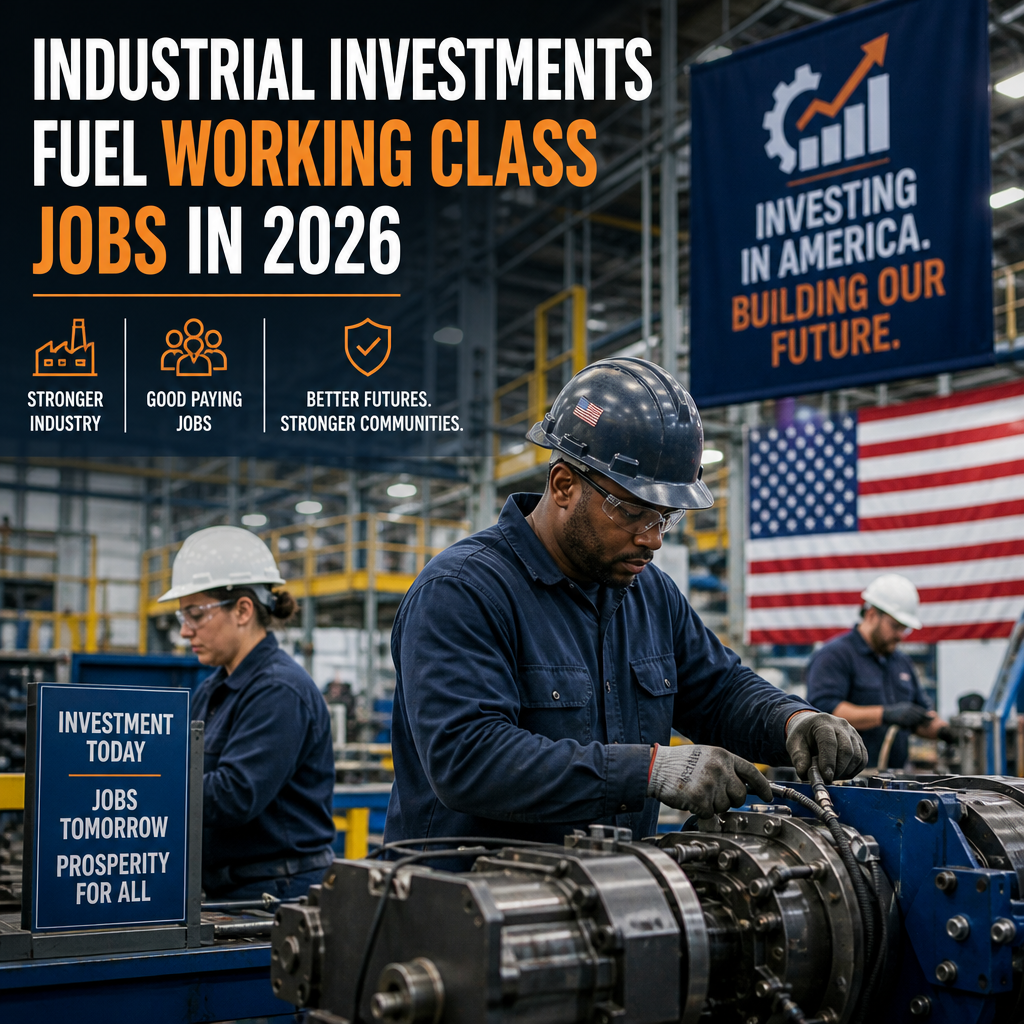
What This Means for the Working Class
1. More high-wage, non-degree jobs
The industrial wave can create careers that do not require a bachelor’s degree. That matters for Americans who want good work without taking on substantial student debt. The most valuable opportunities will go to people who develop practical skills, complete safety training, and build a record of dependable performance.
2. A stronger middle class
Stable wages help families build homeownership, savings, retirement security, local roots, and upward mobility. The connection between work and stability is one reason Industrial Investments matter beyond corporate growth. A reliable job can give a household the confidence to plan several years ahead.
3. More local economic activity
Workers spend where they live. That supports local retailers, restaurants, auto shops, tradespeople, service businesses, and community banks. A strong plant does not guarantee a strong town, but it can provide the economic base from which a town rebuilds.
4. Better paths for young Americans
Young workers can build a future through training, skill, and production rather than credentials alone. Apprenticeships and technical programs can offer a direct connection between education and employment. That gives people a chance to remain near family while still pursuing a serious career.
5. More opportunity for small businesses
Large facilities depend on smaller firms for welding, maintenance, transportation, catering, cleaning, engineering, equipment repair, and specialized supplies. Local entrepreneurs can benefit when procurement systems are accessible and payment terms are fair. Small-business participation helps ensure that the value of Industrial Investments is not captured only by the largest corporations.
How Workers and Communities Can Prepare
The opportunity will be strongest where preparation begins early. Job-seekers can monitor employer career pages, state workforce agencies, community colleges, union apprenticeship programs, and local economic-development offices. They should compare the cost of training with actual job requirements and ask whether a program has a record of placing graduates.
Communities can prepare by identifying available industrial sites, improving transportation and utilities, expanding housing, and coordinating employers with schools. They can also plan for potential pressures, including traffic, water use, rent increases, and demand for public services. Growth is easier to sustain when residents have a voice before construction begins. Communities that map Industrial Investments early can align training, housing, and infrastructure with realistic project schedules.
Employers can strengthen the labor market by offering paid training, transparent promotion paths, predictable schedules, and safety programs. These practices improve retention and make industrial work more attractive to people who have alternatives. They also help ensure that employment gains are lasting rather than temporary.
Preparing for Industrial Investments also means tracking project timelines rather than waiting for a grand opening. Construction contractors may hire years before operations begin, while technicians and production workers may be recruited closer to commissioning. Knowing the stage of a project helps job-seekers choose training with the right timing.
How to Measure Real Progress
Large announcements can create excitement, but serious evaluation requires measurable results. The success of Industrial Investments should be judged by completed facilities, active construction, jobs filled, wages paid, suppliers hired, and production delivered—not by press releases alone.
Useful measures include the amount of private capital actually spent, the number of permanent and temporary jobs created, median wages, benefit quality, employee retention, apprenticeship completion, and the percentage of contracts awarded to local businesses. Communities should also track housing affordability, infrastructure use, workplace safety, environmental compliance, and changes in the local tax base.
Public reporting matters because projects often develop in stages. A facility may receive permits without beginning construction, begin construction without reaching full operation, or open with fewer workers than initially estimated. Transparent milestones make it easier to identify which Industrial Investments are producing results and which require additional attention.
Workers should look for evidence in the labor market itself: posted openings, paid apprenticeships, clear qualifications, competitive wages, and visible promotion paths. A project that produces sustained demand for skills is more valuable than one that depends almost entirely on short-term labor and offers no route into permanent employment.
Accountability also protects continuity. When officials and employers communicate honestly about costs, delays, water and energy needs, and hiring schedules, the public can distinguish manageable problems from fundamental failures. That credibility makes it easier to preserve effective Industrial Investments while correcting projects that do not serve workers or communities as promised.
The Bigger Economic Truth
The industrial buildout now underway is more than a collection of projects. It is a chance to reconnect American growth with American labor, restore pride in production, and spread opportunity beyond a narrow set of places. That is why Industrial Investments matter so much to the working class. Viewed over a decade, Industrial Investments could help restore the connection between national growth, skilled labor, and local prosperity.
The country is not merely discussing rebuilding. It is building factories, energy systems, laboratories, logistics networks, and digital infrastructure. The final result will depend on execution, financing, workforce development, permitting, and demand. It will also depend on whether the people who live near these projects can participate in the gains.
The Case for Continuity
The clearest argument is simple: industrial momentum is not just an economic trend. It is a potential restoration of making things, moving things, building things, and employing people in the process. It is a chance to create jobs that support dignity and employment that can sustain families.
Industrial Investments do not guarantee prosperity, and staying the course does not eliminate every risk. Projects can miss targets, costs can rise, and communities can experience unintended consequences. But breaking the course guarantees delay whenever a new administration or policy regime forces long-term plans back to the starting line.


Leave a Reply