
I was reading the news this morning and came across a story about Aaron Lee Tasjan performing a song called “I Love America” that some people apparently find offensive. I read the lyrics, and while I didn’t find them especially shocking, they did strike me as a familiar collection of cultural clichés. What did stand out to me, though, was how often our public debates fall back on the same tired complaints about wealth, power, and inequality. Of those complaints, the one I find most overused in America is the wealth disparity argument.
I do not share the worldview that treats wealth inequality as the central moral problem of modern life. I believe people should focus on creating value, building skill, and improving themselves rather than obsessing over what someone else has. People should rely on merit, effort, and ability. If a person spends years drifting through school and then ends up in a low-wage job, that is not automatically evidence of injustice. Sometimes it is simply the result of choices, discipline, or the lack of them. In the end, merit matters.
That same belief shapes how I view labor, wages, and unions. The modern debate is usually framed as a struggle between fairness and greed, but that framing is too narrow. At its core, this is not just about pay scales or benefits. It is about two different ways of seeing human beings and their relationship to work. One view trusts the worker. The other assumes the worker is helpless without collective protection. That second view is the union worldview, and it is overdue for a serious reexamination.
The Historical Case for Unions
There was a time when unions served an important and necessary purpose.
In the early industrial era, employers held most of the power. Workers often had very few alternatives, little bargaining leverage, and no meaningful safety net. Conditions could be brutal. Pay could be low. Injuries were common. Abuse was not rare; it was often the norm.
In that environment, collective bargaining made sense. It was a practical response to real exploitation. Unions gave workers a way to resist abuse and demand basic dignity. That history matters, and it should not be erased.
But history can become a trap when people talk as if the past never changed. A model that was useful in one era may be poorly suited to another. The fact that unions once played a valuable role does not mean every union assumption remains valid today.
For a broader look at how labor standards evolved over time, the U.S. Department of Labor’s history resources offer a useful overview of workplace protections and employment conditions.
The Union Worldview Is Stuck in the Past
The problem with the union worldview is that it often behaves as though we are still living in the nineteenth century. It speaks as if workers remain trapped, voiceless, and unable to negotiate for themselves. It assumes that without collective representation, the average worker is simply at the mercy of management.
That assumption is outdated.
Today, many workers have real skills, access to information, and greater mobility than workers once did. They can change employers. They can learn new trades. They can negotiate directly. They can build value through competence and become harder to replace. A worker is not necessarily powerless just because he is not organized into a collective bargaining unit.
The union worldview often refuses to acknowledge that reality. Instead, it treats workers as passive objects who must be managed, protected, and spoken for. That view may flatter the institutions that promote it, but it underestimates the very people it claims to defend.
Why Merit Matters More Than Dependency
There is a better way to think about work: adults should be able to negotiate directly for their pay, responsibilities, and workplace grievances.
That is not naive. It is dignified.
When people rely on their own performance, they gain agency. They are no longer waiting for someone else to speak for them or negotiate on their behalf. They stand on their own record. That is a powerful thing, because it connects effort with outcome in a way that feels both fair and motivating.
Merit-based labor also encourages improvement. If you do better work, you should have better outcomes. If you solve more problems, you should be compensated accordingly. If you take on more responsibility, your pay should reflect that responsibility. That is how healthy markets reward value.
This principle matters beyond labor disputes. It shows up in education, public policy, and accountability systems of all kinds. When institutions reward performance, they tend to improve. When they reward dependency, they often stagnate.
The Problem With Collective Dependency
Unions often describe themselves as defenders of fairness, but in practice they can protect the wrong things.
They may protect low performers at the expense of high performers. They may reward seniority over skill. They may flatten differences between average work and excellent work. They may reduce incentives for workers to improve, adapt, or take initiative. They may also make hiring, firing, and promotion so rigid that both employers and employees lose flexibility.
The result is often a system that discourages excellence.
A union can make sense when workers genuinely need defense against abuse. But when it becomes a permanent structure that overrides merit, it can hold everyone back. It may preserve comfort for the already secure while limiting opportunity for the capable and ambitious. That is one reason the union worldview tends to reproduce the same old assumptions generation after generation.
A free worker should not be treated as someone who must always be shielded from consequences. He should be treated as someone capable of growth, negotiation, and responsibility.
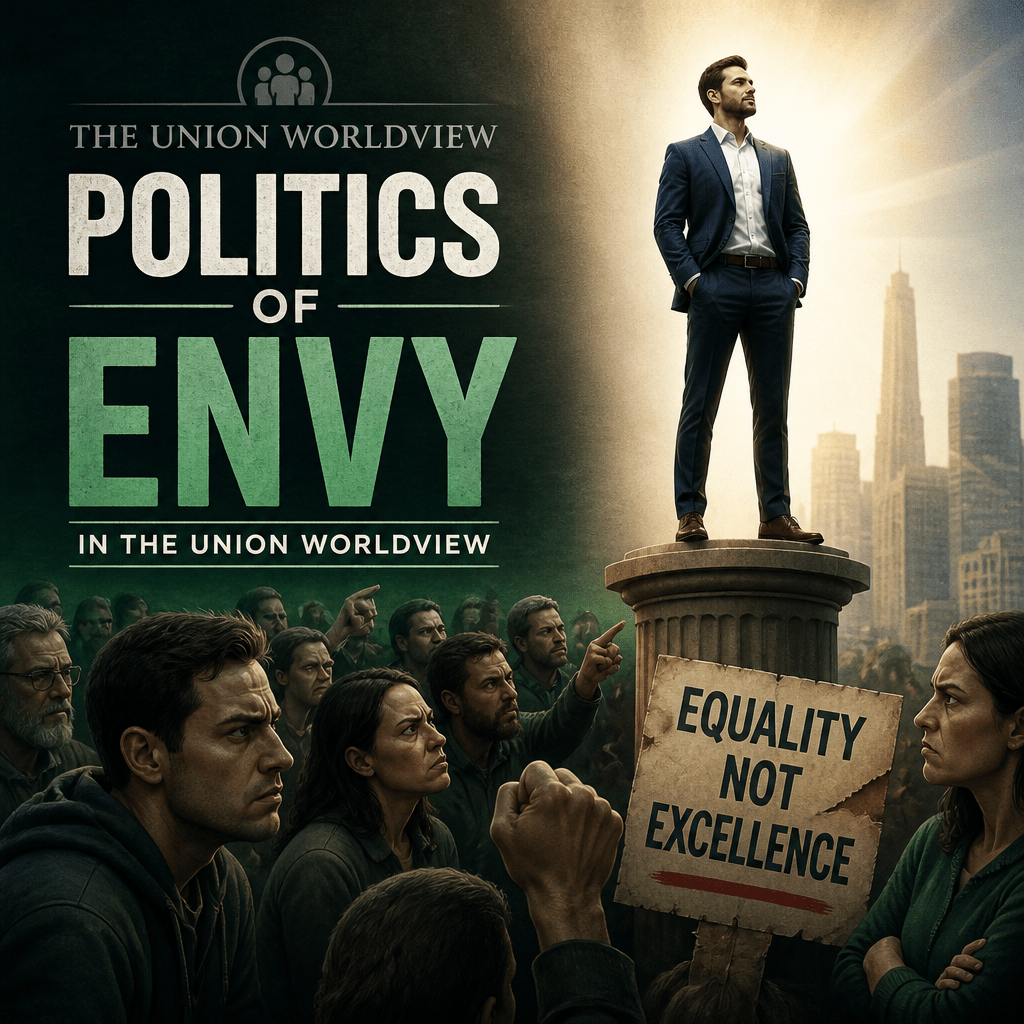
The Politics of Envy
This is where the politics of envy enters the picture.
Envy is not justice. Envy says, “If I cannot have it, no one should.” Merit says, “If you earned it, you deserve it.” Those are fundamentally different moral positions.
A great deal of modern commentary on wealth sounds less like criticism and more like resentment. Success itself is treated as suspicious. If someone earns a great deal of money, people often assume he must have taken it from others. That is not always true, and often it is not true at all.
Wealth can reflect risk, discipline, talent, scale, vision, and innovation. It can be the result of building something that many other people value. According to the U.S. Securities and Exchange Commission’s investor education resources, markets reward value creation. That simple principle explains why compensation can rise when output, responsibility, and impact rise.
If someone builds a company, invents a breakthrough product, creates an industry, or solves a difficult problem at scale, large compensation is not necessarily evidence of greed. It may simply be the market recognizing extraordinary contribution.
Achievement Is Not Exploitation
One of the biggest weaknesses in the union worldview is its tendency to treat success as something that must be morally suspicious.
But not all inequality is injustice.
Different people contribute different things. Some create enormous value. Some take major risks. Some solve problems that affect millions of lives. In a market economy, compensation varies because contribution varies. That is not a flaw in itself; it is part of how exchange works.
Markets do not pay people based on envy. They pay based on what others are willing to exchange for value. That system is not perfect, but it is far better than pretending every person contributes the same amount in the same way.
When people confuse achievement with exploitation, they lose sight of how work, risk, and reward actually function. The old labor story says workers are always trapped. The more realistic story says competence creates options, and options create freedom. Once that becomes clear, it is easier to separate genuine labor concerns from the politics of resentment.
My Own View: Focus Beats Resentment
I have never understood the impulse to resent someone else’s success.
I have spent my life working for every dollar I earned. I never dreamed of being rich. I dreamed of being capable. That distinction matters. Capability gives you leverage. Competence gives you freedom. A useful skill is worth more than a grievance.
When you focus on your own performance, you stop measuring your life against everyone else’s. You stop assuming that another person’s gain is automatically your loss. You stop living inside the politics of envy.
Instead, you build. You improve. You negotiate. You become harder to exploit because you become more valuable.
That is a stronger foundation than dependency on a collective structure. It also creates a healthier kind of ambition: not the urge to tear others down, but the discipline to raise your own standard and meet it.
The Free Worker Is Not a Helpless Worker
The strongest objection to the old union worldview is simple: it underestimates people.
It assumes workers need to be protected from every outcome. It assumes they cannot bargain. It assumes they cannot grow. It assumes they cannot be trusted with their own economic lives.
But a free society depends on the opposite assumption. It depends on adults who can act, decide, negotiate, and accept responsibility for their choices.
That does not mean every employer is fair. It does not mean every workplace is ideal. It does not mean every worker begins with equal leverage. It means the default should be agency, not dependency.
If a worker wants help, the first question should not be whether he is helpless. The first question should be whether he has the freedom and skill to act on his own behalf. That is not anti-worker. It is pro-worker. It respects the worker as a person, not as a client of a system.
Conclusion
The historical role of unions should not be forgotten. They once responded to real abuses and real imbalance. That history deserves acknowledgment.
But the world has changed.
The union worldview often remains frozen in the past, built on fear rather than confidence. It treats workers as vulnerable by nature and success as something to be distrusted. That is why it so often blends into the politics of envy.
A better path is merit, not resentment. Achievement, not comparison. Agency, not dependence.
The man or woman who builds a life through competence does not need to fear exploitation at every turn. He does not need to resent the success of others. He can stand on his own ability and make his own way.
That is the real promise of a free society, and it is why the union worldview deserves to be challenged rather than accepted as common sense.