
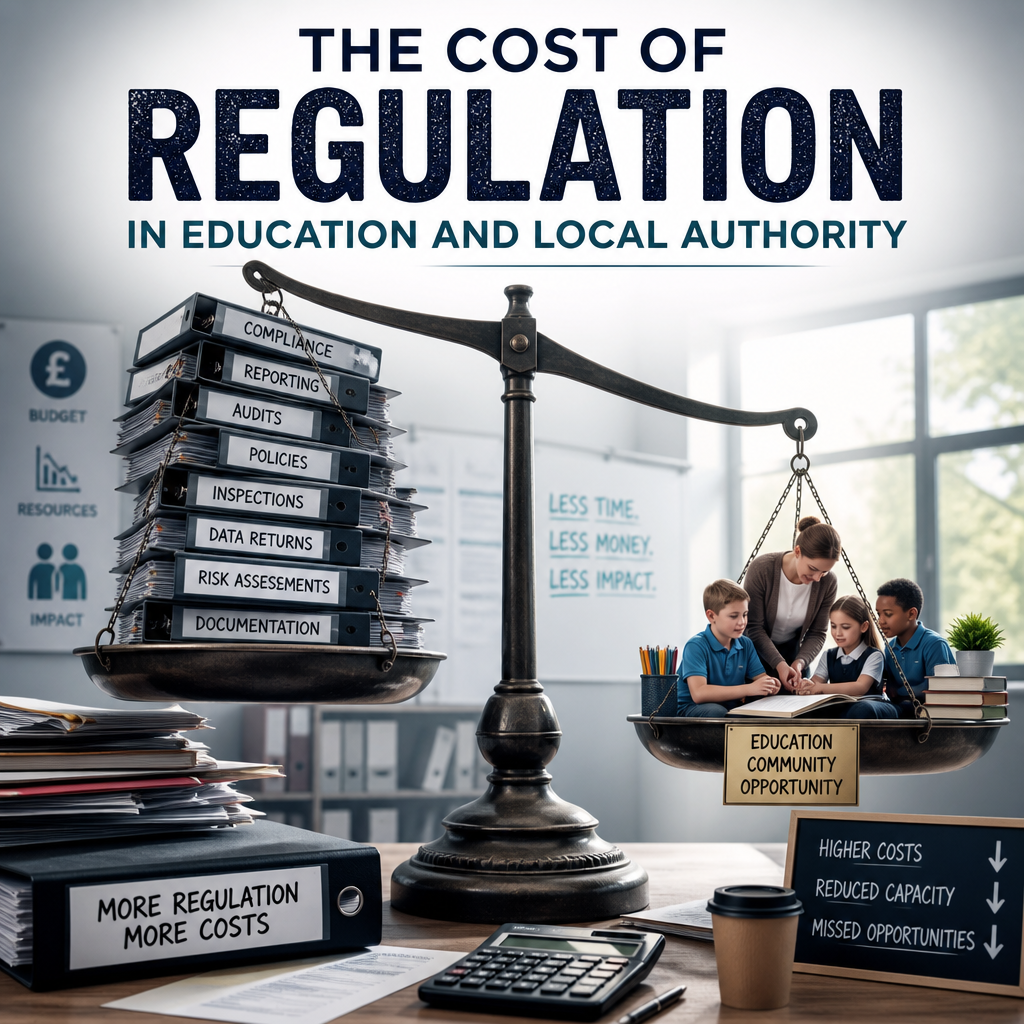
For decades, American schools were shaped by a simple assumption: local communities should guide their own education. That idea changed in the late 1960s, when federal courts, agencies, and compliance systems began stripping districts, principals, teachers, parents, and school boards of the tools they needed to maintain standards.
The result was not merely administrative change. It was a long, structural weakening of school authority. Local authority weakened. Standards fell. Discipline collapsed. And schools lost the power to act like schools.
Table of Contents
- The Real Cost of Regulation
- The Collapse of Standards
- The Collapse of Parental Formation
- Why Teachers Are Leaving
- The Collapse of Trust
- The Remaining Pockets of Strength
- What This Really Means
- Education and the Loss of Local Authority
- Education Regulation and Generational Decline
- Conclusion
The Real Cost of Regulation
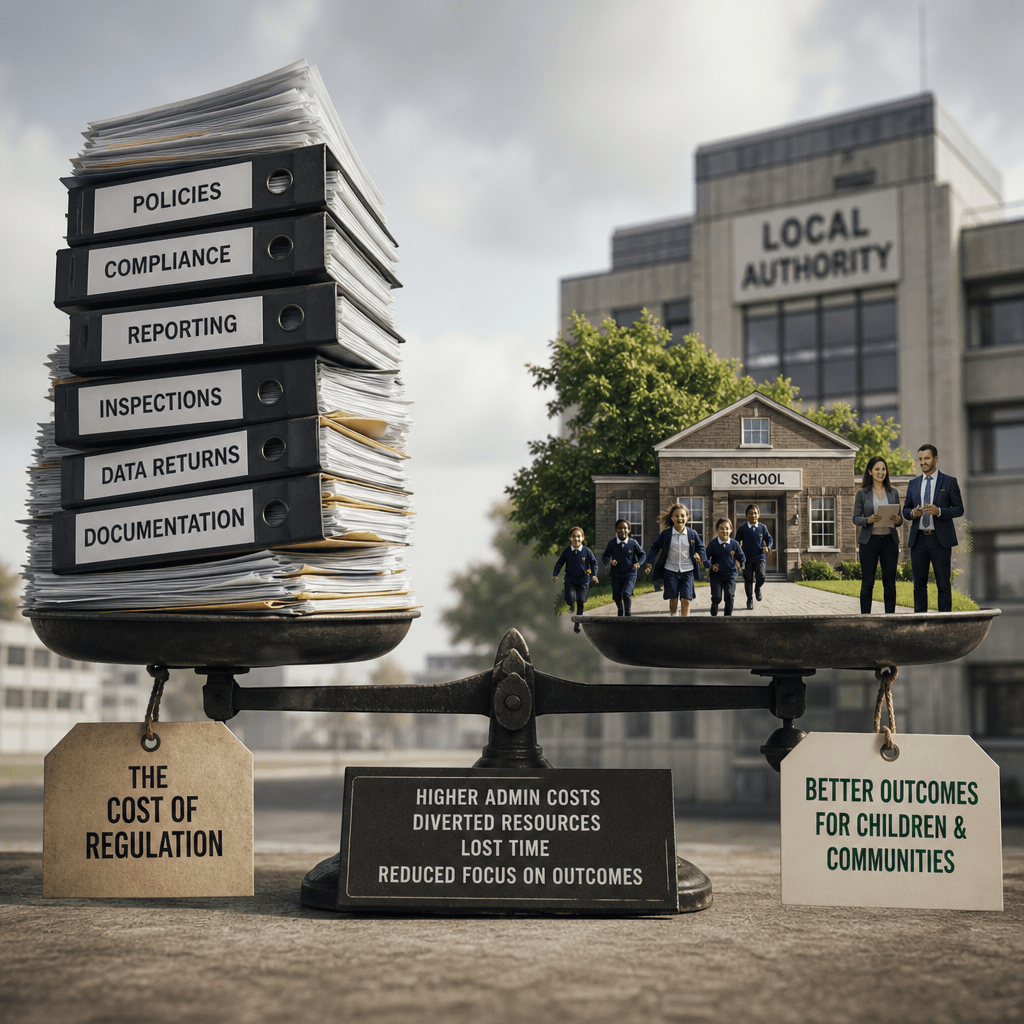
Thomas Sowell often warned that regulation does not come free. It raises costs. It also creates unintended consequences.
In Education, one of the biggest costs was the destruction of local authority. Districts once had the tools they needed to maintain order and standards. They could enforce discipline. They could suspend or expel disruptive students. They could shape curriculum. They could define district boundaries. They could support teacher judgment. They could work closely with parents.
Over time, many of those tools were stripped away. Not all at once and not in one law, but through layers of litigation, administrative rulemaking, and compliance demands that treated local control as a problem rather than a strength.
The message was clear:
- Local authority was suspect
- Adult discipline was risky
- Standards had to be centralized
- Consequences had to be reduced
- Schools had to comply first and lead second
That shift changed everything. Once local communities lost the ability to direct Education, the classroom began to answer more to systems than to people.
For a broader look at how interpretation and trust shape institutions, see Constitutional Interpretation and Public Trust: Why Clarity Matters.
The Collapse of Standards
The first major unintended consequence was the collapse of standards.
You can see it in the frustration many people express about schools today:
- Respect is gone
- Discipline is gone
- Consequences are gone
- Students are not afraid of anyone
- Schools now cater to the worst behavior
- Public schools feel more like subsidized daycare than centers of learning
These complaints are not random. They point to a system where authority has been weakened so much that standards can no longer hold.
Standards do not survive on goodwill alone. They require:
- Consequences
- Enforcement
- Autonomy
- Community backing
When federal regulation removed those supports, schools lost their ability to maintain order.
Even strong suburban districts were not immune. Many had stable families, stable culture, stable economics, and strong norms. For a time, they held up. But eventually, national systems overwhelmed local stability.
The result was predictable. Once authority is removed, culture cannot defend itself. Once culture collapses, standards collapse. Once standards collapse, institutions collapse.
That is why the crisis in Education is not just about test scores or budgets. It is about whether a school can still insist on adult behavior and be obeyed when it does.
The Collapse of Parental Formation
This is where the problem becomes generational.
Today’s parents were formed in the schools that came after the regulatory shift. They grew up in classrooms where:
- Discipline was inconsistent
- Consequences were rare
- Standards were lowered
- Homework was reduced
- Moral formation was removed
- Authority was weakened
That education shaped more than academic performance. It shaped character.
So now many adults:
- Do not respect authority
- Do not know how to enforce discipline
- Do not support teachers
- Do not understand standards
- Do not parent with structure
This is one of the deepest unintended consequences of federal control in Education. When one generation is not formed well, the next generation suffers too.
A collapse in schooling becomes a collapse in parenting. And a collapse in parenting becomes a collapse in citizenship. That is how institutional failure spreads.
It also explains why many reform efforts feel cosmetic. A district can rewrite policies, hire consultants, and publish new frameworks, but if parents were never formed to reinforce order, the school inherits instability at home. The problem is not just what happens in the building; it is what students bring into the building every morning.
In that sense, the crisis is social before it is administrative. Schools are absorbing the effects of a broader breakdown in formation, and Education is carrying a burden it was never designed to carry alone.
Why Teachers Are Leaving
The teacher exodus is one of the clearest signs that the system is breaking down.
Teachers are not just leaving because of workload. They are leaving because they no longer have support.
They face pressure from every direction:
- Students who ignore rules
- Parents who defend misbehavior
- Administrators who fear complaints
- District policies that limit discipline
- Lawsuits and compliance systems that punish firm action
- Social media that turns every conflict into a public attack
Many teachers say the same thing in different ways:
- The good students suffer too
- No one is afraid of anyone
- Admin is afraid of parents
- Parents are afraid of kids
- Kids are afraid of no one
- Phones, social media, and AI have made things worse
The problem is not that students are uniquely bad. The problem is that teachers have been stripped of authority.
They are expected to manage classrooms without real power. They are expected to teach without consequences. They are expected to maintain order without backup.
That is not sustainable, and the consequences are visible in reform efforts like A Revised Reflection on the Department of Education and the Collapse of Formation.
Teachers leave. And when teachers leave, schools become even weaker.
Once that happens, administrators become more cautious, parents become more demanding, and students learn even faster that rules can be negotiated away. The exodus does not just remove adults from the classroom; it removes the last people willing to insist that Education should still mean formation, not just supervision.
The Collapse of Trust
School failure does not stay in school.
Education is the first institution most citizens experience. It shapes how people think about authority, fairness, effort, and community.
When schools stop functioning, trust spreads downward.
Parents lose trust. Students lose trust. Communities lose trust. Future voters lose trust. Future leaders lose trust.
That distrust does not remain local. It becomes national.
Many people now say things like:
- America is declining fast
- A population without critical thinking is easy to control
- The decline is calculated
- The system is breaking on purpose
Whether one agrees with every claim or not, the underlying feeling is real.
People do not trust institutions the way they once did. And schools are a major reason why.
When Education stops producing capable, disciplined, informed citizens, people lose faith in the entire public order.
That loss of trust also connects to civic confidence more broadly, including the arguments made in Election Confidence: Why Trusted Elections Matter More Than Fraud.
For an authoritative overview of school discipline trends and national data, the U.S. Department of Education’s Civil Rights Data Collection is a useful reference: Civil Rights Data Collection.
Trust matters because people notice patterns. When families repeatedly encounter policies that excuse disorder, they begin to assume that institutions will not tell the truth about what is happening. That suspicion can harden into cynicism, and cynicism makes reform harder. In that sense, the damage done to Education spills over into public life far beyond the school walls.
The Remaining Pockets of Strength
There are still places that work.
Some rural communities still maintain:
- Strong discipline
- Traditional moral norms
- High standards
- Teacher authority
- Civic cohesion
- Parent support
These communities survive because national systems reach them less effectively. They still have local habits that protect order.
But they are exceptions. And exceptions are not enough to rebuild the nation.
They prove that strong schools are still possible. They do not reverse the broader trend.
They also reveal what the wider system has lost. Where schools still work, adults still expect responsibility, families still cooperate with teachers, and discipline is treated as a normal part of growing up. That combination is exactly what many large systems have made harder to preserve. So while these communities cannot scale by themselves, they do show that the decline in Education was not inevitable in every place at every moment.
What This Really Means
The story of American Education is not just a story about funding. It is not just a story about technology. It is not just a story about changing family structures.
It is also a story about regulation.
Federal intervention removed local authority. That weakened standards. Weak standards weakened discipline. Weak discipline weakened parents. Weak parents weakened schools. Weak schools weakened trust. And weak trust weakened the country.
That chain matters.
It explains why so many people feel that something has broken.
It explains why teachers are leaving.
It explains why parents are frustrated.
It explains why students are disengaged.
It explains why institutions feel hollow.
For another angle on how authority and formation intersect, see Self-Governing Republic: Stunning Failure of Education.
The deeper issue is that Education is one of the few places where a society can still train habits of self-government at scale. If schools cannot do that, then the rest of public life has to absorb the loss. Courts cannot teach discipline. Agencies cannot create character. Compliance rules cannot replace moral formation. Those things can regulate behavior at the margins, but they cannot produce the internal habits that make a republic work.
That is why the loss of local authority is so consequential. It did not simply alter a few school policies. It changed the relationship between citizens and institutions. It weakened the habits that make freedom sustainable.
Education and the Loss of Local Authority
To understand the modern crisis in Education, it helps to name the pattern plainly: the loss of local authority did not just change who made decisions; it changed what decisions could be made at all. Once districts could no longer rely on local judgment, every serious issue had to be filtered through external rules.
That meant fewer meaningful consequences for repeated misconduct, fewer opportunities for teachers to exercise professional discretion, and fewer ways for families to partner with schools in a real way. The result was a system that looked orderly on paper while becoming less governable in practice.
That is why so many communities experienced the same sequence of decline. First came confusion about authority. Then came weak enforcement. Then came lower expectations. Then came frustration from teachers and parents. In that sense, the cost of regulation was not abstract. It was visible in daily school life.
The more national systems expanded, the harder it became for local communities to preserve their own standards. The more local authority was displaced, the more schools had to depend on centralized procedures instead of character, trust, and leadership.
That pattern also helps explain why some districts held up longer than others. Where family life remained stable and community norms stayed strong, schools resisted decline for a time. But even those places were eventually pulled into the same regulatory logic. The pressure was relentless. And once the authority structure changed, the culture of schooling changed with it.
The practical result was a measurable loss of flexibility. Schools were no longer free to respond to disruption with speed and common sense. They had to manage risk, anticipate complaints, and protect institutions from liability. In that environment, it became easier to avoid consequences than to enforce them.
That is the deeper reason the crisis in Education has proved so difficult to reverse. It is not simply a matter of resources. It is a matter of whether institutions still have the power to expect adult behavior and support it with real authority.
Education Regulation and Generational Decline
The generational problem is just as serious. Children are not born knowing how to respect authority, and adults are not born knowing how to build it. Both are formed. In many cases, the people now raising children were themselves shaped by the very system that weakened standards in the first place.
That means the decline feeds on itself. Students grow up without consistent discipline, become adults without strong formation, and then struggle to give their own children what they never received. This is how Education becomes generationally destructive.
The pattern also helps explain why calls for simple fixes usually fail. More spending does not automatically restore local authority. More technology does not automatically restore discipline. More centralized oversight does not automatically restore trust. If the foundational structure is wrong, adding more of the same will not solve the problem.
To reverse decline, communities would need the freedom to set standards again, the courage to enforce them, and the confidence to back teachers instead of treating them as liabilities. Without that, schools remain trapped in a cycle of compromise.
That cycle has consequences far beyond classrooms. It shapes civic habits, public trust, and even the willingness of adults to believe that institutions can still do hard things well. Once that belief fades, recovery becomes much harder.
The lesson is not that every regulation is harmful in every case. The lesson is that regulation can become self-defeating when it removes the very authority that allows institutions to function. In Education, that happened gradually, then visibly, then almost everywhere.
Conclusion
Thomas Sowell was right. Regulations raise costs. And they create unintended consequences.
In Education, the cost was the destruction of local authority.
The consequences were severe:
- Collapsing standards
- Collapsing discipline
- Collapsing parental formation
- Collapsing teacher retention
- Collapsing institutional trust
The decline was not random. It was regulatory. And it became generational.
The deepest lesson is simple: when local communities lose the authority to uphold standards, Education loses its ability to form citizens.
And when that happens, the damage spreads far beyond the classroom.
That is why the argument matters beyond policy debates. It is not only about schools; it is about whether a self-governing republic can still reproduce the habits it needs to survive. If Education cannot transmit discipline, responsibility, and civic restraint, then every other institution inherits a weaker public.
In the end, the true cost of regulation was not just bureaucracy. It was the slow removal of local authority, followed by the collapse of standards, the erosion of trust, and the loss of the adults schools needed most.