
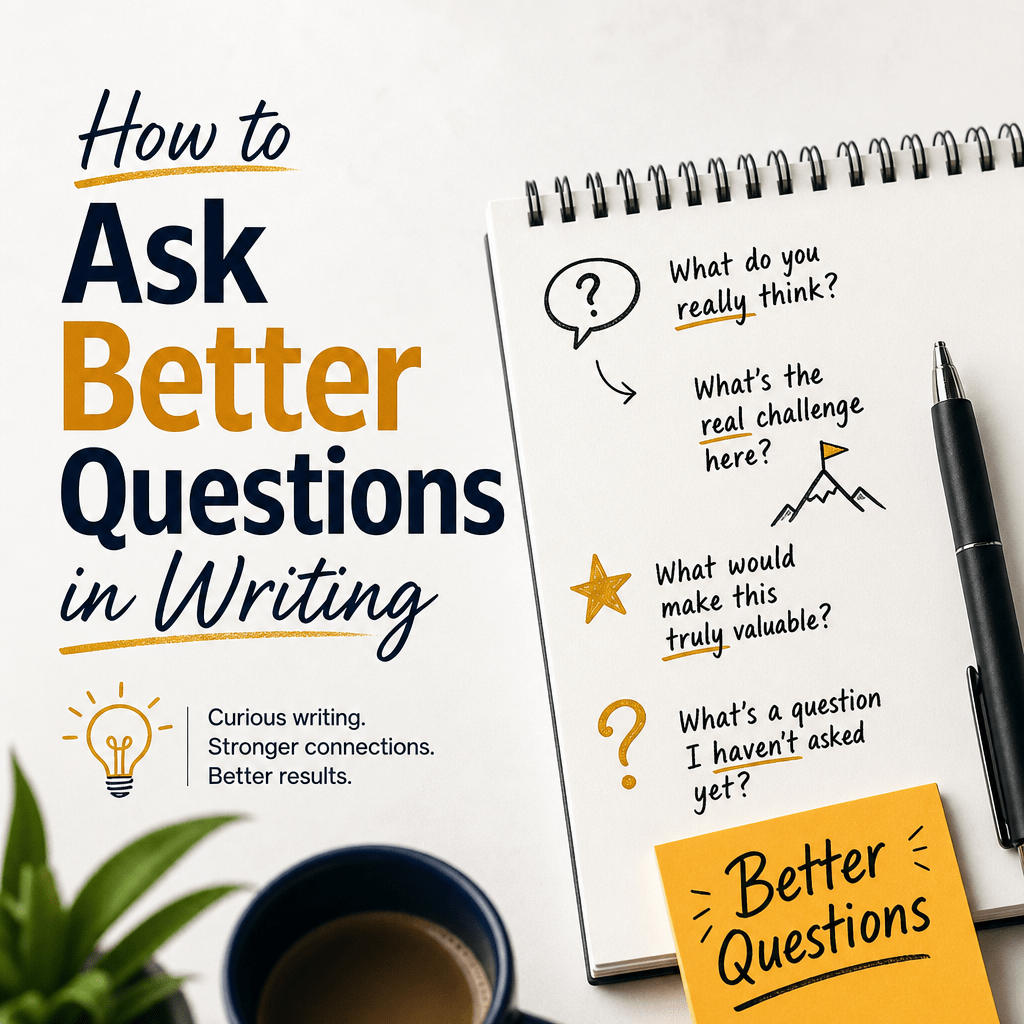
The quality of your life often depends on the quality of your questions. That may sound simple, but it is true in business, learning, leadership, relationships, and everyday decision-making. People who ask Better Questions usually make better choices, see problems more clearly, communicate with more purpose, and arrive at stronger answers.
The good news is that asking Better Questions is a skill. It can be learned, practiced, and improved. And once you develop it, you can use it almost everywhere: at work, at home, in school, and in moments of pressure when a poor choice would be expensive. Better Questions are not just a communication technique. They are a way of thinking more clearly.
Why Better Questions Matter
Many people rush straight to answers. They want quick fixes, fast agreement, and immediate results. But fast answers are not always smart answers.
Better Questions help you:
– Understand the real problem
– Avoid confusion
– Save time and effort
– Make more confident decisions
– Build stronger relationships
– Improve creativity and learning
When you ask a weak question, you often get a weak answer. When you ask a strong question, you open the door to insight.
For example, instead of asking, “Why is this so hard?” ask, “What is making this difficult, and what can I change?” The second question leads to action. The first can lead to frustration or self-pity.
Question quality also shapes your attention. A vague question lets your mind drift. A clear one helps you focus on what matters. That is one reason Better Questions are so useful in planning, coaching, research, and problem-solving.
Questions also affect the tone of a conversation. A person who feels interrogated may become defensive, while a person who feels understood is more likely to speak honestly. That difference matters in teams, families, classrooms, and client work. In many situations, the first step is not to answer quickly, but to clarify what you are really trying to understand.
What Makes a Question Better?
A Better Question is usually clear, specific, and useful.
It does not merely describe a problem. It helps you move forward.
A strong question often has these qualities:
– It is specific, not vague
– It invites useful thinking
– It focuses on what can be changed
– It avoids blame
– It encourages deeper insight
Compare these two questions:
“Why are customers unhappy?”
“What are the top three reasons customers are leaving, and which one can we fix first?”
The second is better because it is focused and actionable.
A useful question also fits the situation. If you are trying to learn, you may need a question that opens explanation. If you are deciding, you may need one that compares options. If you are repairing a relationship, you may need one that invites honesty without defensiveness.
That is why the same skill works in so many areas. The format changes, but the goal stays the same: ask something that creates clarity.
You can think of a question as a tool. A hammer is useful for some jobs, but not all jobs. In the same way, a broad question may be useful for exploration, while a narrow question may be better for decision-making. Choosing the right question at the right time is part of the skill.
When a problem is stated too broadly, break it into smaller pieces. If a project is behind schedule, ask whether the issue is planning, priorities, communication, resources, or unrealistic expectations. If conflict keeps repeating, ask whether the root cause is unclear roles, unmet expectations, or a lack of trust. The more precisely you frame the question, the more useful the answer becomes.
Better Questions Lead to Better Decisions
Every decision starts with a question.
Should I hire this person?
Should I launch this product?
Should I keep this client?
Should I change this process?
If the question is too broad, the decision becomes harder. Better Questions narrow the focus.
Before making an important decision, ask:
– What problem am I trying to solve?
– What does success look like?
– What are the risks?
– What options do I have?
– What will matter most in six months?
These questions help you think clearly. They reduce emotional reactions and keep you from solving the wrong problem.
Good decision-making often depends on separating symptoms from causes. A drop in sales is a symptom. The cause might be poor positioning, weak follow-up, pricing issues, or a market shift. Better Questions help you move beyond the symptom and closer to the real issue.
That is one reason this habit matters so much in leadership. Leaders often must decide with incomplete information. When they ask Better Questions, they reduce guesswork and reach the heart of the matter faster.
It also helps to ask what decision actually needs to be made. Sometimes people spend too long debating something overly large or abstract. Breaking it into smaller decisions makes progress easier. Instead of asking, “Should we overhaul the whole workflow?” you might ask, “Which step slows us down the most, and what change would test an improvement fastest?”
Once you start thinking this way, you notice that many bad decisions come from weak framing. The wrong question leads to the wrong solution. The right question often reveals that the answer was already available.
Better Questions Improve Communication
Good communication is not only about speaking well. It is also about asking well.
In conversations, Better Questions show interest and respect. They help people open up. They also reduce misunderstandings.
Instead of asking:
“Did you finish it?”
Try:
“What progress have you made, and what support do you need?”
Instead of asking:
“Why didn’t this work?”
Try:
“What happened, and what did we learn?”
These small changes matter. They move a conversation from pressure to problem-solving.
Better Questions also make listening easier. When you ask with curiosity, you are less likely to interrupt with assumptions. You create room for another person’s perspective. That matters in disagreements, interviews, coaching, mentoring, and team meetings.
A good follow-up question can be just as valuable as the first one. If someone gives a short answer, ask for an example. If they describe a problem, ask what they have already tried. If they share a concern, ask what would help them feel more confident.
In conflict, a good question can lower the temperature. “What do you need from me right now?” is often more constructive than “Why are you upset?” The first invites clarity and action. The second can sound like a challenge.
In personal relationships, asking well builds trust over time. People remember when they are genuinely heard. They also notice when questions are asked only to prove a point. Curiosity, not control, is what makes a conversation feel safe.
Better Questions at Work
In the workplace, Better Questions can improve teamwork, leadership, and performance.
Managers can use them to guide teams:
– What outcome are we trying to achieve?
– What is blocking progress?
– What is the simplest next step?
– How will we measure success?
– What did we learn from this?
Employees can use them too:
– What is the most important task right now?
– What would make this work more effective?
– What skill do I need to build?
– Where am I wasting time?
Better Questions create better work habits. They help people think like problem-solvers instead of just task-completers.
They are also valuable in meetings. A meeting can drift when no one asks the right question. A strong question can bring it back on track. For example, “What decision do we need to make today?” is often more useful than a long discussion that never ends in action.
In larger organizations, good questions can reveal process problems early. They can expose gaps in training, unclear ownership, or communication failures before those issues become expensive. A few precise questions can save hours of correction later.
Better Questions also support hiring and feedback. During interviews, open-ended questions can reveal how a candidate thinks, solves problems, and handles pressure. In performance reviews, thoughtful questions can move the conversation beyond criticism and toward growth.
For example, instead of only saying, “You need to do better,” a manager might ask, “What is getting in the way of stronger results, and what support would help?” That approach is still direct, but it is more likely to lead to improvement.
Better Questions for Learning
Students and lifelong learners benefit from Better Questions because questions drive understanding.
Instead of memorizing facts only, ask:
– Why does this work?
– How does this connect to what I already know?
– Can I explain this in simple words?
– What is the real meaning behind this idea?
– Where could I use this in real life?
These questions deepen learning. They help information stick, and they make study time more effective.
This is one reason active learning works so well. When you generate questions instead of only repeating answers, your mind has to organize the material. That process strengthens recall and understanding.
Good learners also ask diagnostic questions when they get stuck:
– What do I understand already?
– What part is confusing?
– Which example makes the concept clearer?
– What would happen if I changed one variable?
– How can I test my understanding?
That shift turns learning from passive reading into active discovery.
Questions are also useful for retention. If you want to remember what you read, turn a heading into a question and answer it in your own words. If you want to prepare for a test, ask what you would need to explain to someone else. If you want to master a new skill, ask which part needs repetition and which part needs deeper study.
Better Questions in Personal Life
Better Questions are useful outside of work too. They can improve habits, health, relationships, and mindset.
For example:
– What is one small step I can take today?
– What is draining my energy?
– What is worth my attention right now?
– What am I avoiding, and why?
– What would progress look like this week?
These questions help you reflect without getting stuck. They turn vague stress into clear action.
Personal questions work best when they are honest and realistic. “Why am I like this?” can feel heavy and unhelpful. “What pattern keeps repeating here, and how do I interrupt it?” is more likely to lead somewhere useful.
Better Questions can also help with routines and time management. If a habit is not working, ask what part is hard to sustain. If you feel overwhelmed, ask what can be removed. If a relationship feels tense, ask what needs to be said clearly and respectfully.
Small questions often create small actions, and small actions create steady change. That is why this skill is so practical. The questions you ask yourself shape the mood you carry and the choices you make.
How to Start Asking Better Questions
You do not need a perfect system. You just need to slow down and think before you ask.
Try these simple habits:
1. Be more specific
2. Ask open-ended questions
3. Remove blame
4. Look for action
5. Keep asking
A practical way to build the habit is to pause before speaking and ask yourself, “What do I really need to know?” That pause can change the entire conversation.
You can also improve your questions by rewriting them before you speak. Replace broad words with concrete ones. Replace blame with curiosity. Replace assumptions with evidence.
A few useful question stems:
– What is really happening here?
– What is the smallest useful next step?
– What assumption am I making?
– What would I do if I were not afraid?
– What evidence would change my mind?
These are not magic phrases. They are reminders to slow down, sharpen your thinking, and avoid jumping too quickly to the first answer.
A Simple Rule to Remember
If you want better answers, ask Better Questions.
That rule works because questions shape attention. They define the problem, guide the search for solutions, and influence the tone of a conversation.
So before reacting, pause and ask:
– Is this the right question?
– Is it clear enough?
– Will it lead to useful action?
If not, improve it.
Final Thought
Better Questions do more than get better answers. They improve thinking.
They help you lead with clarity, learn with purpose, and communicate with more impact. They also make your decisions stronger and your conversations more meaningful.
In a noisy world, the ability to ask Better Questions is a real advantage.
Start small. Choose one question today and make it clearer, sharper, and more useful. That one change can lead to better results than you expect.
As you practice, you will notice something important: the right question often opens the right door. It can reduce confusion, uncover solutions, and move people toward action. Once you begin to rely on Better Questions, you may find that many of the answers you needed were waiting just beyond a better frame.
That is the quiet power of asking well.