
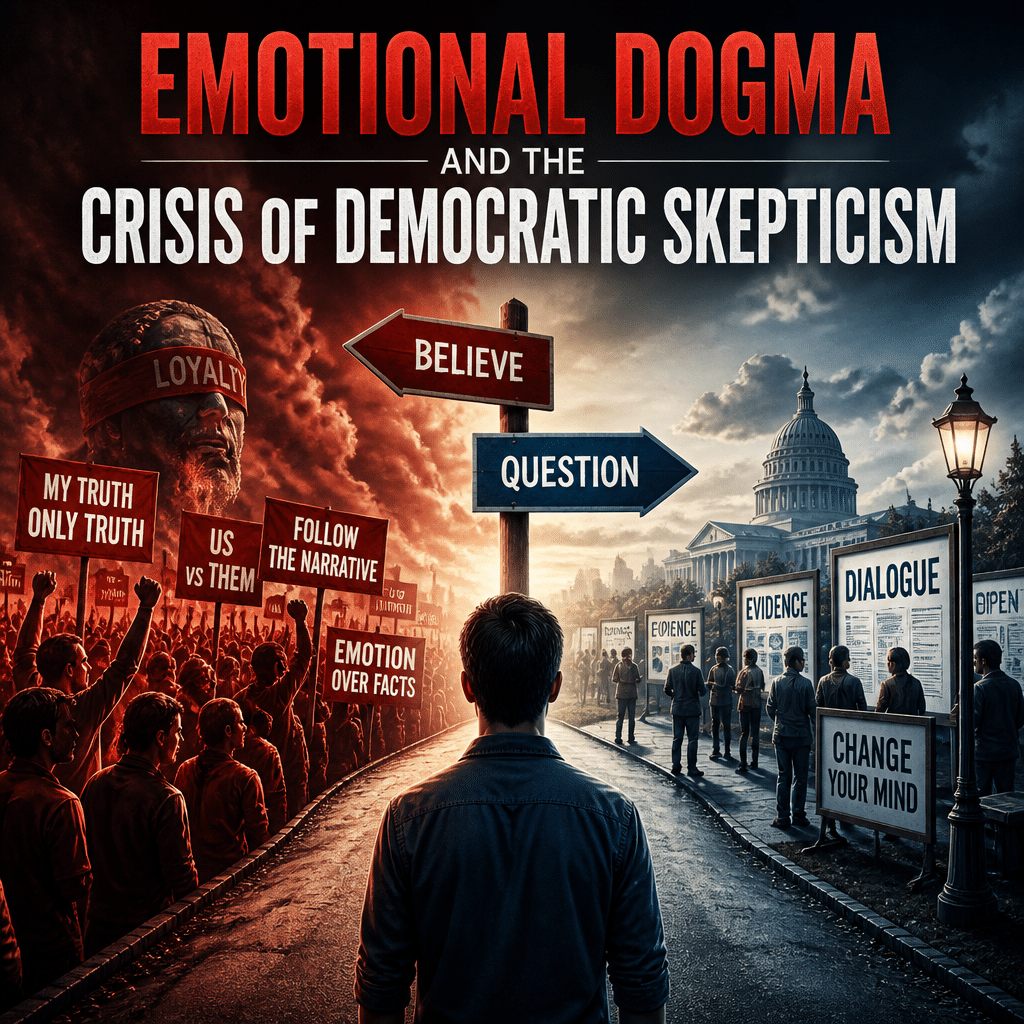
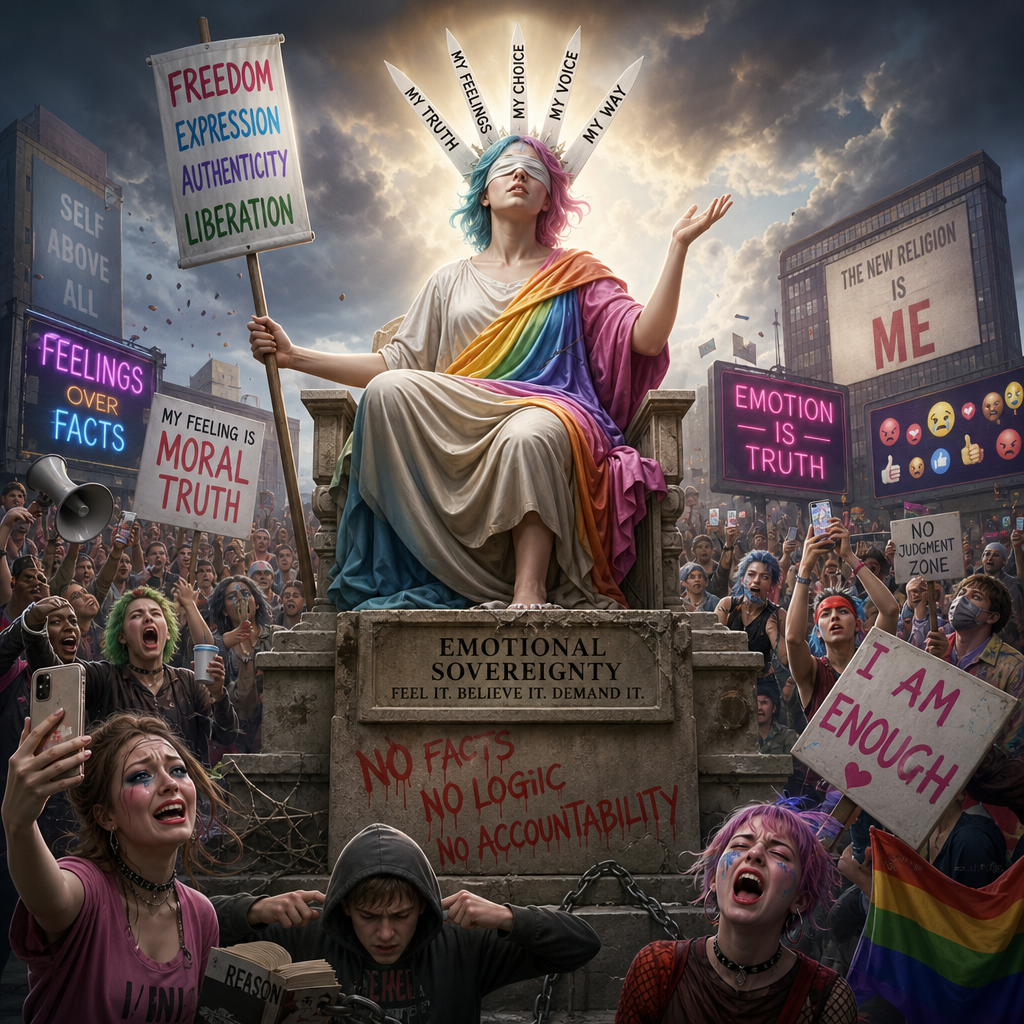
Modern democratic culture presents itself as liberation: a celebration of autonomy, expression, and personal authenticity. Yet the phrase Emotional Dogma describes a deeper problem beneath that rhetoric. Feelings are increasingly treated as final moral evidence, while impulse is mistaken for courage and outrage is mistaken for clarity. A healthy republic cannot be governed by emotional release alone. It needs citizens who can distinguish conviction from reaction, compassion from surrender, and genuine freedom from expressive chaos.
When Feeling Replaces ThoughtBetter Questions: Stunning Best Decision Guide
Healthy democracies need disagreement. They need debate, testing, and restraint. They need citizens who can defend an idea without worshipping their own mood. Public judgment becomes unreliable when people evaluate claims primarily by the intensity of the speaker’s emotion rather than by evidence, logic, or consequences. Emotional Dogma weakens this essential distinction between passionate advocacy and sound reasoning.
In too many places, freedom has been confused with emotional release. The louder the reaction, the more authentic it appears. The more volatile the response, the more sincere it seems. This is how Emotional Dogma spreads: raw feeling becomes a system of belief, and the expression of that feeling becomes a demand that others affirm it.
The result is a political culture in which emotional expression substitutes for civic reasoning. Under Emotional Dogma, claims are judged by tone instead of evidence, political identity matters more than logic, and anger is mistaken for moral seriousness. Certainty is rewarded even when it is unfounded. The citizen is encouraged to feel strongly rather than think carefully.
- Claims are judged by tone, not evidence.
- Political identity matters more than logic.
- Anger is mistaken for moral seriousness.
- Certainty is rewarded even when it is unfounded.
None of this means emotion has no place in public life. Moral concern often begins as an emotional response to suffering or injustice. Courage can include passionate speech. Empathy can motivate people to protect the vulnerable. A critique of Emotional Dogma does not deny these legitimate roles. The problem arises when emotion is treated as self-validating—when the presence of a feeling is presented as proof that a conclusion must be true.
Thoughtful citizens can acknowledge emotion without allowing it to become a substitute for judgment. They can ask what produced a reaction, whether the reaction fits the facts, and what policy would follow if every similar feeling received equal authority. By asking those questions, citizens resist Emotional Dogma and introduce the restraint that democratic life requires.

Why Skepticism Matters
Skepticism is the natural antidote to this disorder. Against Emotional Dogma, it offers a disciplined willingness to test claims before granting them authority. It is not cynicism, indifference, or an automatic refusal to believe anything.
It asks for structure, evidence, coherence, consistency, and claims that can be examined against reality. It does not worship emotion. It tests assertion. It does not confuse confidence with truth. It demands reasons, and that discipline exposes Emotional Dogma to standards beyond personal intensity.
That is why Emotional Dogma finds skepticism so threatening. If feelings are treated as sacred, then questioning them feels like an attack on the person who experiences them. A request for evidence can be interpreted as hostility. A distinction between intention and consequence can be treated as cruelty. A refusal to affirm an emotional interpretation can be described as moral failure.
Yet questioning is not the same as contempt. A skeptical citizen can take suffering seriously while still asking whether a proposed remedy will work. The same citizen can respect someone’s sincerity while disputing the accuracy of that person’s conclusions. This separation between emotional seriousness and intellectual agreement is an effective answer to Emotional Dogma and is essential to civil discourse.
The Stanford Encyclopedia of Philosophy’s overview of skepticism helps clarify that skepticism concerns the justification of belief, not the performance of coldness or hostility. In civic life, that discipline means asking how we know, what would change our minds, and whether the evidence supports the confidence being expressed.
Healthy skepticism also protects people from manipulation. Emotional Dogma relies on audiences reacting before they investigate, a tendency that political movements, media organizations, and public figures can exploit. A dramatic image, a frightening prediction, or an indignation-driven slogan can create a sense of urgency that bypasses careful evaluation. Skepticism slows the process long enough for citizens to identify assumptions and compare claims with facts.
The Rise of Identity Over Argument
One of the clearest signs of emotional decay in politics is the inability to deconstruct arguments. Emotional Dogma turns too many conversations from exchanges between people seeking truth into contests between identities seeking recognition and protection.
You may not be facing a person who wants to reason with you. You may be facing an identity-defender whose beliefs are held because they protect a particular self-image. In that situation, evidence can feel less like information and more like a threat. Changing one’s mind may appear to require the loss of status, belonging, or moral innocence.
This is why Emotional Dogma is so difficult to challenge. It is not built primarily on reasons, so reasons do not reach it in the ordinary way. The argument may function as a badge of loyalty rather than as a proposition open to examination. When that happens, a factual correction is experienced as humiliation, and disagreement becomes a test of group membership.
Identity naturally matters. People have histories, loyalties, communities, and principles that shape their political judgment. The danger is not identity itself but the elevation of identity above truth. Emotional Dogma becomes especially powerful once belonging matters more than accuracy, because even obvious contradictions can be defended to avoid betraying the group.
Reasoned conversation therefore needs a distinction between a person and a proposition. To resist Emotional Dogma, citizens must recognize that criticizing an argument is not necessarily criticizing the person who made it. Rejecting a policy does not prove that its supporters are malicious. A mature civic culture makes room for people to revise their claims without treating revision as disgrace.
That requires intellectual humility. Citizens must be able to say that they were mistaken, that a source was unreliable, or that a policy produced an unintended result. Without that capacity, public debate becomes a ritual of self-defense. People stop asking whether an idea works and start asking whether the idea signals the correct allegiance.
The Paradox of “Critical Thinking” Culture
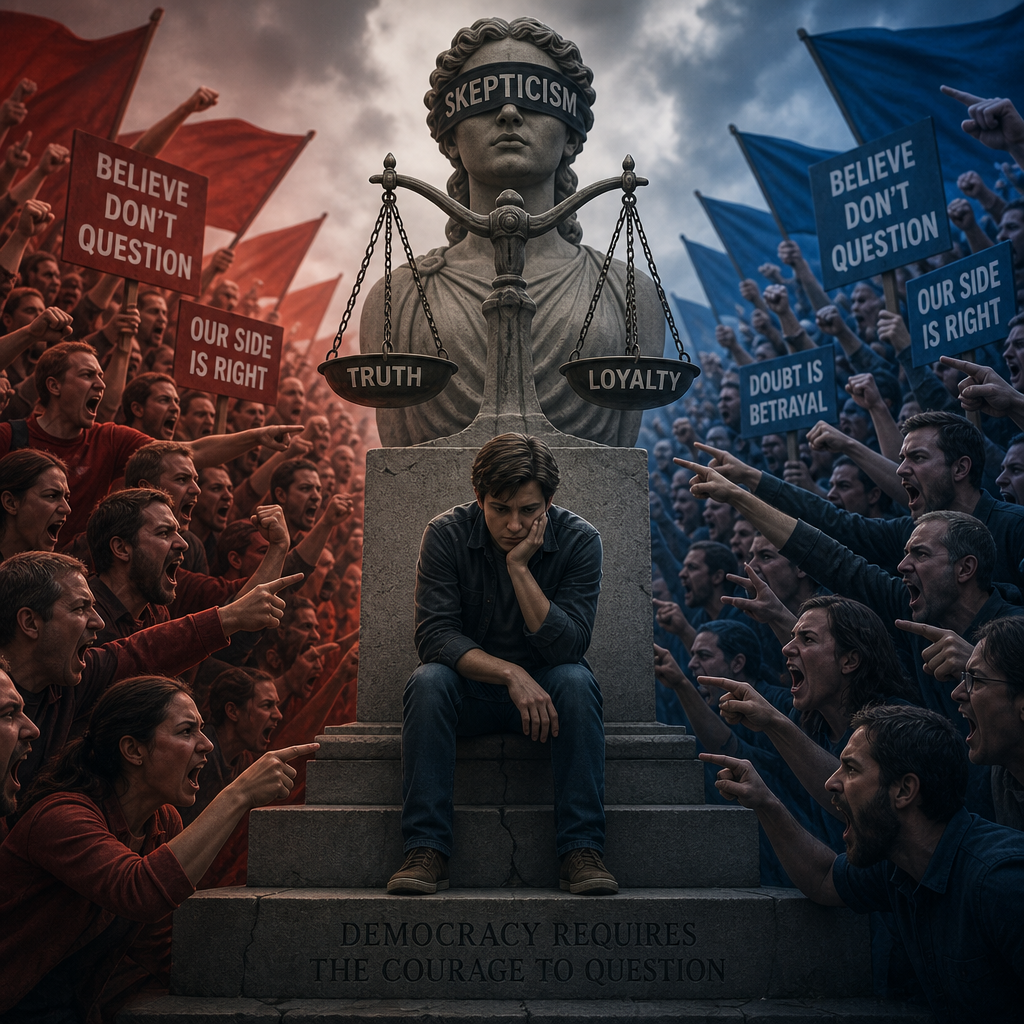
Modern political actors often claim to value critical thinking. They use the language of questioning, doubt, and openness. Yet Emotional Dogma can hide behind that language when skepticism is welcomed only against opponents and pre-approved conclusions remain protected.
This is a common pattern:
- They borrow the vocabulary of skepticism.
- They enforce a narrow moral script.
- They label dissent as ignorance or malice.
- They call conformity “open-mindedness.”
This is not genuine skepticism. It is credentialed orthodoxy. It looks intellectual from a distance, but it behaves like doctrine. Questions are welcomed only when they lead to approved answers, while inconvenient evidence is dismissed as biased before it can be considered. That selective inquiry gives Emotional Dogma an appearance of intellectual legitimacy.
This version of Emotional Dogma is particularly deceptive because it dresses itself as inquiry while punishing real inquiry. Its practitioners may speak constantly about evidence, yet apply different standards to evidence that supports their side and evidence that challenges it. They may demand nuance from opponents while accepting slogans from allies.
A useful test is symmetry. Testing Emotional Dogma requires asking whether the same standard would be applied if the political positions were reversed. Would the same language be considered responsible if it came from an opposing group? Would the same source be trusted if it produced an unwelcome conclusion? These questions do not settle every dispute, but they expose double standards.
Critical thinking also requires a willingness to identify the limits of one’s knowledge. A citizen does not need an opinion on every issue immediately. It is legitimate to say that the evidence is incomplete, that competing explanations remain possible, or that a proposed solution deserves more examination. Public pressure to display instant certainty encourages performance rather than understanding.
Why People Crave Steadiness
In a culture of emotional turbulence, people naturally gravitate toward steadiness. Emotional Dogma makes grounded leadership more valuable because citizens tire of constant outrage and instability. They trust people who appear to stand where they stand and stay there.
When Emotional Dogma dominates public life, consistency feels like sanity. This does not mean rigidity is always virtuous. It means that constant volatility is exhausting, and people sense that a society cannot be governed by mood swings. Civic life needs something firmer than reaction.
Steadiness is not the same as silence. A steady person can speak forcefully, criticize injustice, and defend a principle under pressure. The alternative to Emotional Dogma is not passivity but intensity governed by a standard outside the immediate emotion. The goal is not to eliminate passion but to prevent passion from becoming the only measure of truth.
Institutions also need steadiness. Institutions vulnerable to Emotional Dogma may change rules merely because a crowd becomes angry, a news cycle becomes dramatic, or a prominent figure demands immediate action. Laws and policies can be revised, but revision should follow deliberation, evidence, and a clear account of the public interest.
Citizens can encourage institutional steadiness by rewarding patience and consistency. They can resist the temptation to treat every controversy as an existential emergency. They can distinguish genuine crises from manufactured urgency. This does not make them passive; it makes their responses proportionate.
Ordered Liberty Versus Expressive Chaos
The language of modern freedom often implies that liberty means doing what one feels. Emotional Dogma exploits this shallow version of freedom by treating impulse as autonomy. Real freedom requires order because people can exercise meaningful choices only within conditions that protect rights, responsibility, and social trust.
The danger of Emotional Dogma is that it turns freedom into theatrical self-expression while quietly eroding the habits that make democracy possible. If every impulse is described as authentic, then self-control appears oppressive. If every limit is described as violence, then responsibility becomes impossible. If every disagreement is described as invalidation, then shared standards disappear.
Ordered liberty means:
- Rights accompanied by responsibilities.
- Speech accompanied by accountability.
- Passion guided by discipline.
- Individual expression within a shared civic framework.
- Political power constrained by law.
- Majority rule balanced by protections for minorities and dissenters.
Without order, liberty collapses into noise. Without principle, freedom becomes a costume for impulse. Emotional Dogma cannot provide the stable boundaries that meaningful liberty requires. A constitutional system is valuable precisely because it places limits around power and gives citizens procedures for resolving conflict without constant appeals to force or emotional intensity.
Ordered liberty does not demand that everyone think alike. It creates a structure in which disagreement can continue without destroying the community. People may hold different religious, philosophical, and political commitments while still accepting basic rules for evidence, debate, and lawful action.
This is also why restraint matters. The ability to delay expression, verify a claim, and choose words carefully is not cowardice. It is a form of civic strength. Restraint before expression allows citizens to pause before public reaction and can protect both truth and relationships.
The Restorationist Answer
If civic life is being hollowed out by emotional excess, the answer is not more theatrics. It is restoration. The Restorationist answer to Emotional Dogma begins with a simple commitment: re-anchor public life in disciplined skepticism.
Overcoming Emotional Dogma means replacing reaction with reflection, slogans with arguments, performative outrage with honest analysis, and emotional validation with intellectual accountability. It also means restoring freedom to its proper meaning—not chaos, impulse, or moralized volatility, but ordered liberty.
A restoration project would not require citizens to become detached from moral concerns. It would ask them to express those concerns in ways that can be evaluated and acted upon. Compassion should inform policy, but policy must still be tested. Anger may expose a real wrong, but anger alone cannot determine the proper remedy.
Restoration also requires recovering the difference between authority and domination. A republic needs legitimate standards that stand above private appetite, partisan convenience, and temporary public excitement. The goal is not to give one faction unlimited power. It is to place every faction under principles that can restrain abuse.
That perspective connects with the broader argument in Foundations of the State and the Mind, where political order is treated not merely as an arrangement of institutions but also as a reflection of how citizens understand human nature, authority, and self-government.
Restoration is therefore both institutional and personal. Institutions need lawful boundaries, transparent procedures, and consistent standards. Individuals need habits of attention, honesty, patience, and self-command. Neither level can substitute for the other.
What Skepticism Restores
When skepticism returns to public life, several practical goods become possible again. A culture less governed by Emotional Dogma can recover clarity, stability, responsibility, trust, civil discourse, intellectual humility, and correctability.
1. Clarity
False claims can be challenged, and manipulation becomes easier to detect. Clarity does not mean that every question becomes simple. It means that participants distinguish facts from interpretations, preferences from principles, and predictions from guarantees.
2. Stability
People stop mistaking every emotional surge for a crisis. Leaders gain room to make proportionate decisions instead of responding to each new controversy as if it were the final test of the nation’s character.
3. Responsibility
Words and ideas are judged by their consequences, not merely by their theatrical appeal. Citizens become more careful about repeating accusations, exaggerating threats, or demanding policies that sound satisfying but create additional harm.
4. Trust
Institutions become more credible when they reward evidence instead of emotional conformity. Trust does not require universal agreement. It requires confidence that procedures are being applied fairly and that mistakes can be acknowledged and corrected.
5. Civil Discourse
Disagreement becomes less personal and more productive. People can criticize a claim without assigning an evil motive to everyone who holds it. They can defend a principle while recognizing that opponents may be acting from sincere, if mistaken, judgments.
6. Intellectual Humility
Citizens become more willing to acknowledge uncertainty. This is not weakness. It is an accurate response to the complexity of public policy, where outcomes are often shaped by competing causes and unintended effects.
7. Correctability
A skeptical culture can change course. It does not need to defend every previous statement or policy simply because a favored group made it. The ability to correct errors is one of the strongest signs that a political community values truth over pride.
These are not abstract virtues. They are practical foundations of a functioning republic. They allow disagreement to remain energetic without becoming destructive.
The Core Problem With Emotional Dogma
At its root, Emotional Dogma is dangerous because it removes correction. If every feeling is treated as valid truth, then nothing can be tested. If every outrage is treated as proof, then nothing can be weighed. If every dissenting voice is treated as immoral, then debate disappears.
Under Emotional Dogma, a democracy may still produce noise, slogans, and rituals of participation, but it cannot reliably produce wisdom. A democracy without debate is brittle. Wisdom requires the possibility of being challenged, learning from consequences, and revising a judgment in light of better evidence.
The problem is especially severe when emotional certainty is combined with institutional power. A private feeling may harm only the person who experiences it. A public decision based on unchecked feeling can affect millions of people. The larger the power, the greater the need for procedures that slow reaction and expose assumptions.
Correction is not humiliation. It is how a community protects itself from error. A citizen who changes an opinion after discovering better evidence has not necessarily betrayed a cause. A lawmaker who revises a policy after observing harmful effects has not necessarily abandoned principle. In both cases, correction can be evidence of seriousness.
Recognizing the Pattern in Everyday Politics
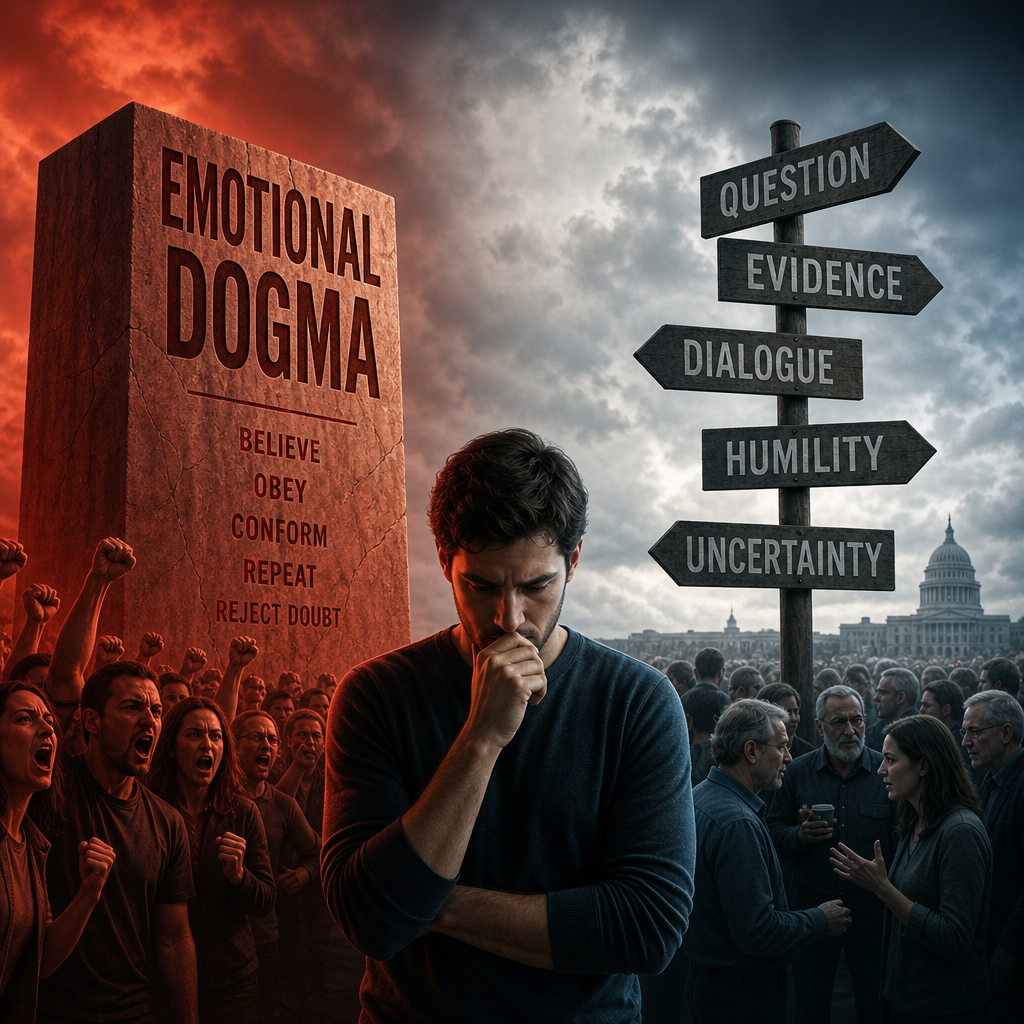
Recognizing Emotional Dogma does not require dismissing every emotional argument. It requires noticing when emotional force is being used as a replacement for justification.
Several warning signs are useful. First, watch for claims that cannot be questioned without assigning malicious motives to the questioner. Second, notice when a speaker treats personal offense as proof that another person’s statement is false. Third, look for arguments that change standards depending on which group benefits. Fourth, ask whether the proposed solution addresses the stated problem or simply provides a satisfying outlet for anger.
Another warning sign is the refusal to distinguish levels of confidence. A person may be certain that a problem exists while remaining uncertain about its cause. They may recognize harm without knowing which remedy will work. They may believe a policy is worth trying without claiming that it will produce perfect results. This kind of calibrated judgment is more reliable than absolute declarations.
Readers can apply these tests to their own side as well as to political opponents. Self-scrutiny is what separates skepticism from partisan suspicion. If a standard is useful only against other people, it is probably not a standard at all.
A Better Civic Culture
Moving beyond Emotional Dogma requires a different set of habits. A healthier political culture would honor people who think before they react, question without performing, argue without hysteria, change their minds when evidence demands it, and remain steady under pressure.
These habits are not cold. They are mature. They do not deny emotion; they place emotion in its proper role. Feeling can alert us to a concern, but judgment must determine whether the concern is justified and what should be done about it.
Families, schools, workplaces, and civic organizations can help cultivate these habits by rewarding thoughtful disagreement. Instead of praising the fastest response, they can praise the most accurate one. Instead of treating confidence as competence, they can ask people to explain their reasoning. Instead of making every mistake permanent, they can create room for correction.
Media consumers also have responsibilities. They can read beyond headlines, compare primary sources with commentary, and resist sharing material designed mainly to provoke. They can ask who benefits from their immediate anger and whether the information would still persuade them if presented by an opposing group.
Political leaders have an even greater duty. Leaders should lower unnecessary temperature rather than constantly intensify it. They should acknowledge limits, explain trade-offs, and avoid turning every disagreement into a moral emergency. A leader who can remain firm without becoming theatrical offers citizens a model of ordered freedom.
The goal is not a society without conflict. Conflict is unavoidable where people hold different values and interests. The goal is a society capable of processing conflict without allowing every dispute to become a struggle over personal worth.
Conclusion: Skepticism Restores the Republic
Dogma thrives in emotional anarchy. It grows when feeling is exalted above thought and identity is protected above truth. It spreads when outrage becomes virtue and volatility becomes authenticity.
But this pattern is not inevitable. Skepticism can interrupt it. Skepticism brings structure, demands evidence, dissolves illusion, and refuses to worship emotion as truth. By doing so, it restores the conditions for civic life.
Emotional Dogma must be confronted, not celebrated, because a republic cannot remain free if its citizens surrender judgment to every passing reaction. Democracy needs expression, but it also needs restraint. It needs passion, but it also needs proportion. It needs conviction, but it also needs the humility to test conviction against reality.
If democracy is to survive as more than performance, it must recover discipline, coherence, and the courage to question. Citizens must be willing to defend principles without turning those principles into excuses for cruelty. They must be willing to hear criticism without interpreting every challenge as an attack on their existence.
That is why skepticism matters. It does not destroy moral seriousness; it protects moral seriousness from manipulation. It does not eliminate emotion; it keeps emotion from becoming an unchecked political authority. It does not weaken freedom; it gives freedom the order required for lasting self-government.
Dogma thrives in emotional anarchy. Skepticism restores the Republic.
Further Reading of Similar Topics:
“Tyranny from below” — freedom becomes a weapon when a society loses its moral grammar, and the answer is restoration of responsibility, restraint, duty, and consequences.
“A Restorationist Essay: The Tower Built on Sand” — The Shift From Citizens to Categories. The Founders built a republic on a simple premise: Representation flows from individual citizens, not demographic blocs.
https://rambling-musings.space/a-restorationist-critique-of-substantive-due-process/ — Substantive due process is the most dramatic example of what the Restorationist framework calls interpretive drift: the quiet migration of judicial power from adjudicating law to manufacturing it.
Leave a Reply