
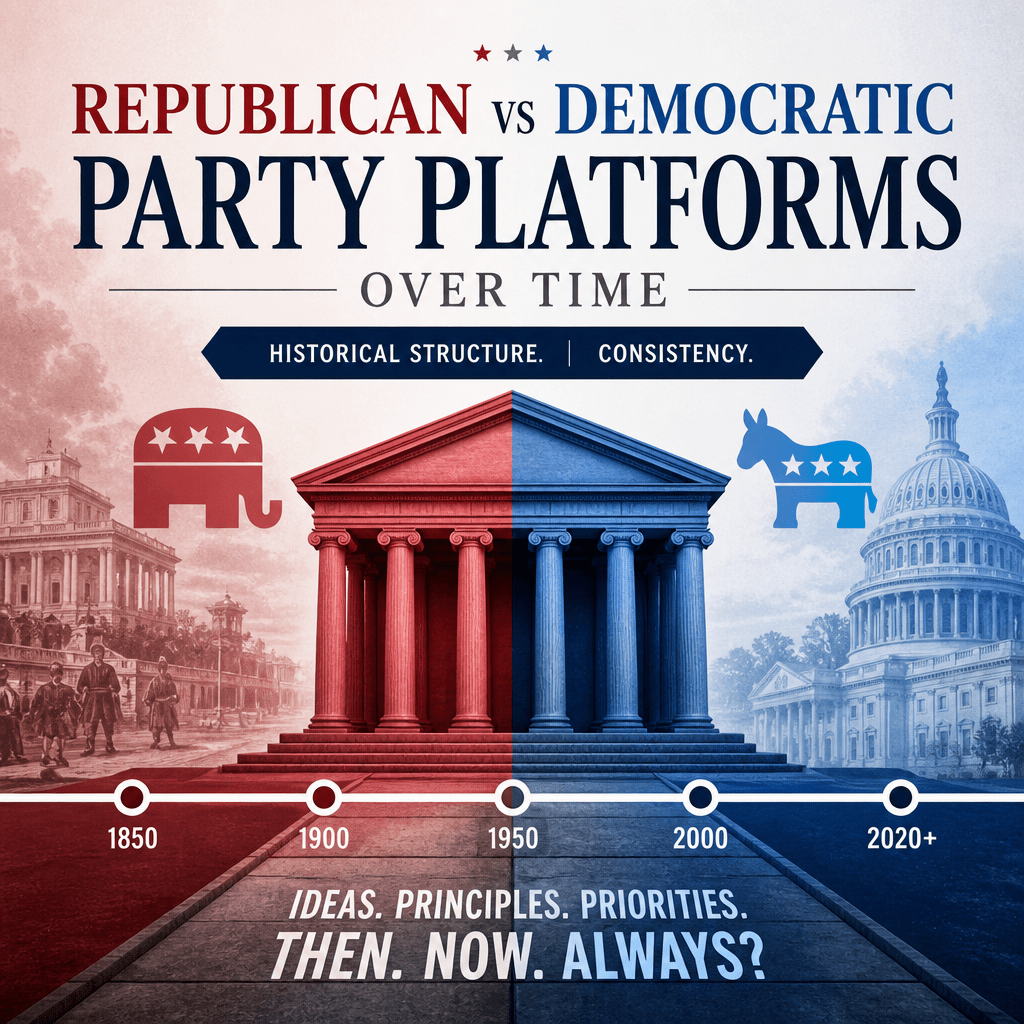
Party Platforms reveal how American political parties define their goals, respond to crises, and build coalitions. Comparing Republican and Democratic platforms from Lincoln’s era to the present shows both continuity and dramatic change. The Republican Party has often preserved recognizable themes involving national unity, constitutional government, markets, and individual responsibility. The Democratic Party has experienced more visible transformations, moving from nineteenth-century states’ rights politics to New Deal liberalism and modern progressivism. Examining Party Platforms across time makes those differences easier to see without reducing either party to a single slogan.
That comparison requires historical care. Neither party has maintained an unchanging identity, and a platform is not the same as every policy adopted by elected officials. Platforms are statements of priorities that reflect the issues, voters, and internal debates of a particular time. Reading Party Platforms in their historical context also helps distinguish formal promises from campaign rhetoric, governing records, and later interpretations.
The Republican Party: From Lincoln to Today
The Republican Party formed in the 1850s from a coalition opposed to the expansion of slavery into the western territories. Its founding moment was therefore closely connected to the slavery question, the future of the Union, and the power of the federal government. Under Abraham Lincoln, Republicans supported a national purpose that differed sharply from the states’ rights arguments used by many Democrats of the period.
Early Republican Party Platforms emphasized:
- Preservation of the Union
- Opposition to slavery’s expansion
- A strong national government
- Economic development and infrastructure
- Free labor and opportunity
Lincoln’s Republicans were not identical to the modern Republican Party. They favored policies, including protective tariffs and federal investment, that many contemporary conservatives would view differently. Still, several broad themes remain recognizable: national unity, constitutional government, economic opportunity, and confidence in public institutions that support national development. The Party Platforms of the period must therefore be read as products of an industrializing nation facing a constitutional crisis.
Long-term Republican themes
Across different periods, Republican platforms have often emphasized limited government, private enterprise, lower taxes, strong national defense, law and order, traditional institutions, and personal responsibility. These themes have never appeared in exactly the same form. Their meaning has changed as the country moved from an industrial economy to a service and technology economy, and as the party’s electoral coalition changed. Party Platforms also show that Republicans have sometimes supported vigorous federal action when they believed national power served security, growth, or social order.
The party’s historical identity is also connected to a preference for national strength. In the nineteenth century, that strength meant preserving the Union and building economic infrastructure. In the twentieth century, it often meant military preparedness and opposition to communism. In the twenty-first century, it has included border enforcement, energy policy, cultural concerns, and skepticism toward international institutions.
For a broader discussion of the moral language associated with restoration and political identity, see Restorationist: 7 Powerful Principles for a Renewed Moral Grammar.
Important shifts in the GOP
The Republican Party has changed in several important ways:
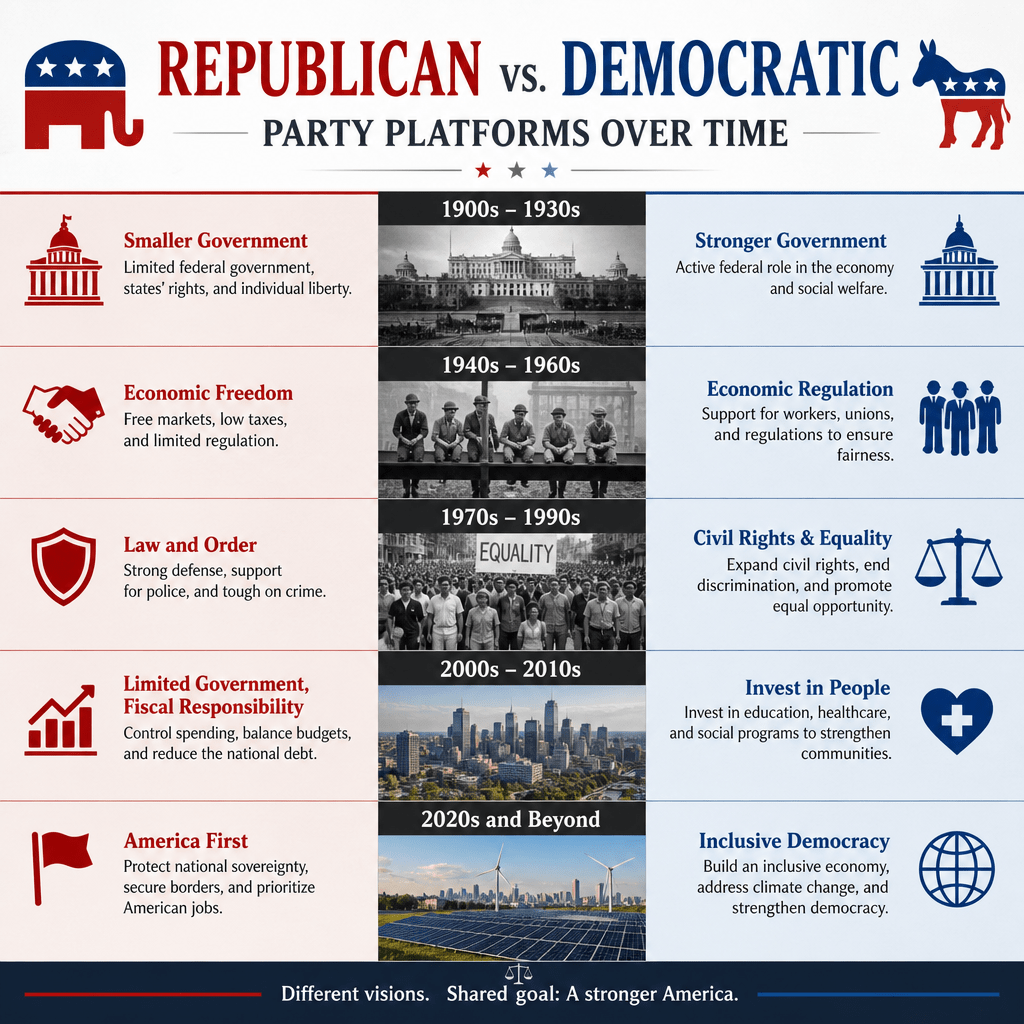
- In the late nineteenth century, it favored tariffs, industrial growth, and national development.
- In the early twentieth century, it divided between progressive reformers and more conservative leaders.
- During the New Deal era, it became the principal opposition to the expansion of federal economic programs.
- By the Reagan era, it was more firmly associated with tax cuts, deregulation, military strength, and social conservatism.
- In the contemporary period, it blends economic conservatism with populism, cultural nationalism, and distrust of administrative institutions.
These changes challenge the idea that the GOP has remained exactly the same since Lincoln. A better conclusion is that the party has maintained a more recognizable set of broad themes than its opponents while repeatedly changing its coalition and policy emphasis. A careful reading of Party Platforms supports continuity as a general pattern, not as proof that every Republican position has remained fixed.
The Democratic Party: Major Historical Shifts
The Democratic Party has the oldest continuous political lineage among the two major American parties, but its platform identity has changed substantially. In the nineteenth century, Democrats were commonly associated with states’ rights, agrarian interests, territorial expansion, and resistance to concentrated federal power. Their coalition included Southern planters, urban machines, immigrants, and other groups that did not always share the same economic interests. Comparing Party Platforms from these periods shows how one party label could encompass very different regional and social factions.
During the Civil War era, many Democrats opposed Republican wartime policies, although the party contained both Unionist and antiwar factions. After Reconstruction, many Southern Democrats defended segregation and resisted civil rights reforms. This part of the party’s history is essential because it demonstrates that modern party labels cannot simply be projected backward without accounting for real political realignment. Party Platforms after the Civil War also reflected the tension between national policy, regional identity, and the demands of an expanding electorate.
The New Deal transformation
The largest Democratic shift came during the Great Depression. Franklin D. Roosevelt’s New Deal expanded the federal government’s role in economic life and reshaped the party’s platform. Democrats increasingly supported:
- Social welfare programs
- Federal economic intervention
- Labor protections
- Public works
- Banking and financial regulation
- Government responsibility for economic security
The New Deal was not socialism in the traditional sense. It preserved private property and a market economy while creating a larger public role in managing risk and protecting workers. Even so, it represented a major departure from the older Democratic emphasis on limited federal power. The New Deal Party Platforms made government responsibility for economic security a central Democratic commitment.
The transformation also created a durable governing philosophy. Democrats became more likely to see national programs as tools for addressing poverty, unemployment, healthcare, education, and economic inequality. Republicans, in contrast, increasingly warned that those programs could weaken local responsibility, expand bureaucracy, or limit economic freedom.
Civil rights and the modern Democratic coalition
A second major shift occurred during the civil rights era. As national Democrats increasingly supported civil rights legislation, many white Southern voters moved away from the party over time. The Democratic coalition gained strength among Black voters, urban voters, labor unions, educated professionals, minority communities, and social progressives. Party Platforms during and after this realignment placed greater emphasis on equal protection and federal enforcement of civil rights.
That coalition encouraged the party to move further left on civil rights, healthcare, education, environmental policy, and social issues. The result was a party that placed greater emphasis on inclusion and federal protection of individual rights, while also supporting a more active economic role for government.
Because political realignment happened over several decades, it is misleading to describe it as a single event. Voters changed gradually, candidates adapted to new coalitions, and national issues altered the meaning of party membership. The Democratic Party’s modern platform is therefore best understood as the product of several overlapping transformations rather than one abrupt ideological conversion.
How the Two Parties Differ Today
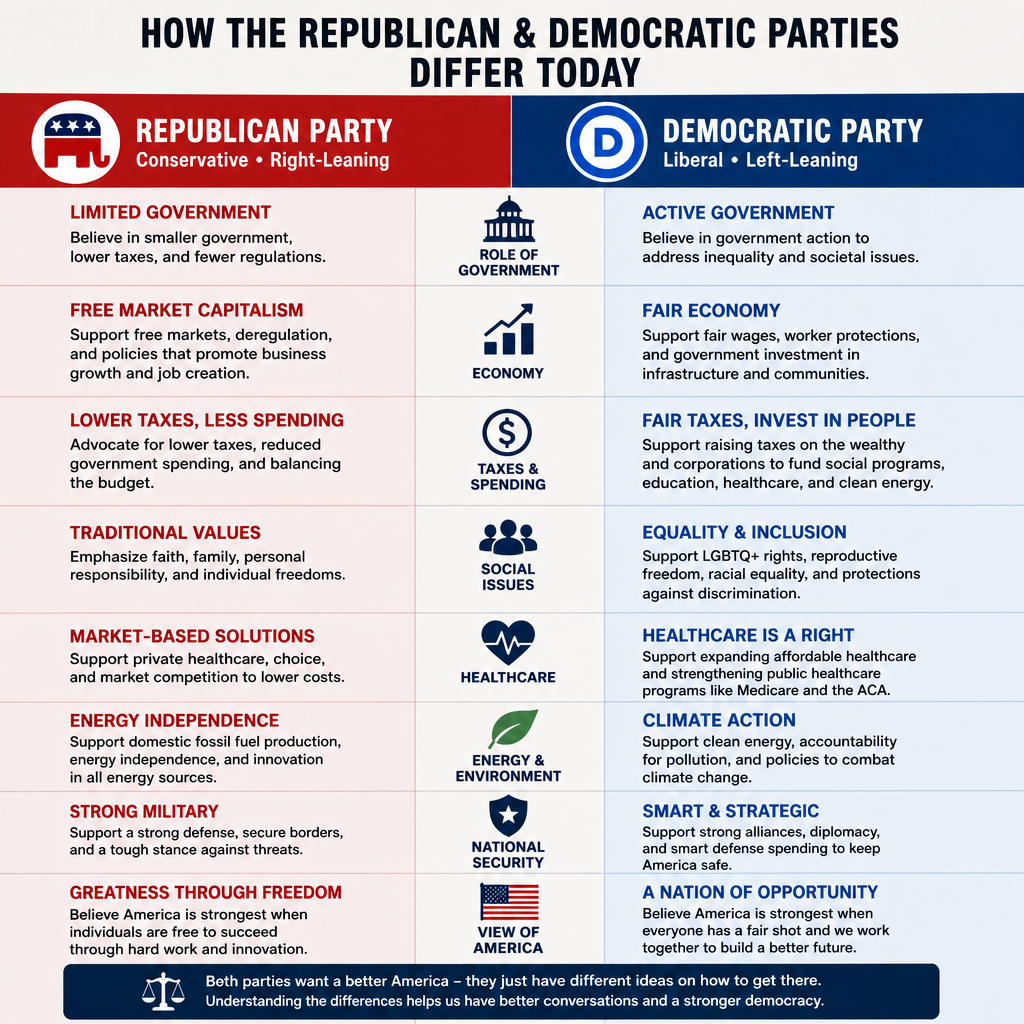
Contemporary Republican and Democratic platforms differ in policy, political language, and assumptions about the proper role of government. Current Party Platforms are shaped by both long-running traditions and immediate concerns such as inflation, immigration, climate change, abortion, technology, and international conflict. The differences are not absolute: both parties contain internal factions, and both sometimes support policies that contradict their usual rhetoric. Nevertheless, their broad priorities are distinct.
Republican priorities today often include:
- Lower taxes and reduced regulation
- Border enforcement and stricter immigration controls
- Domestic energy production and energy independence
- Conservative judicial appointments
- Strong national defense
- Religious liberty and traditional social values
- Concerns about censorship and free speech
- Greater state and local control in selected policy areas
Democratic priorities today often include:
- Expanded social programs and healthcare access
- Climate policy and clean-energy investment
- Civil rights protections
- Measures addressing income and wealth inequality
- Student debt relief and affordable education
- Stronger workplace, consumer, and environmental regulation
- Public investment in housing, infrastructure, and education
- Protection of reproductive rights
Party Platforms do not exist in isolation from voters. They reflect contrasting political coalitions. Republicans generally draw more support from rural communities, many small-business owners, religious conservatives, and voters who prioritize national sovereignty and public order. Democrats generally draw more support from urban areas, younger voters, minority communities, organized labor, and college-educated professionals. Neither coalition is uniform, and each contains significant regional and generational differences.
Official party platforms can be compared with historical documents through resources such as the American Presidency Project’s guide to party platforms, which provides a useful reference for studying changes over time. The historical record of Party Platforms is especially valuable because it allows readers to compare stated goals rather than relying only on later commentary.
Has the Democratic Party Become Socialist?
Calling the modern Democratic Party socialist is a common political claim, but the label requires careful definition. Traditional socialism generally involves social or public ownership of major productive resources. The Democratic Party continues to operate within a capitalist system, supports private property, and runs candidates through standard democratic institutions. Party Platforms can support extensive public programs without proposing that the state own the entire economy.
Critics are responding to real policy differences when they point to:
- More government spending
- Broader welfare programs
- Higher taxes on wealthy households and corporations
- More economic regulation
- Public-sector solutions to healthcare, housing, education, and climate problems
However, those policies do not automatically amount to socialism. A more precise description is that the modern Democratic Party contains a strong social-democratic or progressive wing. Social democracy generally accepts private markets while supporting taxation, regulation, and public programs intended to reduce insecurity and inequality.
The disagreement is therefore partly about policy and partly about political language. Supporters describe these programs as tools for economic fairness and public investment. Critics view them as steps toward excessive government control. The word “socialist” often functions as a warning rather than as a precise description of the party’s economic system.
The Biggest Historical Difference Between the Parties
The most important difference is not simply what each party supports today. It is the direction and scale of change each party has experienced. Party Platforms make that contrast visible because they preserve the priorities that party leaders wanted to present to voters at particular moments.
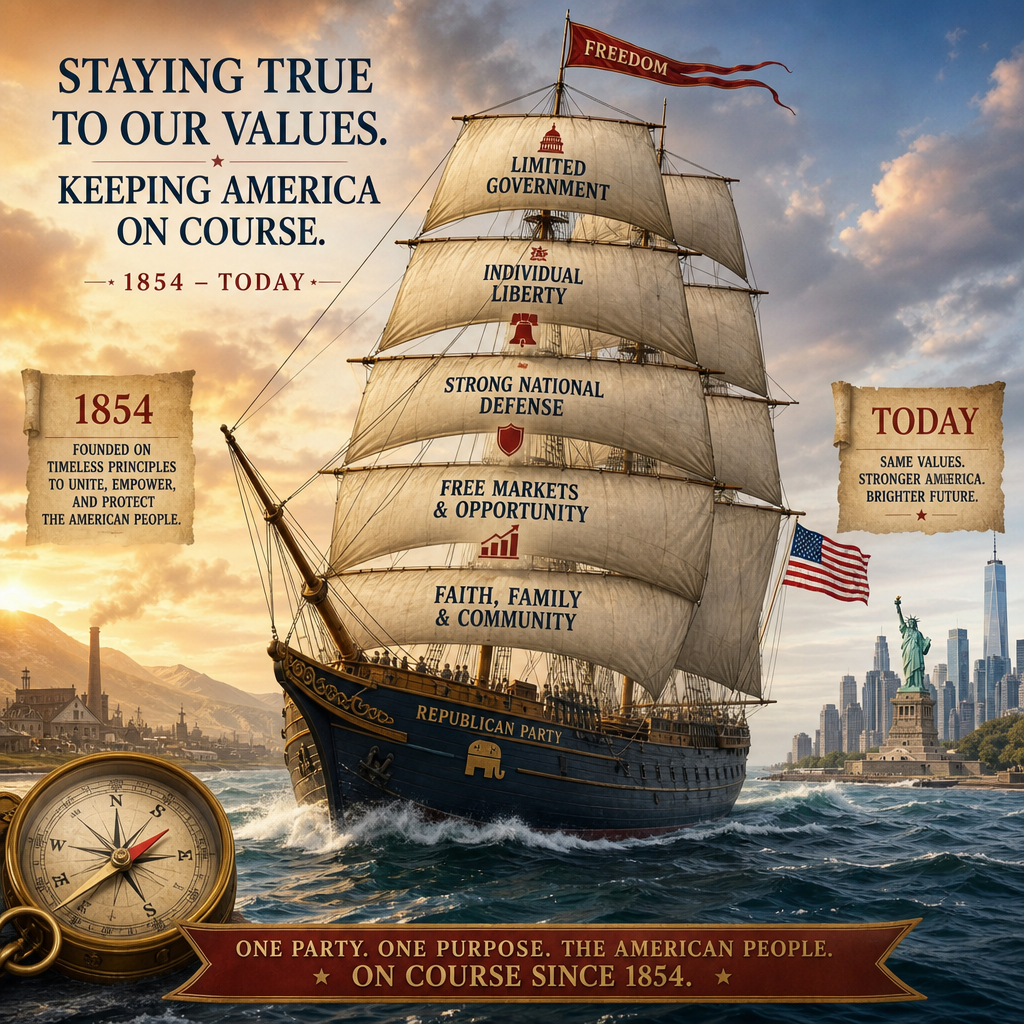
Republican historical pattern
- More continuity in broad themes such as national strength, markets, and individual responsibility
- Strong attachment to constitutional order, although interpretations of that order vary
- Preference for private enterprise and limited federal programs
- Repeated changes in coalition, from antislavery Republicans to modern conservatives and populists
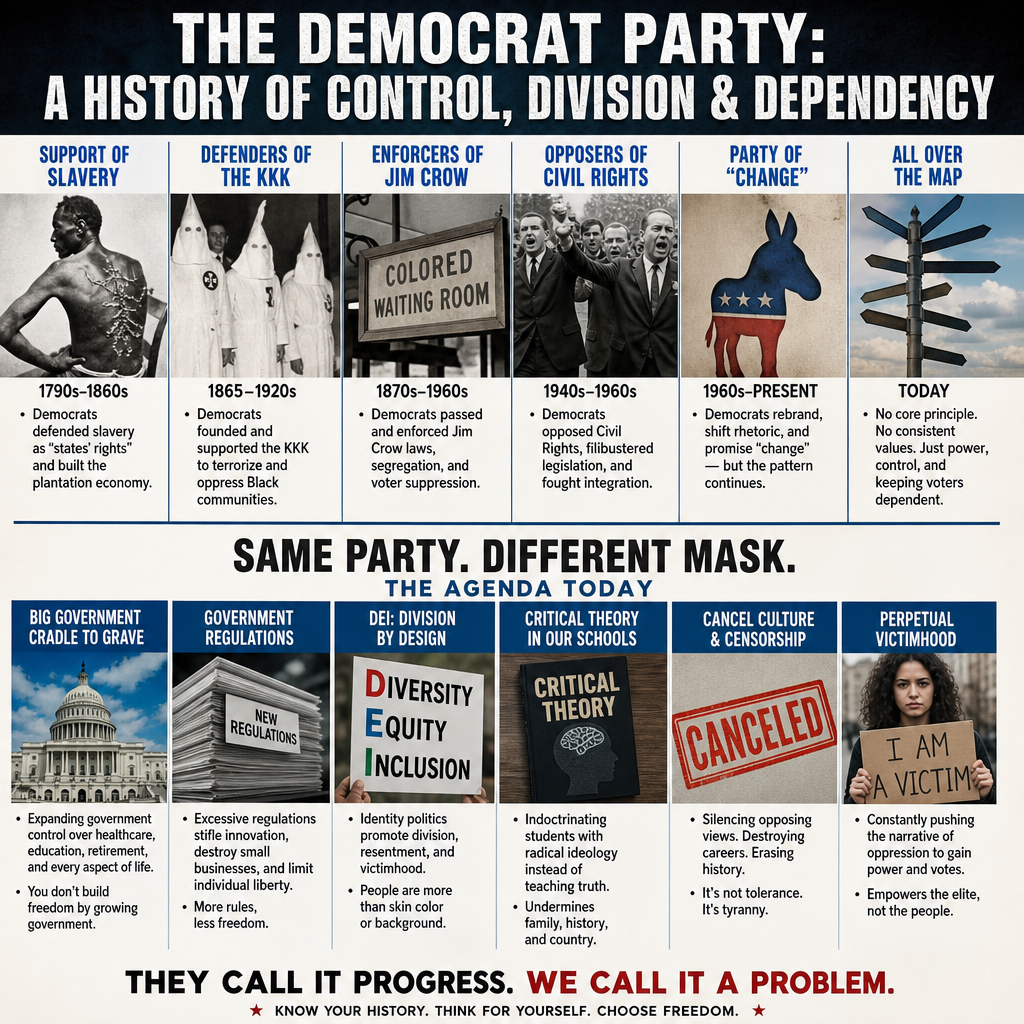
Democratic historical pattern
- More major ideological shifts across different eras
- Movement from states’ rights and agrarian politics toward New Deal liberalism
- Transformation during the civil rights era
- Greater willingness to expand government power in social and economic life
This is where the idea of consistency becomes useful, but it should not be overstated. The Republican Party may appear more consistent because its modern themes are easier to connect to certain older principles. Yet the party’s positions on tariffs, government spending, immigration, trade, and foreign policy have changed considerably. Likewise, the Democratic Party has changed substantially, but it has maintained recurring themes of reform, inclusion, and responsiveness to disadvantaged groups.
A Simple Timeline of Change in Party Platforms
A timeline of Party Platforms helps show that political change usually develops in stages rather than through one sudden replacement of an ideology.
1850s to the Civil War
- Republicans: opposition to slavery’s expansion, preservation of the Union, and national development.
- Democrats: states’ rights, sectional interests, agrarian concerns, and resistance to centralized power.
1890s to the 1930s
- Republicans: business development, protective tariffs, industrial growth, and a strong national economy.
- Democrats: agrarian populism, regional interests, and criticism of concentrated corporate power.
The New Deal era
- Republicans: opposition to the expansion of federal economic authority.
- Democrats: broader government responsibility, social programs, labor support, and public works.
The civil rights era
- Republicans: gradual movement toward becoming the stronger conservative party.
- Democrats: internal conflict between Southern traditionalists and national liberals, followed by a stronger civil rights identity.
The modern era
- Republicans: limited government, cultural conservatism, national sovereignty, and populist nationalism.
- Democrats: progressive economics, a multicultural coalition, civil rights, and stronger state intervention.
What Has Stayed the Same?
Despite major changes, both parties retain long-term tendencies. Republicans have often presented themselves as defenders of national identity, constitutional continuity, market-based economics, and skepticism toward large federal programs. Democrats have often presented themselves as advocates of reform, broader inclusion, federal activism, and social welfare policies. Party Platforms preserve these recurring themes even when specific proposals change.
These descriptions are tendencies, not permanent rules. Republicans have supported substantial federal action during wars, economic emergencies, and infrastructure campaigns. Democrats have sometimes accepted market-oriented policies, balanced-budget arguments, and limits on government programs. The strongest historical analysis recognizes both the recurring themes and the exceptions.
Platforms also reveal what parties want voters to believe about the country. Republican documents often emphasize order, responsibility, sovereignty, and continuity. Democratic documents often emphasize opportunity, inclusion, reform, and protection from economic or social harm. Those rhetorical differences help explain why the parties can interpret the same problem in sharply different ways, and why Party Platforms are political arguments as well as policy documents.
How to Read Party Platforms Historically
A useful comparison begins by separating three questions: what a platform says, what a party actually attempts to enact, and how voters interpret the message. These questions overlap, but they are not identical. A platform may promise a broad principle without specifying a workable legislative path. Conversely, elected officials may pursue policies that were not central to the campaign document because a crisis, congressional compromise, or court ruling changed the governing context.
Readers should also compare documents from similar moments whenever possible. A wartime platform should not be measured only against a peacetime economic platform, and a short modern document may use different language from a nineteenth-century text. Looking at recurring subjects such as federal authority, labor, civil rights, trade, immigration, and foreign policy makes the comparison more meaningful than counting isolated words.
Another important distinction is between national and regional politics. Earlier platforms often reflected powerful sectional factions that later weakened or moved into another party. A national platform could therefore contain compromises that concealed sharp disagreements among delegates. This is one reason a historical judgment should consider convention debates, voting patterns, legislation, and coalition changes alongside the written text. Party Platforms are evidence of political identity, but they are not the entire historical record.
Finally, readers should be cautious with labels such as “liberal,” “conservative,” and “socialist.” Their meanings have changed over time, and a policy associated with one label in one era may have carried a different meaning in another. Historical comparison is strongest when it defines terms, acknowledges exceptions, and distinguishes broad tendencies from absolute claims. That approach produces a clearer account of both continuity and change.
Final Takeaway
Comparing Party Platforms across American history shows two different patterns of political development. The Republican Party, from Lincoln onward, has often preserved a recognizable core around union, constitutionalism, economic freedom, national strength, and limited government. It has changed considerably, but its supporters and critics can often identify a continuing set of themes.
The Democratic Party has shifted more dramatically. It moved from Jacksonian and states’ rights politics to New Deal liberalism, civil rights liberalism, and modern progressivism. That evolution made the party more flexible and responsive to new coalitions, but it also created a platform identity that looks very different from its nineteenth-century origins. The record of Party Platforms supports the conclusion that both parties evolved, but not in identical ways or at the same pace.
In short:
- Republicans are often seen as the party of continuity, even though their policies and coalitions have changed.
- Democrats are often seen as the party of transformation, while still retaining recurring commitments to reform and inclusion.
The most accurate conclusion is not that one party has remained unchanged, and the other has reinvented itself completely. Both have evolved. The difference is that Republican change has often been framed as an adaptation of enduring themes, while Democratic change has more visibly altered the party’s governing philosophy and coalition. Reading Party Platforms carefully reveals continuity, realignment, compromise, and political reinvention in both traditions.
Leave a Reply