
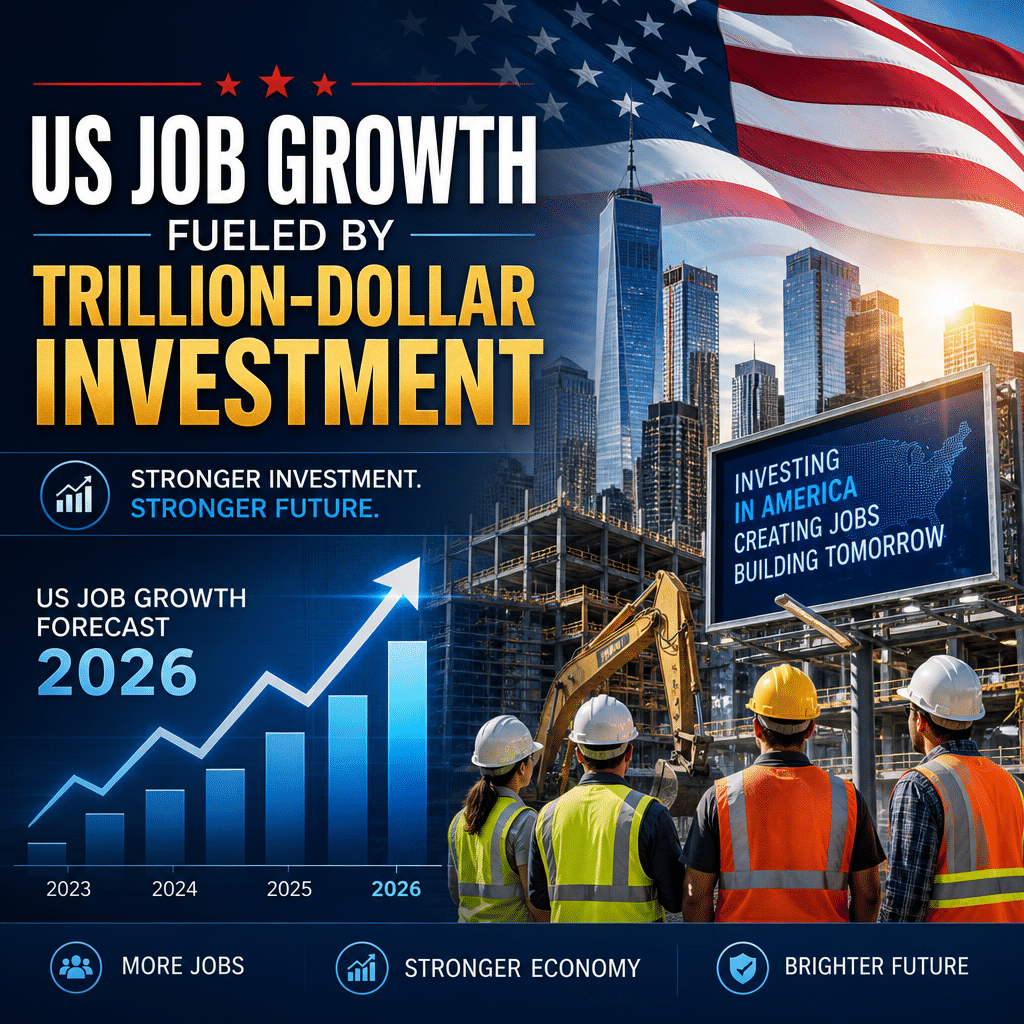
The us job growth forecast 2026 points to a rare economic moment for the United States. More than $11.2 trillion in announced investment is moving through manufacturing, energy, pharmaceuticals, technology, and infrastructure. If these projects continue, they could support 8 to 10 million jobs over the next decade.
That scale matters for job seekers, workers, and families approaching the 2026 midterms. The issue is not only political. It is personal and economic: paychecks, stability, training, and whether the current wave of investment keeps moving forward. For anyone following the us job growth forecast 2026, the central question is how announced capital becomes completed projects and lasting employment.
The estimates in this article are projections rather than guarantees. Actual employment will depend on project completion, financing, demand, permitting, workforce availability, and broader economic conditions. Still, the direction of investment provides a useful way to understand the possible future of American employment. That distinction is important when evaluating any us job growth forecast 2026: an announced investment is not the same thing as a finished facility or a filled position.
Us job growth forecast 2026: The Scale of Investment
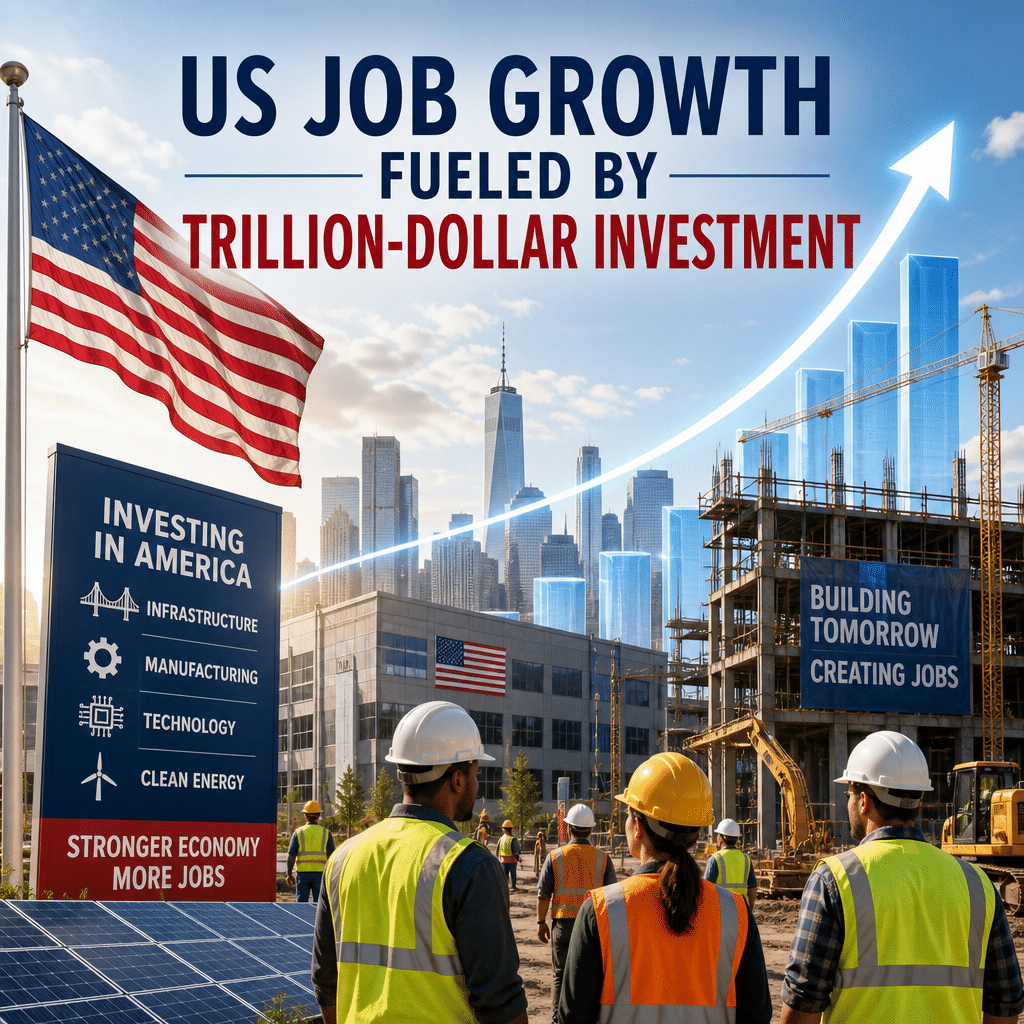
The numbers are unusually large. Across the sectors listed on the White House investment ledger, the totals point to one of the biggest coordinated capital expansions in modern American history. In practical terms, the us job growth forecast 2026 is closely connected to whether these commitments produce operating factories, expanded energy systems, research facilities, and digital infrastructure.
Major announced investment categories include:
- Manufacturing and industry: $5.03 trillion
- Technology, AI, and semiconductors: $2.38 trillion
- Energy and environment: $1.03 trillion
- Pharmaceuticals and biotech: $469.9 billion
- Data centers and digital infrastructure: $164.2 billion
- Financial services, logistics, defense, food, construction, and more: hundreds of billions more
These are not short-term stimulus measures. They represent long-term commitments involving factories, semiconductor fabs, refineries, shipyards, energy terminals, data centers, pharmaceutical plants, logistics hubs, and infrastructure upgrades. Because these assets take years to plan and build, they can influence employment well beyond a single calendar year. For planners and workers, the us job growth forecast 2026 also offers a way to identify which industries may need the most labor and training.
In other words, they are the physical structure of future employment. They also create demand for contractors, engineers, inspectors, equipment suppliers, software developers, transportation companies, maintenance providers, and local service businesses. A reliable us job growth forecast 2026 must therefore include both direct jobs at a project and indirect jobs in the surrounding supply chain.
For additional context on the relationship between industrial investment and working-class opportunity, see Industrial Investments: 7 Powerful Reasons for a Hopeful Working-Class Future.
Why announced investment matters
Investment announcements can signal confidence, but they should be interpreted carefully. A company may announce a project before final financing, environmental review, site preparation, equipment procurement, or hiring. Some proposals may be reduced or postponed. Others may expand beyond the original plan. This is why the us job growth forecast 2026 should be viewed as a range of possible outcomes rather than a guaranteed employment total.
Even with that caution, a large pipeline of projects can change business decisions. Suppliers may add capacity, training providers may develop new programs, and local governments may improve roads, utilities, and industrial sites. The economic effect begins before the first permanent worker starts a shift, although the strongest benefits arrive only when projects become productive. Tracking those milestones can make the us job growth forecast 2026 more useful than relying on announcements alone.
These Investments Can Create Millions of Jobs
When this level of capital is deployed, the labor impact can be substantial. Using standard economic multipliers, the announced investments could support the following categories of employment. This is one reason the us job growth forecast 2026 attracts attention from workers without four-year degrees as well as professionals in engineering, information technology, and management.
- 4 to 6 million permanent industrial jobs
- 3 to 4 million permanent technology, semiconductor, and pharmaceutical jobs
- millions more in construction, logistics, maintenance, and support services
That is not just a Wall Street story. It is a working-class story. A new facility may employ thousands of people directly, but its wider supply chain can support many more jobs. Steel producers, machine shops, trucking firms, electricians, food vendors, security companies, and commercial landlords can all benefit from a major project.
Job quality will vary by occupation and region. Some positions will be permanent, while others will last only through construction. Some will require apprenticeships or technical certificates; others will demand engineering, management, or specialized software skills. The important point is that the investment wave can create several layers of opportunity rather than a single category of factory work.
Employment projections also need to distinguish between gross jobs and net jobs. Gross job creation counts positions connected to new activity. Net job creation accounts for jobs that may disappear elsewhere, workers who change occupations, and productivity gains that allow companies to produce more with fewer employees. A responsible us job growth forecast 2026 should acknowledge both measures.
Direct, indirect, and induced employment
Direct employment occurs inside a factory, plant, laboratory, data center, or construction site. Indirect employment occurs among suppliers that provide materials, machinery, software, transportation, legal services, maintenance, and specialized components. Induced employment results when workers spend their wages at restaurants, stores, clinics, housing providers, and other local businesses.
These layers help explain why one large project can affect a region more broadly than its payroll suggests. They also explain why a project can create opportunity for people with very different backgrounds. A construction worker, laboratory technician, forklift operator, restaurant employee, cybersecurity analyst, and equipment mechanic may all benefit from the same investment ecosystem. Including each layer gives the us job growth forecast 2026 a more complete picture of potential employment.
The Jobs Are Spreading Across America
One of the most important features of this investment wave is geography. Growth is reaching states that have long carried America’s industrial identity and states that are becoming major centers for advanced manufacturing and energy production. Regional distribution is a major part of the us job growth forecast 2026 because a job opportunity is most valuable when workers can realistically access it.
Likely beneficiaries include:
- Texas
- Louisiana
- Ohio
- Pennsylvania
- Tennessee
- Georgia
- Arizona
- North Carolina
- South Carolina
This is a potential geographic rebalancing. It shifts some opportunity away from a narrow concentration of expensive coastal markets and toward the American interior and Southeast. The result could be more high-value production in communities where land, energy, and labor availability make large projects practical.
For many workers, that means a future closer to home. It may also reduce the pressure to move to a handful of major metropolitan areas just to find a well-paid career. However, communities will still need housing, schools, transportation, healthcare, and workforce programs if they are to absorb rapid growth successfully.
The location of a facility does not automatically determine who receives the benefit. A region may attract a project but lack enough trained workers. Housing costs may rise faster than wages. Long commutes may exclude people without reliable transportation. Local residents may also compete with workers who move into the area. The best us job growth forecast 2026 analysis therefore considers access, affordability, and local capacity alongside job counts.
Regional supply chains
Industrial projects can connect several states through supply chains. A plant in one state may purchase steel from another, use components made elsewhere, and ship finished products through a third region. Ports, railroads, highways, warehouses, and energy networks can all gain from increased production.
This network effect can strengthen smaller communities that do not host a major facility themselves. A machine shop, trucking company, or maintenance contractor may serve several industrial customers. Over time, that demand can encourage entrepreneurship and help existing businesses invest in equipment and training. Regional supply-chain data can therefore sharpen the us job growth forecast 2026 by revealing benefits outside major project sites.
How Industrial Growth Becomes Consumer Growth
Industrial investment does more than create factory jobs. It also creates spending power. When millions of workers earn steady industrial wages, the effect spreads through the whole economy. This consumer channel is an important part of the us job growth forecast 2026 because employment gains can affect businesses that never enter a factory.
The ripple effect looks like this:
- average industrial wage: about $65,000 per year
- new wage base: $520 billion to $650 billion annually
- consumer spending rate: about 75%
- retail and services multiplier: about 2.2x
That produces roughly $1.2 trillion to $1.8 trillion per year in added economic activity under the assumptions behind the projection. The exact result could be higher or lower depending on saving rates, taxes, inflation, imports, interest rates, and household debt. These assumptions are why any us job growth forecast 2026 should present a range instead of treating the upper estimate as certain.
Industrial jobs do not stay inside the plant. They show up in:
- restaurants
- auto dealers
- homebuilding
- grocery stores
- local banks
- repair shops
- schools
- healthcare
- small businesses
Industrial employment can lift entire communities because workers spend their income where they live. Higher demand can support new businesses, expand existing ones, increase local tax revenue, and strengthen the market for housing and services.
There are also limits to the multiplier effect. Households may save part of their income, purchase imported goods, pay down debt, or face higher prices when demand grows faster than supply. If housing construction does not keep up, rents and home prices can absorb some of the wage benefit. Local planning and responsible growth are therefore essential to turning higher employment into higher living standards. These local constraints should remain part of every realistic us job growth forecast 2026.
Why the 2026 Midterms Matter Economically
This is where politics and economics meet. Large industrial projects are slow and capital-intensive. They do not happen overnight, and they need years of stable conditions to move from announcement to completion. That long timeline gives the us job growth forecast 2026 a political dimension without making it a prediction of election results.
Major industrial projects usually require:
- stable regulatory rules
- predictable permitting
- consistent energy policy
- long-term planning
- reliable infrastructure
- access to trained workers
- limited disruption from administrative changes
Without those conditions, projects can slow down, be delayed, be reworked, be litigated, be re-permitted, or stall before they produce the jobs they promised. This is not necessarily about ideology. It is about how industrial development works.
A semiconductor fab does not rise in six months. It often takes 3 to 5 years. An energy terminal may take 4 to 7 years. A pharmaceutical plant can take 2 to 4 years. A data center may take 18 to 36 months. A useful us job growth forecast 2026 must account for these construction timelines rather than assuming every announcement immediately becomes a payroll.
When voters look ahead to the 2026 midterms, they may therefore be asking a practical question: will the current momentum continue, or will it be interrupted? This article does not predict election outcomes. It explains why continuity can matter to projects that require multiple years of planning and construction.
Policy continuity does not mean that every existing rule should remain unchanged. Projects still need oversight, safety standards, environmental review, and public accountability. It means that investors and communities need understandable processes and reasonable confidence about how decisions will be made. Sudden uncertainty can raise costs even when a project ultimately proceeds. For that reason, policy stability remains a practical variable in the us job growth forecast 2026.
What This Means for Working-Class Americans
1. More high-wage jobs that do not require a four-year degree
Many industrial roles reward skill, training, reliability, and practical judgment rather than a traditional four-year degree. Examples include:
- electricians
- welders
- machinists
- robotics operators
- semiconductor technicians
- grid specialists
- heavy equipment operators
- plant maintenance workers
- quality-control technicians
- industrial safety specialists
These are good opportunities for people who want to work with their hands, operate advanced equipment, solve problems, and build something real. Apprenticeships, community colleges, employer training, and industry certifications can help workers qualify. The us job growth forecast 2026 is especially relevant to workers deciding whether a short technical program could lead to a durable career.
Modern industrial work is also becoming more technical. A maintenance worker may use diagnostic software, a machinist may program computer-controlled equipment, and a warehouse employee may manage automated systems. Practical experience remains valuable, but digital literacy and problem-solving skills increasingly complement traditional trades. This changing skill mix is another important consideration within the us job growth forecast 2026.
2. A stronger industrial middle class
Industrial jobs can support homeownership, savings, family formation, upward mobility, and long-term financial security. Benefits may include predictable schedules, health insurance, retirement plans, paid training, and a clearer promotion path.
That is a meaningful alternative to low-wage, unstable gig work. It restores a ladder into the middle class, although employers and local institutions will need to ensure that these opportunities remain accessible to workers without extensive prior experience.
Pay alone does not define job quality. Workers also need safe conditions, dependable hours, respectful management, opportunities to advance, and benefits that protect families from unexpected costs. A positive us job growth forecast 2026 should therefore measure the quality and durability of work, not only the number of openings.
3. Healthier local economies
When industrial workers earn more, they spend more locally. That creates demand for housing, childcare, restaurants, retail, transportation, healthcare, and repair services.
Then local businesses grow. Local tax bases can grow as well, making it easier to support schools, roads, utilities, public safety, and other infrastructure. This is how industrial policy becomes community policy.
4. A generational reset
For many younger Americans, this may be the first real chance in years to build a future without heavy debt and without depending on credential inflation. Technical careers can provide a path to stable adulthood without requiring people to leave their hometowns.
That matters in towns and regions that have watched opportunity leave for decades. It also creates a reason for young workers to view skilled trades and technical education as long-term professional choices rather than temporary alternatives. In that sense, the us job growth forecast 2026 is not only about near-term hiring; it is also about whether a new generation can see a credible path to independence.

The Skills and Infrastructure Challenge
Investment alone does not guarantee employment growth. The country must also prepare people to fill the jobs and communities to support the facilities. Employers may face shortages of electricians, welders, maintenance technicians, engineers, truck drivers, construction managers, and advanced manufacturing specialists.
That makes workforce development especially important. Effective programs can include paid apprenticeships, partnerships between employers and community colleges, high-school career pathways, short-term technical certificates, and training that allows workers to earn while they learn.
Training must also be flexible. Adults may already have families, jobs, transportation challenges, or limited savings. Evening classes, online instruction combined with hands-on practice, childcare support, and paid work-based learning can make programs more accessible. Without those supports, the jobs highlighted by the us job growth forecast 2026 may go to workers who can afford training rather than to the people living closest to the opportunity.
Infrastructure matters just as much. New facilities need dependable electricity, water, roads, rail connections, broadband, housing, and emergency services. If local systems cannot keep pace, projects may face higher costs, longer timelines, and opposition from residents concerned about congestion or quality of life. Infrastructure readiness can therefore determine whether the us job growth forecast 2026 becomes actual hiring in a particular community.
A successful industrial revival therefore requires more than announcing capital. It requires coordination among employers, workers, educators, utilities, local governments, and residents. Measuring progress should include completed training, apprenticeship placement, local hiring, wage growth, project timelines, and the availability of affordable housing.
The Bigger Economic Story
What is happening now is larger than one election cycle. It is a possible reset of the American production model. The long view behind the us job growth forecast 2026 asks whether the country can maintain productive capacity over many years rather than simply record a temporary hiring surge.
For years, the economy was tilted toward finance, speculation, and services. Now the center of gravity may be shifting back toward things that are made, refined, powered, transported, and built.
That includes:
- steel
- chips
- batteries
- energy systems
- medicines
- data infrastructure
- logistics networks
- manufacturing capacity
This is not simply nostalgia. It is a strategic rebuild shaped by supply-chain concerns, national security, energy demand, technological competition, and the desire for resilient domestic production. Those forces provide the broader economic context for the us job growth forecast 2026.
Information technology will remain central to this transformation. Advanced factories rely on automation, sensors, data systems, cybersecurity, and artificial intelligence.
Technology may increase productivity while changing the mix of available jobs. Some repetitive tasks may be automated, but demand can grow for technicians, programmers, equipment operators, analysts, and specialists who maintain complex systems. The strongest us job growth forecast 2026 scenario is therefore not based on technology replacing all workers; it is based on technology creating new combinations of technical and practical work.
If the investment holds, it may define American employment for a generation. If projects are canceled or delayed, the benefits will be smaller and arrive later than expected. The outcome will depend on execution, workforce preparation, infrastructure, demand, and the ability to translate capital into productive capacity.
The Restorationist Interpretation
Here is the core argument, plainly stated:
America is in the middle of a potentially once-in-a-century industrial expansion. Trillions of dollars are already announced across manufacturing, energy, technology, pharmaceuticals, and infrastructure. That is the foundation for the us job growth forecast 2026, although the final results will depend on how many projects reach completion.
Those investments could create millions of good jobs, raise wages, revive local economies, and restore the industrial middle class. They could also expand opportunities for workers who prefer technical training and practical experience to a four-year college path.
But the outcome is not automatic. Projects need time, skilled workers, reliable infrastructure, financing, stable rules, and sufficient demand. Communities need to plan for growth, and employers need to make training accessible. These conditions separate a hopeful us job growth forecast 2026 from a simple list of announcements.
That is why continuity matters. Factories, fabs, terminals, plants, and data centers need years to move from plans to operating facilities. They need policy stability and a system that lets capital turn into real jobs.
For workers, the stakes are not abstract. They are measured in pay, training, hometown opportunity, and the chance to build a life with dignity. That is why the 2026 midterms may matter far beyond party politics: they may help determine whether America’s industrial comeback keeps moving forward.
For authoritative labor-market data and definitions, readers can consult the U.S. Bureau of Labor Statistics. Its data can help readers compare the us job growth forecast 2026 with actual employment, wage, occupation, and industry trends as new information becomes available.
The most balanced conclusion is hopeful but cautious. The United States has an unusually large investment pipeline and a chance to rebuild productive capacity. If projects are completed, workers are trained, and communities prepare responsibly, the benefits could reach far beyond individual facilities. They could support a broader industrial future in which more Americans can find stable work, build skills, and remain connected to the places they call home.
Leave a Reply