
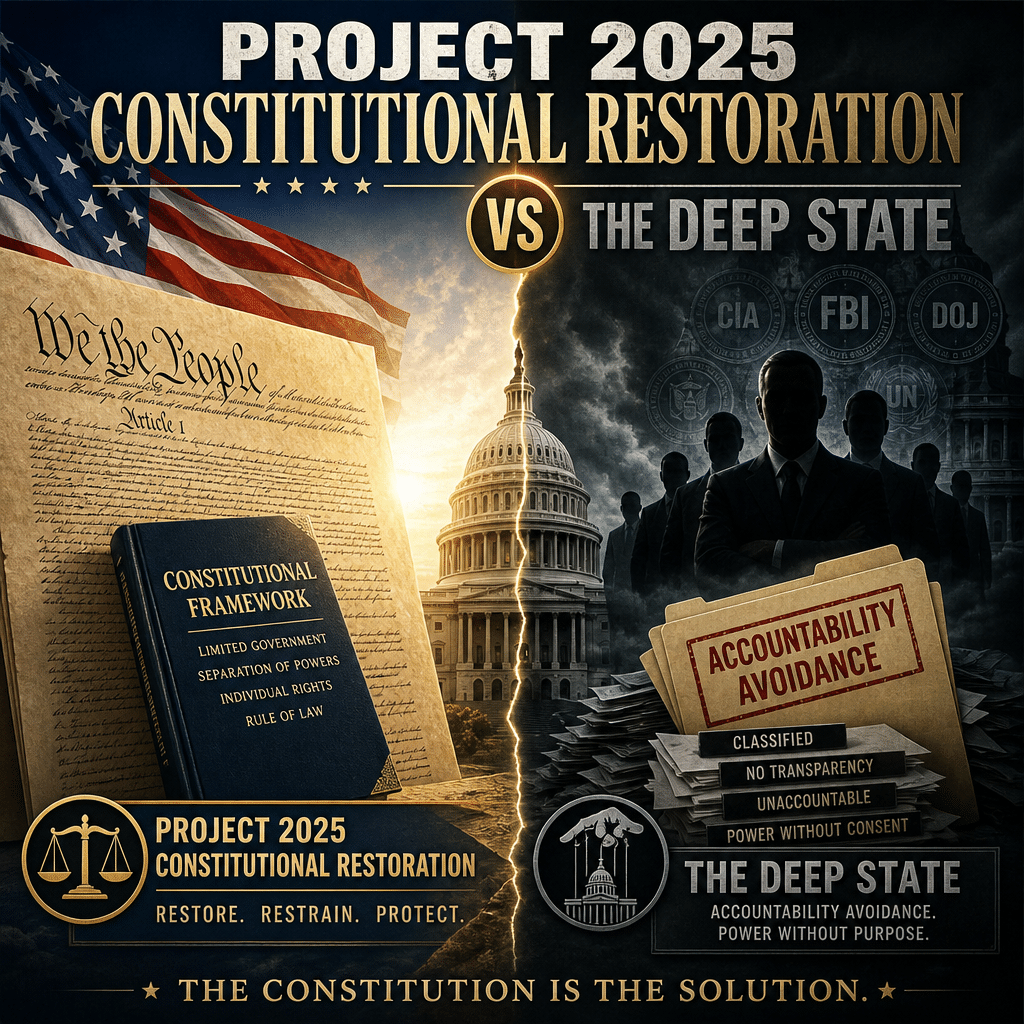
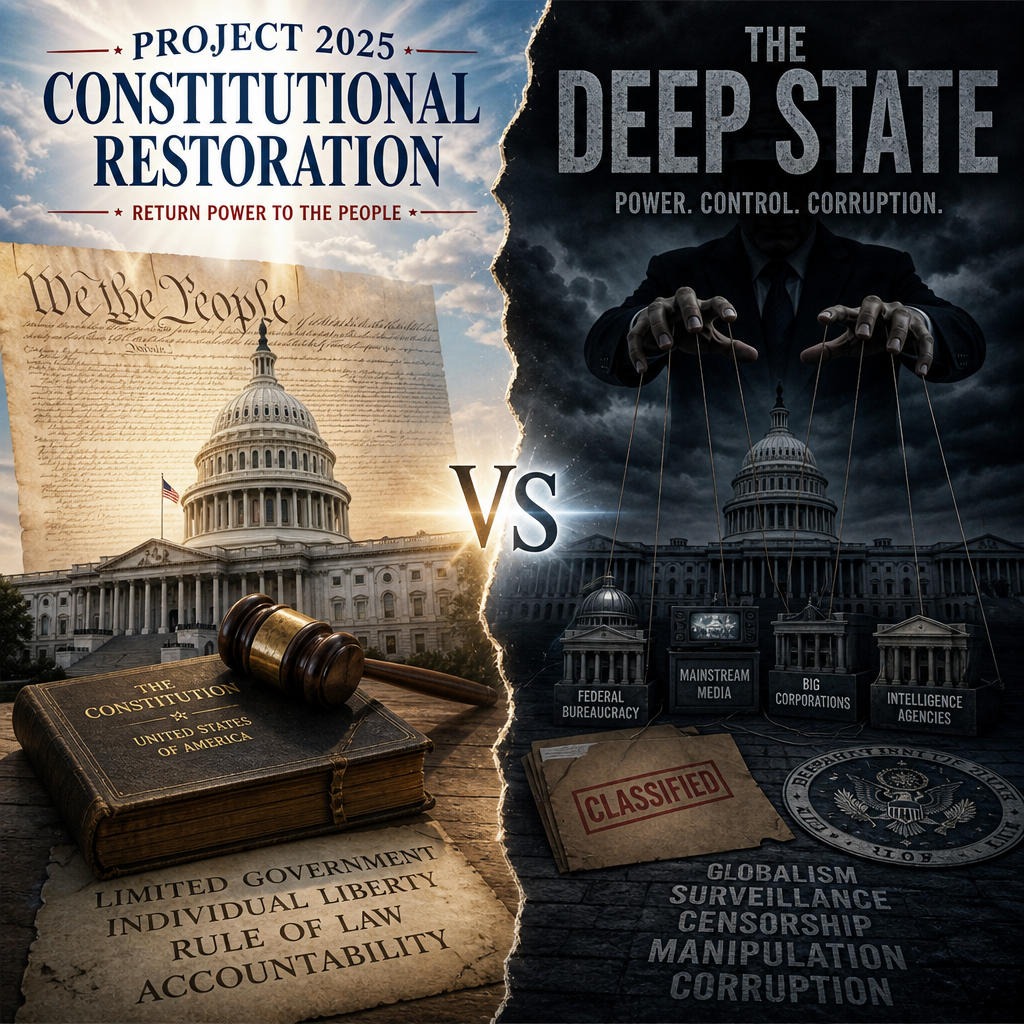
From a restorationist perspective, the modern Democratic project is not merely opposition to Project 2025. It is opposition to the Constitution’s original design. Project 2025 constitutional restoration is therefore best understood as a dispute over who governs: elected officials operating through the constitutional branches, or a permanent administrative system that can continue shaping policy regardless of election results.
Table of Contents
I. The Administrative State as the Center of Modern Power
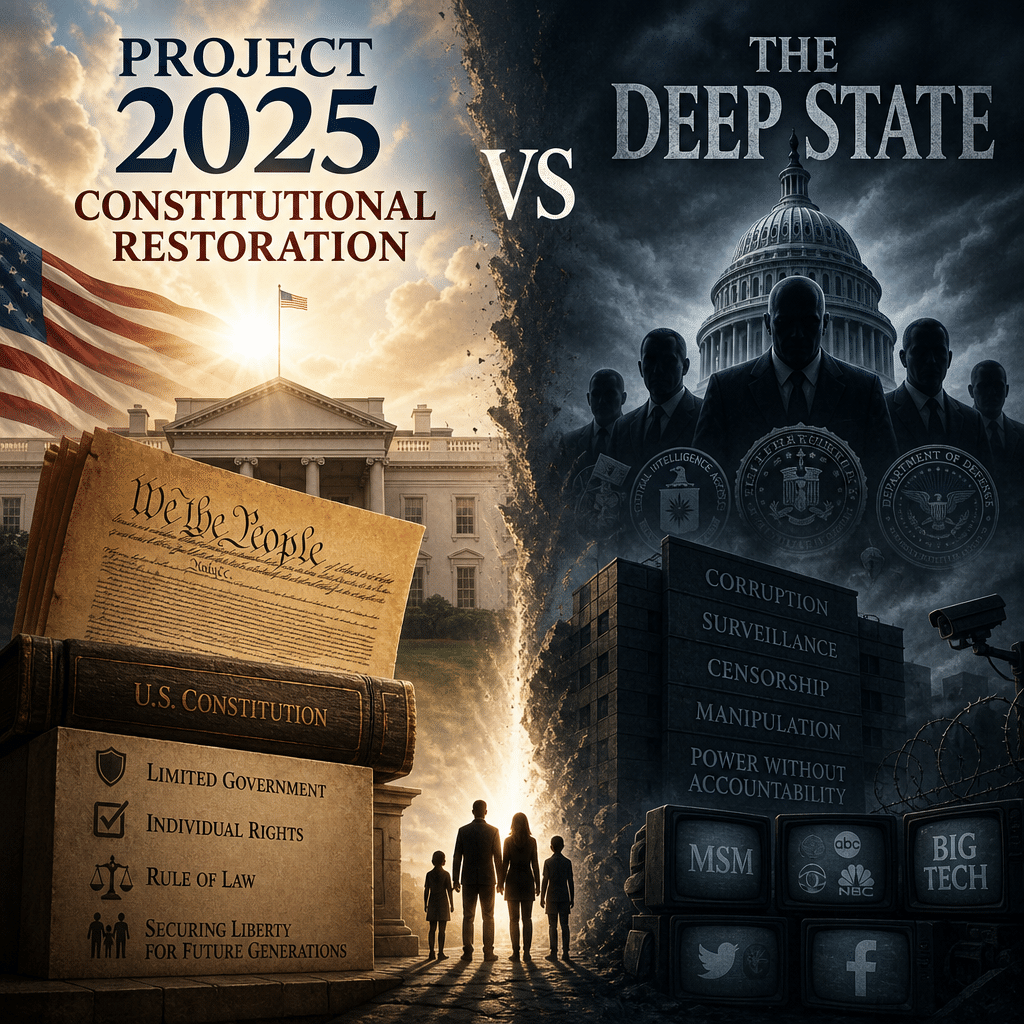
Project 2025 is treated by many Democrats and progressive organizations as an existential threat because it targets the machinery that now performs much of the practical governing in Washington. That machinery includes independent agencies, civil-service bureaucracies, regulatory commissions, nonprofit partnerships, federal grant ecosystems, DEI and SOGI enforcement offices, and ESG-aligned procurement networks. Project 2025 constitutional restoration places these institutions at the center of its accountability argument.
From the restorationist point of view, these institutions create a governing structure that is difficult for voters to identify, supervise, or replace. A president may campaign on one set of policies, yet agencies can interpret statutes, issue regulations, distribute grants, enforce standards, and shape public priorities through administrative guidance. The result is a system in which formal elections do not always produce an equivalent change in policy. Project 2025 constitutional restoration responds by emphasizing a clearer chain of responsibility.
The criticism is not that every federal employee is acting illegally or that every agency program is illegitimate. The criticism is structural: the administrative state has accumulated authority that appears to blur the constitutional boundaries among legislation, execution, and adjudication. When agencies write rules, enforce them, interpret them, and impose penalties, they can exercise several forms of governmental power at once. Project 2025 constitutional restoration challenges that concentration of authority.
That arrangement also creates a political advantage for organizations that can work effectively through administrative channels. A party that does not control Congress, the presidency, or most state governments can still influence policy through agency appointments, career staff, regulatory interpretation, litigation, grant conditions, and partnerships with advocacy organizations. This is why the restorationist argument treats the administrative state as more than a collection of offices. It is a durable governing network. Project 2025 constitutional restoration seeks to make that network more answerable to elected officials.
Supporters of Project 2025 argue that the answer is to restore a clearer chain of command. In their view, the president is elected nationally and is accountable to the electorate for executive-branch decisions. If the president cannot direct the officials who execute federal law, then voters cannot meaningfully assign responsibility for the results of government. Project 2025 constitutional restoration presents this as an institutional rather than merely partisan question.
This interpretation connects Project 2025 with a broader argument about America’s Formative Tradition. That tradition emphasizes ordered liberty, representative institutions, and the need to connect public power to constitutional authority. The debate is consequently not just about personnel policy or agency management. It is about the meaning of executive responsibility in a constitutional republic. Project 2025 constitutional restoration applies that tradition to the modern administrative state.
II. The Constitutional Argument for Presidential Accountability
The constitutional case begins with Article II. Article II, Section 1 provides that “The executive Power shall be vested in a President of the United States.” Restorationists read that language as establishing a unitary executive: executive authority is ultimately lodged in one elected president rather than dispersed among officials who can operate independently of presidential supervision. Project 2025 constitutional restoration relies heavily on this reading of Article II.
Article II, Section 2 reinforces that relationship by allowing the president to require the written opinion of the principal officer in each executive department. Departments therefore exist within a hierarchy of presidential administration. Their officials may provide expertise and professional judgment, but the restorationist position holds that advice is not the same as an independent veto over the president’s lawful direction. Project 2025 constitutional restoration treats this distinction as essential to accountability.
Article II, Section 3 adds the Take Care Clause, requiring the president to “take Care that the Laws be faithfully executed.” The practical question is how a president can be held responsible for execution if the officials carrying out federal programs are insulated from meaningful presidential supervision. In the restorationist view, responsibility and control must correspond. Project 2025 constitutional restoration makes that correspondence a central constitutional principle.
The official text of Article II of the U.S. Constitution provides the primary reference point for this argument. The text does not expressly name modern independent agencies, administrative courts, civil-service protections, or the immense regulatory system that developed long after ratification. The argument from constitutional design is therefore that later institutions should remain subordinate to the Constitution’s allocation of powers rather than becoming substitute centers of authority. Project 2025 constitutional restoration uses this framework to question administrative independence.
This does not necessarily mean that every agency is unconstitutional or that every public employee must be directly removable at will. It means that the constitutional status of administrative arrangements should be examined rather than assumed. A structure that prevents elected officials from directing executive officers may raise serious questions about accountability, separation of powers, and the president’s duty to execute the law. Project 2025 constitutional restoration calls for that examination.
Restorationists also argue that the Framers were concerned about concentrated power, but they distinguished between concentration in an accountable executive and the uncontrolled combination of powers in an unaccountable body. An elected president can be investigated, impeached, defeated, or replaced. A permanent administrative network is less directly exposed to those forms of public judgment. Project 2025 constitutional restoration therefore emphasizes accountable concentration rather than unchecked power.
III. The Deep State as a Democratic Power Base
The phrase “deep state” can be used irresponsibly when it implies a secret conspiracy. The structural use of the phrase is different. It refers to a permanent administrative environment in which career officials, regulatory institutions, contractors, nonprofits, professional associations, and advocacy networks can preserve policy commitments across changes in elected leadership. Project 2025 constitutional restoration uses the term in this structural sense.
Under this definition, the deep state is not a hidden government operating outside all law. It is a network of institutions with substantial continuity and limited electoral exposure. Its influence can be visible in budgets, regulations, grant requirements, enforcement priorities, procurement rules, and administrative interpretations. The concern is that these mechanisms can make policy durable even when voters seek a different direction. Project 2025 constitutional restoration focuses on this continuity.
The Democratic governing model, according to the restorationist critique, benefits from six forms of administrative continuity:
- Bureaucratic continuity: agencies remain in place when elections change the party in power.
- Civil-service insulation: personnel systems can make it difficult for elected leaders to remove officials who resist administration priorities.
- Regulatory governance: agencies can establish detailed policy requirements without waiting for Congress to enact a new statute.
- Nonprofit partnerships: advocacy groups can influence policy through grants, research, litigation, consultation, and public campaigns.
- Administrative rule-making: agencies can translate broad statutory language into binding standards and compliance programs.
- Judicial deference: courts have sometimes given agencies substantial room to interpret ambiguous statutes.
These mechanisms are not exclusively used by one political party. Any administration can attempt to use the administrative state. The restorationist claim is that progressive organizations have developed a particularly strong relationship with the federal bureaucracy, regulatory institutions, universities, foundations, and nonprofit advocacy networks. As a result, reforms that increase presidential control are perceived as threats to an established governing coalition. Project 2025 constitutional restoration challenges that coalition’s durability.
That coalition may include independent agencies, civil-service protections, DEI and SOGI offices, ESG procurement standards, environmental enforcement networks, and NGO-government partnerships. Defenders describe these arrangements as expertise, independence, civil rights enforcement, or professional administration. Critics describe them as a parallel system of political power that is insufficiently accountable to voters. Project 2025 constitutional restoration adopts the latter critique.
The disagreement is therefore partly about terminology. One side sees a professional administrative state that protects law and expertise from political interference. The other sees an insulated bureaucracy that can frustrate the choices of elected officials. Project 2025 constitutional restoration takes the second position and argues that independence must not become immunity from constitutional supervision.
IV. The Fact-Laden Rebuttal to Administrative-State Expansion
1. Independent Agencies and Divided Executive Authority
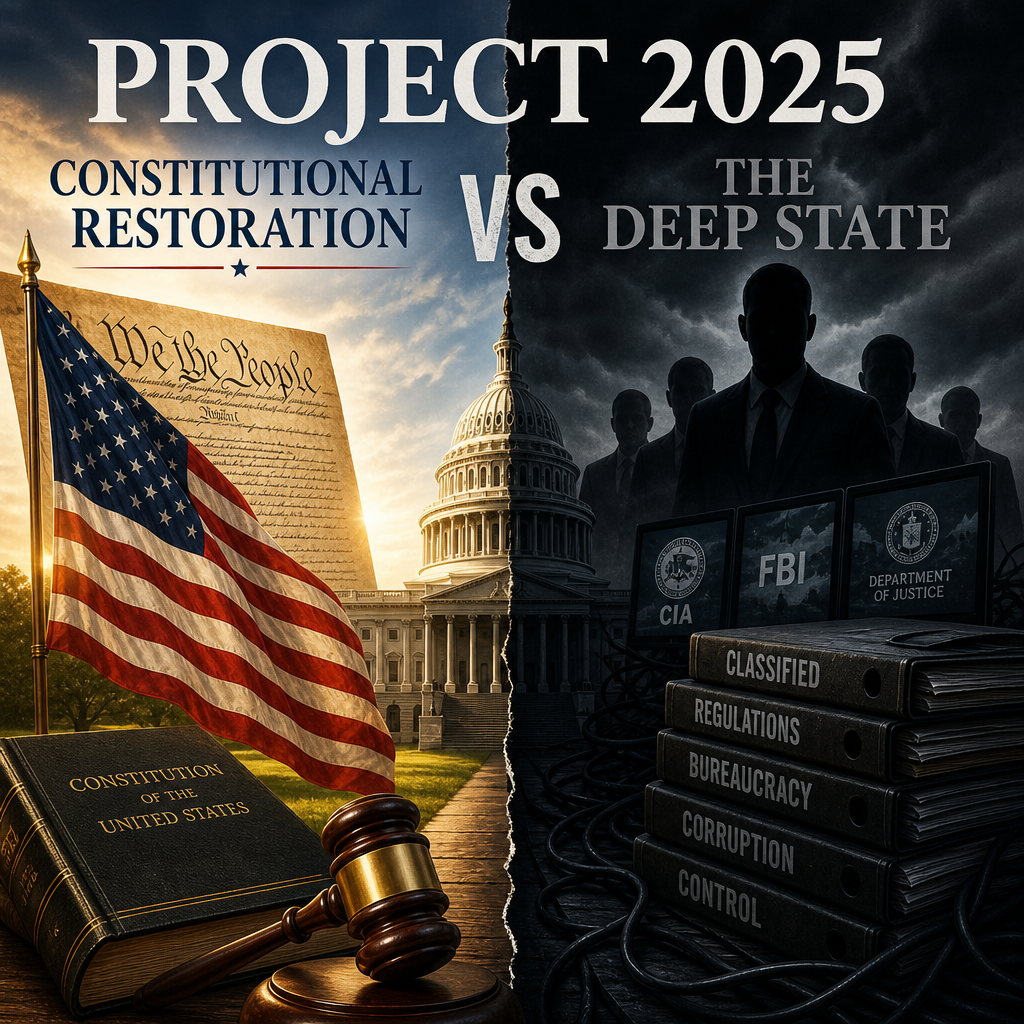
Restorationists argue that independent agencies are difficult to reconcile with the idea of a unified executive branch. Agencies such as the Federal Trade Commission and Federal Communications Commission exercise significant regulatory authority, while the Federal Reserve operates with a distinctive degree of independence. Supporters of independence contend that these arrangements protect technical decisions from short-term political pressure. Critics respond that policy choices are never purely technical when they impose costs, define rights, or determine which conduct will be punished. Project 2025 constitutional restoration places that disagreement within Article II.
The central issue is accountability. If an agency can make major policy decisions while its leaders are protected from direct presidential removal, voters may struggle to determine who is responsible. A president may be blamed for an agency action but lack sufficient authority to change it. Congress may conduct oversight but lack the time or agreement needed to manage daily administration. Courts may review the final rule but usually do not supervise the full policy process. Project 2025 constitutional restoration seeks to close this accountability gap.
Hamilton warned that divided executive authority could produce confusion and unaccountability. Restorationists apply that warning to modern agencies. They argue that a fragmented executive makes it easier for officials to shift blame, for interest groups to capture regulatory processes, and for agencies to expand their own jurisdiction. In this view, presidential supervision does not eliminate expertise; it places expertise within a chain of democratic responsibility. Project 2025 constitutional restoration reflects that argument.
A constitutional restoration program would therefore seek clearer lines of authority. It might strengthen appointment and removal powers, require agencies to justify major decisions publicly, limit informal guidance that functions like law, and insist that executive officials answer to the president for the policies they administer. The purpose would be to restore responsibility rather than to abolish every specialized institution. Project 2025 constitutional restoration presents these reforms as practical accountability measures.
2. Civil-Service Insulation and Article II
Modern civil-service protections were developed to reduce patronage and create a professional federal workforce. Those goals have legitimate importance. Government cannot function well if every change of administration replaces every employee, and public employees should not be punished simply for following lawful procedures or expressing protected views. Project 2025 constitutional restoration acknowledges this tension while questioning excessive insulation.
The restorationist objection concerns the boundary between professional protection and policy insulation. If senior officials can disregard presidential directives, delay implementation, leak internal disputes, or preserve an agency’s preferred agenda regardless of election results, then civil-service protections may operate as a practical veto. The president remains formally responsible, while the bureaucracy retains operational control. Project 2025 constitutional restoration treats that imbalance as a constitutional concern.
Project 2025 supporters argue that a president needs a team capable of carrying out the elected administration’s program. They favor clearer distinctions between career positions and policy-making positions, more reliable performance accountability, and procedures for addressing officials who deliberately obstruct lawful directives. Critics worry that such changes could politicize the civil service. The constitutional question is whether the current system has moved so far toward insulation that it undermines executive responsibility. Project 2025 constitutional restoration addresses that question directly.
A balanced approach would protect career expertise while distinguishing neutral administration from high-level policy implementation. Career employees should not be required to violate law or abandon professional standards. At the same time, officials who make major policy choices should not be able to claim permanent independence from the elected executive whose administration must answer to the public. Project 2025 constitutional restoration favors this distinction.
3. NGO Partnerships and Democratic Accountability
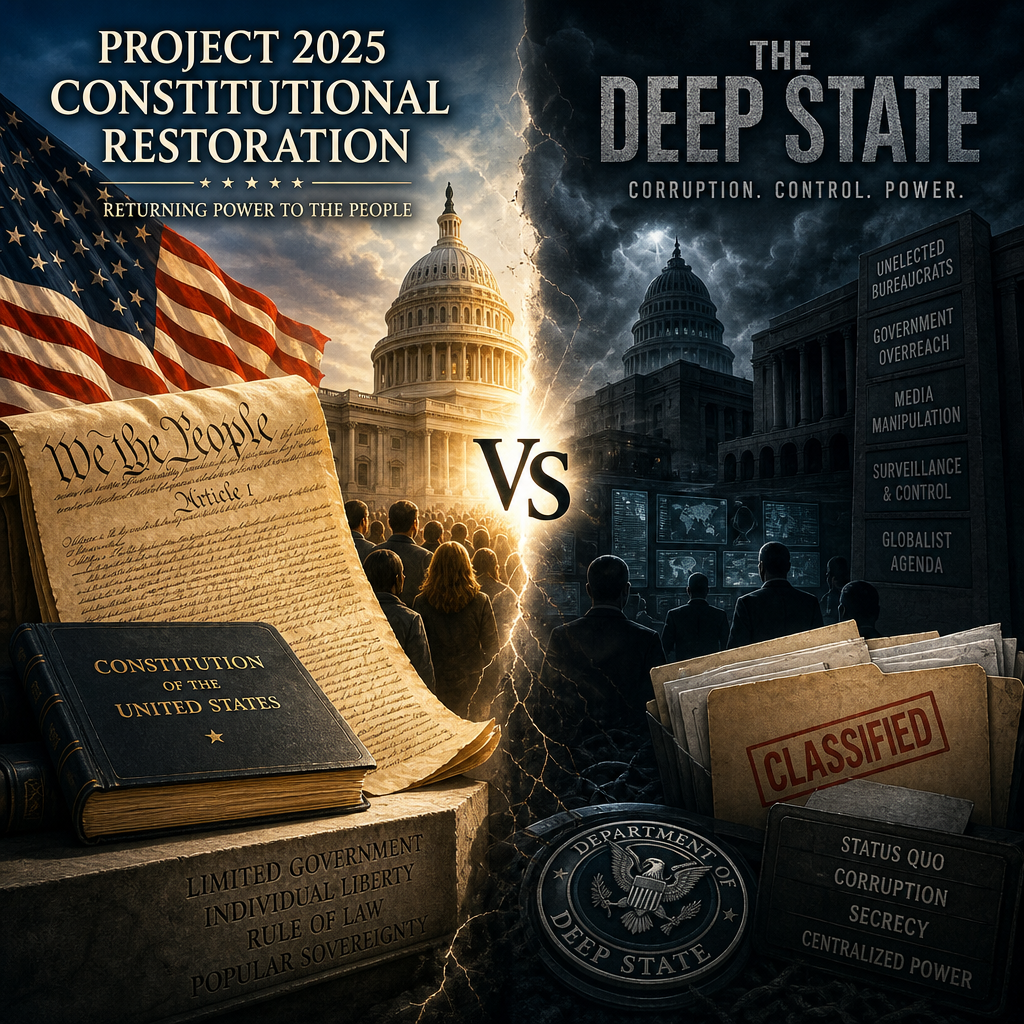
Non-governmental organizations influence public policy through research, litigation, public education, lobbying, grant-making, and partnerships with federal agencies. Groups such as the ACLU, Human Rights Campaign, Sierra Club, Planned Parenthood, the Southern Poverty Law Center, and large private foundations can shape the policy environment even though their leaders are not elected. Project 2025 constitutional restoration questions how much influence such partnerships should have.
Nonprofit participation is not inherently improper. Civil society organizations often bring expertise, identify abuses, represent communities, and challenge government action in court. The concern arises when agencies outsource policy development or enforcement priorities to organizations that are not subject to the same transparency and accountability requirements as government officials. Project 2025 constitutional restoration calls for clearer limits and disclosures.
Grant conditions, regulatory lobbying, administrative guidance, DEI and SOGI frameworks, and ESG compliance networks can create practical rules for employers, schools, contractors, and local governments. If those requirements are developed through informal partnerships rather than enacted by Congress or adopted through transparent rule-making, affected citizens may have limited opportunity to challenge them. Project 2025 constitutional restoration treats this as an accountability problem.
The restorationist position is that public power should remain traceable. Officials should disclose which private organizations helped develop a policy, what statutory authority supports it, how public funds are used, and which avenues exist for appeal. NGO expertise can inform government decisions, but it should not replace elected lawmaking or become a hidden route for imposing obligations on the public. Project 2025 constitutional restoration applies that transparency principle to public-private governance.
4. Administrative Rule-Making and Legislative Power
The Constitution assigns legislative power to Congress. Modern government, however, depends heavily on administrative regulations. Agencies write detailed rules, establish compliance programs, interpret statutory terms, investigate violations, and impose penalties. These activities may be necessary to administer complex laws, but they also raise the question of how much policy discretion Congress may delegate. Project 2025 constitutional restoration urges closer scrutiny of that delegation.
Restorationists argue that some regulations function as legislation without legislators. An agency may convert a broad statutory objective into thousands of pages of requirements affecting energy, labor, health care, education, finance, housing, or environmental policy. The agency’s decisions can determine what businesses may do, what institutions must fund, and what individuals may be penalized for doing. Project 2025 constitutional restoration seeks to return major policy choices to accountable lawmakers.
The objection is not simply that regulations are burdensome. It is that the process can weaken representation. Members of Congress must face voters, negotiate publicly, and vote on legislation. Agency officials usually do not face direct electoral review. When major policy choices move from Congress to agencies, citizens may lose the ability to identify who made the decision and how to reverse it. Project 2025 constitutional restoration frames this loss of traceable responsibility as a democratic defect.
A restorationist program would encourage Congress to legislate with greater specificity, limit delegations that contain no meaningful standards, require stronger review of economically significant rules, and prevent agencies from treating guidance documents as binding law. These reforms would not eliminate administration. They would seek to ensure that agencies administer laws rather than create a substitute legal order. Project 2025 constitutional restoration places that distinction at the heart of regulatory reform.
5. Judicial Deference and Chevron
Chevron v. Natural Resources Defense Council, decided in 1984, became associated with judicial deference to reasonable agency interpretations of ambiguous statutes. Supporters argued that agencies possess technical expertise and political accountability through the executive branch. Critics argued that deference transferred interpretive authority from courts to agencies and encouraged agencies to stretch statutory language.
The restorationist critique is that agencies should not be allowed to interpret, enforce, and adjudicate their own regulatory schemes with minimal independent review. When one institution performs all three functions, the separation of powers may become less meaningful. Agencies can select an interpretation, enforce that interpretation, and defend it in court while regulated parties bear the costs of uncertainty. Project 2025 constitutional restoration challenges this combination of institutional roles.
The Supreme Court’s later reconsideration of broad Chevron deference has strengthened the argument that courts, not agencies, must decide what the law means. That development does not automatically resolve every administrative-law dispute. Courts still must interpret statutes, agencies still must implement congressional commands, and Congress still must decide how much discretion is appropriate. It does, however, reinforce the principle that expertise does not replace legal authority.
Restorationists see the end of automatic deference as an opportunity to return interpretive responsibility to the judiciary and legislative responsibility to Congress. Their goal is not to prevent agencies from using expertise. It is to prevent expertise from becoming an independent source of lawmaking power. Project 2025 constitutional restoration treats independent judicial review as an essential safeguard.
V. Project 2025 constitutional restoration: The Restorationist Conclusion
Project 2025 aims, in the restorationist account, to restore Article II unity, reassert presidential control, reduce bureaucratic autonomy, limit NGO-driven governance, end automatic deference to agency interpretations, return lawmaking responsibility to Congress, and restore accountability to voters.
Its opponents view those goals as an attempt to weaken professional administration, remove safeguards, politicize enforcement, and concentrate authority in the presidency. That concern should be taken seriously because executive power can also be abused. A president who controls every administrative decision without legal limits could threaten liberty just as surely as an unaccountable bureaucracy can.
The restorationist response is that constitutional control is not the same as personal rule. Presidential authority remains bounded by statutes, appropriations, judicial review, congressional oversight, elections, impeachment, federalism, and individual rights. The argument is that those safeguards work better when the public can identify which officials are responsible for executive decisions.
The competing visions can be summarized this way:
- The Framers’ vision: a government of separated powers with a single, accountable executive responsible for executing federal law.
- The administrative-state vision: a professional and partially insulated network that uses expertise and continuity to manage complex public problems.
- The restorationist vision: a return to the constitutional architecture of 1787, with administrative expertise retained but subordinated to elected authority, statutory limits, and judicial review.
The disagreement is not merely over whether government should be effective. Both sides claim to support effective government. The disagreement concerns who should decide, who should answer for the decision, and what legal limits apply when an agency exercises public power.
VI. What Constitutional Restoration Would Change
Constitutional restoration would have practical consequences for federal administration. First, it would make presidential elections more consequential. If the president can select a governing team and direct executive officials, then voters can reasonably expect a change in administration to produce a change in enforcement priorities and regulatory policy.
Second, restoration would place greater pressure on Congress to perform its legislative role. Congress could no longer rely as heavily on broad delegations that leave agencies to fill in the central policy details. Legislators would need to state objectives, define standards, authorize programs, and accept responsibility for difficult choices.
Third, agencies would need to distinguish between advice and authority. Experts could still provide data, analysis, and technical recommendations. But the final policy decision would need to rest with officials who possess lawful authority and remain answerable through the constitutional system.
Fourth, citizens and regulated institutions could receive clearer notice of their obligations. When agencies rely on guidance, informal letters, settlement agreements, or grant conditions to establish policy, people may not know whether they are facing advice, a legal requirement, or an enforcement threat. A restorationist approach would favor published rules, statutory authorization, transparent procedures, and meaningful avenues for review.
Fifth, private organizations would remain active in public life but would have less ability to exercise government power indirectly. Advocacy groups could continue to lobby, litigate, publish research, and organize citizens. They would not, however, be treated as substitutes for Congress, accountable agencies, or judicially reviewable legal procedures.
These changes would also create risks. More presidential control could encourage abrupt policy changes, weaken continuity, or make agencies vulnerable to political pressure. A responsible restoration program would therefore need professional standards, records requirements, whistleblower protections, inspector-general oversight, due process, and strong judicial review. The goal would be accountable administration, not arbitrary administration.
VII. Final Assessment
The central claim behind Project 2025 constitutional restoration is that the United States cannot preserve constitutional government if the most consequential decisions are made by institutions that are insulated from elections and difficult for the public to supervise. The administrative state may provide expertise and continuity, but those benefits do not eliminate the need for legal authority, presidential responsibility, congressional lawmaking, and judicial review.
From this perspective, the conflict over Project 2025 is a conflict over the republic’s operating system. One side seeks to preserve a professional administrative network that can advance policy across election cycles. The other seeks to restore a more direct relationship between voters, elected officials, and executive action.
Calling the administrative system a “deep state” can obscure important distinctions, and claims about constitutionality require careful legal analysis rather than slogans. Nevertheless, the structural concern is clear: when agencies make rules, enforce them, interpret them, and resist elected direction, constitutional accountability becomes harder to locate.
The restorationist conclusion is that executive power should be unified enough for voters to assign responsibility, legislative power should remain with Congress, judicial power should remain independent, and administrative expertise should serve rather than replace the constitutional branches. Whether readers support or reject Project 2025, that institutional question deserves serious attention because it affects who governs after every election.
Leave a Reply