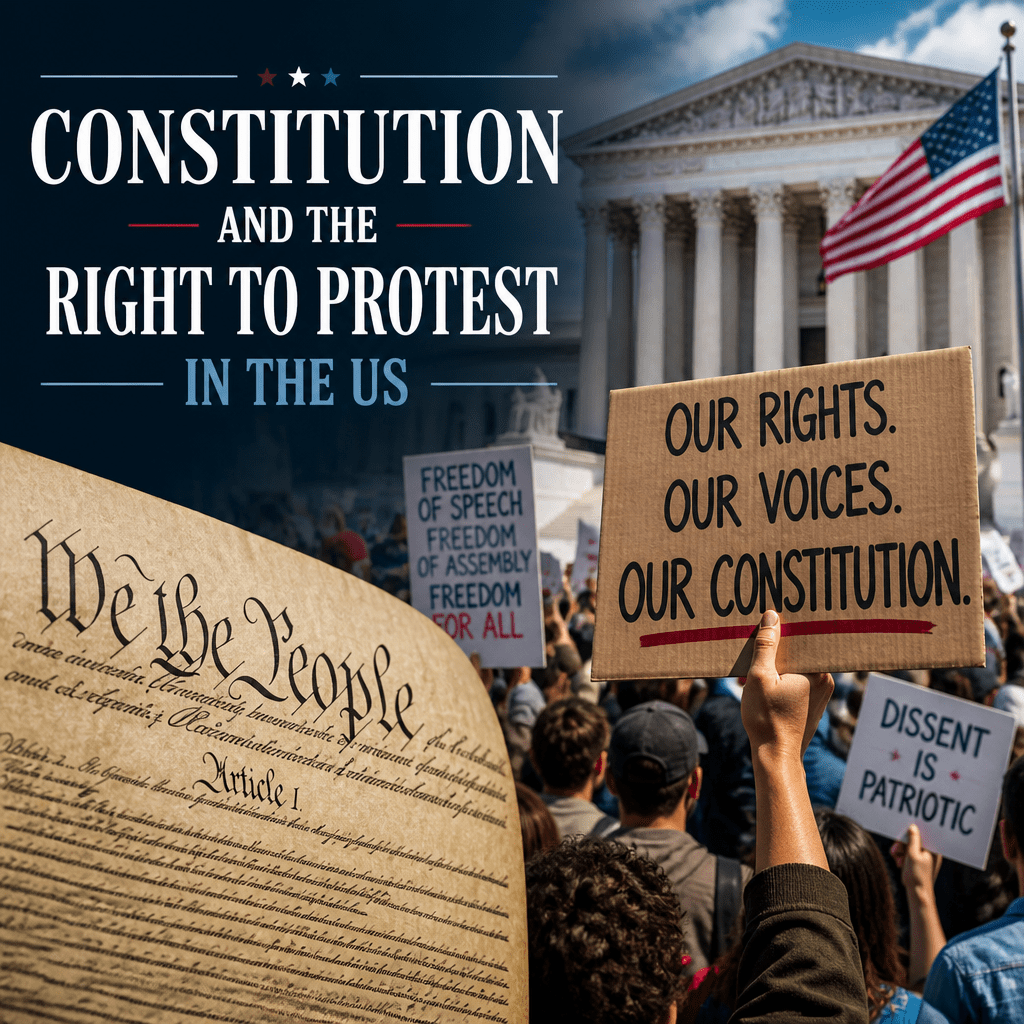
Constitution and the Right to Protest in the US
A lot of people get this wrong.
They assume the Constitution gives every person a blanket right to protest anywhere, anytime, and in any way they want. That is not true. The Constitution does protect speech, assembly, and petition, but those rights are not unlimited. Protest is allowed under the law, yet it is also regulated. The details matter, and understanding them helps clear up one of the most common misunderstandings about the Constitution and public demonstrations.
When people talk about protest rights in the United States, they are usually talking about the First Amendment in practice. That amendment is powerful, but it does not erase property rules, traffic laws, security restrictions, or other neutral laws that apply to everyone. A peaceful rally in a public park is very different from a disruptive event in a restricted space. The Constitution protects expression, not every possible method of expression.
What the Constitution Actually Protects
The First Amendment protects several related freedoms:
– Freedom of speech
– Freedom of the press
– Freedom of religion
– Freedom of peaceful assembly
– The right to petition the government
That is a broad list, and it is meant to be. But broad does not mean absolute.
You have the right to express your views. You have the right to gather with others. You have the right to ask the government for change. What you do not have is a right to ignore every law simply because your conduct is tied to a political message.
Courts have long recognized assembly as a protected liberty, but they have also allowed governments to regulate conduct through neutral rules. In constitutional law, that distinction is essential. Expression is protected. The specific method used to express that message can still be subject to reasonable limits.
That is why many protest disputes are not really about whether speech is protected. Instead, they are about whether the government response is lawful, neutral, and narrowly tailored. The Constitution does not operate in a vacuum. It works alongside ordinances, property rules, and judicial decisions that define how those freedoms apply in real life.
If you want a useful companion read on the Constitution itself, One Sentence Summary of the Constitution: Best Guide offers a concise overview of the broader framework.
Constitution and Protest Is Protected, But Not Unrestricted
This is the key point.
The Constitution does not give people a free pass to protest anywhere they want, at any time, without rules. Government can impose reasonable limits on protest activity, especially when public safety, traffic flow, emergency access, or order are at stake.
Authorities may regulate:
– Time of day
– Location
– Noise levels
– Crowd size
– Use of public streets
– Permits for large gatherings
These are often called content-neutral restrictions. That means the government is not banning the protest because of its message. It is regulating how the protest happens.
That distinction is central to constitutional law. A city may require a permit for a march that would block traffic or use amplified sound, while still allowing the same group to speak in a park or on a sidewalk. The law is focused on public order, not viewpoint suppression.
The same idea appears in everyday situations more often than people realize. A town may allow picketing near a public building during certain hours, but not permit a crowd to block fire lanes or emergency entrances. A university may allow students to assemble in designated areas while still enforcing rules against blocking classrooms. A courthouse may permit peaceful expression nearby while imposing strict limits inside the building itself.
Those are not violations of the Constitution. They are examples of how lawful regulation works. The government may preserve access, safety, and functionality as long as it does not single out a message for punishment.
Public Spaces Are Not the Same as Private Property
Many people also confuse public access with an unlimited right to protest.
A sidewalk, park, or street may be open to protest activity, but even public spaces can have rules. Private property is different. On private property, the owner has the right to control access. That means protestors usually cannot enter and remain there without permission.
Examples include:
– A rally in a public park may be lawful with a permit
– A march on a public street may be allowed with police coordination
– A protest inside a private store can lead to trespassing charges
So yes, the Constitution protects protest in a general sense. But it does not erase property rights or local laws.
It also helps to remember that not all public spaces are treated the same. A courthouse plaza, a transit station, and a city park are not identical in legal terms. Security concerns, traffic flow, and the ordinary use of the space all matter when officials set rules.
Private property adds another important point: owners are not required to convert their space into a protest site simply because a cause is politically important. The Constitution limits government censorship. It does not force private owners to surrender control over their property.
That matters in shopping centers, office buildings, apartment complexes, factories, and privately owned public accommodations. A protest near those places may be lawful in some circumstances, but the constitutional analysis is different from what applies on a public sidewalk or in a city park.
So when someone says, “I have a constitutional right to protest here,” the first question is always: here where? The answer determines which rules apply.
Peaceful Assembly Does Not Mean Any Behavior Is Protected
The First Amendment protects peaceful assembly.
That word matters.
If a protest becomes violent, destructive, or threatening, the legal protection weakens or disappears. Law enforcement can step in when conduct crosses the line.
Not protected:
– Assault
– Vandalism
– Arson
– Blocking emergency access
– Threats of violence
– Rioting
– Trespassing
Peaceful protest is protected. Criminal conduct is not.
That is a major difference, and it is often ignored in public debate.
A protest may be loud, disruptive, or highly visible and still remain lawful. But once it turns into intimidation, property damage, or obstruction that endangers others, the law treats it very differently. Courts and police departments focus heavily on specific conduct for exactly that reason. The Constitution is not judged by feelings alone. It is judged by facts.
For readers who want a plain-language reference on the First Amendment, the National Constitution Center has a clear overview here: National Constitution Center’s First Amendment explanation. It is a helpful source because it explains the principle without turning it into a slogan.
Government Can Set Reasonable Time, Place, and Manner Rules
The Constitution allows governments to place reasonable limits on protest activity.
These rules generally must be:
– Content-neutral
– Narrowly tailored
– Related to a significant government interest
– Leave open alternative ways to communicate
That means the government cannot silence a protest simply because it dislikes the message. But it can manage safety, traffic, and public order.
Examples of lawful restrictions may include:
– Requiring permits for large marches
– Limiting sound amplification near hospitals
– Restricting access to secure government areas
– Setting curfews during emergencies
These are not bans on protest. They are rules for how protest may occur.
Consider a rally outside a government building. Officials may require demonstrators to stay in a designated area, keep emergency entrances clear, and avoid blocking pedestrian paths. Those requirements do not erase the right to speak; they help preserve access and safety.
The Supreme Court has repeatedly approved this kind of framework. In constitutional terms, the question is not whether protest is allowed in the abstract. The question is whether the restriction serves a legitimate public purpose and applies fairly.
Permit systems are not automatically unconstitutional, either. A permit process can be lawful if it is administered evenly and does not give officials unlimited power to deny speech. In fact, a well-run permit system can protect protest rights by helping cities plan for traffic, sanitation, emergency access, and crowd control.
The Constitution Does Not Guarantee a Right to Interrupt Everything
Another common myth is that protest gives people the right to disrupt any event they want.
It does not.
You cannot claim a constitutional shield just because you are expressing an opinion. A protest at a public event, school, or government meeting can still be regulated if it interferes with order, safety, or the rights of others.
For example:
– Shouting down speakers may violate event rules
– Blocking entrances may be unlawful
– Disrupting a court proceeding can lead to penalties
– Refusing to leave after lawful orders may result in arrest
The Constitution protects expression. It does not protect unlimited disruption.
This matters because public institutions need room to function. Schools must teach, courts must hear cases, and meetings must proceed in an orderly way. If one person can shut down every forum by causing a disturbance, everyone else loses their own rights to participate.
At the same time, government cannot use “order” as a cover for viewpoint discrimination. The question is not whether officials dislike the message. The question is whether the rule addresses actual disruption in a neutral and proportionate way.
Why This Misunderstanding Matters
This issue matters because people often use the Constitution as a slogan instead of a legal standard.
They say, “I have a constitutional right to protest,” as if that ends the discussion. It does not.
The real questions are:
– Where is the protest taking place?
– Is it peaceful?
– Is it on public or private property?
– Is there a permit requirement?
– Are the rules content-neutral?
– Is the conduct lawful?
Those facts determine the legal answer.
In real life, misunderstanding the law can lead to unnecessary arrests, preventable conflicts, and bad advice repeated online. The better approach is to start with the First Amendment, then ask how local rules, property rights, and public safety concerns apply to the specific situation.
This misunderstanding also matters politically. When people overstate rights, they create frustration when lawful limits are enforced. When people understate rights, they encourage authorities to treat protected speech as if it were criminal behavior. Both errors damage trust.
That is why constitutional clarity matters in public life. Citizens do not need to memorize case citations to understand the basic principle, but they do need to understand that rights and restrictions can exist at the same time.
For readers interested in the larger issue of interpretation in public debate, Constitutional Interpretation and Public Trust: Why Clarity Matters is a useful companion piece.
The First Amendment Is Strong, But It Has Limits
The First Amendment is one of the strongest protections for expression in the world. That is true.
But strong protection is still not unlimited protection.
The Constitution balances free expression against other important interests, including:
– Public safety
– Traffic control
– Property rights
– Orderly government operations
– Access to public spaces
– Protection from violence and threats
That balance is why protest rights exist, but also why protest is regulated.
It is also why courts examine whether a rule targets speech itself or simply manages conduct. A curfew, a permit requirement, or a noise limit can be constitutional if it is applied fairly and leaves room for expression. But a rule that singles out one viewpoint for disfavored treatment raises serious constitutional problems.
A useful way to think about it is this: the government may regulate the setting, but not the viewpoint. It can care about where and how a protest occurs, but it cannot lawfully care only about whether officials like the cause.
That distinction is one of the clearest markers of constitutional legitimacy in protest cases. When a rule applies equally to everyone, it is easier to defend. When it changes depending on who is speaking, it becomes much harder to justify.
What Courts Look At in Real Disputes
When a protest case reaches the courts, judges usually begin with facts, not slogans.
Courts often ask whether:
– The protest occurred in a traditional public forum, a designated public forum, or a nonpublic forum
– The restriction was content-neutral
– The restriction served an important government interest
– The rule was narrowly tailored
– Alternative channels of communication remained available
– The conduct involved true threats, vandalism, trespass, or violence
These questions shape the outcome. They are also why simplified online arguments often miss the point.
For example, a city may lawfully regulate sound equipment near a hospital because of patient care and safety concerns. But if the same city bans only one political group from speaking because of its views, that is a different matter entirely. The first is regulation. The second is censorship.
Court decisions often turn on this difference. Even when the government has a legitimate reason to regulate, it still has to do so carefully. The Constitution does not allow overreach simply because the government can point to a good intention.
That is why protest law is so fact-specific. What is permitted in one place may be unlawful in another. What is allowed at one time may be restricted during an emergency. What is protected as speech may lose protection when it becomes a threat or a trespass.
How Free Speech and Public Order Coexist
People often talk as if free speech and public order are opposites. They are not. In a constitutional system, they are meant to coexist.
Public order gives expression a workable space. Free speech gives public order legitimacy. Without order, protests can become unsafe and chaotic. Without speech, government power becomes too easy to abuse.
That is why the law seeks a middle ground:
– Enough freedom to speak honestly
– Enough structure to keep events safe and functional
– Enough neutrality to prevent viewpoint discrimination
– Enough enforcement to stop actual criminal conduct
This balance is not always neat, but it is the constitutional design.
A protest that obeys lawful rules can be one of the most powerful forms of civic participation in the United States. It can influence public opinion, draw attention to injustice, and pressure officials to respond. Those are important democratic functions. But they remain lawful only because they operate inside a system of rules that protects everyone’s rights, not just the loudest voice in the crowd.
When the system works properly, protest is not suppressed and order is not abandoned. Both survive because neither is treated as absolute.
Bottom Line
Here is the truth:
There is no absolute constitutional right to protest without limits in the United States.
The Constitution protects peaceful speech, assembly, and petition. But it does not give people the right to break laws, violate property rights, ignore permit rules, or create unlawful disruption.
So the point is not that protest is unprotected. It is that protest is not unlimited.
That is where a lot of people have it twisted.
When you strip away the slogans, the rule is straightforward: protest is protected as a form of expression, but it remains subject to lawful, content-neutral regulation. That is the balance the Constitution was built to preserve.
Understanding that balance helps keep public debate honest. It (Incomplete: max_output_tokens)