
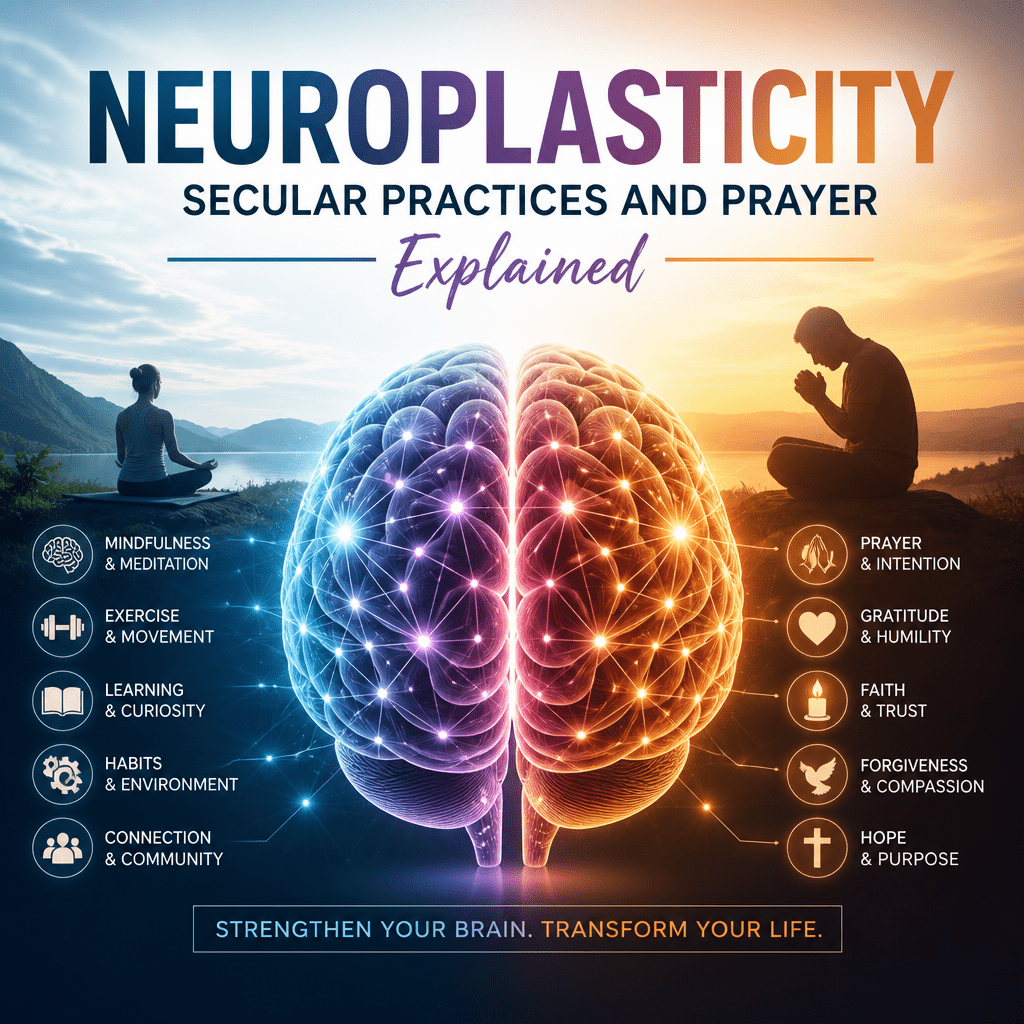
Neuroplasticity: secular practices and prayer both point to one of the most hopeful truths in modern science: the brain can change. It is not fixed, and it is not locked into one pattern of thought, emotion, or behavior. Through repeated experience, focused attention, and emotional training, the brain can adapt and reorganize itself over time. That means people from many different worldviews can pursue meaningful change through discipline, repetition, and intentional practice.
Neuroplasticity: secular practices and the science of brain change
Neuroplasticity refers to the brain’s ability to rewire itself in response to experience. This is not a metaphor. It is a biological reality shaped by neural activity, learning, and repetition. The more often a pathway is used, the more likely it is to strengthen. The less a pathway is used, the more likely it is to weaken.
This is why habits matter so much. It is also why attention, emotion regulation, and consistent mental practice are so powerful. Neuroplasticity: secular practices is a useful framework because it explains how ordinary routines can create long-term changes in the brain.
Several core mechanisms make this possible:
– Synaptic strengthening: frequently used connections become stronger
– Pruning: weak or unused connections are reduced
– Cortical remapping: brain regions can adapt based on experience
– Hebbian learning: neurons that fire together wire together
– Long-term potentiation: repeated activation strengthens synapses
– Long-term depression: less-used connections weaken over time
– Default Mode Network modulation: self-focused mental activity can decrease, reducing rumination
Together, these processes help explain why people can grow, recover, and develop new mental habits. The brain learns through repetition, and that is the foundation of neuroplasticity: secular practices.
How prayer influences the brain
Many religious traditions describe prayer as deeply transformative, and neuroscience helps explain why. Prayer is more than a spiritual ritual for many people; it can also function as a form of mental training. In repeated prayer, a person often practices focus, surrender, gratitude, hope, and emotional regulation.
According to the source material, prayer may:
– Quiet the amygdala, reducing fear and stress
– Strengthen the prefrontal cortex, improving self-control and clarity
– Reduce Default Mode Network activity, lowering rumination
– Increase positive neurotransmitters such as dopamine, serotonin, and oxytocin
– Tune the Reticular Activating System toward goals, values, or spiritual attention
These effects show that prayer can influence the brain in real and measurable ways. But just as importantly, they also reveal something broader: the brain responds to repeated, intentional practice. That is where neuroplasticity: secular practices becomes especially relevant.
Secular practices that produce the same neuroplastic effects
Many non-religious practices can produce similar benefits. The language may be different, but the underlying mechanisms often overlap. Whether a person is praying, meditating, journaling, or exercising, the brain can respond in remarkably similar ways when the practice is repeated consistently.
Emotional regulation and amygdala down-regulation
The amygdala plays a major role in fear detection and stress response. When it is overactive, people often feel anxious, reactive, or overwhelmed. Practices that calm the nervous system can help reduce this reactivity.
Secular practices that support emotional regulation include:
– Mindfulness meditation
– Breathwork
– Cognitive reappraisal from CBT
– Progressive muscle relaxation
– Brief daily pauses for calm breathing
These habits train the brain to respond more thoughtfully and less impulsively to stress. Over time, they can reduce emotional reactivity and increase resilience. This is one of the clearest examples of neuroplasticity: secular practices at work.
Executive function strengthening through the prefrontal cortex
The prefrontal cortex supports planning, judgment, concentration, and self-control. Like a muscle, it grows stronger with deliberate use. Mental training that requires focus and follow-through can reinforce these abilities.
Helpful secular practices include:
– Focused attention training
– Journaling
– Metacognitive reflection
– Working memory exercises
– Goal tracking
– Structured daily routines
These practices improve clarity and decision-making. They also support better self-regulation, which is why routine often feels stabilizing. Repeated use of these skills strengthens the systems associated with neuroplasticity: secular practices.
Reduced rumination through Default Mode Network quieting
The Default Mode Network becomes active when the mind wanders, especially during self-referential thinking. A certain amount of mind wandering is normal, but too much can fuel rumination, worry, and mental fatigue.
Secular practices that help reduce this pattern include:
– Meditation
– Flow states in music, art, or sports
– Sensory grounding
– Mindful walking
– Single-task concentration
– Quiet reflection without multitasking
These practices bring attention back to the present moment and reduce repetitive mental loops. That can make the mind feel calmer, clearer, and more usable. Again, this is a major benefit associated with neuroplasticity: secular practices.
Positive neurochemistry and emotional reinforcement
Certain habits support neurotransmitters linked to motivation, well-being, and social connection. When people feel good after a practice, they are more likely to repeat it, which helps reinforce the habit and the neural pathway behind it.
Secular practices that promote positive neurochemistry include:
– Exercise
– Acts of kindness
– Gratitude journaling
– Social bonding
– Cooperative group activities
– Consistent sleep and recovery habits
These practices can improve mood while also reinforcing patterns of healthy behavior. They help create a self-sustaining cycle: the practice feels rewarding, so it becomes easier to continue. That is another reason neuroplasticity: secular practices is so practical.
Attentional tuning and the Reticular Activating System
The Reticular Activating System helps the brain filter information and prioritize what deserves attention. When you repeatedly focus on a goal, your brain becomes more likely to notice relevant opportunities, cues, and patterns.
Secular practices that support this include:
– Goal visualization
– Daily intention-setting
– Affirmations without spiritual framing
– Planning routines
– Habit stacking
– Reviewing priorities at the start of the day
These habits shape what the mind notices and values. Over time, they can influence behavior in very concrete ways. This makes neuroplasticity: secular practices a useful tool not just for inner peace, but for real-world follow-through.
Why both paths work
Prayer and secular practices may look different on the surface, but they often work through the same cognitive architecture. The difference is usually meaning, not mechanism.
Both paths involve:
– Directed attention
– Emotional regulation
– Cognitive reinforcement
– Repetition
That combination is what drives neuroplastic change. Prayer may involve trust, gratitude, surrender, or devotion. Secular practice may involve mindfulness, reflection, or intention-setting. But both can repeatedly activate the brain in ways that reshape thought and behavior.
In other words, neuroplasticity: secular practices does not compete with prayer. It explains how many of the same brain changes can happen through a different lens.
Implications for inclusivity and mental health
This understanding has practical value because it respects people with different worldviews. Transformation is not limited to one belief system.
For believers, prayer can be valued not only as a spiritual discipline, but also as a brain-shaping one.
For non-believers, similar benefits can be accessed through secular practices that do not require religious language.
For communities and institutions, the lesson is clear: mental health support is stronger when it includes multiple pathways. Schools, churches, counseling programs, and community groups can better serve people when they offer both spiritual and secular tools for growth. This is where neuroplasticity: secular practices becomes a bridge between science, faith, and everyday life.
It also encourages mutual respect. A person can appreciate the discipline behind prayer without adopting its theology. A person of faith can appreciate the science behind secular habits without feeling that those habits threaten spiritual practice. Both perspectives can coexist.
Additional secular pathways worth considering
Beyond meditation, journaling, and breathwork, many ordinary habits also support healthy brain change.
Reflection, walking, creative work, limiting overstimulation, sleep, nutrition, and movement all matter. These practices may seem simple, but simplicity is not weakness. Repeated consistently, they can strengthen self-regulation and support better decision-making.
Creative work deserves special attention. Writing, drawing, music, and hands-on building can create flow states that quiet mental noise and deepen concentration. These moments of absorption can support the same kinds of neural changes discussed throughout this article.
Sleep and physical health are equally important. A rested brain learns better, remembers more efficiently, and adapts more effectively. Nutrition and movement provide the biological support that makes learning possible.
Social connection also plays a major role. Shared meals, honest conversation, teamwork, and service help shape trust, belonging, and emotional stability. Because the brain is social, healthy relationships can leave a lasting imprint.
All of this reinforces the same truth: small practices, repeated over time, can reshape the brain in significant ways.
Conclusion
Neuroplasticity is universal. The brain changes through repeated experience, focused attention, and emotional training.
Prayer is one powerful pathway to that change, but it is not the only one. Neuroplasticity: secular practices can produce many of the same benefits through the same underlying biological mechanisms.
That is why the most useful approach is often a pluralistic one. People should be free to choose the method that fits their worldview while still benefiting from the science of brain change.
Whether through prayer or secular practices, the human brain is capable of remarkable transformation.