
The American Republic was built on a grammar of clarity. Its founders wrote with discipline, using evidence, proportion, and constitutional restraint to organize public life. They expected citizens to distinguish truth from narrative, fact from feeling, and duty from impulse. That expectation now feels fragile. The conflict is not simply partisan; it concerns the habits people use to interpret reality, evaluate evidence, and respond to uncertainty. This article examines how cognitive style shapes civic judgment and why a constitutional republic requires both emotional maturity and disciplined reasoning.
Table of Contents

The Republic Was Built on Reality
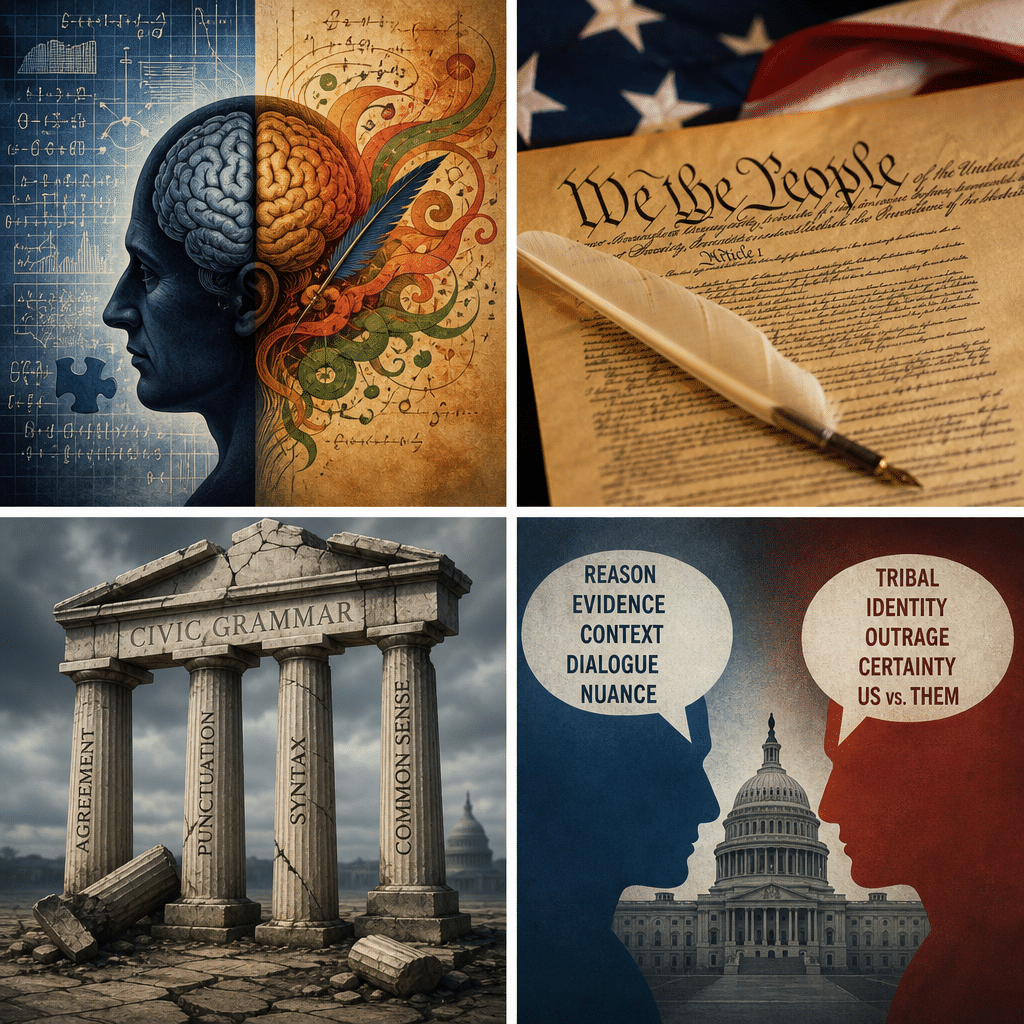
The American system depends on a shared public grammar. That grammar includes evidence before emotion, facts before feelings, law before narrative, proportion before outrage, and responsibility before blame. This is not coldness or a lack of empathy. It is a method of self-government.
A constitutional republic cannot survive if citizens lose the ability to distinguish what is true from what is merely compelling. It cannot function if every conflict becomes a story of moral identity. It cannot remain free if emotion replaces judgment. The institutions of a republic assume that public claims can be tested, disputed, corrected, and evaluated according to standards that do not change with every person’s private experience.
The founders understood that liberty required restraint. Rights required limits, and law had to stand above sentiment. Their political vision depended on a citizenry capable of disciplined thought.
The constitutional order was not designed to eliminate disagreement. It was designed to give disagreement a lawful structure.
That structure depends on a shared relationship with reality. People may disagree about policy, values, history, or the proper balance between liberty and security. Yet disagreement becomes destructive when participants no longer accept any common standard for deciding whether a claim is accurate. Without that standard, debate becomes a contest between competing loyalties rather than an effort to discover what is true. A healthy cognitive style keeps that common standard visible even when political disagreement becomes intense.
The idea of cognitive style helps explain this problem. It describes the habitual way a person interprets events, weighs evidence, handles uncertainty, and responds to pressure. It does not perfectly describe every individual, and no citizen fits neatly into a single category. Still, the distinction is useful when examining the tendencies that shape public life. In civic life, cognitive style influences whether disagreement becomes a search for truth or a contest for emotional validation.
Readers interested in the relationship between instinct, emotion, and political judgment can also explore the reflexive mind and its evolutionary influences.
Two Cognitive Styles in American Life
A cognitive style is the habitual way a person interprets the world. It shapes reactions to evidence, conflict, authority, and uncertainty. In broad terms, two styles now compete for influence in American life: an objective, reality-oriented approach and a narrative-driven, emotionally organized approach. That cognitive style distinction concerns tendencies rather than permanent categories or judgments about intelligence.
1. Objective Cognitive Style
The first style is grounded in external reality. It asks what happened, what the evidence shows, what the likely consequences are, what response is proportionate, and what the law requires. It values clarity, restraint, and accuracy. It does not deny emotion, but it does not allow emotion to lead the investigation.
This approach supports constitutional reasoning, scientific inquiry, engineering, law, journalism, and institutional stability. Each of these fields requires people to compare claims with evidence and to accept correction when a claim fails. None is perfect. Human beings remain biased, and institutions can be corrupted. The method is valuable because it provides a way to identify and correct error. This cognitive style therefore relies on standards that remain open to examination and revision.
Objective reasoning also creates room for disagreement without immediate condemnation. A person can reject a policy without treating its supporters as evil. A court can reject a claim without declaring the claimant worthless. A citizen can acknowledge suffering while still asking whether the proposed explanation is supported by facts. That separation between compassion and verification is essential to fair judgment.
2. Narrative-Driven Cognitive Style
The second style is grounded in internal emotional coherence. It asks how an event feels, what story explains it, who a person is within the conflict, and which side affirms that identity. Narrative gives events meaning and can help communities express genuine suffering. It becomes dangerous, however, when loyalty to a story replaces loyalty to truth.
This style is not necessarily malicious, and it is not automatically unintelligent. Every person uses stories to understand experience. The problem begins when a compelling narrative is treated as proof. Under pressure, a person may confuse accusation with guilt, outrage with justice, identity with truth, feeling with evidence, or moral storytelling with analysis. Here, cognitive style becomes consequential because it determines whether the story remains subject to correction.
A narrative-driven response often seeks immediate validation rather than careful correction. It wants an explanation that restores emotional order, even when the facts remain incomplete. Uncertainty feels like indifference, and a request for evidence can be interpreted as hostility. This makes the approach especially unstable during crises, when information is partial and emotions are intense.
The difference is not that one group feels and another does not. Objective thinkers experience anger, fear, grief, and compassion. The difference concerns which faculty has final authority. In a disciplined public culture, emotions can identify concerns and motivate action, but evidence and law determine what happened and what response is justified.

Why Cognitive Style Matters
Cognitive style is not a minor personal preference. It has public consequences. The habitual way citizens process information affects elections, institutions, family relationships, journalism, education, and the public response to crisis. Because cognitive style influences both interpretation and action, private habits of thought can eventually alter public institutions.
A citizen who relies on evidence-oriented reasoning is more likely to wait for information, respect due process, avoid panic, distinguish the personal from the political, and accept inconvenient facts. Such a person can still be passionate. The discipline lies in refusing to make passion the sole test of truth. This cognitive style favors verification without requiring indifference to suffering.
A citizen who relies heavily on narrative is more likely to react quickly to emotionally charged claims, interpret disagreement as hostility, reduce complex events to moral theater, confirm identity through group loyalty, and treat discomfort as proof of injustice. These tendencies do not make someone permanently irrational. The cognitive style at issue describes risks that can affect anyone when fear, anger, or social pressure becomes intense.
The public consequences become serious when entire institutions reward the most emotional interpretation of an event. News organizations may emphasize conflict because it attracts attention. Political campaigns may frame every election as an existential struggle. Online platforms may amplify outrage because outrage produces engagement. Citizens then receive a distorted picture of public life and begin to mistake visibility for importance. In this environment, cognitive style can become a powerful factor in determining which claims receive attention.
When objective reasoning weakens, institutions become unstable. When narrative replaces evidence, politics becomes theater. When feeling becomes proof, civic trust collapses. A society can survive strong disagreement, but it cannot easily survive disagreement in which no shared method exists for distinguishing a true claim from a convenient one.
The Danger of Emotional Truth
Modern politics often treats emotion as a form of authority. This can sound compassionate and humane. Personal experience matters, and genuine pain deserves to be heard. But emotional testimony and factual proof are not identical. A feeling can be authentic without providing a complete explanation of an event. A cognitive style that respects both experience and verification can recognize this distinction.
If feelings become evidence, every grievance can become a verdict, every conflict can become oppression, every disagreement can become betrayal, and every accusation can demand immediate belief. That is not justice. It is volatility. Justice requires a process that can distinguish serious wrongdoing from misunderstanding, deliberate harm from accident, and legitimate criticism from exaggeration.
A free society cannot operate on emotional reflex alone. Courts require standards. Elections require rules. Policing requires evidence. Public debate requires proportion. Even compassionate policy must account for consequences, trade-offs, costs, and the rights of people who may be affected indirectly.
The danger is not emotion itself. Emotion can alert people to suffering that formal systems overlook. It can inspire courage, solidarity, and generosity. The danger arises when emotion is detached from fact and granted authority over every other form of judgment. At that point, the strongest reaction wins, regardless of whether it is accurate or constructive.
A healthier public culture treats emotion as information rather than a verdict. Anger may indicate that a person believes a wrong has occurred, but further inquiry is needed to determine whether the belief is justified. Fear may reveal a perceived danger, but evidence is needed to estimate its probability. Compassion may motivate assistance, but practical judgment is needed to decide which assistance will work. This cognitive style preserves the moral value of emotion while limiting its authority over factual conclusions.
Why the Republic Needs Objective Reasoning

The Republic does not ask citizens to eliminate feeling. It asks them to govern feeling. That distinction matters. Objective reasoning does not deny human pain or dismiss compassion. It insists that reality must be evaluated before it is morally interpreted and that proposed solutions must be judged by their results.
This is the foundation of responsible citizenship. A disciplined cognitive style helps a nation preserve constitutional order, protect individual rights, maintain institutional legitimacy, reduce hysteria, and respond proportionately to crisis. It creates a pause between stimulus and action, allowing citizens to consider whether a reaction will solve a problem or make it worse. At its best, this cognitive style joins emotional awareness with factual discipline.
That pause is a civic resource. In a crisis, rumors travel faster than verification. A dramatic image can create an immediate impression that later evidence does not support. Leaders may exploit fear to justify extraordinary measures, while activists may exploit anger to excuse destructive conduct. Citizens who value careful judgment are more likely to ask what is known, what remains uncertain, and who benefits from a particular interpretation.
The founders understood that freedom without discipline could become chaos. Self-government requires self-command. The constitutional system distributes power because no person or faction can be trusted with unlimited authority. The same principle applies to the individual mind: no single impulse, grievance, party, or narrative should be allowed to govern without review.
External standards strengthen this habit. The National Archives transcript of the United States Constitution provides a primary source for examining the framework of limited government, separated powers, and constitutional responsibility. Returning to primary sources can help citizens distinguish the actual structure of an institution from the simplified stories told about it.
The Problem With Narrative Loyalty
Narrative can be powerful. It gives events meaning, organizes identity, and creates social belonging. Families, movements, political parties, and nations all rely on stories to explain where they came from and what they hope to become. A shared story can encourage sacrifice and cooperation.
But narrative becomes dangerous when loyalty to the story replaces loyalty to truth. This happens when a person stops asking, “Is it true?” and begins asking only, “Does it serve the story I live by?” At that point, facts become negotiable, evidence becomes selective, and disagreement becomes a threat to identity. A cognitive style organized around narrative loyalty can make correction feel like betrayal.
The resulting behavior can be destructive. People may excuse harmful conduct if it fits the preferred narrative, reject valid criticism if it challenges group identity, interpret every event through political symbolism, or confuse intensity with moral depth. The same action may be praised or condemned depending entirely on which side performed it.
This double standard erodes legitimacy. A republic cannot endure if the law is considered fair only when it benefits one’s faction. Public trust cannot survive if identity matters more than evidence. Civic peace cannot last if every disagreement becomes a battle between competing moral myths.
Narrative loyalty also makes learning difficult. If a person’s identity depends on being correct, new information feels like a personal attack. The person may move the goalposts, question the motives of the source, or search for an exception that protects the original belief. These defenses are understandable, but they prevent the correction of error. Changing cognitive style begins with separating personal worth from the accuracy of any single belief.
Intellectual humility offers a better alternative. It does not require citizens to abandon convictions or treat all claims as equally credible. It requires them to acknowledge that strong beliefs can still be mistaken and that a responsible person must be willing to revise a conclusion when the evidence changes.
Cognitive Responsibility Is a Civic Duty
There is a moral dimension to cognition. To think responsibly is not just an intellectual choice; it is a civic duty. Other people live with the consequences of our beliefs, votes, accusations, public statements, and political demands.
Cognitive responsibility means respecting reality, accepting evidence, staying proportionate, avoiding emotional distortion, and distinguishing truth from preference. It does not require cruelty or cynicism. It requires maturity. A mature citizen can feel deeply and still think clearly.
That maturity includes several practical habits. First, separate observation from interpretation. “The event occurred” is different from “the event proves this motive.” Second, distinguish probability from certainty. Most public decisions must be made with incomplete information. Third, seek disconfirming evidence rather than only supportive evidence. Fourth, judge comparable cases by comparable standards. Finally, consider consequences before endorsing a dramatic response.
Cognitive style also affects how people treat opponents. If disagreement is interpreted as evidence of corruption or hatred, conversation becomes impossible. If disagreement is treated as an opportunity to test assumptions, debate can improve understanding even when no consensus emerges. A constitutional republic needs citizens who can oppose one another without demanding that one side be erased.
Without cognitive responsibility, people become easy to manipulate. They are pushed by media, parties, slogans, and carefully selected images. They react instead of judging. They become politically active but intellectually unmoored. That is how republics weaken from within: not necessarily through one dramatic act, but through the gradual abandonment of standards that once made correction possible.
Education should therefore teach more than information. It should teach source evaluation, probability, historical context, logic, and the difference between primary evidence and commentary. A responsible cognitive style develops through repeated practice rather than slogans alone. Families and communities can reinforce those habits by rewarding honest uncertainty instead of pretending to possess perfect knowledge. Institutions can help by explaining decisions clearly and correcting errors publicly.
The Restorationist Argument
The Restorationist project is not about defeating people. It is about restoring the grammar of self-government. That means restoring careful speech, accurate judgment, constitutional reasoning, respect for evidence, and emotional discipline. The cognitive style needed for restoration combines restraint, verification, humility, and personal responsibility.
The goal is not to eliminate difference. The goal is to preserve a shared reality in which differences can be negotiated without violence or permanent institutional paralysis. A nation can survive disagreement. It cannot survive the collapse of reality-testing.
Restoration begins when citizens remember that there is one reality, facts do not depend on identity, law must stand above feeling, truth is not created by narrative, and freedom requires restraint. These principles do not solve every political dispute. They provide the conditions under which disputes can be addressed honestly.
Restoration also requires self-criticism. It is easy to identify emotional reasoning in an opposing faction while overlooking it in one’s own. Every political community creates stories that flatter its members and simplify its enemies. No cognitive style deserves exemption from evidence, consistency, or correction. The demand for evidence must therefore apply across party, class, race, ideology, and personal loyalty.
The project is practical as well as philosophical. Citizens can slow the spread of unverified claims, read beyond headlines, consult primary documents, distinguish policy criticism from personal attack, and demand consistent standards from leaders. This cognitive style becomes credible through daily choices rather than abstract declarations. Institutions can publish supporting evidence, acknowledge uncertainty, and make it easier for the public to see how decisions were reached. In this sense, cognitive style is cultivated through ordinary habits of verification and restraint.
These habits may appear modest compared with the scale of national conflict. They are not. Self-government is sustained through ordinary acts of restraint repeated by millions of people. Each time a citizen refuses to convert anger into an accusation, checks a claim before repeating it, or accepts an inconvenient fact, the public grammar becomes a little stronger.
Conclusion
The American Republic was not built for emotional certainty. It was built for disciplined freedom. That freedom depends on a shared commitment to reality, citizens who can distinguish evidence from narrative, and a culture that values truth over self-validation.
The central challenge is not to suppress emotion or make every citizen think alike. It is to place emotion within a larger framework of evidence, law, proportion, and responsibility. A healthy cognitive style allows compassion without surrendering judgment and conviction without abandoning correction.
There is only one reality, even though people interpret their experiences differently. There is only one responsible way to engage that reality: with clarity, proportion, humility, and constitutional reason. The Republic can survive disagreement when citizens retain those habits.
That cognitive style is the one the Republic requires. It is also the lost grammar that must be restored.Lost Moral Grammar: Stunning Best Civic Renewal Guide
Leave a Reply