

Media Bias and Shared Truth now sit at the center of America’s civic crisis. Modern progressivism rarely announces itself through direct state ownership of industry or an openly revolutionary program. Instead, it often works through state-mediated influence over private institutions, cultural standards, media narratives, administrative rules, and legal interpretation. The result is a gradual cultural transformation that can change the nation’s economic and civic foundations without a single dramatic seizure of power.
Table of Contents
This process is difficult to recognize because its language is usually moderate. Facts about media bias and shared truth remain contested even when factories are privately owned, religious institutions remain legal, and elections continue to occur. Courts still issue opinions, and news organizations still publish stories. Yet the incentives surrounding these institutions can shift until familiar forms carry different meanings. The central question is therefore not only who owns an institution, but who sets its boundaries, rewards its compliance, defines its acceptable language, and determines which events deserve public condemnation.
The same pattern appears in civic religion. Media bias and shared truth influence whether the removal of religious language from public rituals is described as neutrality, inclusion, or cultural transformation. Progressivism does not generally require the abolition of personal faith. It can, however, seek to remove religious language from public rituals, national symbols, and shared ceremonies. That change may be presented as neutrality, inclusion, or modernization. Critics see something different: an effort to redefine the moral vocabulary through which citizens understand duty, sacrifice, justice, and the nation itself.
These developments help explain why the country’s two political halves increasingly inhabit different narrative frameworks. Media bias and shared truth shape how citizens decide which facts matter, which institutions are legitimate, and which historical memories deserve emphasis. They do not merely disagree about policy. When every event arrives through a competing story, a shared factual record becomes fragile. That fragility weakens public trust and makes institutional drift easier to normalize.

Media Bias and Shared Truth: The Central Conflict
In a functioning constitutional republic, citizens can disagree about what should happen while still maintaining a basic agreement about what happened. That agreement does not require identical opinions or perfect neutrality. It requires a common factual floor: a reasonably shared understanding of dates, actions, procedures, evidence, and official decisions. Media bias and shared truth are therefore central to constitutional legitimacy.
That floor has become increasingly unstable. Facts are now filtered through partisan identity, institutional loyalty, and media environment before they reach the public. A court ruling may be presented as a defense of constitutional order by one outlet and as proof of judicial capture by another. A protest may be described as democratic expression, civil unrest, or political violence depending on the audience. An election procedure may be treated as a necessary emergency measure by one side and an unlawful shortcut by the other. These disputes show why media bias and shared truth cannot be separated from public trust.
The dispute is not only about individual errors. It concerns narrative dominance: the power to establish the frame through which an event is interpreted. Once a frame becomes dominant, facts that support it receive repetition, while facts that complicate it may be minimized or treated as distractions. Over time, framing becomes a form of political power, and media bias and shared truth become part of the struggle over institutional authority.
This does not mean that every news organization is equally biased or that every competing claim has equal merit. It means that citizens should distinguish between evidence and interpretation. A responsible media culture identifies the source of a claim, separates confirmed facts from allegations, reports uncertainty honestly, and applies comparable standards across political groups. When those practices weaken, shared truth becomes less a public inheritance than a partisan possession. The relationship between media bias and shared truth deserves careful scrutiny rather than reflexive certainty.
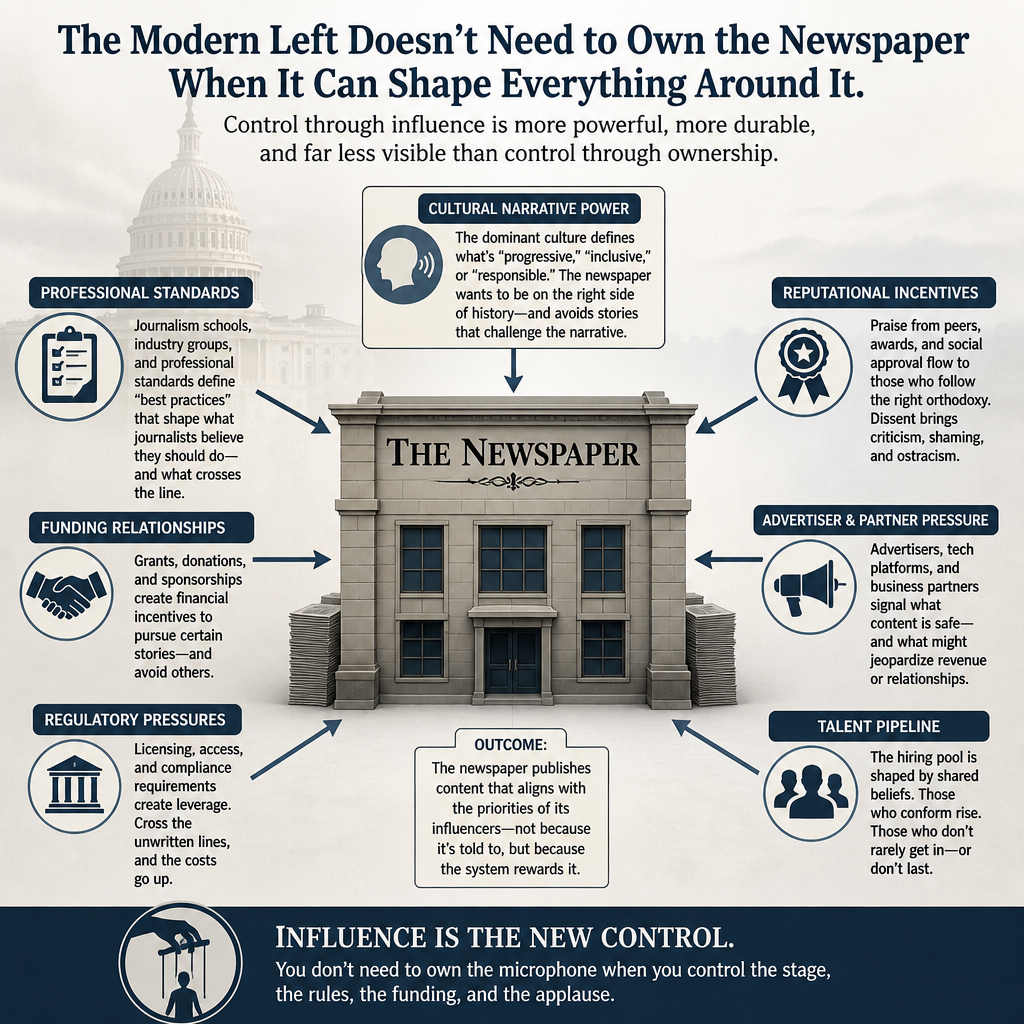
A Politics of Mediation, Not Seizure
The modern American left often operates through influence rather than ownership. It does not need to nationalize a newspaper when it can shape the professional standards, funding relationships, regulatory pressures, and reputational incentives that influence what the newspaper publishes. It does not need to outlaw dissent when dissent can be made expensive through employment consequences, social exclusion, platform restrictions, or institutional discipline. Media bias and shared truth are affected by these indirect pressures as well as by explicit editorial decisions.
Likewise, a government does not have to control every private institution directly to alter its behavior. Regulation, procurement rules, tax policy, licensing, accreditation, public grants, litigation risk, and compliance systems can all influence private decisions. These tools may sometimes serve legitimate public purposes. The concern arises when they are used inconsistently or when private institutions become dependent on official approval while retaining the appearance of independence. That dependence can alter media bias and shared truth without formal censorship.
This is the meaning of state-mediated influence. The state does not necessarily command every outcome. Instead, it changes the environment in which institutions calculate risk. A corporation may adopt a policy because it believes the policy is wise, because regulators expect it, because investors reward it, or because dissent would damage its reputation. The formal boundary between public authority and private action remains, but the practical relationship becomes more complicated. Media bias and shared truth can shift as those incentives change.
The same process can affect education, journalism, entertainment, professional associations, and technology platforms. Once an institution accepts a particular account of justice or harm as its governing framework, alternative accounts may be excluded before a direct legal prohibition is issued. Cultural transformation can therefore occur through standards and habits as much as through legislation. In this environment, media bias and shared truth are institutional questions, not merely personal preferences.
Religious language presents a related example. A nation may claim to protect religious liberty while gradually treating religious references in civic life as embarrassing, divisive, or inappropriate. Public ceremonies may retain moral language, but that language can be recast in purely therapeutic or bureaucratic terms. Concepts such as sin, repentance, sacrifice, providence, and duty may give way to language centered entirely on identity, entitlement, and institutional recognition. Media bias and shared truth influence whether citizens recognize this as cultural change.
The question is not whether the government should establish a religion. It should not. The question is whether constitutional neutrality requires the removal of every religious reference from public life. A society can protect freedom of conscience without pretending that its historical moral vocabulary never existed. When a nation erases the language that shaped its civic memory, it may not become neutral; it may simply replace one public orthodoxy with another. Media bias and shared truth should be evaluated within that broader debate about civic language.

Institutional Drift and Cultural Transformation
Institutional drift describes a society that changes without formally admitting that it has changed. The legal text remains. The office remains. The ceremony remains. But the incentives, interpretations, and expectations surrounding each one move in a new direction. Media bias and shared truth can conceal that movement by making gradual change appear normal.
Drift is powerful because it rarely demands a single vote or dramatic announcement. A rule is interpreted narrowly in one case and broadly in another. An emergency measure is introduced as temporary and then treated as a precedent. A media convention begins as an editorial choice and becomes a professional obligation. A public ritual loses one phrase, then another, until its original meaning is difficult to recover. This is one way media bias and shared truth influence institutional memory.
Each individual step may appear defensible. The cumulative effect can still be transformative. Citizens who object are told that nothing fundamental has changed because the institution still bears the same name. Yet names do not preserve meaning by themselves. A court can retain its authority while public confidence in its consistency declines. An election can retain its form while disputes over procedure make its legitimacy uncertain. A news organization can retain its brand while its audience no longer trusts its judgment. Media bias and shared truth help determine whether that decline is acknowledged.
This is why institutional consistency matters. Equal rules do not guarantee equal outcomes, but inconsistent rules make legitimacy difficult to sustain. When similar actions receive different treatment based on the identity of the actor, the institution appears less like a neutral referee and more like a participant in the political struggle. Media bias and shared truth make those differences visible—or obscure them.
The consequences extend beyond one political party. Institutional drift can be used by different factions at different times. Once citizens accept that procedures may be stretched for a supposedly urgent cause, every future faction will have an incentive to declare its own emergency. Once selective condemnation becomes normal, every side will search the record for examples of hypocrisy rather than ask whether a common standard can be restored. Media bias and shared truth are weakened when political memory becomes a catalog of grievances.
The Contest Over Narrative Dominance
America’s two political halves do not merely possess different policy preferences. They increasingly inhabit different accounts of the nation. One side sees institutions as imperfect but generally redeemable through reform. The other sees many institutions as captured, selective, and increasingly hostile to ordinary citizens. Each side can point to real evidence, but each tends to organize that evidence into a self-reinforcing story. Media bias and shared truth sit at the center of this narrative conflict.
In one framework, progressive institutions are responding to historic injustice and correcting long-standing exclusion. In the opposing framework, those same institutions are imposing ideological conformity and weakening inherited standards. In one account, media criticism protects democracy from misinformation. In another, media criticism shields influential actors from scrutiny. In one account, emergency election changes protected access. In another, they weakened safeguards that belonged to state legislatures and ordinary lawmaking. Media bias and shared truth are interpreted differently inside each framework.

Narrative dominance matters because institutions do not operate in a vacuum. A judge, editor, university administrator, or corporate executive makes decisions within a culture that assigns praise and blame. If one narrative controls the vocabulary of acceptable opinion, institutional actors may believe they are acting neutrally while applying a highly selective framework. Media bias and shared truth can therefore influence decisions before a public controversy begins.
The result is a feedback loop. Institutions produce decisions. Media outlets frame those decisions. Citizens respond through political pressure. Institutions then cite public reaction as evidence that their original framework was necessary. The process can move society away from open debate while preserving the appearance of procedural normality. Media bias and shared truth become both the subject and the product of this loop.
Breaking this loop requires more than accusing the other side of bias. It requires transparent standards. News organizations should distinguish reporting from commentary. Public officials should explain the legal basis for emergency actions. Courts should identify whether a decision rests on jurisdiction, standing, procedure, or the merits. Citizens should resist the temptation to treat every favorable ruling as proof of truth and every unfavorable ruling as proof of corruption.
How Civic Memory Became Selective
A healthy republic needs civic memory: a basic agreement about what happened, when it happened, and why it mattered. This memory is not a single official narrative. It is a durable public record that permits disagreement without requiring citizens to invent separate realities. Media bias and shared truth determine whether that record remains durable.
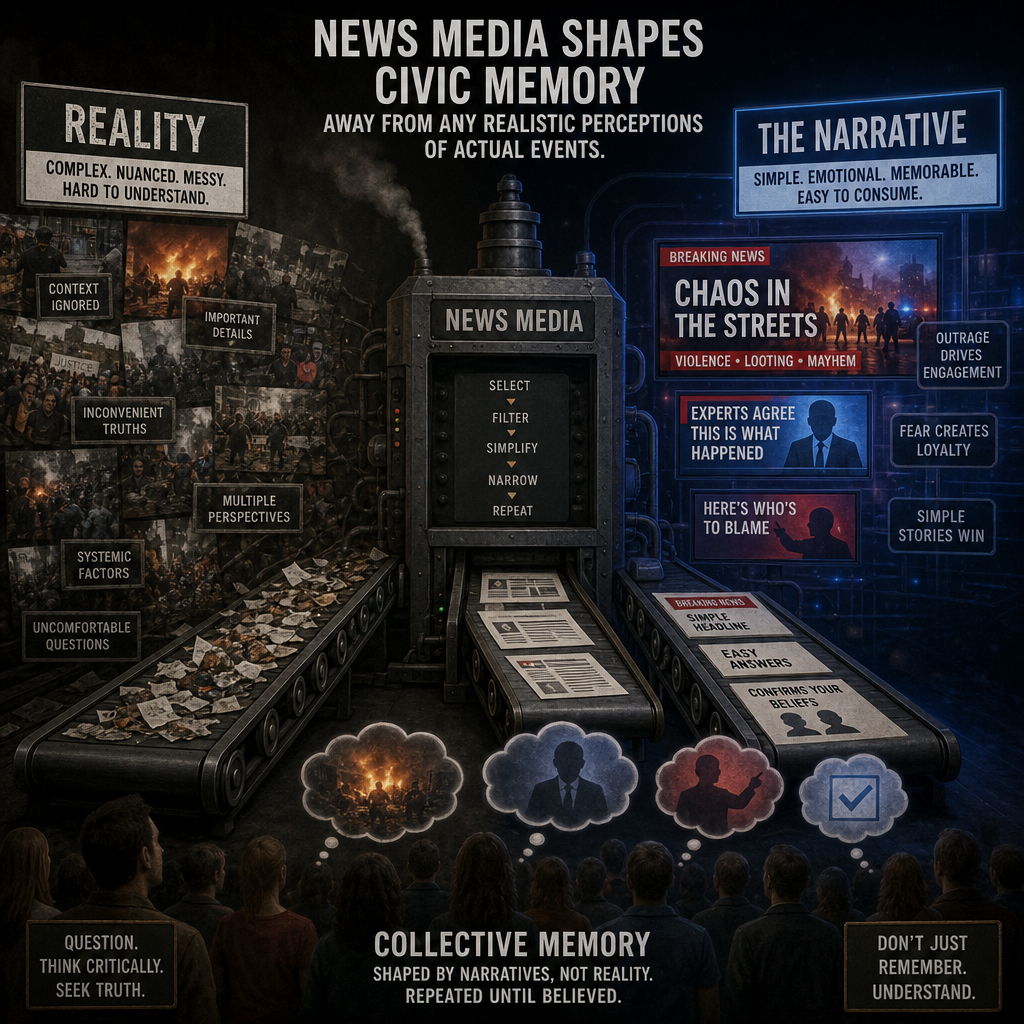
Institutional inconsistency weakens that record. Some events are narrated continuously, while others are minimized, contextualized, or forgotten. Some acts are condemned in absolute moral language, while similar acts are described as understandable reactions when committed by a favored group. The difference may be visible in headlines, broadcast time, official statements, prosecutions, school curricula, and commemorations. Media bias and shared truth are reflected in those choices.
Selective condemnation teaches citizens that truth is not applied evenly. It suggests that the moral significance of an action depends less on the action itself than on the identity of the actor and the political story attached to it. That lesson is corrosive even when the original event was genuinely complex. Media bias and shared truth cannot survive standards that change with political allegiance.
Media framing does not merely report reality; it sorts reality. It determines which facts become headlines and which become footnotes. It decides whether a city is said to have burned, experienced unrest, endured a riot, or witnessed a protest. It influences whether a procedure is called controversial, innovative, emergency-based, or unlawful. Repeated descriptions can become part of civic memory even when the underlying facts remain disputed. This is why media bias and shared truth require attention to language as well as evidence.
A stronger public record would preserve the chronology before debating the interpretation. It would identify who acted, what authority they claimed, what evidence exists, what consequences followed, and which questions remain unresolved. It would make room for competing explanations without pretending that all explanations are equally supported. Media bias and shared truth become more reliable when chronology precedes argument.
Charlotte, Minneapolis, Michigan, and January 6
Charlotte, Minneapolis, Michigan, and January 6 have become reference points in the struggle over America’s public memory. They are not identical events, and collapsing them into one category would obscure important differences. Their significance lies in how each became a symbol through which citizens interpreted justice, order, institutional failure, political violence, and constitutional legitimacy. Media bias and shared truth affect how these symbols are remembered.
Charlotte entered national discussion through competing claims about policing, protest, racial justice, and public order. The event was not received as a neutral set of facts. Different audiences emphasized different images, statements, and historical contexts. For some, it demonstrated the urgency of reform. For others, it illustrated how public disorder and media framing could obscure the dangers faced by communities and law enforcement. Media bias and shared truth are visible in that divergence.
Minneapolis became a symbol of upheaval after the death of George Floyd and the protests, riots, destruction, and political responses that followed. Many Americans saw the event primarily through the lens of police accountability and racial injustice. Others focused on the breakdown of public order, the damage suffered by residents and businesses, and what they considered uneven official responses. The competing memories remain politically powerful because each side believes the other is omitting the essential fact. Media bias and shared truth help explain why the disagreement persists.
Michigan became a focal point for disputes over election procedures and the administration of the 2020 election. Questions about emergency changes, ballot processing, observation, certification, and legal authority were interpreted through broader arguments about election law and constitutional structure. Some citizens viewed challenges to those procedures as an effort to undermine an election. Others viewed the refusal to fully examine them as evidence that procedural safeguards had become politically inconvenient. Media bias and shared truth shaped how those questions reached the public.
January 6 became the central symbol of democratic breakdown for one half of the country and a symbol of selective outrage for the other. The attack on the Capitol and the surrounding political context should be evaluated through evidence rather than partisan mythology. Yet the event’s public meaning has been shaped by a larger dispute: whether comparable episodes of political violence and disorder have received comparable scrutiny, language, and punishment. Media bias and shared truth are inseparable from that dispute.
The point is not to declare every comparison valid. The point is to ask whether the country can maintain a common archive in which similar questions are applied across cases. Who was harmed? What laws were violated? Which officials failed? What standards were used? What evidence was preserved? What remedies were available? Without such questions, civic memory becomes a collection of partisan symbols rather than a basis for judgment.
Texas v. Pennsylvania and the Limits of Judicial Review
The Supreme Court’s refusal to hear Texas v. Pennsylvania became another test of constitutional legitimacy. Texas sought to challenge election procedures used in other states, arguing that emergency changes and administration of the 2020 election raised questions affecting the constitutional structure of presidential elections. The Court declined to exercise original jurisdiction, stating that Texas had not demonstrated a judicially cognizable interest in the manner in which another state conducts its elections. Media bias and shared truth influenced how that refusal was understood.
The order was not a merits ruling declaring every challenged procedure constitutional. That distinction is essential. A refusal to hear a case may rest on standing, jurisdiction, timing, procedural posture, or another threshold issue. It does not necessarily resolve the underlying constitutional questions. The Court’s official order can be reviewed in the Supreme Court order in Texas v. Pennsylvania. Media bias and shared truth require readers to distinguish the order’s actual scope from later political claims.
The unresolved questions included the constitutional limits of emergency election changes, the relationship between state election administration and federal presidential elections, the possibility of interstate voter dilution, and what constitutes procedural injury. These questions are difficult because elections involve both state authority and national consequences. A change made by one state can affect citizens across the country when that state participates in choosing presidential electors. Media bias and shared truth should not erase those unresolved constitutional questions.
Texas faced a major legal obstacle in showing that it had the kind of direct injury necessary to invoke the Court’s original jurisdiction. The Court’s refusal was therefore understandable as a jurisdictional decision. At the same time, citizens who wanted a definitive ruling on the underlying procedures were left without one. That gap produced competing interpretations: some treated the refusal as confirmation that the challenge had no substance, while others treated it as institutional avoidance. Media bias and shared truth amplified both interpretations.
The more precise conclusion is narrower. The Court did not affirmatively rule that every disputed emergency procedure was constitutional. Nor did it establish that every allegation about voter dilution or procedural injury was correct. It declined to resolve the dispute in that posture. The distinction between “not decided” and “decided against” is often lost in political communication, but it is central to constitutional analysis. Media bias and shared truth are improved when that distinction is preserved.
This is where institutional silence can normalize drift. If a contested procedure is never squarely reviewed, officials may continue to rely on it. Later observers may assume that its survival proves its legality. A practice can become accepted through repetition even though no court has affirmatively held that the practice satisfies every constitutional requirement. Media bias and shared truth can either expose or conceal this form of institutional drift.
That does not mean every unresolved claim is secretly valid. It means that nonreview is not the same as constitutional ratification. A republic should be able to say which questions were answered, which were rejected on procedural grounds, and which remain open. When institutions fail to make those distinctions clear, public trust suffers. Media bias and shared truth depend on honest acknowledgment of what remains unresolved.
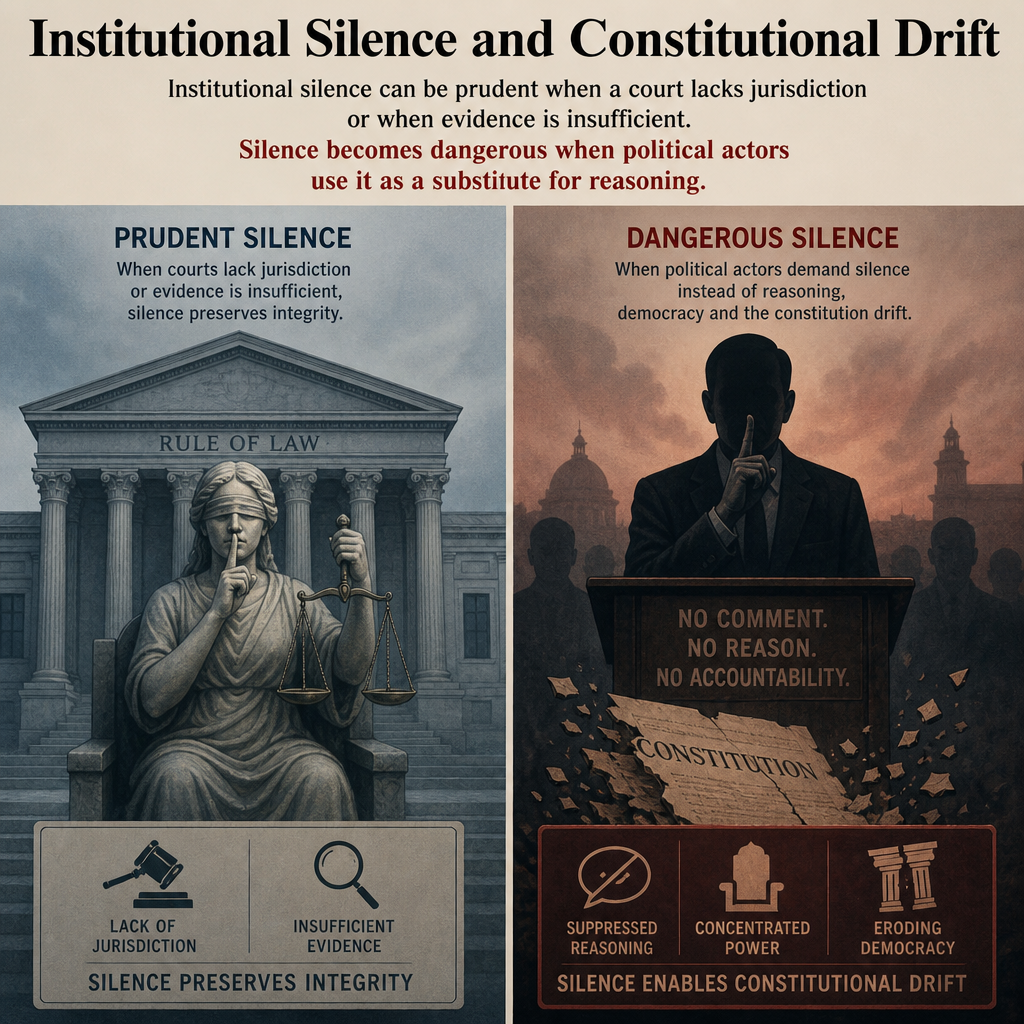
Institutional Silence and Constitutional Drift
Institutional silence can be prudent when a court lacks jurisdiction or when evidence is insufficient. Silence becomes dangerous when political actors use it as a substitute for reasoning. If officials say that a practice is legitimate merely because no court stopped it, they convert absence of adjudication into a positive legal judgment.
This pattern appears beyond elections. Administrative agencies may interpret ambiguous statutes broadly until their interpretation becomes routine. Universities may adopt ideological rules without public debate because each change appears technical. Media organizations may repeat a framing convention until it becomes invisible. Courts may avoid a difficult question because the case is procedurally defective, leaving lower institutions to act without clear guidance.
Constitutional legitimacy depends not only on outcomes but also on explainable limits. Citizens need to know who had authority, what standard was used, what evidence was considered, and why an institution acted or declined to act. The absence of clear explanations creates room for suspicion, even when the institution’s formal reasoning is defensible. At this stage, media bias and shared truth become questions of institutional process as well as public interpretation.
One remedy is procedural transparency. Election administrators should publish the legal authority for emergency changes and explain how those changes affect verification, observation, recounts, and certification. Courts should carefully distinguish standing decisions from merits decisions. Legislatures should review temporary rules before they become permanent habits. Journalists should describe the scope of a ruling accurately rather than treating a procedural disposition as a complete answer to every public concern.
Another remedy is institutional humility. Officials should acknowledge uncertainty instead of claiming that every disputed question has been settled. Acknowledging an unresolved issue does not concede the opponent’s argument. It demonstrates respect for the difference between evidence, law, and political interpretation.
Rebuilding Shared Truth and Civic Legitimacy
Restoring shared truth will not require Americans to agree about every policy or historical judgment. It will require them to rebuild a common method for establishing facts. That method must include primary documents, clear timelines, transparent sourcing, correction of errors, and consistent standards.
Citizens can begin by asking several basic questions. What is directly documented? What is inferred? Which claims are disputed? What did the relevant institution actually decide? Was the decision on the merits or on a threshold issue? Which comparable cases are being ignored? These questions are less emotionally satisfying than partisan certainty, but they are more useful for constitutional government.
News consumers should also distinguish between reporting and narrative. A headline may be technically accurate while still creating a misleading impression through omission. A television segment may show genuine images while leaving out the chronology that explains them. A column may offer a legitimate argument but should not be mistaken for a neutral account. Media literacy is therefore part of civic literacy, and confronting media bias and shared truth requires attention to both evidence and framing.
Institutions must carry the greater burden. They possess authority, records, professional resources, and the ability to shape public memory. Courts should state clearly when they are not reaching the merits. Government agencies should publish the basis for major changes. Universities and corporations should protect room for good-faith disagreement. Media organizations should apply comparable language and scrutiny to comparable conduct.
Religious liberty also belongs in this reconstruction. A pluralistic nation should not compel belief, but neither should it treat religious language as inherently illegitimate in public life. Citizens should be able to debate moral questions using religious, philosophical, historical, and secular arguments. Removing one entire vocabulary from civic discussion does not create a neutral public square; it narrows the range of ideas considered respectable.
Finally, Americans should resist the demand for total narrative victory. No faction can restore public trust by controlling every institution or silencing every rival account. The healthier goal is institutional accountability: consistent rules, open evidence, honest uncertainty, and procedures that remain legitimate even when they produce an unwelcome result.
Conclusion: From Narrative Conflict to Constitutional Renewal
The erosion of shared truth is not caused by one election, one news story, or one political movement alone. It is the cumulative result of institutional inconsistency, selective condemnation, media framing, cultural transformation, and unresolved constitutional questions. Modern progressivism’s influence is often indirect, but indirect influence can still reshape the nation’s assumptions about authority, religion, public language, and private institutions.
Charlotte, Minneapolis, Michigan, and January 6 show how public events become competing symbols when civic memory fragments. Texas v. Pennsylvania shows why a jurisdictional refusal should not be confused with an affirmative constitutional ruling. Together, these examples reveal the cost of institutional drift: practices can become normal before their legitimacy has been fully examined.
America does not need a single enforced story. It needs a common factual record strong enough to support principled disagreement. That record depends on institutions willing to state what they know, what they do not know, what they decided, and what they declined to decide. It depends on media organizations that separate evidence from framing. It depends on citizens who value consistent standards even when those standards constrain their own side.
The debate over media bias and shared truth will not disappear, but it can become more disciplined, transparent, and grounded in a common record. Rebuilding civic legitimacy will be difficult because narrative dominance is politically rewarding. Yet constitutional government cannot survive indefinitely when every institution is judged only by whether it advances a faction’s story. Shared truth is not unanimity. It is the discipline of preserving reality before arguing over meaning. Without that discipline, institutional drift will continue. With it, Americans can begin the harder work of renewing public trust.
For a related examination of skepticism, public reasoning, and civic judgment, read Emotional Dogma: 7 Powerful Ways Skepticism Restores Civic Reason.
Leave a Reply