
There was a time when the republic produced adults who could think for themselves, govern their passions, and serve their communities.
That idea feels distant now.
Today, many people are raised inside systems that manage behavior more than they form character. They are trained to consume information, react quickly, and follow external signals. But they are not always encouraged to develop judgment, discipline, or civic duty.
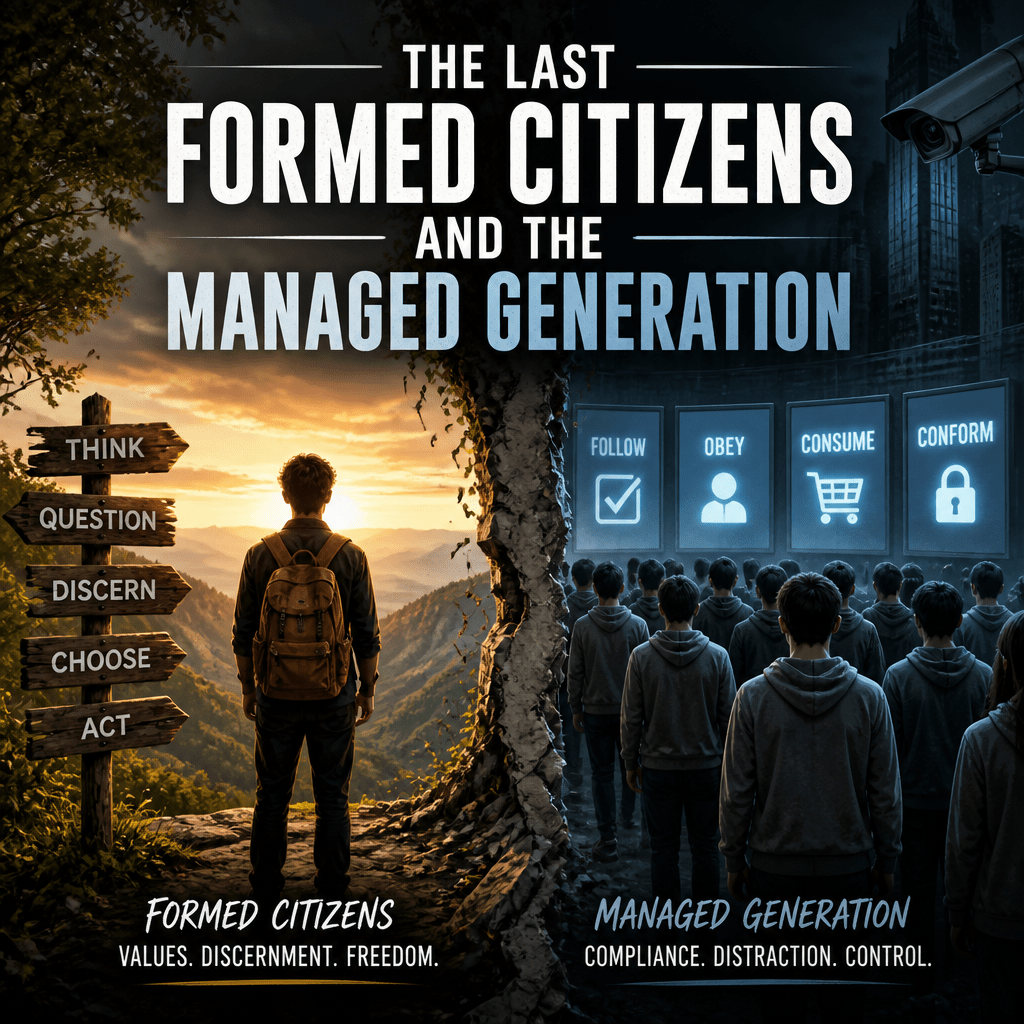
This is the difference between formed citizens and a managed generation.
One is shaped by education, duty, restraint, and moral responsibility. The other is shaped by convenience, distraction, and constant oversight.
- What It Means to Be a Formed Citizen
- The Shift From Formation to Management
- Why Self-Government Matters
- How the Managed Generation Is Shaped
- What We Lost When We Lost Formation
- The Role of Education
- The Role of Family
- The Role of Faith and Moral Tradition
- The Role of Community
- Can a Managed Generation Become Formed Again?
- What Renewal Requires
- The Choice Before Us
What It Means to Be a Formed Citizen

A formed citizen is more than a voter or a taxpayer. In a healthy republic, formed citizens are people who can live with restraint, act with judgment, and carry responsibility without being forced at every step.
A formed citizen knows how to:
- think clearly
- control impulses
- tell truth from noise
- respect law and liberty
- serve the common good
- accept responsibility for personal choices
This kind of person is not made by accident.
It takes family, school, faith, work, and local community to form a person of character. It takes repetition, example, and moral standards. It takes institutions that expect more from people than instant gratification.
The old republic depended on this kind of formation.
Without it, freedom becomes fragile.
And once freedom becomes fragile, public life becomes easier to control from above because fewer people have the habits required to sustain liberty from within.
The Shift From Formation to Management
Modern life often prefers management over formation.
That means systems focus on compliance, not character. They track behavior, reward convenience, and reduce people to data points. Schools emphasize standardized outcomes. Media encourages reaction over reflection. Public life rewards performance over principle.
The result is not a more free society.
It is a more manageable one.
A managed person is easier to direct because he has not been taught to direct himself.
This is a serious change.
When citizens lose the habit of self-rule, the state, the market, and the culture rush to fill the gap.
That is why the concern raised in Educational Bureaucracy and the Managed Generation: Forming Citizens or Training Subjects matters so much: institutions can either enlarge liberty or quietly shrink it.
The shift did not happen overnight. It came gradually, as people accepted that efficiency mattered more than wisdom and that measurable output mattered more than moral formation. Once that bargain was accepted, the language of education, public service, and even parenting began to change. Children were no longer primarily future citizens to be formed; they became projects to be processed.
That shift explains why so many people are capable of navigating systems yet struggle to govern their own habits. They may know how to pass through institutions, but not how to stand upright apart from them. They may be competent at compliance, but weak at conscience.
In that sense, management is not neutral. It is a philosophy of people. It assumes that behavior can be engineered without first shaping the soul.
But societies do not remain free when they forget how to form the people who sustain freedom.
Why Self-Government Matters
A republic cannot survive on procedures alone.
It needs people who can govern themselves before they try to govern others. That is one reason formed citizens matter so deeply to public life.
That means:
- patience under pressure
- restraint in desire
- courage in conflict
- honesty in speech
- duty before convenience
These are not small virtues. They are the foundation of public life.
If a society produces only skilled consumers and emotional reactors, it will struggle to produce citizens. And without citizens, republics drift toward dependence, bureaucracy, and soft despotism.
The problem is not simply political.
It is moral.
For a broader view of the modern machinery behind this drift, see the Encyclopaedia Britannica overview of education as a civic institution.
Self-government begins in small things. A person who can keep promises, tell the truth, and finish difficult work is already practicing the habits of citizenship. A person who cannot delay gratification, accept correction, or submit desire to reason will eventually struggle in every larger sphere of life.
That is why the health of a republic cannot be measured only by elections or legal structures. It must also be measured by the character of the people. Where self-government weakens, external control naturally expands.
How the Managed Generation Is Shaped
The managed generation is not formed by one event. It is shaped by habits.
1. Constant stimulation
People are bombarded with alerts, feeds, and entertainment. Attention becomes fragmented. Silence feels uncomfortable. Reflection becomes rare.
When attention is constantly pulled outward, interior life weakens. A person who cannot sit still with a thought is less able to examine conscience, weigh consequences, or enter serious conversation. In time, distraction becomes a way of life, and depth begins to look like inconvenience.
2. Reduced responsibility
When institutions handle every problem, individuals stop practicing judgment. Over time, they lose confidence in their own capacity to act.
This happens in subtle ways. The school handles discipline, the government handles risk, the platform handles speech, and the expert handles truth. The individual is left with opinions but little practice in responsibility. He learns to wait for instructions instead of taking initiative.
3. Emotional politics
Public life is turned into performance. People are encouraged to feel strongly, but not necessarily to think deeply.
Emotion is not the problem. Human beings are not machines. But when emotion becomes the main tool of public persuasion, reason is weakened and judgment is hurried. Citizens begin to react like spectators, not deliberate like stewards.
4. Weak local ties
When families, neighborhoods, churches, and civic groups decline, people lose the places where character is most naturally formed.
Local relationships matter because they create accountability. In large systems, it is easy to disappear into anonymity. In a neighborhood, your conduct has consequences. People know whether you keep your word. They notice whether you show up, whether you serve, whether you live honestly.
5. Moral ambiguity
If every standard is negotiable, then discipline looks oppressive and virtue looks outdated.
A culture that cannot name the good cannot reliably produce the good. When standards are treated as arbitrary, the habits that form citizens begin to seem burdensome rather than beautiful.
This is how a society moves from character formation to behavioral management.
The result is not only personal weakness but social confusion. People become unsure what they owe one another. They lose confidence in sacrifice, honor, and duty. Public institutions then expand to fill a moral vacuum they helped create.
What We Lost When We Lost Formation
The decline of formed citizens has consequences.
People become easier to manipulate.
They are less able to handle disagreement.
They struggle with sacrifice.
They want rights but resist duties.
They expect institutions to solve problems that used to be addressed by character, family, and community.
This produces a public that is loud but weak, connected but lonely, informed but shallow.
It also produces a deeper crisis: the loss of inner authority.
A person who cannot rule himself will always seek someone else to do it.
That loss shows up in ordinary life before it shows up in public affairs. It appears when adults cannot manage their time, their appetites, or their commitments. It appears when children are shielded from hardship instead of taught resilience. It appears when work is treated as self-expression alone and not as service, discipline, and contribution.
Once these habits weaken, a society begins to normalize dependence. People come to expect comfort without effort, guidance without obligation, and liberty without virtue. But those expectations cannot hold a republic together for long.
What was lost was not merely a style of education or a preference for stricter manners. What was lost was the old belief that people should become capable of governing themselves. That belief once shaped families, schools, churches, and local institutions. It made adulthood something to be earned, not merely reached by age.
The Role of Education
Education should form minds and shape souls.
It should teach reading, writing, and reasoning. But it should also teach attention, memory, patience, and courage. A good education does not merely transfer facts. It trains a person to live wisely.
That means helping students learn:
- how to read difficult ideas
- how to disagree without cruelty
- how to delay impulse
- how to weigh evidence
- how to distinguish truth from opinion
When education becomes only job training or ideological messaging, it stops forming citizens.
It produces efficiency, not wisdom.
For a deeper look at the civic stakes, see The Department of Education and the Collapse of Formation: A Revised Reflection.
Education should also teach students how to live with complexity. A formed person is not shocked by difficulty. He has been trained to wrestle with ideas, revise his own assumptions, and continue seeking truth even when the answer is inconvenient. That is why serious education is slow. It respects the time required for judgment to mature.
When schools become obsessed with metrics, they can miss the very things that matter most. Scores may rise while wisdom declines. Procedures may improve while courage disappears. A system can produce graduates who are technically credentialed but unprepared for moral life.
That is one reason the language of formation matters. It reminds us that the purpose of education is not simply to sort people or certify them. It is to prepare them for the burdens of freedom.
Formed Citizens and the work of education
Formed Citizens are not produced by slogans or software. They are shaped by habits repeated over time, especially in classrooms that still value memory, argument, and accountability.
When education keeps its proper purpose, it helps young people learn how to read beyond the surface, listen before answering, and endure difficulty without collapse. Those habits matter because formed citizens must be able to weigh claims, examine evidence, and resist manipulation.
The problem is that many modern systems prefer compliance to wisdom. They measure what is easy to count and neglect what is hard to cultivate. In that environment, formed citizens become rarer, not because people are less capable, but because the institutions around them no longer ask enough of them.
If a republic wants a future of formed citizens, it must recover an education that values discipline as much as information.
That recovery does not require nostalgia. It requires seriousness. It requires classrooms where reading is demanding, writing is disciplined, and students are expected to think before they speak. It requires teachers who understand that authority and care are not opposites. Most of all, it requires the conviction that the mind and the character should be educated together.
Without that, young people may learn many useful things and still remain unformed. They may become proficient at passing tests, but not at making good judgments. They may know how to navigate systems while remaining strangers to their own responsibilities.
The Role of Family
No institution is more important than the family.
Families teach children how to live with others, how to respect authority, and how to handle limits. They are the first school of duty.
A child who learns to wait, share, listen, and obey is being prepared for citizenship.
A child who is never corrected or required to contribute is being prepared for dependency.
Strong families do not make perfect people.
They make formed people.
That is why formed citizens usually begin at home, long before they ever enter public life.
Family life gives children early contact with reality. It teaches that other people have needs, that promises matter, and that love includes correction. In a healthy home, children discover that freedom is not the same as doing whatever they want. They learn that authority can be protective rather than merely restrictive.
Parents who understand formation do not only ask whether a child is happy. They ask whether the child is becoming responsible. They know that delight is good, but not sufficient. They know that a child left to appetite will not naturally become virtuous.
That is why family life remains central even when schools, media, and institutions try to take over its tasks. No bureaucracy can replace the daily work of shaping a conscience.
The Role of Faith and Moral Tradition
For centuries, faith traditions helped form citizens by teaching humility, self-examination, sacrifice, and service.
They reminded people that life is bigger than the self.
They taught that freedom without virtue leads to chaos. They also gave communities a shared moral language that made trust possible.
Even in a plural society, moral tradition still matters.
A republic cannot thrive if every person treats desire as law.
Where moral tradition remains strong, formed citizens are more likely to emerge because people are reminded that they answer to something higher than appetite or convenience.
Faith and tradition also teach the limits of human power. They resist the temptation to believe that technical expertise can solve every problem. They remind people that wisdom includes humility, and that a nation becomes dangerous when it confuses cleverness with goodness.
Many old practices of formation were never merely private. They produced the habits that made public trust possible. Shared rituals, shared language, and shared obligations helped ordinary people live with one another in relative peace. When those habits weaken, communities can become more fragmented and institutions more coercive.
Even for those who do not share a religious commitment, the moral insights preserved by tradition remain valuable. Self-denial, gratitude, honesty, courage, and mercy are not obsolete ideas. They are the civic virtues that keep freedom from unraveling.
The Role of Community
Communities teach what abstract systems cannot.
In a neighborhood, people see the consequences of their behavior. They know one another. They are accountable. They learn that freedom has boundaries and that responsibility is personal.
Local life forms character because it is real.
You cannot hide forever in a community where your choices affect actual people.
That is why strong local institutions matter:
- schools
- churches
- clubs
- volunteer groups
- civic associations
- extended families
These are the places where formed citizens are still made.
They also preserve the social memory that a managed generation tends to lose.
Community gives people opportunities to practice service without spectacle. It teaches that not every good act will be noticed by strangers online. It also gives people a place to fail, repent, and begin again. That rhythm of responsibility and restoration is deeply human, and it is one of the most powerful alternatives to passive dependence.
Local communities also create a boundary against abstraction. They remind people that policy affects real lives, that public decisions have personal consequences, and that civic health cannot be reduced to slogans. In a strong community, people learn to see neighbors as persons rather than categories.
That habit is essential for formed citizens, because citizenship is not only about rights. It is also about seeing, serving, and sustaining the common good in ordinary life.
Can a Managed Generation Become Formed Again?
Yes, but not by accident.
Formation must be chosen.
It begins when individuals reject passivity and recover discipline. It grows when parents raise children with standards. It strengthens when schools demand more than compliance. It deepens when communities reward service and truth.
This is not about nostalgia.
It is about renewal.
A free society needs more than smart devices and expert systems. It needs adults who can act with courage and restraint. It needs formed citizens who can say no to temptation, yes to duty, and no to lies.
That recovery is difficult, but it is possible when people decide that character is not optional.
The first step is often personal. Someone must choose to become harder to manipulate by becoming more capable of attention, patience, and moral courage. Then the work spreads outward. Families begin to expect more. Schools recover standards. Communities notice what used to be ignored. In time, small acts of formation can accumulate into a cultural change.
Recovery will not happen through slogans. It will happen through habits. It will happen when ordinary people decide to live differently and teach the next generation to do the same.
What Renewal Requires
If a society wants to recover formed citizens, it must recover a few basic truths.
Discipline is freedom
Self-control is not oppression. It is what makes freedom usable.
Character matters more than image
Public performance is cheap. Virtue is costly.
Duty is not outdated
A healthy republic depends on people who do what is right even when it is inconvenient.
Community is essential
No one forms alone. People need institutions that shape habits and expectations.
Truth is non-negotiable
A citizen cannot govern well without reality.
These are the conditions in which formed citizens can reappear.
Renewal also requires patience. Character is not rebuilt in a week, and culture does not turn quickly. But the work is still worth doing because the alternative is a society that grows more manageable while becoming less free.
People often ask what can be done when systems are already large, impersonal, and self-protecting. The answer begins locally and personally. Teach children to tell the truth. Require completion of difficult tasks. Honor service. Practice restraint. Keep promises. Build institutions that reward virtue rather than indulgence.
Those practices may seem small, but they are the beginning of civic repair. They restore the habits through which people become capable of freedom.
The Choice Before Us
The future will be shaped by one of two models.
The first is the managed model.
It produces compliant, distracted, and dependent people. They may be educated, connected, and technologically advanced. But they are not fully formed.
The second is the citizen model.
It produces men and women capable of self-rule, service, and sacrifice. These are the formed citizens a republic requires.
The question is not whether society will shape people.
It always does.
The question is what kind of people it will shape.
The answer depends on whether institutions, families, and communities still believe in the hard work of forming citizens rather than merely managing behavior.
The choice is visible in everyday life. Do we raise children to obey truth or to manage impressions? Do we train students to think or only to perform? Do we honor responsibility or only convenience? The answers to those questions will determine whether the next generation is free enough to carry the burdens of citizenship.
Conclusion
There was a time when the republic produced adults who could think for themselves, govern their passions, and serve their communities.
That time was not perfect. But it understood something important: liberty survives only when character is strong.
If the modern world wants more than managed behavior, it must recover the hard work of formation.
It must rebuild families, strengthen schools, revive local life, and honor duty again.
Only then can a society produce formed citizens worthy of a free republic.
That work begins with the refusal to accept passivity as normal. It continues with the patient rebuilding of habits that teach self-command, moral seriousness, and civic responsibility. And it matures only when communities once again believe that the purpose of life is not merely to be managed, but to be formed.