
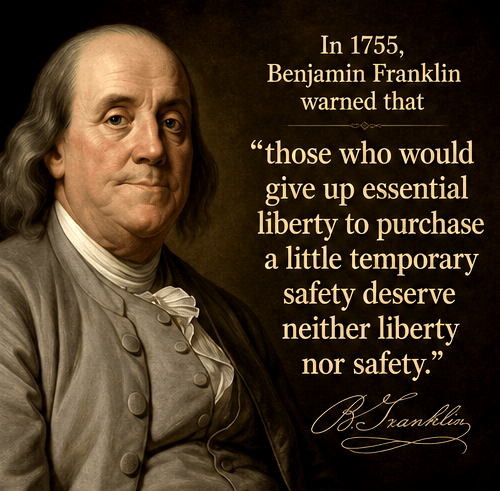
In 1755, Benjamin Franklin warned that “those who would give up essential liberty to purchase a little temporary safety deserve neither liberty nor safety.” His words were aimed at colonial tax disputes, not surveillance technology, but the principle he articulated has become one of the most important constitutional warnings of the modern era. Today, in a nation of 340 million people, Franklin’s distinction between real safety and temporary safety is more relevant than ever.
Modern policing faces a challenge the Founders could never have imagined. In 1776, the United States had roughly 2.5 million people. There were no cameras, no phones, no digital records, and no mass movement tracking. Law enforcement was personal, local, and limited by physical presence. A sheriff could know his entire town by name. A constable could walk his beat and see everything he needed to see.
But a nation of 340 million cannot be policed like a nation of 2.5 million. Criminals today exploit mobility, anonymity, and technology. Stolen vehicles cross state lines in hours. Human traffickers use interstate corridors. Drug distribution networks operate across thousands of miles. Reckless drivers kill innocent people every day. The criminal element is not nostalgic for Mayberry, and modern policing cannot afford to be either.
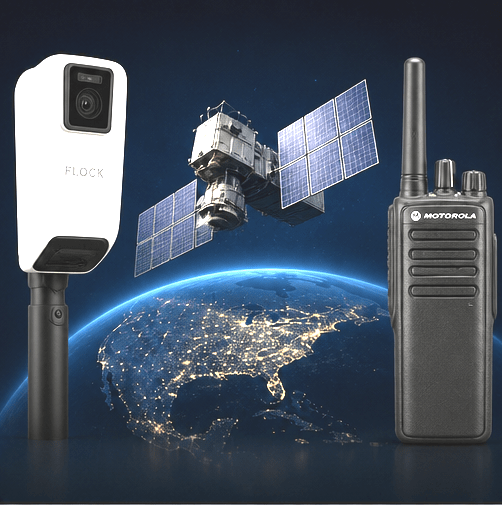
This is where technologies like Flock cameras and automated license plate readers enter the picture. These tools provide real, proven safety. They help recover stolen vehicles, locate suspects fleeing crime scenes, identify reckless drivers, and disrupt human trafficking routes. They are force multipliers in a world where manpower is limited and criminals are mobile. For law‑abiding citizens, these systems overwhelmingly detect criminal behavior, not ordinary life. In this sense, they represent the “Jetsons” version of policing — efficient, modern, and effective.
But technology has a darker potential when it is used without constitutional guard rails. The events of January 6, 2021 revealed how powerful tools can be weaponized when the government identifies citizens first and determines suspicion later. Geofence warrants — later ruled by the Supreme Court to be Fourth Amendment searches — collected the location data of every device inside the Capitol, regardless of intent, warning, or individual behavior. Some officers at certain entrances did not block entry or issue dispersal orders. In those moments, citizens could reasonably believe they were permitted to enter. Yet technology did not distinguish between peaceful presence and criminal intent. It identified devices, not actions. It created a dragnet, not a targeted investigation.
This is the constitutional danger Franklin warned about. Not technology itself — but temporary safety, the illusion of security purchased at the cost of essential liberty. When surveillance identifies citizens before identifying crime, the Fourth Amendment is inverted. The traditional sequence — suspicion, warrant, search, evidence, charge — becomes reversed. Search first, identify later. This is the digital resurrection of the general warrant, the very abuse the Founders wrote the Fourth Amendment to abolish.
The solution is not to reject technology. Modern policing requires modern tools. Criminals will be criminals, and law enforcement must have the means to defeat them. The solution is to regulate technology with constitutional guardrails that protect law‑abiding citizens. Technology should be used to catch criminals — not to identify citizens. It should detect criminal behavior, not create lists of innocent people. It should enhance public safety, not erode civil liberty.
Franklin’s warning still stands: liberty must never be traded for temporary safety. But real safety — the kind that protects families, deters criminals, and strengthens communities — is not temporary. It is necessary. And it is achievable when technology is paired with constitutional limits that preserve the rights of every citizen.
In a nation of 340 million people, the future of liberty depends on getting this balance right.
Leave a Reply