
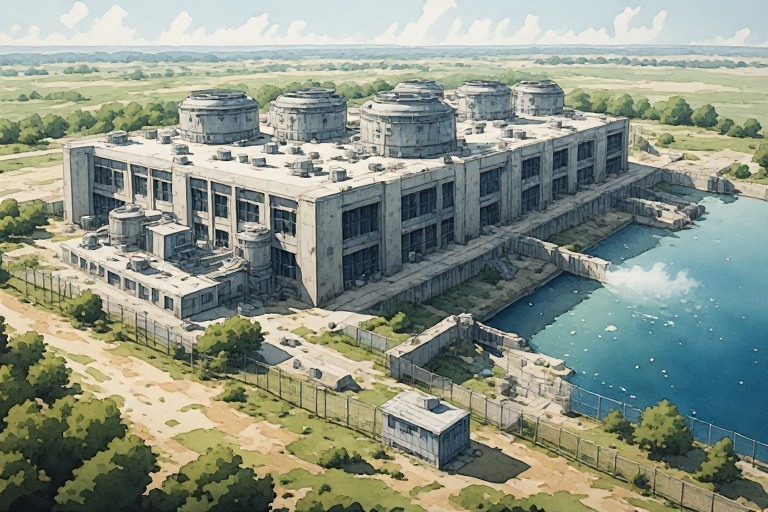
A Modern Paul‑Harvey‑Style Warning About Data Centers
If I were building the future — and wanted no one to notice — I wouldn’t start with laws or leaders or loud announcements.
No, I’d start with buildings.
Big ones.
Windowless ones.
Buildings so large they could swallow a shopping mall, yet so quiet you couldn’t hear a server fan from a hundred yards away. I’d scatter them across farmland and forest edges, places where people still trust the horizon. And I’d build them fast — faster than anyone could ask what they were for.
And if the public grew curious, I’d smile and say, “Oh, these? Just data centers. Nothing to see here.”
But there would be something to see.
Because inside those concrete shells, I’d be assembling the machinery of a new age — racks of processors, rivers of fiber, cooling towers that drink more water than a town, and power lines thick as a man’s arm. I’d call it infrastructure. I’d call it innovation. I’d call it progress.
But what it would really be is control.
Not the old kind — not the kind that needs armies or ballots or borders.
No, this would be the quiet kind.
The invisible kind.
The kind that runs underneath everything else.
Because if I were building the future, I wouldn’t need to govern people directly.
I’d just need to govern their data.
And if I governed their data, I’d govern their lives.
I’d know what they buy, what they fear, what they hope for, what they whisper, what they regret. I’d know their habits before they formed them, and their weaknesses before they admitted them. And I’d feed all of it — every click, every message, every movement — into those silent buildings humming in the dark.
And I’d call it artificial intelligence.
And the public, God bless them, would sense something was wrong. They always do. They’d look at those billion‑dollar complexes and say, “This isn’t for us.” They’d feel the shift in their bones, the way farmers feel a storm before the clouds arrive.
They’d say, “These are AI factories.”
And they’d be right.
They’d say, “Our data is the raw material.”
And they’d be right again.
They’d say, “Someone is building a tollbooth for the future.”
And they’d be closer to the truth than the experts.
Because if I were building the future, I wouldn’t just want your data.
I’d want your dependence.
I’d want your job applications to run through my models.
Your medical decisions to run through my algorithms.
Your government services to run through my cloud.
Your national defense to run on my compute.
Your children’s education to run on my platforms.
And I’d make it all so convenient, so efficient, so irresistible, that you’d never notice the moment you stopped being the customer and became the product.
And if the government finally woke up and said, “We’d like to build our own systems,” I’d object — loudly, morally, theatrically. I’d say it was about privacy. I’d say it was about ethics. I’d say it was about safety.
But really, it would be about the money.
Because if the government built its own data pipelines, its own AI engines, its own intelligence models, then it wouldn’t need to buy mine. And I’d lose the most profitable business ever invented: selling the public’s digital reflection back to the state that’s supposed to protect them.
And the public — bless their stubborn wisdom — would see through it.
They’d say, “Big Tech doesn’t want the government collecting data because then Big Tech can’t sell it to them.”
And they’d be right a third time.
Because the public may not know how a GPU works, but they know how power works.
They know when something enormous is being built without their consent.
They know when institutions stop explaining themselves.
They know when the story doesn’t add up.
And if I were building the future, that’s the one thing I’d fear — not regulation, not competition, not even government.
I’d fear the moment the public finally understood what those buildings were for.
Because once they understood, they’d remember something we hoped they’d forgotten:
A free people do not outsource their sovereignty.
Not to kings.
Not to corporations.
Not to algorithms.
And that, ladies and gentlemen…
is the rest of the warning.