
A Restorationist Essay on Power, Profit, and the Erosion of Trust
I. The New Cathedrals of the Digital Age
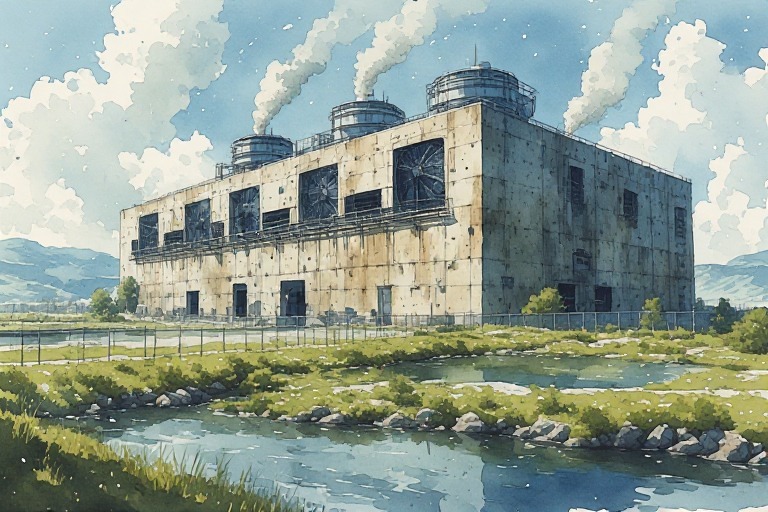
Across the continent, vast concrete shells rise from farmland and forest edges — windowless, silent, and consuming more electricity than entire towns. To the average citizen, these billion‑dollar data centers feel less like infrastructure and more like monuments to a new priesthood. They appear suddenly, without explanation, and with a scale that dwarfs anything built in living memory.
People do not need technical expertise to sense when something enormous is underway. They know when a society is shifting its center of gravity. And they know when they have not been invited into the conversation.
The public’s first perception is simple:
These are not warehouses. These are power plants for a new ruling class.
II. The Vacuum of Explanation
In a healthy republic, institutions explain themselves. They justify their footprint, their purpose, and their impact on the commons. But in the age of drift, silence has become the default. Citizens watch as:
- land is rezoned
- water rights are diverted
- electrical grids are expanded
- tax incentives are granted
…and no one bothers to articulate the purpose of these structures.
Into that vacuum, the public inserts the only framework they have left: pattern recognition.
They have seen this movie before — in finance, in social media, in surveillance, in pharmaceuticals, in defense contracting. A small cluster of institutions builds something enormous, opaque, and unaccountable, and the public is told to trust the process.
They no longer do.
III. The Public’s Working Theory: “These Are AI Factories.”
Citizens now believe — with more accuracy than elites admit — that these data centers are the physical machinery of the coming AI economy. They imagine them as:
- training mills
- inference engines
- surveillance hubs
- automation foundries
They may not know the vocabulary, but they understand the stakes. They sense that these buildings are not about storage; they are about control.
In the Restorationist frame, this is the public’s instinctive recognition that sovereignty is shifting from civic institutions to computational ones.
IV. The Money Stream as the Public Sees It
When citizens ask, “Why are these being built?” they are not asking about GPUs or transformer architectures. They are asking about incentives — the one language that has never lied to them.
1. The Public Believes Their Data Is the Raw Material
For a decade, Big Tech harvested:
- behavior
- preferences
- relationships
- location
- psychology
- purchasing patterns
…and converted it into profit.
So when they see billion‑dollar data centers, they assume — correctly — that the raw material is still them.
The public’s model is brutally simple:
Our lives → their models → their revenue.
This is not cynicism. It is memory.
2. The Public Believes Big Tech Is Building a Tollbooth Economy
Citizens increasingly believe that the future economy will run through these centers, and that Big Tech will charge rent on every layer:
- rent on compute
- rent on AI access
- rent on automation
- rent on identity verification
- rent on digital labor
- rent on government services
- rent on the very act of participating in society
In the Restorationist frame, this is the return of feudalism — not with land, but with compute.
3. The Public Believes Big Tech Wants to Replace Government, Not Serve It
This is the perception that elites most fear and least understand.
Citizens see Big Tech objecting to government data collection and conclude:
“They don’t want competition.”
If the state builds its own data‑fusion systems, its own AI models, its own intelligence engines, then Big Tech loses:
- leverage
- exclusivity
- revenue
- political influence
The public interprets the fight not as a privacy debate but as a turf war between two surveillance powers — one elected, one not.
And they are not wrong.
4. The Public Believes AI Will Replace Jobs, and Big Tech Will Own the Replacement
People sense that automation is coming for:
- clerical work
- logistics
- customer service
- transportation
- analysis
- even creative labor
And they believe the profits will flow upward, not outward.
In the Restorationist frame, this is the collapse of the social contract: the tools built with public data will be used to displace the public itself.
V. The Deeper Perception: “This Is About Control.”
When you strip away the noise, the public’s perception resolves into a single, coherent thesis:
Big Tech is building the infrastructure of a new order — one in which they mediate identity, labor, communication, governance, and truth itself.
The data centers are not the product.
The AI models are not the product.
The citizen is the product.
And the public knows it.
VI. The Restorationist Diagnosis
A society loses its moral grammar when institutions stop telling the truth and citizens stop believing the stories they are told. The data‑center boom is not merely a technological shift; it is a referendum on legitimacy.
The public’s perception — whether technically accurate or not — is a signal that:
- trust has collapsed
- sovereignty is contested
- incentives have drifted
- the commons has been privatized
- the people no longer believe the stewards of their data are stewards of their dignity
In the Restorationist view, the crisis is not compute.
It is consent.
VII. The Path Forward
A Restorationist society would not fear data centers. It would:
- define their purpose
- constrain their incentives
- protect the citizen as the primary stakeholder
- ensure that the tools built from public data serve the public good
- restore transparency, accountability, and moral grammar to the digital domain
The public’s perception is not paranoia.
It is a warning.
And warnings, in a healthy republic, are invitations to repair.