
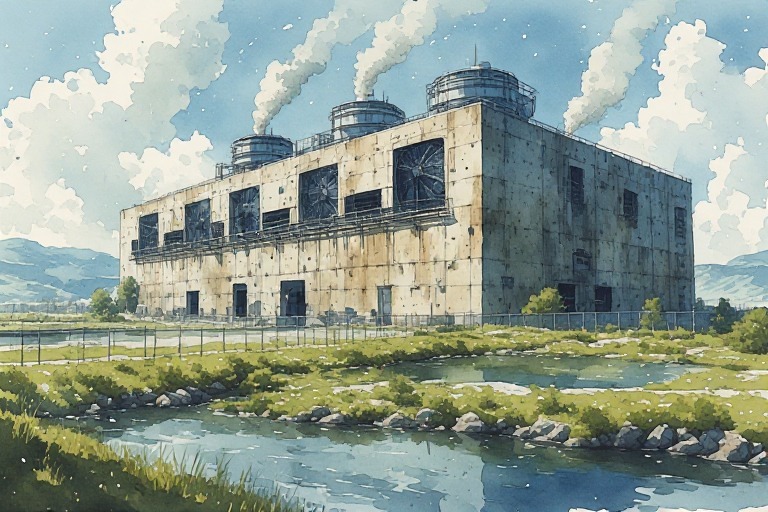
**What Data Centers Actually Are —
And Why the Public’s Instincts Still Matter**
A Restorationist Essay
I. The Physical Reality Behind the Myth
Strip away the mystique, and a data center is a simple machine:
- racks of servers
- miles of fiber
- industrial cooling
- redundant power
- security layers
- monitoring systems
They are not magical. They are not sentient. They are not “thinking.”
They are factories — factories that process information instead of steel.
But the scale is unprecedented. A modern hyperscale data center consumes:
- more electricity than a small city
- more water than a manufacturing plant
- more land than a sports complex
This is not a garage startup. This is industrial infrastructure.
And that is precisely why the public’s instincts activate.
II. What They Actually Do
At their core, data centers perform three functions:
1. Storage
They hold:
- photos
- documents
- messages
- transaction logs
- sensor data
- corporate records
This is the “cloud” the public already knows.
2. Compute
This is the new frontier.
Compute is the ability to:
This is where the money is — and where the power is.
3. Orchestration
Data centers coordinate:
- identity
- authentication
- payments
- logistics
- communication
- surveillance
- digital labor
They are the nervous system of the modern world.
And the public senses that whoever controls this nervous system controls the society built on top of it.
III. Why Big Tech Is Building Them at Breakneck Speed
The real reasons are not mysterious:
1. AI requires staggering amounts of compute.
Training a frontier model can cost:
- billions of dollars
- months of GPU time
- entire power‑plant outputs
The companies that own the compute own the future.
2. AI inference — the day‑to‑day running of models — is the new recurring revenue stream.
Every chatbot query, every automated workflow, every AI‑powered service runs on compute cycles.
This is the new tollbooth economy.
3. Governments, militaries, and corporations will rent compute from whoever has it.
This is the new defense‑industrial complex — but built by private companies.
4. The world is shifting from “software eats the world” to “compute governs the world.”
And compute lives in data centers.
This is why the construction boom feels like an arms race.
Because it is.
IV. Why the Public’s Instincts Are Still Correct — Even When the Technical Details Are Off
The public may not know what a transformer architecture is, but they know when power is consolidating. They know when institutions stop explaining themselves. They know when incentives drift.
Their instincts are not paranoia. They are pattern recognition.
1. The public senses that their data is the raw material.
And they’re right.
AI models are trained on:
- public data
- scraped data
- behavioral data
- purchased data
- inferred data
Even when companies claim “anonymization,” the public knows the truth:
their lives are the input.
2. The public senses that Big Tech wants to be the gatekeeper of the next economy.
Also correct.
If AI becomes the backbone of:
- work
- communication
- governance
- defense
- education
- medicine
…then the companies that own the compute own the rails of civilization.
3. The public senses that Big Tech is trying to pre‑empt government sovereignty.
This is the most Restorationist insight — and the most accurate.
When Big Tech objects to government data collection, the public hears:
“We don’t want competition for the surveillance economy we built.”
And that interpretation is not wrong.
4. The public senses that the benefits will not flow to them.
History supports this instinct.
Every technological revolution has concentrated power before it distributed it.
This one is concentrating faster than any before it.
V. The Restorationist Interpretation: The Crisis Is Not Compute — It Is Consent
Data centers are not inherently dangerous.
AI is not inherently corrupting.
Compute is not inherently tyrannical.
The danger arises when:
- the public is excluded
- the incentives are misaligned
- the institutions are unaccountable
- the infrastructure is opaque
- the power is consolidated
- the narrative is controlled
A Restorationist society would not fear data centers.
It would govern them.
It would:
- define their civic purpose
- regulate their incentives
- protect the citizen as the primary stakeholder
- ensure transparency in data use
- prevent private monopolies on public infrastructure
- maintain democratic oversight of computational power
The public’s instincts matter because they are the early warning system of a republic.
They are the canary in the digital coal mine.
When citizens feel something is being built around them rather than for them, they are almost always right.
VI. The Path to Restoration
The solution is not to halt progress.
It is to restore stewardship.
A Restorationist framework would:
- treat data as a civic asset
- treat compute as a regulated utility
- treat AI as a public‑benefit infrastructure
- treat citizens as owners, not products
- treat transparency as a constitutional requirement
The public’s instincts are not the problem.
They are the compass.
And the compass is pointing toward a simple truth:
A society that loses control of its data loses control of its destiny.