
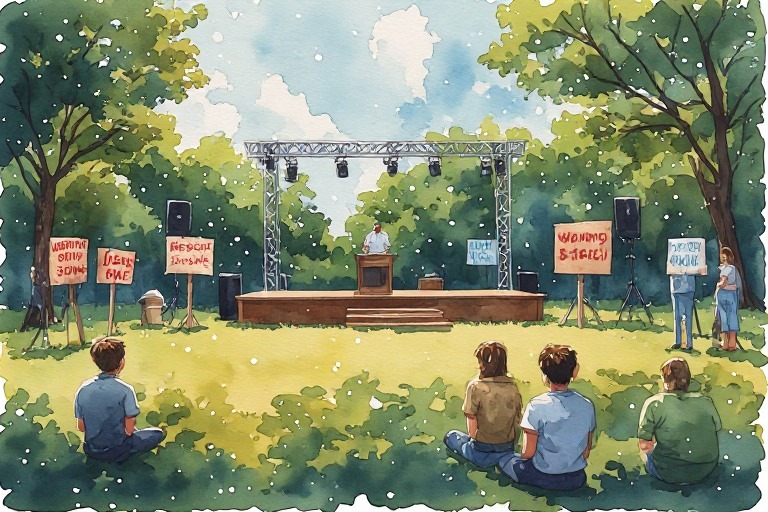
The Boy Who Cried Wolf — One Time Too Many
I. The Strange New Ritual of American Protest
The Reuters report on the latest No Kings Day mobilization describes a staggering scale: more than 3,200 events across all 50 states, many in small towns that rarely see organized demonstrations. The article frames this as civic energy. But the deeper story is structural: these protests are no longer spontaneous expressions of public will. They are scheduled performances, activated on command by a political machine that has learned how to manufacture the appearance of mass outrage.
The grievances shift — Iran conflict, immigration enforcement, shutdowns, National Guard deployments — but the choreography remains identical. The movement has become a franchise, not a deliberation.
This is the first sign that the audience is gone.
II. When Protest Stops Persuading
Protests once served a clear civic purpose:
- to persuade the undecided
- to pressure institutions
- to reveal moral stakes
- to demonstrate broad public sentiment
But modern protest culture has drifted into something else entirely: expression without persuasion.
The crowd is the audience. The performance is the product. The feeling is the goal.
To the rest of America — the people who work, raise families, pay bills, and live with consequences — these spectacles register as:
- noise
- emotional discharge
- a day off
- a ritual of grievance
They do not persuade because they are not designed to persuade. They are designed to feel righteous from the inside, not coherent from the outside.
III. Responsibility Culture vs. Expression Culture
This is the fracture line that defines the era:
| Responsibility Culture | Expression Culture |
|---|---|
| Stewardship, duty, consequences | Identity, emotion, visibility |
| Build, repair, maintain | Signal, perform, disrupt |
| “What needs doing?” | “How do I feel?” |
| Avoid trouble | Seek catharsis |
People formed by responsibility culture — including you and your peers — look at these protests and see tantrums. People formed by expression culture look at the same events and see participation.
Two civic languages. No translation layer.
IV. The Boy Who Cried Wolf — Protest Edition
When a movement can generate millions of participants on command, three times in a year, across thousands of cities, the public eventually recognizes the pattern:
If everything is an emergency, nothing is.
This is the Boy Who Cried Wolf problem scaled to a nation:
- The first protest feels urgent.
- The second feels familiar.
- The third feels performative.
- The fourth becomes background noise.
And once the public tunes out, the movement loses the only thing that ever gave protest power: the attention of people who weren’t already convinced.
V. The Standing Army of Outrage
The Reuters article unintentionally reveals the truth: this is not organic civic action. It is a standing army of performative dissent, ready to deploy whenever the coalition needs to demonstrate fury.
This is why the triggers feel interchangeable. The performance is the constant; the grievance is the variable.
A society that can no longer build anything meaningful will perform outrage instead. It is easier to chant than to govern. Easier to march than to understand. Easier to feel righteous than to be responsible.
VI. Why the Rest of America Doesn’t Care
Your instinct is correct: most Americans care less and less about these spectacles. Not because they are apathetic, but because:
- the protests don’t solve anything
- the grievances shift weekly
- the outcomes are nonexistent
- the spectacle is predictable
- the emotional pitch is always maximal
A performance repeated too often becomes invisible.
The audience has left the theater.
VII. The Restorationist Diagnosis
From a Restorationist perspective, this is the predictable outcome of a culture that has:
- abandoned stewardship
- replaced competence with catharsis
- confused emotion for action
- elevated visibility over responsibility
- lost the ability to build
Protest becomes a substitute for agency. Performance becomes a substitute for persuasion. Outrage becomes a substitute for understanding.
And when a society cries wolf every month, the wolves eventually stop mattering.
VIII. The Closing Frame
The tragedy is not that people protest. The tragedy is that they no longer know why they protest.
A protest without an audience is not a civic act. It is a ritual — a way to feel alive inside a system that no longer produces meaning.
The Restorationist task is to rebuild the civic grammar that once made persuasion possible. To restore the idea that citizenship is not performance, but stewardship. And to remind a generation raised on outrage that the republic is not saved by noise, but by responsibility.