The Day Thinking Begins
A Chapter on Intellectual Humility, the Classical Tradition,
and the Citizen Who Learns to See
By VA Barac • May 28, 2026 • Estimated reading time: 18–22 minutes
There is a kind of knowing that is really only the echo of what someone else once said with confidence. For years, I did not know the difference. This is the story of when I found out — and why it matters for every citizen who still believes the republic is worth the effort of understanding it.
I. The Man Who Thought He Knew
I remember the evening with an uncomfortable clarity. It was the kind of gathering that happens in church fellowship halls and around extended-family dinner tables all across this country — a dozen people, plates of food going cold, and someone saying something that everyone else in the room feels entitled to correct. That night, I was the corrector. I had the floor, and I held it with the confidence of a man who had given a great deal of thought, or so I told myself, to the subject at hand.
The subject was constitutional — something about federal authority, the intentions of the Founders, and what, precisely, the Tenth Amendment was meant to protect. I spoke with what I can only describe, in retrospect, as the fluency of inherited opinion. I had words. I had cadence. I had a general sense that I was right, and the faint, agreeable murmur around the table confirmed it. I named Madison. I cited Jefferson — loosely, as one does. I invoked the founding era with the casual authority of a man who has read summaries of books that summarize other books.
What I did not have, though I could not have told you so at the time, was knowledge. Not real knowledge — the kind built from primary sources read carefully, arguments followed from premise to conclusion, and conclusions held open to revision. What I had was the simulacrum of knowledge: confident opinion dressed in the borrowed clothing of scholarship. And I wore it, that evening, as though it were a tailored suit.
I do not tell this story to embarrass myself — or rather, I do, but only because I suspect the reader has sat in that chair. Not necessarily the chair of the man holding forth on the Constitution, but the chair of the person who has carried, for years and perhaps for decades, a set of settled convictions about Scripture, or history, or human nature, or the proper ordering of society — convictions held not because they were examined and found true, but because they were received, absorbed, and never seriously questioned. We are, most of us, more confident than we have any right to be. And the price of that confidence, paid quietly and over time, is the slow calcification of the mind.
The man who thought he knew was not stupid. He was not malicious. He was, in most outward respects, a reasonably educated, reasonably thoughtful person. That is precisely what made his condition so dangerous — and so ordinary.
II. When the Question Would Not Go Away
The crack, when it came, was not dramatic. It did not arrive as a bolt of intellectual lightning or a sudden confrontation with a brilliant adversary. It arrived as a simple question from a quiet man across the table who had been listening to me for several minutes without speaking. When I finished, he waited a moment — the kind of pause that, in retrospect, carries far more weight than it seemed to at the time — and then he said, almost gently:
| “Have you read the Federalist Papers themselves? Not about them — the actual text?” — A question I was not prepared to answer honestly |
The honest answer was no. I had read about them. I had read commentary on them, and commentary on the commentary, filtered through the editorial preferences of whoever had curated the sources I happened to encounter. But the primary source — the actual arguments of Madison, Hamilton, and Jay, written in the crucible of ratification, intended for the citizenry of New York and, through history’s long arm, for us — those I had not read. Not carefully. Not at all, really.
I did not say this. What I said was something evasive and technically defensible — the kind of answer that buys time without costing pride. But the question followed me home. It sat with me through the drive, through the quiet of the house after everyone had gone to sleep, and into the next morning. It was a small question — four words at its core: Have you actually read? But it had a quality that certain questions possess, which is the quality of not going away. It pressed. It persisted. It was, I eventually came to understand, a gift.
The first response to such a question is almost always defensive. Mine was. I ran through a mental list of everything I did know, every book I had touched, every argument I had made that had not been immediately refuted. I tried to reassemble the fortress of my confidence from the inside, and I found, working in the dim light of private honesty, that the mortar between the stones was thinner than I had imagined. The walls still stood, but they stood on assumption more than foundation.
Then came something harder to describe — a kind of settling, like sediment in water going still. The defensiveness receded, slowly, and in its place came something quieter and more uncomfortable: the simple admission, made to no one but myself in the silence of an ordinary night, that I did not know as much as I had been acting as though I knew. That the confidence I had displayed at that table was not the confidence of a man who had done the work. It was the confidence of a man who had never been seriously challenged.
That admission — private, unwitnessed, unannounced — was the most important intellectual event of my adult life. That night, without ceremony or fanfare, my thinking began.
III. What Intellectual Humility Actually Feels Like
We have domesticated intellectual humility into something pleasant. We speak of it as a virtue the way we speak of patience or generosity — admirable in the abstract, something the better sort of person displays, a mark of graciousness in conversation. But the actual experience of intellectual humility — the real encounter with the limits of one’s own understanding — is nothing so comfortable. It is unsettling in the way that only an encounter with reality can be unsettling, because reality has a way of being far less accommodating than our image of it.
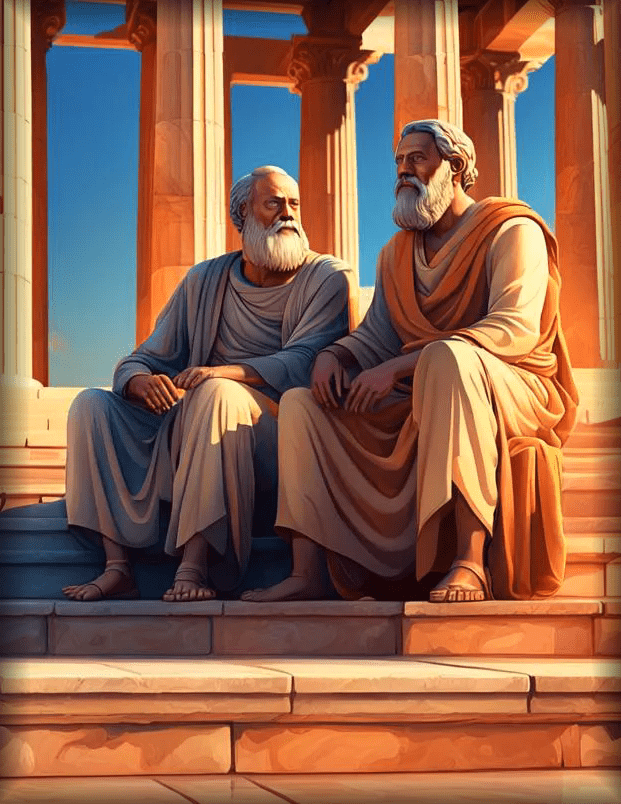
Socrates understood this. The Oracle at Delphi had declared him the wisest man in Athens, and the philosopher, puzzled by this verdict, set out to disprove it. He spoke with the politicians, the poets, the craftsmen — all the men of reputation and acknowledged expertise — and he found, to his great interest and their considerable irritation, that none of them knew what they claimed to know. They had opinions, many of them vivid and forcefully held. But opinion is not knowledge, and the distance between the two is not a matter of degree but of kind. What Socrates possessed, and what his interlocutors lacked, was not superior information. It was the accurate awareness of his own ignorance. He knew that he did not know. And that knowledge — paradoxically, uncomfortably — was the beginning of wisdom.
The Scripture, with its characteristic economy of means, makes the same point with more drama. In the parable of the Pharisee and the publican (Luke 18:9–14), Jesus presents two men at prayer. The Pharisee catalogs his virtues with the efficiency of a man filing a satisfactory quarterly report. He fasts, he tithes, he is not as other men are. He knows where he stands. The publican, by contrast, will not so much as lift his eyes. He strikes his breast. He says only: God, be merciful to me, a sinner. The parable is usually read as being about moral humility, and it is. But it is equally a parable about epistemology — about who can see clearly and who cannot. The Pharisee’s confidence in his own righteousness has become the thing that prevents him from appraising it accurately. The publican’s self-knowledge, however painful, is the thing that opens him to grace. The humble man saw clearly. The confident man did not.
This is not a comfortable observation, because most of us, if we are honest, recognize ourselves more readily in the Pharisee than in the publican. We are the ones with the catalog. We are the ones who have, over years of Sunday mornings and dinner conversations and carefully selected reading, assembled a portrait of ourselves as people who have basically gotten things right. Intellectual humility is not the pleasant thing we perform in polite company when we say, “Well, of course, I could be wrong.” It is the harder, more private work of actually holding that possibility open — and then doing something about it.
| “True humility is not thinking less of yourself; it is thinking of yourself less.” — C.S. Lewis, Mere Christianity |
Lewis, as usual, puts the point with a precision that sends the reader back to examine his own interior. Real humility is not self-deprecation. It is not the affected modesty of a man who insists he knows nothing while holding firm opinions about everything. It is accurate self-assessment — the willingness to measure one’s actual knowledge against the standard of what there is to know, and to be honestly reckoned by the result. That reckoning is where thinking begins.
IV. Biblical Anthropology and the Clouded Mind
To understand why this intellectual cloudedness is so persistent, so universal, so resistant to the simple corrective of more information, one needs a doctrine of man. And the biblical tradition, whatever its detractors may say, provides one with unusual depth and precision.
The Fall, in the Christian understanding, was not merely a moral catastrophe. It was a perceptual one. When Adam and Eve ate the fruit — the fruit of the knowledge of good and evil, note, not the fruit of ignorance — they did not become more knowing in any reliable sense. They became, in the most fundamental way, less capable of knowing truly. The image of God in which they were made was not erased, but it was distorted. The mind that was created to perceive the world clearly, to name things rightly, to distinguish truth from illusion, was bent. The Apostle Paul, writing to the Corinthians, reaches for an image that any honest reader will recognize: For now we see through a glass, darkly; but then face to face: now I know in part; but then shall I know even as also I am known (1 Cor. 13:12). The glass is dark. We see, but not clearly. We know, but in part.

The prophet Jeremiah offers the companion diagnosis: The heart is deceitful above all things, and desperately wicked: who can know it? (Jer. 17:9). This is not poetic exaggeration. It is a clinical assessment of the organ by which we evaluate everything else. The very instrument we use to judge our knowledge is the instrument most susceptible to self-deception. We are not merely ignorant; we are inclined to be comfortable in our ignorance, to mistake the warmth of familiar opinion for the light of verified truth.
Pride — including, and perhaps especially, intellectual pride — is the great distorter. It bends perception around the self. It makes the mind a mirror rather than a window: instead of looking through to reality, we see only a reflection of what we already believe, already feel, already wish were true. The great tradition of Christian education existed precisely because the Church understood this. It did not assume that redeemed people were automatically clear thinkers. It knew that the mind, like any other faculty affected by the Fall, required formation — careful, patient, rigorous formation — before it could be trusted to reason about great matters.
| A Word on the Restorationist Purpose The Restorationist Project is not, at its heart, a political enterprise. It is an educational one. It proceeds from the conviction that citizens who cannot think cannot govern themselves, and that citizens who cannot govern themselves cannot maintain ordered liberty. The recovery of right thinking is not a luxury; it is a precondition. Formation precedes function. |
Thinking freely without thinking rightly does not produce liberty. It produces the particular kind of confusion that our present moment has in such abundant supply: passionate, articulate, confident, and, beneath the noise, deeply lost. The freedom to think, without the discipline to think well, is less a gift than a temptation — and we have, as a civilization, largely succumbed to it.
V. The Classical Tradition and the Discipline of Thought
The ancients were not romantic about human beings. They admired us, certainly — the Greeks in particular had a high regard for human potential that has never quite been matched in its combination of ambition and rigor. But they did not assume that human beings were naturally good thinkers any more than they assumed we were naturally good athletes or musicians. Excellence, in any domain, was understood to be the result of disciplined formation, not spontaneous emergence.
Aristotle opens the Nicomachean Ethics with the observation that every art, inquiry, action, and pursuit aims at some good. He spends the remainder of the work arguing that the good life — the life of human flourishing — is not found by following instinct but by cultivating virtue through habit and reason. Intellectual virtue, he insisted, is no different from moral virtue in this regard. The mind capable of sound judgment is not born but made. It is the product of practice, of encounter with difficulty, of the slow accumulation of well-formed habits of reasoning.
The medieval university took this insight and built a civilization upon it. The trivium — grammar, logic, and rhetoric — was not a curriculum designed to produce pleasant conversationalists. It was the foundational architecture of the mind: grammar to apprehend what language is and how it works; logic to reason from premises to conclusions without error; rhetoric to express truth persuasively and with appropriate force. A student who had mastered the trivium was not yet educated in any particular subject. He was something more valuable: he was equipped to be educated. He had the tools of thought before he was asked to think about the great questions of theology, philosophy, law, and governance.
| “The purpose of a liberal education is not to fill a bucket but to light a fire — and before you can light a fire, you must learn to make one.” — Paraphrase of the classical tradition’s understanding of paideia |
I encountered this tradition as an adult, and I will not pretend that the encounter was without its sting. Here was a civilization — the civilization that built the cathedrals, produced Aquinas and Dante and Shakespeare, and eventually gave rise to the liberal political order I had been loosely defending at that dinner table — that had taken thinking seriously enough to teach it systematically before expecting it to function reliably. And I, product of twelve years of compulsory schooling and four years of university, had been handed opinions about Shakespeare and the Constitution and the nature of man without ever being given the tools to evaluate them. The question rose in me, not without some heat: Why had no one told me?
The answer, I eventually came to understand, is both institutional and cultural. The tools of the trivium were displaced, gradually and then decisively, by a model of education that valued information over formation, content over capacity, the what over the how. We teach students what to think about history far more reliably than we teach them how to think about it. We hand them conclusions and expect the conclusions to do the work that only the process of reasoning can do. The result is a culture of confident incompetence — people who know enough to have opinions but not enough to know whether their opinions deserve to be called knowledge.
VI. The Restorationist Turn — Going Back to Go Forward
The word restoration is easily misunderstood, and I want to be precise about what it does and does not mean in this context. The Restorationist does not worship the past. He does not imagine that some earlier era of American or Western history was a golden age to which simple nostalgia can return us. He knows — because he has done the reading — that every era had its failures, its injustices, its blind spots, and its sins. The past is not a refuge. It is a resource.
What the Restorationist does is something more disciplined and more demanding than nostalgia. He goes back to first principles — to revealed truth, to natural law, to the founding vision of ordered liberty — not in order to live in the past but in order to have a standard outside the present moment by which the present moment can be judged. This is the function that first principles serve: they provide a fixed point from which movement can be measured. Without them, every shift in cultural temperature seems like progress, because there is nothing stable against which progress or regress can be assessed.
Russell Kirk, writing in The Conservative Mind, described the conservative disposition as one that recognizes “an enduring moral order” — not invented by any generation but inherited, discovered, and passed on. The Restorationist adds to this the specifically American dimension: the founders designed a republic on the assumption that certain truths were self-evident, that human nature was fixed and fallen and therefore required institutional checks, and that ordered liberty was the achievement of formed citizens, not the default condition of natural ones. These are not merely historical observations. They are living principles, and they require living engagement.
My own awakening was, I now understand, a small image of this larger turn. The day I admitted “I don’t know” was the day I became capable of learning what was actually true. Not because ignorance is a virtue — it is not — but because the honest recognition of ignorance is the only door through which genuine knowledge can enter. The man who is certain he has arrived will not take a step. The man who knows he is lost will begin to look for the road.
Restoration begins with confession. Not the dramatic confession of the courtroom or the therapy session, but the quiet, private, morally serious confession of assumption — the admission that what I have been calling knowledge was, in significant part, the comfortable drift of a mind that had never been seriously required to examine itself. From that confession, something new becomes possible. Not certainty — not yet, and perhaps not fully in this life. But direction. Method. The willingness to do the work that truth requires.
VII. The Civic Dimension — Citizens Who Think
None of what I have described is merely personal. The stakes of intellectual formation are not confined to the interior life of the individual, however important that life is. They extend outward, into the body politic, into the republic that depends — more than any other form of government in history — on the quality of the citizens who compose it.
The Founders were not modest about this dependency. Thomas Jefferson, with the directness that characterized his best writing, argued that an educated citizenry was the only reliable guardian of liberty: “If a nation expects to be ignorant and free, in a state of civilization, it expects what never was and never will be.” John Adams, in his characteristically earnest way, connected the fate of the republic not to its institutions alone but to the moral and intellectual character of the people those institutions were meant to serve. James Madison, the architect of the constitutional system, understood that the checks and balances of the Constitution were designed for a people capable of understanding and insisting upon them. Remove the understanding, and the checks become formalities.
We have traveled some distance from that founding expectation. The citizen who outsources his political judgment to a media personality, a party platform, or a social media algorithm is not self-governing in any meaningful sense. He is managed. He is, in the political sense of the word, a subject rather than a citizen — not because anyone has formally revoked his freedom, but because he has, through the slow atrophy of the habit of thought, gradually ceased to exercise it. The republic decays not only through the corruption of officials but through the abdication of citizens. When the people stop thinking, the people who want to think for them are always ready to oblige.
| On the Civic Stakes Self-government is not a spectator sport. It requires, as its basic unit of operation, the citizen who has done the work of forming his own judgment — who can read a primary source, follow an argument, recognize a fallacy, and hold a position because he has examined it, not merely because he received it. The Restorationist Project exists in part to recover this citizen — to make him possible again, one mind at a time. |
This is why Vic’s private intellectual awakening — my awakening — carries a meaning that exceeds its private dimensions. One person who begins to think clearly is one more citizen capable of self-governance. One person who goes back to the primary sources — who reads the Federalist Papers and the Anti-Federalist Papers, who reads Scripture in its context and not merely in its comfortable excerpts, who encounters Aristotle and Aquinas and Burke not as names to drop but as thinkers to engage — is one more person capable of participating intelligently in the great ongoing argument of a free republic.
Multiply that person by a generation, and you have the possibility of genuine restoration. Not the restoration of a past era — that is the Restorationist’s caricature, not his program — but the restoration of a capacity: the capacity of a free people to govern themselves because they have done the work, individually and collectively, of becoming the kind of people self-government requires.
VIII. The Invitation — Your Day Has Not Yet Passed
I want to speak to you directly now, and I want to do so without the kind of urgency that shuts a reader down rather than opening him up. This is not a call to alarm, though the times warrant concern. It is a call to something older and more hopeful: the call to begin.
Whatever age you are — whether you are young enough that your opinions are still freshly received from parents and teachers and peers, or whether you are at the stage of life where your opinions have calcified into identity — your day has not yet passed. The moment of honest reckoning I have described is available to you. It requires nothing elaborate: no expensive course of study, no formal program, no dramatic conversion. It requires only the willingness to ask, with genuine seriousness, the question that my dinner-table interlocutor asked me: Have I actually read? Have I followed the argument? Do I know what I think I know, or have I merely absorbed what was ambient?
This is not an essay about shame. Shame closes the mind; it does not open it. The man who has spent decades operating on inherited opinion is not to be condemned — he is, as I said at the outset, ordinary. The invitation is not to self-flagellation but to honest joy: the honest joy of a person who discovers, perhaps for the first time in adulthood, that the world is far larger, far richer, far more interesting than the received version of it suggested. The joy of the student who opens a primary source and finds that Madison is more nuanced than the commentary, that Paul is more demanding than the sermon, that Aristotle is more human than the footnote. There is a particular pleasure in discovering that the great thinkers are actually worth thinking with — and that thinking with them is something you are capable of doing.
| “The unexamined life is not worth living.” — Socrates, as recorded by Plato in The Apology |
Socrates paid for that proposition with his life, which is perhaps the most eloquent argument for its seriousness. He did not mean that the unexamined life is comfortable, or popular, or without its pleasures. He meant that it is not worth living — that there is something in the nature of a human being that is diminished, perhaps fatally, by the refusal to examine. The examined life begins not with answers but with questions. Not with the security of arrived conclusions but with the productive discomfort of conclusions held open — questioned, tested, revised, and held again with the firmer grip of one who has earned what he believes.
The day your thinking begins is not the day all your questions are answered. It is the day the right questions are finally asked. It is the day you sit down with a primary source for the first time, or return to a familiar text with genuinely new eyes. It is the day you hear a question you cannot answer and, instead of deflecting it, carry it home. It is the day the comfortable shell of assumed knowledge develops its first real crack — and you choose, against every defensive instinct, to let the light come in.
I cannot tell you what you will find on the other side of that crack. I can tell you what I found: a tradition deeper and richer than I had imagined, a republic more demanding and more worth defending than I had supposed, a Scripture more difficult and more alive than I had allowed, and a self more in need of formation — and more capable of it — than I had ever seriously considered. The day my thinking began was not a comfortable day. But it was the most important one. I hope yours comes soon. And if the question is already sitting with you, quietly, insistently, refusing to go away — I hope you will not wait much longer to answer it.
✦ ✦ ✦
Vic writes for the Education section of the Restorationist Project. This chapter is part of a longer work exploring the recovery of classical intellectual formation for citizens of the American republic. The Restorationist Project is dedicated to the proposition that ordered liberty requires formed citizens — and that the formation of citizens begins with the formation of their minds.
Scripture references: Luke 18:9–14; 1 Corinthians 13:12; Jeremiah 17:9. Classical references: Plato, The Apology; Aristotle, Nicomachean Ethics. Further reading: C.S. Lewis, Mere Christianity; Russell Kirk, The Conservative Mind; Os Guinness, Time for Truth; Alexander Hamilton, James Madison, and John Jay, The Federalist Papers.