
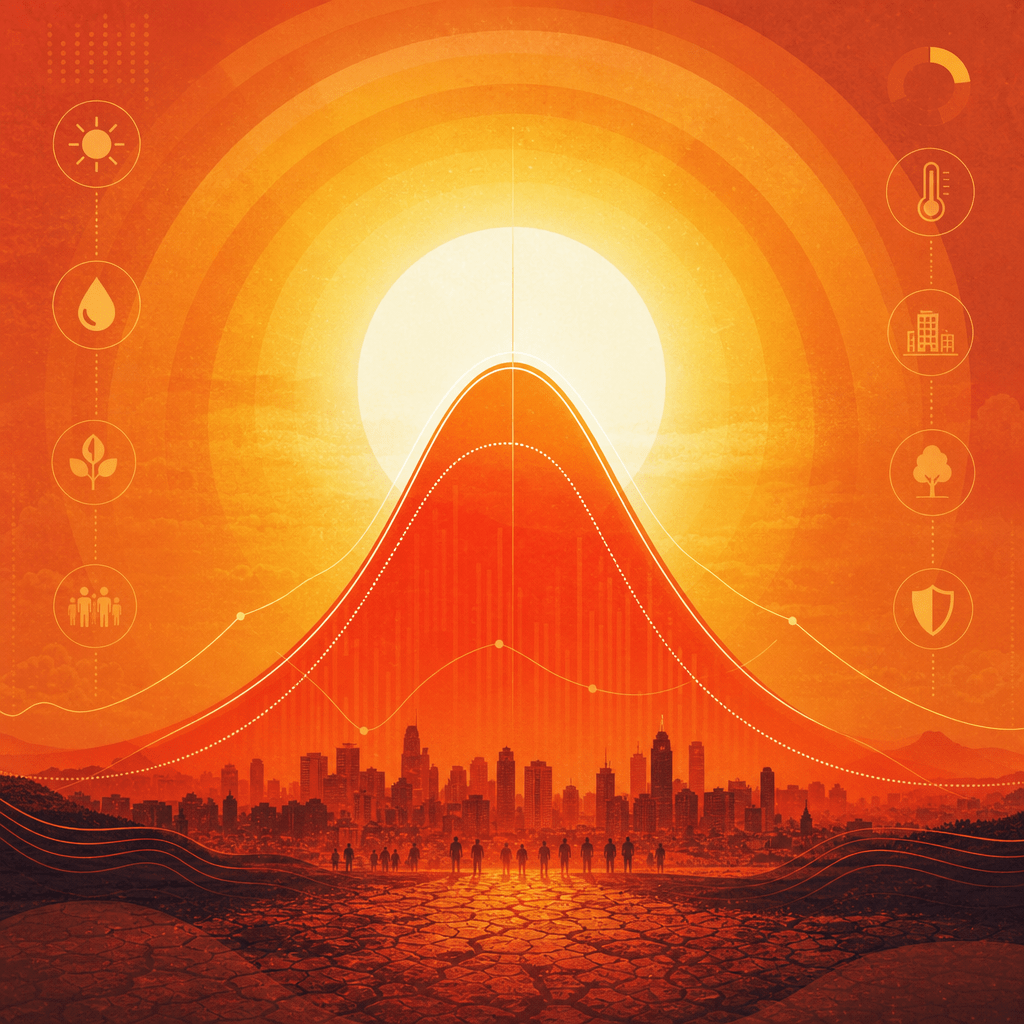
As climate history continues its long cycle, humanity is moving toward the warm peak of Earth—the warmest phase of the current interglacial period. This is not a distant abstraction. It is a practical challenge that will shape where people live, how cities function, what food is available, and which societies remain stable enough to endure.
The coming century will demand more than clever engineering. It will require a civilization capable of staying calm, organized, and morally disciplined under sustained pressure. It will also require clear public planning, because the warm peak of Earth will not be managed by private improvisation alone.
The Scale of the Challenge
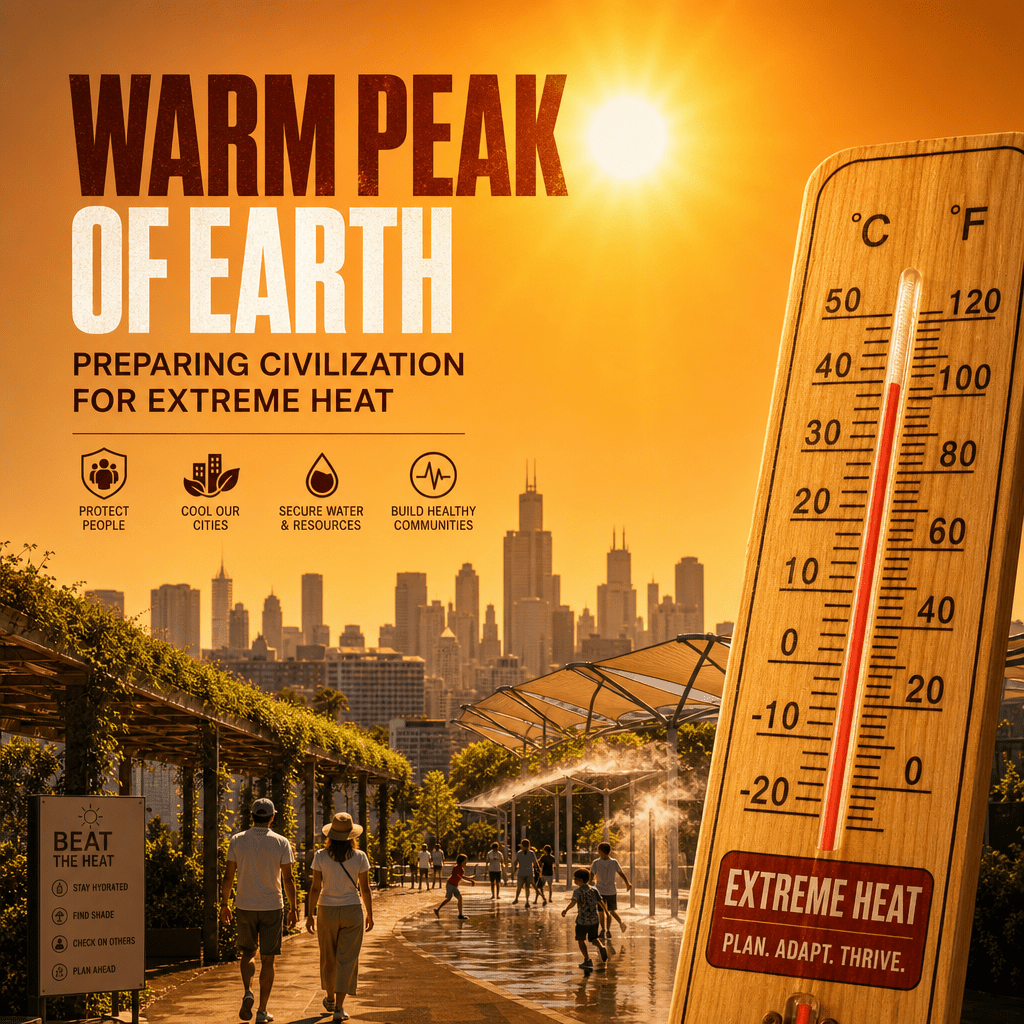
The warm peak of Earth will strain nearly every system modern life depends on. The problem is not only higher average temperatures. It is the compound pressure created by heat, water stress, migration, infrastructure fatigue, and economic disruption happening at the same time.
Coastal cities face flooding, erosion, and eventual abandonment. Freshwater supplies will become less reliable as rainfall patterns shift and evaporation increases. Crop yields will become more volatile as heat, drought, and extreme weather disrupt traditional farming. These are not isolated inconveniences; they are connected pressures that can destabilize whole regions if they are ignored.
Energy demand will rise as cooling, desalination, and water transport become basic necessities rather than luxuries. In earlier eras, societies could treat climate stress as temporary. In the coming era, adaptation will be permanent. That means rebuilding infrastructure not around past assumptions, but around survival in a hotter world.
The warm peak of Earth also changes the political meaning of planning. What used to be a local matter becomes a civilizational task. A port, a reservoir, a rail line, or a power station is no longer just a piece of infrastructure; it becomes part of a survival network that must function reliably under heat stress.
For that reason, the response must be both technical and cultural. Cities, farms, transport corridors, and energy systems will all need to be redesigned with the expectation that temperature extremes, water stress, and relocation pressures will persist for generations.
It is useful to think of this period as a test of organization as much as environment. The warm peak of Earth will reward societies that plan ahead, maintain public order, and preserve confidence in shared institutions. It will punish those that mistake delay for prudence.
That is why the challenge cannot be reduced to a single policy debate. It touches housing, agriculture, energy, education, transport, insurance, and emergency response. Every sector will feel the pressure, and every sector will need to adapt in coordination with the others.
Technology Will Lead the Way
No civilization can meet this challenge without advanced technology. The solutions are already visible, even if they are not yet fully scaled. The warm peak of Earth will likely accelerate investment in systems that can produce water, energy, and food under harsher conditions.
Key tools will likely include:
- Fusion energy for high-output, low-carbon power
- Large-scale desalination to supply growing inland populations
- Engineered irrigation networks to stabilize food production
- Advanced cooling systems for cities, hospitals, and industrial zones
- Heat-tolerant crops that can survive harsher conditions
- Controlled-environment agriculture such as greenhouses and vertical farms
- Biologically adapted food sources designed for extreme environments
These technologies will matter enormously. But technology alone does not create stability. Machines can produce power and water, but they cannot make people cooperate, relocate peacefully, or accept necessary sacrifices.
That requires something deeper: institutions that work, communities that trust one another, and citizens who understand that technical systems only function when human behavior supports them. The warm peak of Earth makes that fact unavoidable.
It also means that research, education, and engineering must be organized around practical outcomes rather than abstract aspiration. The societies that do best will be those that move from invention to deployment quickly and maintain the discipline to keep those systems working when conditions become difficult.
In that sense, technology is not an escape from the problem. It is the toolset that allows adaptation to become possible. Yet even the best toolset is useless if the people managing it are divided, careless, or unwilling to do hard things for the common good.
For example, large-scale water management will require not just pumps and membranes, but maintenance schedules, trained operators, legal authority, and public consent. The same is true for cooling grids, food systems, and transport networks. The warm peak of Earth will therefore test both hardware and administration.
As a practical matter, the transition will favor technologies that are modular, scalable, and durable. Societies will need systems that can be repaired quickly, deployed in phases, and operated under stress. This is one more reason why the ability to plan is as important as the ability to invent.
Why Moral Formation Becomes a Survival Trait
A civilization facing the warm peak of Earth must be populated by people who can think clearly under stress. Panic, denial, and factionalism become more dangerous when the margin for error is small.
Moral formation, in this context, is not a luxury. It is a survival asset.
Citizens will need to be trained to:
- remain calm during disruption
- cooperate in scarcity
- accept relocation when necessary
- work within large-scale civic projects
- avoid emotional escalation that turns hardship into conflict
- maintain discipline in thought and action
When people respond to crisis with outrage or fragmentation, infrastructure slows, trust breaks down, and collective action becomes impossible. When people respond with rational objectivity, the same crisis can be managed, adapted to, and eventually overcome.
This is why civic virtue matters as much as engineering. The warm peak of Earth will not merely test mechanical systems; it will test character. Populations that can delay gratification, accept limits, and cooperate across differences will be more likely to preserve order when resources become tighter and movement becomes necessary.
That kind of formation is not abstract moralism. It is social resilience. It is the difference between a population that can endure disruption and a population that turns every disruption into a wider collapse.
In practical terms, moral formation teaches people how to stay useful when circumstances become uncomfortable. That matters because a stable workforce, a disciplined public, and a trustworthy civic culture all reduce the damage caused by shortages, relocations, and emergency measures.
The warm peak of Earth will not be survived by those who only know how to demand comfort. It will be survived by those who can distinguish between what is desirable and what is necessary, and then act accordingly.
For readers who want a broader context on how large-scale social order and stewardship can shape resilience, see Moral Formation: Stunning Guide to Survival Stability.
Infrastructure Mobilization on a Civilizational Scale
The transition into a hotter world will require one of the largest infrastructure mobilizations in human history. A useful comparison can be found in the scale of the great public works of antiquity, but the challenge today is broader: it is global, continuous, and tied to everyday survival.
Entire coastal regions may need to be abandoned. New inland settlements will need housing, water, power, transport, and medical systems. Farming will need to shift toward protected environments and climate-resistant methods. Industrial zones will need redesigning for heat resilience and water efficiency.
Public planning will need to become long-term, flexible, and brutally honest about what can no longer be preserved. This is not a matter of maintaining the old world with minor adjustments. It is a matter of building a new one.
That means rethinking cities around survivability rather than tradition, comfort, or nostalgia. It also means recognizing that some forms of development will become obsolete while others become essential. The warm peak of Earth rewards adaptation, not attachment to dead assumptions.
One useful example of civilizational adaptation is the way large societies have historically handled water, transit, and emergency logistics. Those lessons still matter, and they point toward a future in which coordinated systems matter more than isolated local pride. For a related discussion of public order and shared responsibility, see Random Musings: On Floods, Power, Stewardship, and the Architecture of a Shared Future.
In practical terms, the next era will likely require new standards for building materials, cooling strategies, water recycling, and energy distribution. It will also require administrative systems that can approve and coordinate projects at a speed appropriate to the pace of environmental stress.
None of this can be improvised at the last minute. The warm peak of Earth will favor societies that begin building before scarcity becomes total. Delayed planning always becomes expensive, and in this case, it can become fatal.
Long-horizon infrastructure also means accounting for maintenance, not just construction. Cooling systems must be serviced, pipes must be monitored, roads must withstand heat, and power networks must remain stable under load. The future civilization will be judged not only by what it builds, but by what it can keep functioning.
Water, power, and settlement redesign
Water systems will have to be rebuilt around desalination, aquifer protection, long-distance transport, and local conservation. Energy systems will need to support continuous cooling loads and large-scale water processing. Settlement patterns will shift inland, upward in efficiency, and outward into more carefully planned regions.
At the same time, regional independence will no longer be enough. A resilient society will need connected systems that can move supplies where they are needed most. The warm peak of Earth makes interdependence unavoidable.
In this setting, cities may become more compact, more vertical, and more deliberately engineered. Housing, transit, and workplaces will increasingly be designed together rather than separately, because heat resilience depends on efficient circulation of people, water, energy, and materials.
Food systems under heat pressure
Food production will also change radically. Open-field agriculture will remain important where it can, but controlled environments, greenhouse cultivation, and engineered crops will become increasingly valuable. What matters is not preserving every old method, but ensuring reliable nutrition under new conditions.
That will place great importance on agronomy, soil protection, seed development, and logistics. The warm peak of Earth creates a premium on every form of agricultural intelligence.
Food systems will likely need more regional redundancy than they do today. If one harvest fails, another system must be able to compensate. That means diversified production, better storage, stronger distribution, and more disciplined management of water and fertilizer.
Such changes may feel technical, but they also have moral implications. Waste becomes harder to justify when production itself is costly. The warm peak of Earth will force a culture of conservation whether people prefer it or not.
The Role of the Citizen
In an era defined by climate stress, the citizen’s role changes. People are no longer only consumers, voters, or residents. They become participants in a continuous rebuilding effort.
That participation will include:
Relocation
Some regions will become too costly or unstable to maintain. Citizens must be willing to move.
Resource discipline
Water, energy, and food will need to be managed carefully. Waste will become a moral issue as much as a technical issue.
Cooperative labor
Large projects will depend on public cooperation, not isolated individualism.
Psychological stability
Societies cannot function if large numbers of people collapse into fear, resentment, or ideological panic.
Acceptance of loss
Not every city, coastline, or landscape can be saved. Civilizational maturity will require the ability to grieve losses without becoming politically destructive.
This is where moral formation meets practical survival. Citizens who can accept reality without self-deception are better prepared to contribute to rebuilding efforts. The warm peak of Earth will reward populations that can face difficult facts and still act constructively.
The same principle applies to institutions. Governments, schools, churches, civic organizations, and technical agencies will all need people who can manage disappointment without collapsing into cynicism. If public life becomes dominated by outrage or withdrawal, the work of adaptation slows.
That is why civic education should not only teach technical skills. It should also cultivate patience, responsibility, and the ability to work toward long-term goods. A hot world demands adults, not perpetual adolescents.
The citizen of the future will need to be useful in more than one sense. He or she must be able to understand the stakes, follow procedures, cooperate with neighbors, and remain steady when systems are under strain. Those are not small requirements; they are the foundations of survival.
A note on stewardship
The question is not whether humanity should value the Earth. The question is how to steward human life wisely within the conditions that exist. In that sense, the warm peak of Earth is not merely a scientific event but a moral one, because every choice about land, water, shelter, and mobility has consequences for future generations.
Stewardship also means honest triage. Some places will be saved; others will be transformed; still others may have to be left behind. Wisdom lies in making those distinctions without sentimental denial.
Reason and Stability Are Now Necessities
The warm peak of Earth will reward societies that can think clearly. It will punish those that confuse emotional intensity with wisdom.
Reason is no longer a philosophical preference. Mental stability is no longer merely personal well-being. Both are survival traits.
The civilizations most likely to endure will be those whose people can:
- evaluate reality honestly
- adapt without hysteria
- prioritize common goods over factional loyalty
- support technical systems with disciplined civic behavior
The Restorationist argument is simple: without moral formation, the technologies required to sustain human life will exist, but the civilization needed to operate them will not.
That argument becomes more persuasive, not less, as the temperature burden increases. The warm peak of Earth will not be navigated successfully by brilliance alone. It will require citizens who can remain objective when circumstances become uncomfortable and who can organize their lives around durable reality rather than preferred narratives.
In that setting, mental steadiness becomes a public good. A stable person is not only helping themselves; they are reducing friction in their family, workplace, neighborhood, and civic environment. Multiplied across millions of people, that stability becomes a national asset.
Reason also helps society distinguish between what must be defended and what must change. Not every institution can survive unchanged, and not every tradition is suited to a hotter future. Clear thinking prevents both panic and rigidity.
For readers interested in the broader scientific basis of long-term climate phases, a concise educational overview is available through the NASA Climate portal.
The warm peak of Earth therefore presents a moral and intellectual challenge together. People must know what is happening, but they must also have the character to respond appropriately. Knowledge without discipline is fragile. Discipline without knowledge is blind.
Building for a Hotter Future
The warm peak of Earth does not mean the end of human civilization. It means the end of civilization as we have known it.
What comes next will depend on whether people can accept reality early enough to prepare for it intelligently. If they do, humanity can build new systems of power, water, food, and habitation suited to a hotter planet.
If they do not, even the best technologies will fail under the weight of disorder.
The future belongs to societies that can combine innovation with discipline, engineering with moral seriousness, and adaptation with courage. In the age of heat, that combination may be the difference between collapse and continuity.
There is no reason to romanticize the transition. There will be loss, relocation, and hard choices. But there is also no reason to assume collapse is inevitable. The warm peak of Earth can be met with realism, planning, and the steady habits of a people prepared to work together.
If the public learns to treat stability, cooperation, and truthfulness as civic strengths, then the next era can still be built deliberately rather than endured chaotically. That is the central challenge—and the central hope.
The warm peak of Earth is therefore not only a climatic fact but a civilizational invitation: build before necessity becomes desperation, organize before disorder spreads, and prepare in a way that honors the reality of the world as it is.
And if that preparation is done well, then heat need not mean decline. It can mean re-formation: a more disciplined, more adaptive, and more resilient human future.