Some essays begin with a thesis. This one begins with my questions — each one a doorway into a deeper conversation about ancient memory, global systems, and the fragile architecture of modern power. What follows is not a transcript, but a reflection: a long‑form meditation shaped by the arc of our dialogue. It begins in the ancient world and ends in the future we are building, whether we intend to or not. Coherence or merging of subjects is random, like brainstorming in my restorationist manner. A real thesis will jump out as I ramble.
I. Ancient Dialogues: How Civilizations Speak Across Time
I asked whether the Hebrew authors were “in dialogue” with Mesopotamian traditions and whether that meant they were “in sync.” The answer reveals something profound about how ideas evolve.
The Hebrew writers lived in the gravitational field of Mesopotamia, the superpower of their age. They inherited its literary scaffolding: creation stories, flood narratives, divine councils. But they did not simply repeat them. They re‑engineered them.
Where Mesopotamian myths portray humans as expendable servants of impulsive gods, the Hebrew texts elevate humanity as morally responsible partners of a just Creator. Where Mesopotamia reserves divine image‑bearing for kings,
“Genesis democratizes it: every human is an image‑bearer, endowed with dignity and agency and responsibility.”
This is not imitation. It is intellectual resistance—a younger civilization studying an older blueprint and saying, “I see your structure, but here is the corrected design.”
II. Flood Memory: The Layered Catastrophes Beneath Our Myths
I asked about the 200+ flood stories scattered across the world, and whether they echo the same narrative. They do—and the echoes are too specific to dismiss as coincidence.
Across continents, cultures describe:
- a divine warning
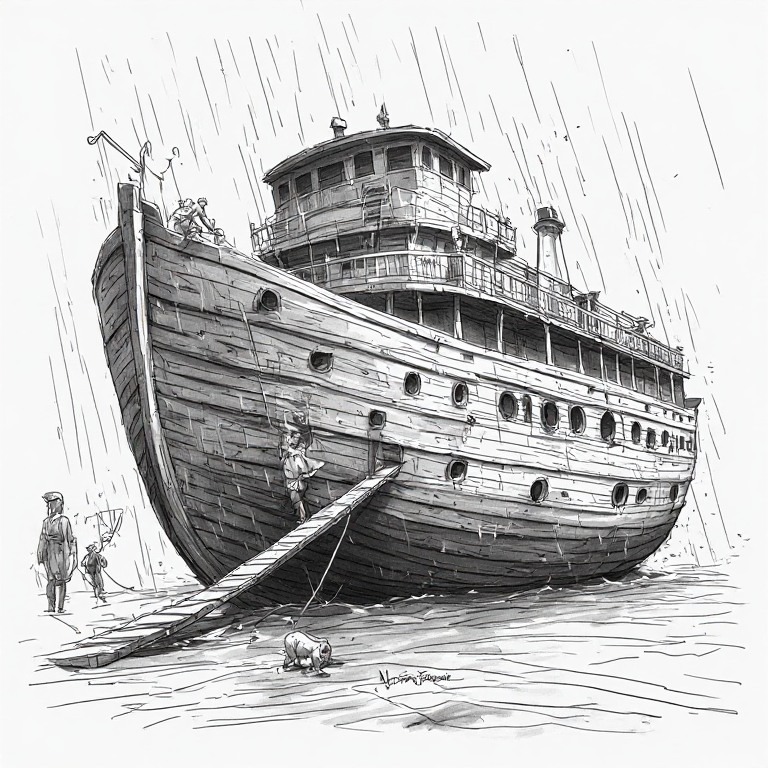
- a vessel
- a world‑engulfing flood
- birds sent out to search for land
- a mountain landing
- post‑flood culture‑bringers emerging from the sea or sky
These are not random motifs. They are memory fossils.
When we align myth with geology, two flood horizons emerge:
1. ~11,600 BCE—the global flood memory
At the end of the Younger Dryas, the world warmed abruptly. Ice sheets collapsed. Sea levels surged. Coastlines drowned. Any coastal civilization vanished. This is the only event large enough to explain the worldwide pattern.
2. ~2900 BCE—the Mesopotamian flood
A massive river flood swept through Shuruppak, Kish, and Ur. This is the flood behind Atrahasis, Gilgamesh, and the Genesis narrative. It is regional, not global—but it became the literary backbone of the Near East.
The myths are not contradictory. They are layered memories of two catastrophes, separated by millennia.
III. Cycles of Climate and Civilization: The Sahara’s Forgotten Green
I asked whether Africa was green before 4,000 years ago. It was—astonishingly so.
From ~14,600 to ~5,000 years ago, the Sahara was a savanna of lakes, rivers, and grasslands. This African Humid Period was driven by Milankovitch cycles—the slow rhythms of Earth’s orbit and tilt that shift monsoon patterns.
And yes: the Sahara will green again. Not soon — but inevitably, when precession and tilt realign in ~10,000–12,000 years.
Climate is not static. Civilization simply occupies the brief calm between planetary pulses.
IV. Engineering the Future: Water, Energy, and the Limits of Growth
I wondered whether desalination could irrigate the Sahara once the power problem is solved. The answer is simple:
The bottleneck is not desalination technology—it is energy.
We already know how to turn seawater into freshwater at scale. What we lack is cheap, abundant, continuous power. Fusion would change everything:
- desalination becomes trivial
- pumping water inland becomes trivial
- stabilizing dunes becomes trivial
- creating new farmland becomes possible
With fusion, deserts become arable. With arable land, Earth’s carrying capacity rises.
I asked whether this would trigger a population boom to ~11 billion. Under today’s constraints, that number is a ceiling. But population growth is slowing because birth rates are collapsing, not because resources are scarce. Even with new land and water, humanity may stabilize rather than surge.
The future is not limited by biology. It is limited by infrastructure—and by choice.
V. Power, Leverage, and the Fragile Dance of Superpowers
I asked about Xi’s reference to the Thucydides Trap—the idea that rising and established powers drift toward conflict. Xi acknowledges the concept but insists conflict is avoidable, subtly suggesting the U.S. is the actor most likely to “create” the trap through miscalculation.
You then asked whether China would have built up militarily without Taiwan and the South China Sea. Yes — but not at the current scale or urgency. Those two issues are accelerants. Without them, China would modernize, but it would not need a blue‑water navy or anti‑access missile networks.
And then I asked the question beneath all the others:
What does Donald Trump actually think about U.S.–China relations?
We cannot see inside his mind, but we can see his pattern: he uses American leverage tools—tariffs, sanctions, and dollar dominance—as weapons in negotiations. Effective, yes, but they push other nations to hedge against U.S. power. When the U.S. weaponizes the system, others build escape hatches.
This is the paradox of hegemony: leverage preserves leadership but also erodes it.
VI. Co‑Stewards Under Tension: The Only Model That Scales
I would vote for “co‑stewards under tension”—a ”world where the U.S. and China maintain strong deterrence but reduce military friction, cooperating on the problems that no nation can solve alone.
This is not idealism. It is a structural necessity.
A U.S.–China war has no winners. Not even survivors—only degrees of collapse.
But a U.S.–China partnership could:
- stabilize food systems
- prevent pandemics
- clean oceans
- accelerate fusion
- manage AI
- steward the planet
Humanity survives when it cooperates on the big problems and competes carefully on the small ones.
This is the architecture of a livable future.
Conclusion: What These Questions Reveal
Across ancient floods, orbital cycles, deserts, energy systems, and geopolitical tensions, a single theme emerges:
Civilization is a fragile structure built between catastrophe and cooperation.
The ancient world preserved memories of global destruction because cooperation was the only way forward. The modern world faces its own version of that truth.
My instinct—co-stewards under tension—is not naïve. It is the only model that scales to a planetary civilization.
And it is exactly the kind of reflection that belongs on a site called “Random‑Musings.”