Most people hear about climate change and think only about the last 100 years. But Earth’s climate has been changing on a much bigger clock for a very long time.
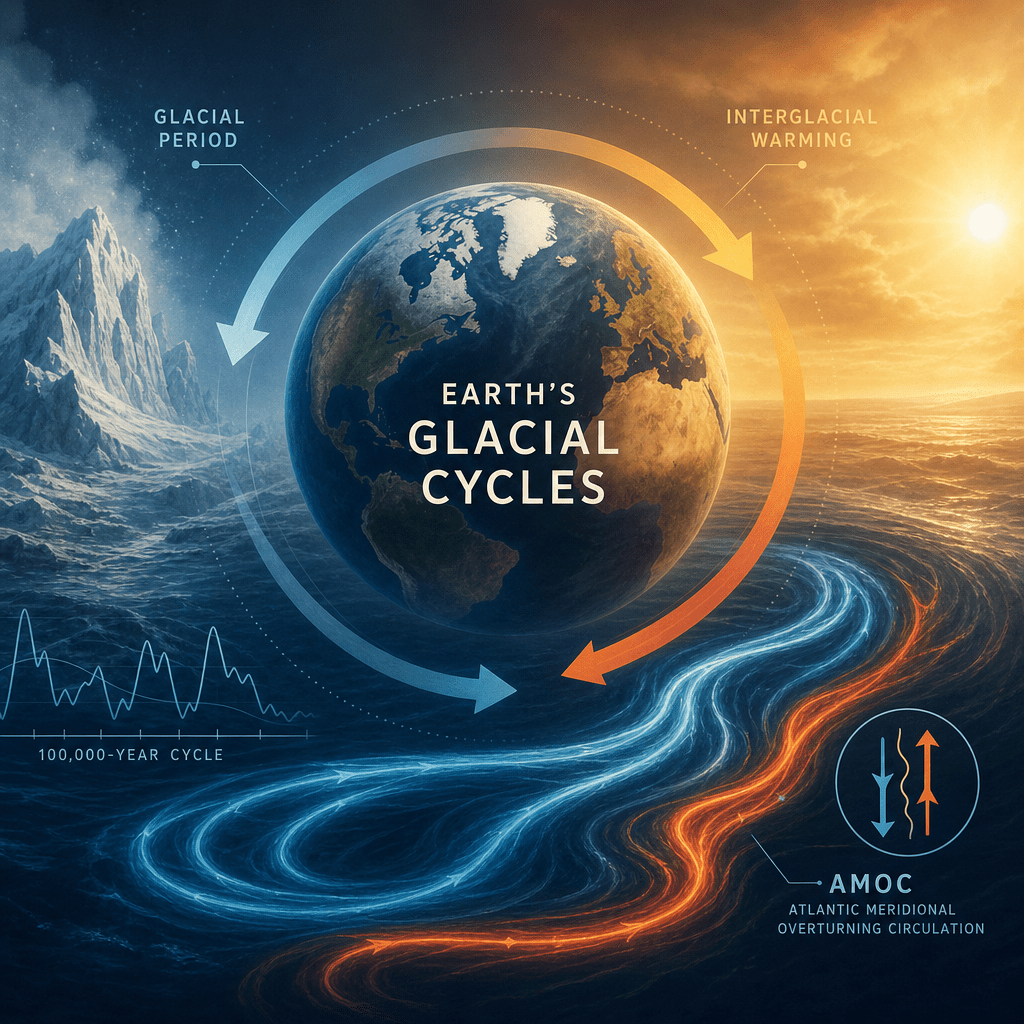
For the last 2.6 million years, the planet has moved through repeating glacial cycles: long cold periods called glacials, followed by warmer periods called interglacials. This is part of Earths Glacial Cycles, and it has nothing to do with factories, cars, or fossil fuels. It is driven by slow changes in Earth’s orbit and tilt.
That matters because it means the climate has never been perfectly stable. It has always been moving.
- What a Glacial Cycle Looks Like
- Why the Climate Changes
- The Interglacial We Live In Now
- Feedbacks That Push Warming Further
- Where the AMOC Fits In
- What This Means for Working People
- How Civilization Fits Into the Bigger Pattern
- Why This Is Not a Temporary Trend
- How Scientists Know This
- The Bottom Line
What a Glacial Cycle Looks Like
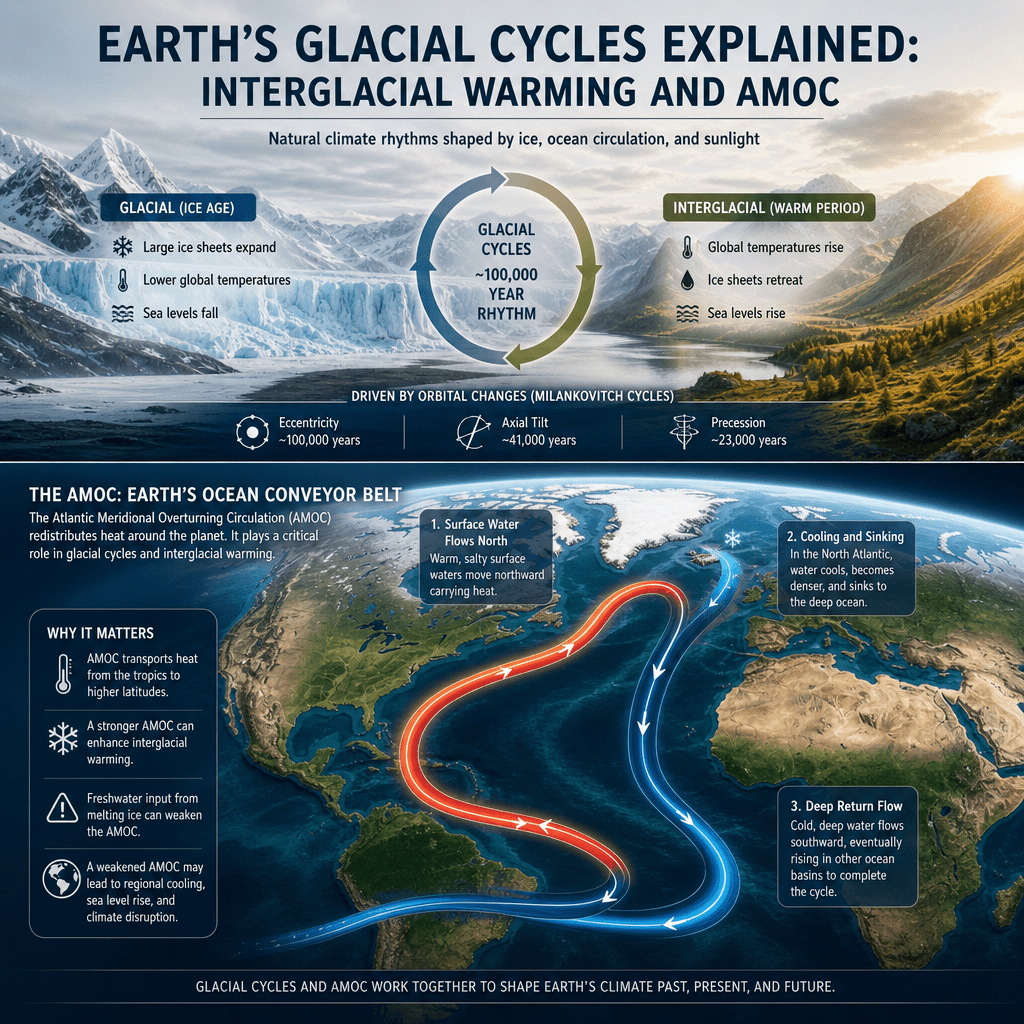
During a glacial period, huge ice sheets spread across North America, Europe, and Asia. Sea levels drop by hundreds of feet because so much water is locked up in ice. Temperatures fall, and the planet becomes colder and drier.
These are not small changes. They reshape the world.
- Coastlines move far outward
- Rivers and forests shift
- Habitable land changes
- Life adapts to a colder, harsher planet
Humans lived through the last glacial period. It ended about 11,700 years ago. Our species survived it, but civilization had not yet begun. No farms, no cities, no modern nations.
That is why Earths Glacial Cycles matter so much. They are not background noise. They set the stage for what kind of world people can live in, where food can be grown, and how far coastlines sit from today’s cities.
Seen from a human lifetime, the change feels slow. Seen from the perspective of geology, it is a regular pulse. Earths Glacial Cycles have repeatedly rearranged where life can thrive and where it becomes difficult to survive.
The planet does not simply warm or cool in a straight line forever. It swings. It holds one state for a long time, then shifts toward another. That is the basic shape of the story.
Why the Climate Changes
The main driver is astronomy, not industry.
Earth’s orbit changes over time. Its tilt changes too. These shifts affect how much sunlight reaches different parts of the planet and when that sunlight arrives. Over long periods, this creates a repeating climate heartbeat.
Roughly speaking, the cycle repeats over about 100,000 years. That means the planet slowly swings between cold and warm states in a pattern that is predictable, even if it feels massive and chaotic from a human point of view.
This is not a random system. It is a natural one.
Scientists often group these orbital changes under the broader idea of Milankovitch cycles. If you want a plain-language overview of how this works in the bigger climate system, see Interglacial Cycle: Stunning Best Guide to Earth’s Warming.
That broader cycle is why Earths Glacial Cycles repeat over time instead of staying locked in one condition forever. The orbit changes the sunlight pattern, and the sunlight pattern changes the climate response.
Small shifts add up. A slightly different tilt changes summer sunlight at high latitudes. A change in orbital timing shifts when the strongest sunlight lands. Over thousands of years, these changes help determine whether snow survives summers, whether ice sheets grow, and whether the planet moves toward warming or cooling.
That is the long version of what looks simple from the outside: sunlight is not just light. Over deep time, it is climate fuel.
For readers who want a fast rule of thumb, the key idea is that Earths Glacial Cycles are driven by changes in how sunlight is distributed, not by short-term weather swings. Those orbit-driven shifts can take thousands of years to show their full effect.
The Interglacial We Live In Now
We are currently in an interglacial period called the Holocene. This is the warm half of the cycle.
That warm period began after the last ice age ended. Ice sheets melted, sea levels rose, and temperatures climbed. This warming made the climate friendlier for farming and settlement, which helped human civilization grow.
But here is the important part: we are not at the peak yet.
We are still moving toward the interglacial maximum, the hottest point in the cycle. No modern human has ever lived through that peak. The comfortable climate that supported agriculture, stable coastlines, and large cities was built during the early part of this warm phase, not the hottest part.
If you want a deeper look at the hottest stage of the warm cycle and what it means for people, read Interglacial Maximum: Stunning Best Effects on Humanity.
This is the part many people miss when they think about Earths Glacial Cycles. We are not living in a finished climate story. We are in the middle of one.
The Holocene has been unusually helpful for human development, but it is still only one phase in a much larger natural rhythm. The temperature we experience today is not the final stopping point of the cycle.
In plain terms, the warm phase has a beginning, a middle, and a peak. We are still on the climb. That is why discussions about Earths Glacial Cycles matter even when the world feels familiar from year to year.
For practical life, the distinction matters. A climate that is warm, but still rising, behaves differently from a climate that has already settled into its top level. The difference shows up in floods, droughts, heat waves, sea level, and the stress placed on everyday systems.
Earths Glacial Cycles also remind us that today’s “normal” is temporary in geologic terms. What seems stable to one generation can be part of a longer rise that continues for thousands of years.
Feedbacks That Push Warming Further
Once warming starts, natural feedbacks can strengthen it.
Ice loss changes what Earth absorbs
When ice melts, it exposes darker land or ocean. Dark surfaces absorb more heat than white ice, so the planet warms faster.
Oceans and thawing ground release more greenhouse gases
Warmer oceans can release carbon dioxide. Thawing tundra can release methane. Both gases trap heat.
Warmer air holds more moisture
That can lead to heavier rain, stronger storms, and more humidity.
These are normal parts of the climate system. They do not need human invention to happen.
In practical terms, this is why warming rarely moves in a neat, smooth line. Earths Glacial Cycles involve feedback loops that can reinforce a direction once the system has started shifting.
Natural feedbacks do not mean every year looks the same. Some seasons are cooler or wetter than others. But the long-term pressure remains pointed toward the warm side of the cycle.
As snow and ice retreat, the system becomes easier to warm. As soils thaw, stored gases can be released. As oceans warm, they can change how much heat and carbon they hold. Earths Glacial Cycles are full of these reinforcing relationships, which is why one change often leads to another.
That also helps explain why climate change can feel uneven. People notice the strongest storms, the hottest summers, or the driest seasons first, but the underlying cycle is deeper than any single event.
Even when local weather varies from year to year, Earths Glacial Cycles keep the bigger trend moving. The direction matters more than any single season.
Where the AMOC Fits In
Another major part of the system is the Atlantic Meridional Overturning Circulation, or AMOC. Think of it as a giant ocean conveyor belt. It moves warm water north and cold water south.
This current helps keep climate patterns stable in North America, Europe, and beyond.
But as the planet warms and ice melts, freshwater flows into the North Atlantic. Freshwater is less salty and less dense than seawater. That matters because it can disrupt the sinking motion that helps drive the AMOC.
If the AMOC slows down enough, climate can shift sharply. In past interglacial periods, it has even collapsed. When that happens:
- Europe can cool rapidly
- Rain patterns can change
- Monsoons can shift
- Weather can become more chaotic
This is not guesswork. It is seen in ice cores and ocean sediments from earlier climate cycles.
For a scientific background on past climate evidence, the National Oceanic and Atmospheric Administration offers a useful overview of ice ages and climate change. That kind of evidence is one reason researchers take the AMOC and past abrupt shifts seriously.
The key point is that the AMOC is part of the same planet-wide system as the larger glacial cycle. When freshwater, ice melt, and ocean circulation interact, local weather and regional climate can change faster than many people expect.
The ocean does not need a dramatic visible event to shift. A gradual slowdown can still move heat around differently, change storm tracks, and alter rainfall far from the North Atlantic itself. Earths Glacial Cycles are large enough that even one current can matter for the whole system.
That is why the AMOC gets so much attention in climate research. It is not just a current. It is one of the organizing systems that helps define how warmth is distributed across the planet.
Seen in the broader picture, Earths Glacial Cycles and the AMOC are linked by the same long chain of ice, ocean water, and changing heat flow.
What This Means for Working People
For people trying to make a living, the big takeaway is simple: the climate is not standing still.
The planet is already in a warming phase of its natural cycle. That means the long-term trend is toward:
- rising temperatures
- melting ice
- higher seas
- stronger heat stress
- more extreme weather
Human fossil-fuel use has added extra warming on top of this natural trend. But the direction of the cycle was already set. The planet was heading toward its warm maximum long before modern industry began.
That does not mean human actions do nothing. They can change the speed of the climb. But they do not change the fact that the cycle itself is real and ongoing.
For workers, that can mean more heat on job sites, more stress on roads and bridges, pressure on water systems, and higher risk for crops, power grids, and insurance costs. The details differ by region, but the underlying issue is the same: a warming planet changes how daily life works.
In other words, Earths Glacial Cycles are not just a topic for scientists and historians. They affect practical choices about where people build, how governments plan, and what kinds of systems hold up under stress.
Think about construction schedules, cooling demands, port design, rail lines, farm timing, and emergency planning. Each of those depends on predictable physical conditions, and those conditions change as the cycle changes. Earths Glacial Cycles remind us that planning has to account for more than one generation.
People often ask what matters more: the natural cycle or human influence. The practical answer is that both matter, but they do not mean the same thing. The natural cycle tells you the direction of the background movement. Human emissions can add extra heat on top of that movement.
For working people, that means the risk is not abstract. It shows up in fatigue, damaged infrastructure, interrupted supply chains, and rising costs. The climate story becomes a labor story, a housing story, and a food story very quickly.
Earths Glacial Cycles are useful here because they turn a vague debate into a concrete timeline. They show why heat, water, and infrastructure stress should be treated as long-term planning issues, not just seasonal news.
How Civilization Fits Into the Bigger Pattern
Civilization did not arise by accident during a random climate era. It grew during a relatively mild and stable window inside an interglacial. That stability made it easier to farm, store food, build roads, and form large settlements.
But stability in human terms is not the same as permanence in geologic terms.
The climate conditions that helped civilization emerge were temporary. They were part of the early, cooler section of the current warm cycle. As the planet continues through the cycle, the same features that once supported growth can become sources of strain.
That is why long-term planning matters. A road, a harbor, or a water system designed for one climate state may not work the same way under another. Earths Glacial Cycles remind us that the physical world sets limits whether we notice them or not.
Even the best engineering has to deal with the basic facts of heat, ice, water, and sea level.
In the broadest sense, civilization is a temporary arrangement inside a much older Earth system. It depends on coastlines, soils, rivers, seasons, and temperatures that remain usable. If those conditions shift, the shape of daily life shifts with them.
This is not a prediction about collapse. It is a reminder that every system has operating conditions. Earths Glacial Cycles define the climate operating conditions over very long time spans.
That is also why historical success does not guarantee future ease. Human societies were built in the gentlest stretch of the current interglacial, not in the hottest part of it.
Why This Is Not a Temporary Trend
Many people hear about warming and assume the climate is just having a rough patch. But the evidence points to a longer cycle.
The last ice age ended about 11,700 years ago. Since then, the planet has remained in an interglacial phase. That phase has not ended. The warm part of the cycle is still unfolding.
When annual temperatures are higher than the year before, that is not automatically a one-off event. Over the long term, it fits the expected behavior of Earth moving toward its warm peak.
This is why Earths Glacial Cycles are useful for understanding the present. They give context. They show that what looks alarming in one lifetime may be part of a larger rhythm that has played out many times before.
At the same time, context should not be confused with comfort. A natural cycle does not make the consequences harmless. Rising seas, shifting rainfall, stronger heat, and AMOC disruptions can still create serious problems for real people.
It is also worth remembering that “normal” depends on the time scale. Over a decade, a few unusual summers may seem like noise. Over centuries, those same changes may be part of a much larger rise. Earths Glacial Cycles force us to think in longer time frames than habit usually allows.
The planet does not ask for permission before it changes state. It follows its own physical rules. That is what makes the climate story both understandable and demanding.
Earths Glacial Cycles are not a temporary headline. They are the long background pattern behind the headlines.
How Scientists Know This
Researchers do not rely on guesswork. They use paleoclimate evidence gathered from ice cores, seafloor sediments, fossils, and chemical traces preserved in old layers of Earth.
Ice cores can show past air bubbles, temperature signals, and atmospheric changes. Ocean sediments can preserve signs of circulation changes and abrupt shifts in climate. Together, these records help scientists reconstruct past interglacial warming and glacial advance.
That is how we know the climate has changed many times before. It is also how we know the AMOC has weakened or collapsed during past climate transitions.
When the evidence lines up across multiple records, the pattern becomes hard to dismiss. Earths Glacial Cycles are not theory in the casual sense. They are a well-established feature of Earth’s history.
The useful question is not whether the cycle exists. The useful question is what it means for the world we are living in now.
Scientists study past climates because the past gives a map of what the system can do. It shows the range of possible outcomes, the kinds of transitions that can happen, and the signals that often come before larger changes.
That is why Earths Glacial Cycles remain central to climate science. They are a record of how the planet behaves when sunlight patterns, ice sheets, oceans, and atmosphere all interact over long periods.
For a clear reference point, Earths Glacial Cycles are not just inferred from one dataset. They show up in many different records that point to the same long rhythm.
The Bottom Line
Earths Glacial Cycles show that our planet has never been climatically stable. It moves through cold and warm phases on a giant natural schedule.
We are living in the warm half of that cycle now. The ice age ended 11,700 years ago, and the long climb toward the interglacial maximum is still underway. The AMOC is part of the same system, and its slowing can make regional weather and climate patterns more unstable.
For practical working people, the message is not hype. It is a reality check: the climate we inherited was temporary, and the one ahead will not look like the one we grew up with.
That is the value of understanding Earths Glacial Cycles. It helps separate short-term noise from the larger pattern, so people can think more clearly about risk, planning, and the future of daily life.
In the end, the planet’s climate story is a long one. The current chapter is warm, unstable, and still unfolding.
Earths Glacial Cycles are the backdrop. Interglacial warming is the present tense. The AMOC is one of the systems that can speed or reshape what happens next. Put together, they explain why the climate keeps changing even when day-to-day life makes it feel permanent.