
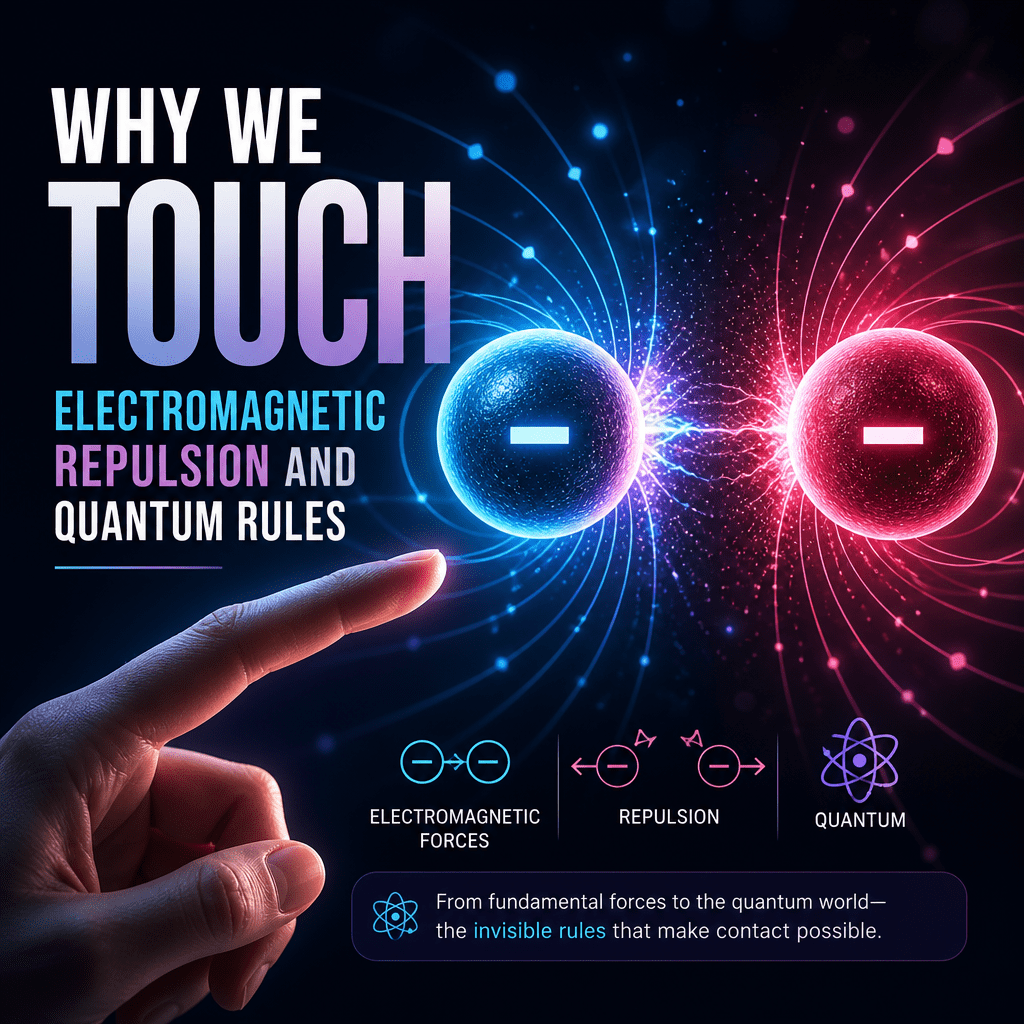
When you press your hand against a wall, it feels solid. You stop. The wall does not let your hand pass through.
But the real reason is not that your hand and the wall are blocked by tiny hard surfaces.
Atoms are not little billiard balls with smooth shells. They are made of charged particles, and those particles interact through electromagnetic forces and quantum rules.
That is what creates the feeling we call touch. It is also why electromagnetic forces matter so much in everyday life, even though we cannot see them directly.
Touch Is Not What It Seems
At first glance, touch sounds simple.
You touch a table. The table pushes back.
But on the atomic level, something more interesting is happening.
Your skin never truly makes direct contact with the atoms in the table. Instead, the atoms in both objects get very close. Then strong forces take over.
These forces prevent the atoms from merging into one another.
So the sensation of touch is really a result of:
- Electromagnetic Forces
- Repulsion between electrons
- Quantum rules that control how matter behaves
To see how charge and force work together in matter, it helps to review a basic explanation of electromagnetism from Britannica.
The Role of Electromagnetic Forces
Atoms are made of a nucleus and electrons.
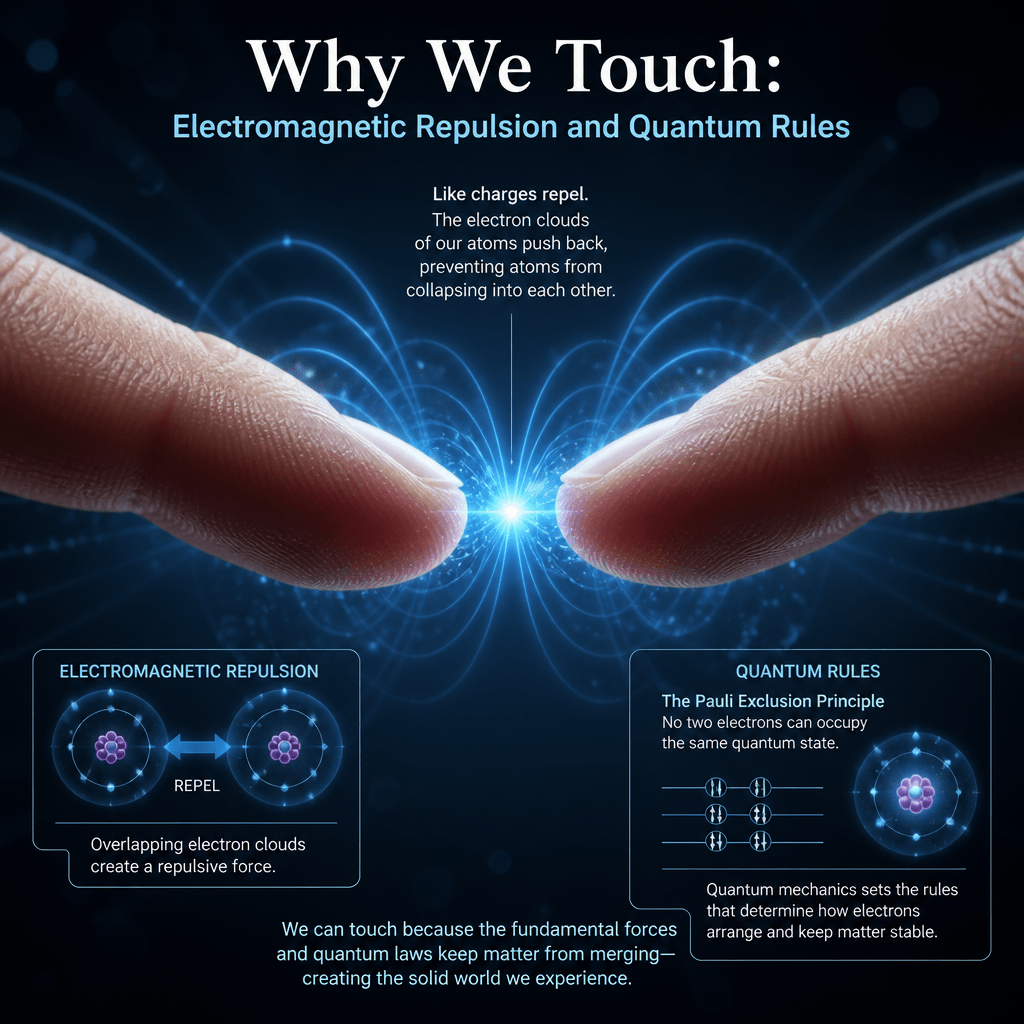
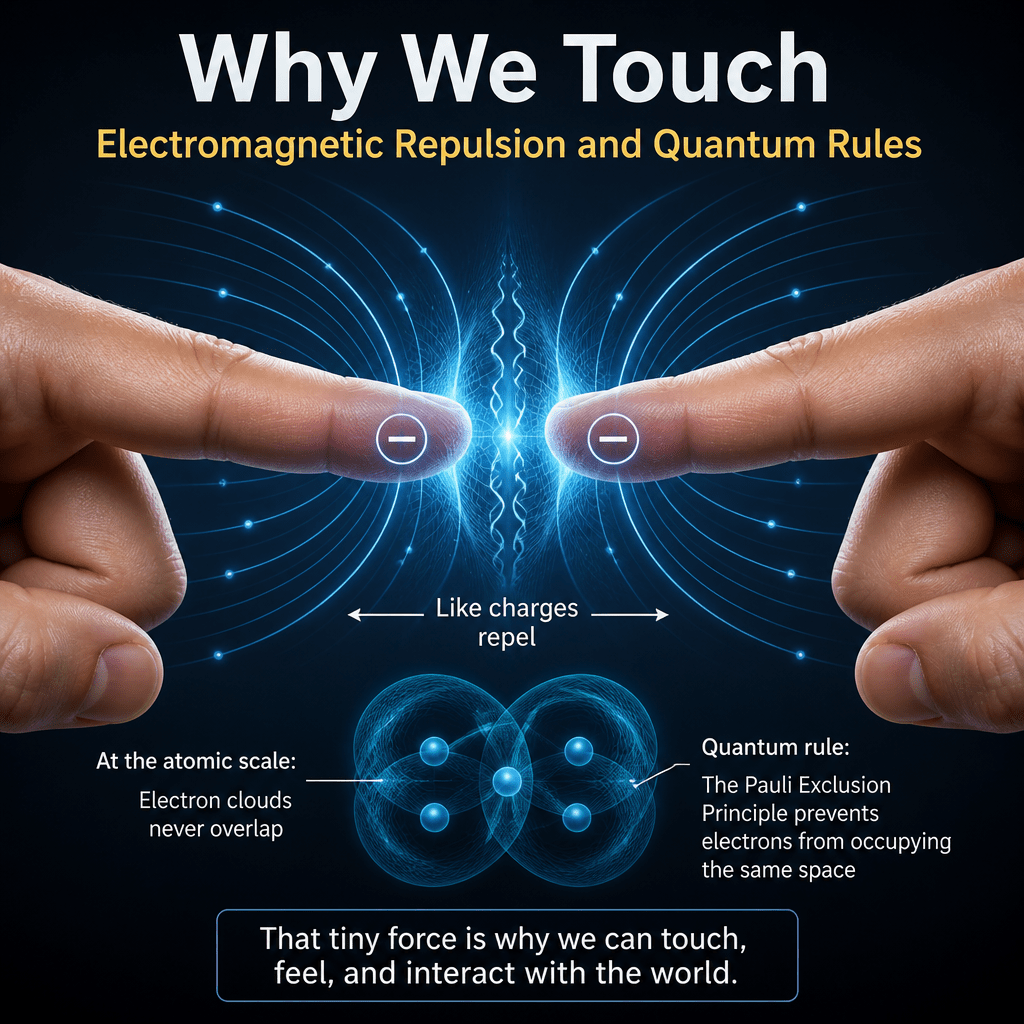
The electrons carry negative charge. When two objects move close together, the electrons in one object interact with the electrons in the other object.
Because like charges repel, they push against each other.
This is one of the main reasons solid objects feel solid. In fact, electromagnetic forces are a major reason everyday matter keeps its shape.
The closer the atoms get, the stronger the electromagnetic forces become. That growing force creates resistance.
In simple terms:
- Your hand moves toward an object
- The electrons in your hand and the object get closer
- Their negative charges resist overlap
- That resistance is what you feel as pressure or touch
So the sensation is not caused by hard surfaces colliding. It is caused by invisible forces acting between atoms.
This is easier to picture when you think of matter as a system of fields and charges rather than a collection of tiny marbles. The rules are subtle, but the result is very familiar: a firm table, a resisting wall, and a floor that holds your weight.
Why Repulsion Happens
The word repulsion is key here.
Repulsion means pushback. In everyday life, we see it when magnets repel or when two like-charged particles push apart.
At the atomic scale, repulsion happens because electrons do not like to occupy the same space very closely.
As atoms approach, the electrons in each atom begin to interfere with each other.
This leads to a strong pushing effect.
That push is why:
- A chair supports your weight
- A floor does not collapse under your feet
- A door stops when it hits the frame
- Your hand cannot pass through a wall
Without this repulsion, matter would not hold its shape the way it does.
The same principle explains why objects can be compressed only so far before they push back. At first the force is small, but as atoms are crowded together, resistance rises quickly. That steep increase is part of what makes solids seem hard and stable instead of soft and fluid.
The Quantum Rule That Makes Matter Stable
There is another important layer to the story.
It is not only about electric charge. It is also about quantum mechanics.
Quantum physics says that particles like electrons do not behave like tiny planets. They follow special rules.
One of the most important is the Pauli exclusion principle.
This rule says that two identical electrons cannot occupy the same quantum state in the same place.
That matters a lot.
When atoms are pushed together, their electrons would need to share states too closely. Quantum rules block that from happening.
This creates an additional force-like resistance.
So the resistance you feel is not just electromagnetic repulsion. It is also a quantum effect that prevents matter from collapsing into the same state.
If you want a broader picture of how matter stays organized in complex systems, the same general idea appears in many areas of physics: microscopic rules create macroscopic structure. The hard surface you feel is really the outcome of countless tiny interactions happening at once.
Why Your Hand Feels the Wall Before It Touches It
This may sound strange, but your hand starts feeling the wall before the atoms actually “touch” in the everyday sense.
That is because forces act at a distance, even if the distance is extremely small.
As your hand gets closer, the electromagnetic forces grow rapidly.
Then the quantum restrictions make it even harder for the atoms to overlap.
The result is a firm stop.
So the experience of touch is really the result of a balance:
- Your hand moves forward
- Atomic forces push back
- Quantum rules prevent overlap
- You feel pressure, not penetration
In practical terms, electromagnetic forces are what give the wall its resistance and your hand its sense of stopping.
That same resistance is present in many ordinary moments. You feel it when you sit on a chair, lean on a counter, or grip a tool. None of those experiences require solid surfaces to be “hard” in the everyday sense. They only require atoms to resist being forced too close together.
A Simple Example: Two Magnets
A magnet can help make this easier to picture.
If you try to push two like poles together, they resist each other. You feel a force before they ever make direct contact.
That is a useful analogy for atomic repulsion.
But atoms are even more complex than magnets.
They are shaped by charge, electron clouds, and quantum behavior. That is why the forces involved in touch are so strong and so reliable.
When you compare a magnet’s push to the resistance of matter, the role of electromagnetic forces becomes easier to imagine, even if the scale is very different.
Magnets also remind us that invisible forces can produce very real results. You do not need to see the field to feel the effect. In the same way, you do not see atomic interactions directly, but you experience them every time you place a hand on a desk or stand on the ground.
Why Solids Stay Solid
Solid matter works because atoms stay arranged in stable patterns.
They do not pass through one another because:
- Their electrons repel each other
- Their electron clouds resist compression
- Quantum rules prevent identical states from overlapping
This is why a rock feels hard, a desk feels firm, and metal feels dense.
The sensation of hardness is the macroscopic result of tiny invisible interactions.
In other words, the solidity of everyday life comes from deep physical laws.
Those laws make electromagnetic forces part of the reason anything around you can remain stable, shaped, and touchable.
It also explains why different materials feel different. Foam compresses more easily than wood because its internal structure allows more movement before resistance becomes strong. Metal feels harder because its atomic arrangement and electron behavior produce a stronger pushback at short distances.
What This Means for “Contact”
People often think of touch as direct contact between two surfaces.
Science tells a different story.
What we call contact is really the result of extreme closeness between atomic structures. The objects never fully merge.
Instead, they are kept apart by:
- Electromagnetic Forces
- Repulsion between charged particles
- Quantum principles
So when you shake someone’s hand, your atoms are not smashing together like solid cubes. They are interacting through fields and quantum rules.
That is the hidden reality behind a very familiar feeling.
The word “touch” is still useful in daily life, but physics gives it a deeper meaning. It is not a moment of simple surface-to-surface collision. It is the point where molecular and atomic resistance becomes strong enough for you to notice it as pressure, texture, or hardness.
Everyday Examples That Make the Idea Clear
Once you understand the basics, the idea shows up everywhere.
When you press a sponge, it compresses because its structure allows more space to close. When you press a steel beam, it barely changes because the atoms inside it strongly resist that change. When you sit in a chair, the chair responds not because it is a single rigid block, but because its atoms and bonds push back against your weight.
Even walking depends on this principle. Your shoe meets the ground, but the sole does not sink endlessly into the earth because the atoms in both materials resist each other. The same invisible pushback that makes the wall feel solid also keeps your steps possible.
That is why the phrase electromagnetic forces is more than a technical term. It describes the reason the physical world remains reliable from one moment to the next.
The Big Idea in One Sentence
The reason is that atoms interact through forces, not through little hard surfaces.
What we experience as touch is the pushback created by electromagnetic forces, repulsion, and quantum rules that stop matter from occupying the same state in the same place.
The Big Picture
This idea is more than a scientific curiosity.
It helps explain:
- Why objects have shape
- Why matter is stable
- Why solid things resist compression
- Why your body can stand, move, and hold tools
It also shows how everyday experience is shaped by invisible physics.
The world feels solid because atoms obey strict rules.
And those rules are powerful enough to keep your hand from passing through a wall.
That is why electromagnetic forces are not just a theory for textbooks; they are part of the reason ordinary objects feel real and firm.
In that sense, the firmness of the world is not an illusion. It is the visible consequence of deep laws acting beneath the surface of ordinary life.
Final Thought
Touch is real, but it is not what we usually imagine.
You are not pressing against tiny rigid surfaces. You are meeting the limits set by electromagnetic forces and quantum mechanics.
That limit feels like hardness.
That resistance feels like contact.
And that is why the world around you stays solid.

Leave a Reply