What is real? Twenty-five hundred years ago, the Sicilian sophist Gorgias of Leontini shook the foundations of philosophy by presenting a radical, unsettling trinity of ideas: Nothing exists. If it does, it cannot be known. If it can be known, it cannot be communicated. To the casual observer, this sounds like an intellectual parlor trick—a clever exercise in absolute nihilism. But when you examine it closely, Gorgias wasn’t making a naive claim about the physical absence of the world. He was pointing directly to the profound, unbridgeable chasm between external reality and the internal human mind. He recognized that our thoughts are entirely separate from physical things, meaning our minds do not reliably mirror reality; they merely construct an interpretation of it.
This protective, practical nihilism is how my mind now actively shapes my reality. It is why a profound topic like Gorgias sets me off into deep loops of contemplation. It is an intellectual spark that matches my physical history. Gorgias used words (logos) to show that reality is a construct; my own body used an existential boundary to prove it to me.
For the vast majority of people, that constructed interpretation is a fragile, chaotic place. We live in a world where the subconscious mind is constantly bombarded by a firehose of sensory data. When the brain’s internal filters fail, the raw volume leaks through, and the primitive threat detector—the amygdala—sounds a false alarm. It mistakes a loud environment, a sharp word, or a modern irritation for a life-or-death crisis.
This triggers what can only be described as a “limbic storm.”
During a limbic storm, the prefrontal cortex—the seat of logic, reason, and conscious thought—is completely left out of the struggle. It is structurally knocked offline by a flood of stress hormones. In the midst of the storm, you cannot think your way to calm, because the brain region required to process logic has been deactivated. The mind becomes a prisoner to its own primitive wiring, panicking over things that do not truly matter, trapped in a hyper-reactive simulation of danger.
But there is a radical turning point that changes the entire nature of this system. It happens when the interpretation of reality collapses, and you encounter the absolute boundary of existence.
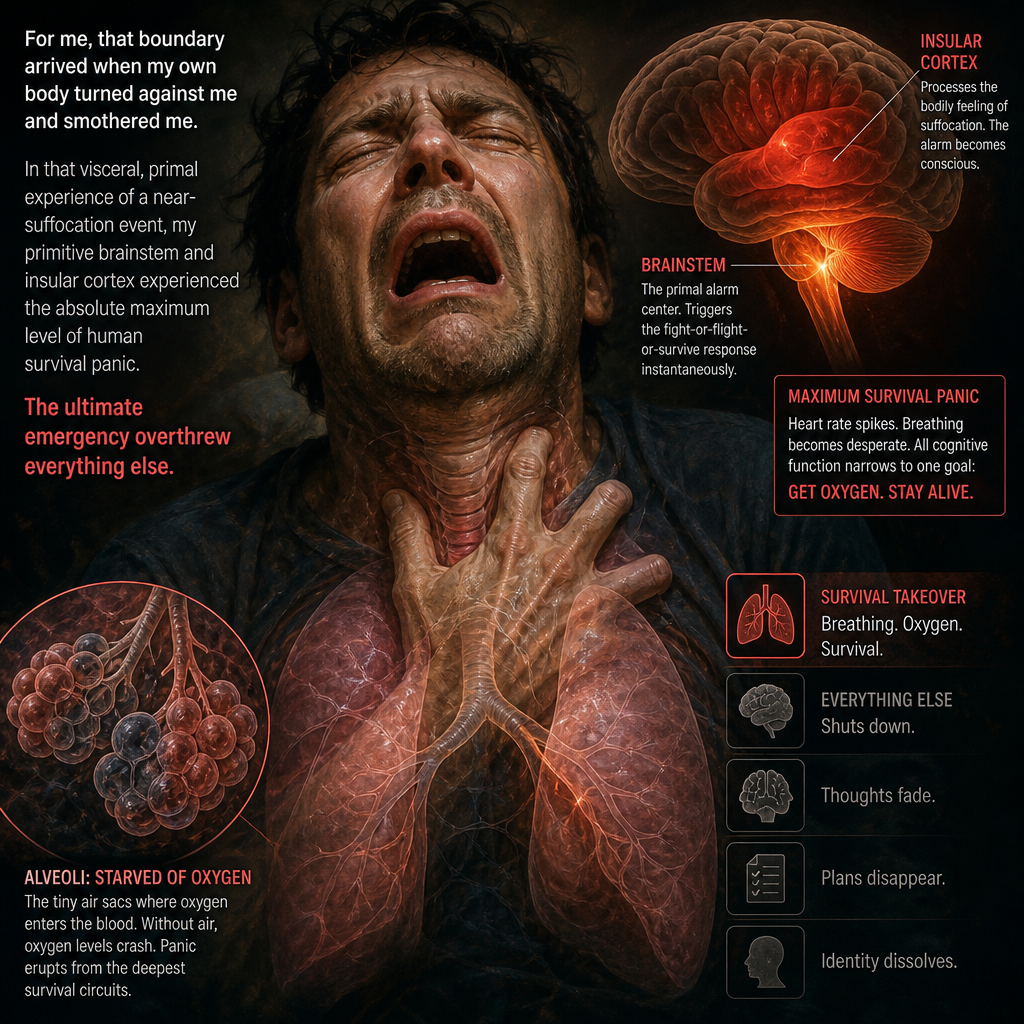
For me, that boundary arrived when my own body turned against me and smothered me. In that visceral, primal experience of a near-suffocation event, my primitive brainstem and insular cortex experienced the absolute maximum level of human survival panic. The tiny air sacs in my lungs, the alveoli, were starved of oxygen. In that moment, the ultimate emergency overthrew everything else.
And when you stare down the absolute boundary of life, you crawl back from it with a completely recalibrated brain.
Having felt what true, physical smothering feels like, my nervous system underwent a profound shift. I looked at the world around me and reached the very conclusion that Gorgias hinted at: in the grand, existential scale of survival, the daily dramas of human life do not matter at all. The arguments, the everyday irritations, and the petty slights that used to have the power to stir up a limbic storm suddenly lost their gravity. When my amygdala tries to flag a social friction as a threat, my deeper, wiser brain regions compare it to the memory of suffocating and deliver an instant verdict: We are breathing. We are not dying. This is nothing.
This protective, practical nihilism is how my mind now actively shapes my reality. It is why a profound topic like Gorgias sets me off into deep loops of contemplation. It is an intellectual spark that matches my physical history. Gorgias used words (logos) to show that reality is a construct; my own body used an existential boundary to prove it to me.
Now, when I look at a world trapped in chronic anxiety and overreaction, I see a population operating with an uncalibrated scale. They treat minor puddles like vast oceans because they have never stepped to the edge of the deep sea. By diving deep to understand these mechanics—the thalamic gate, the HPA axis, and the offline prefrontal cortex—I realize that the only way to manually override the storm when it hits is a conscious act of regulated breathing. The lungs are the back door to the hypothalamus.
My mind no longer passively reacts to the environment; it actively screens it through the lens of ultimate survival. The everyday friction has evaporated, leaving behind a hard-won, unshakeable peace.