
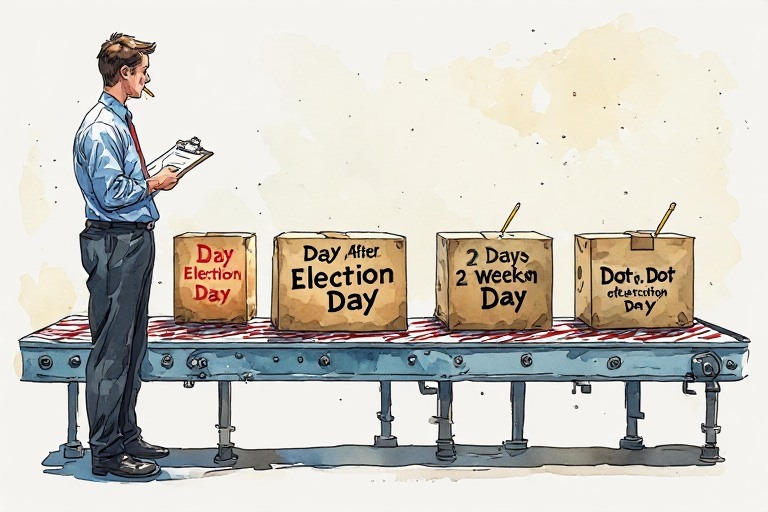
Election Day as a Day: How Drift Fractured a Once‑Unified Federal Moment
For most of American history, a federal election was a single, synchronized act. Citizens across the nation made their choices on the same day, under the same temporal boundary, and the republic spoke with one voice. The architecture was simple and powerful: Election Day was the day the electorate chose its leaders.
Today, that clarity has faded. States now operate on radically different timelines. Some begin accepting ballots weeks before Election Day. Others count ballots days after. Still others allow votes to be “cast” by mail even when they do not arrive until long after the election has ended. What was once a unified national moment has become a patchwork of asynchronous processes.
This is not evolution. It is drift—a slow, largely unexamined departure from the structural logic that once anchored federal elections. And as drift continues, the meaning of Election Day itself becomes less certain, less shared, and less national.
The Original Architecture of Election Day as a Day
The Constitution gives states authority over the “manner” of elections, but Congress sets the day for choosing federal officers. That day was meant to be fixed, not flexible—a civic fulcrum around which the entire nation turned.
Historically, the system reflected that principle:
– Ballots had to be received by Election Day.
– Absentee voting was limited and tightly controlled.
– Counting could continue after the election, but the act of choosing happened on the day.
– The electorate spoke together, not in fragments.
This architecture served an important purpose. It ensured that all voters acted within the same broad information environment. It preserved the sense that a federal election was one national event, not fifty overlapping local ones. And it kept the sovereign act of suffrage temporally bounded.
The system was not perfect, but it was coherent. That coherence mattered.
How Drift Unwound the Federal Moment
Over the past several decades, states expanded early voting, broadened absentee eligibility, and adopted increasingly permissive mail-ballot rules. Each change was defended in familiar terms: convenience, accessibility, modernization, or accommodation.
Individually, these changes may have seemed modest. Together, they produced a structural fracture.
Some states now begin voting a month before Election Day. Others accept ballots days or even weeks after Election Day. Some treat the act of mailing as the act of voting. Others treat the act of receipt as the decisive act. Still others allow ballot curing and corrections long after the election has formally ended.
The result is that a federal election no longer occurs on a federal day.
Instead of one synchronized national decision, the country now has a rolling, asynchronous process in which the meaning of “Election Day” varies from place to place. The phrase still exists, but its force has weakened. In many jurisdictions, it no longer marks a true endpoint; it is merely one checkpoint in a longer administrative sequence.
That is drift in its purest form: a slow erosion of a once-clear boundary, replaced by ambiguity and inconsistency.
Why Election Day as a Day Still Matters
The case for restoring a single day of decision is not partisan. It is architectural. It concerns the structure of the republic, not the preferences of one party or another.
Suffrage is an act, not an intention
A vote is not a sentiment, and it is not a plan. It is a presented choice. The act of voting becomes meaningful only when it is completed within the rules that define the election itself.
If a ballot is not received by Election Day, then it is not part of the election as constitutionally structured. It may still reflect an intention to vote, but intention is not the same as participation. A republic must distinguish between the two.
A republic requires a shared moment of decision
The strength of a national election lies partly in its simultaneity. Citizens vote under broadly shared conditions, with the same calendar boundary governing the process.
When some voters cast ballots before debates conclude, others after major scandals break, and others after late developments change the political landscape, the electorate is no longer deciding together. It is participating in different elections at different times, even if the ballots are all labeled the same.
That weakens the civic meaning of Election Day. It also undermines the idea that the nation speaks in one voice.
The federal statute requires a day, not a season
Congress did not create an “Election Period.” It created Election Day. That distinction matters. A day is a boundary; a season is a drift zone.
The federal election system depends on a temporal cutoff that is meaningful and enforceable. Without that boundary, the legal structure becomes elastic, and the election itself becomes harder to define.
Receipt, not mailing, completes the act
In law, timing rules usually turn on completion, not intention. Tax filings must be received on time. Court submissions must be filed by a deadline. Contract acceptance requires actual assent, not a promise to assent later. Even legislative votes are counted when they are cast, not when they are merely prepared.
Suffrage should not be treated differently without a compelling structural reason. If an election is to remain an election, the ballot must be part of the process by the deadline that defines the process.
Uniformity is a federal interest
States may administer elections differently, but federal elections are still federal. That means the nation has an interest in a common temporal framework. Uniformity does not require identical procedures in every respect, but it does require a common moment of decision.
A federal election should not depend on whether one state counts a ballot before midnight and another counts it a week later. That kind of disparity may be administratively convenient, but it comes at a cost: the erosion of a shared constitutional event.
What the Mississippi Case Could Clarify
The Mississippi case now before the Supreme Court exposes the tension between state-level procedural discretion and the federal requirement of a single day of choosing.
The Court does not need to adopt every part of any particular lawyer’s reasoning to reach a structural conclusion. It can simply reaffirm a basic principle: a ballot must be received by Election Day to count as part of the election.
That would not strip states of authority over election administration. States would still run polling places, manage registration, regulate absentee voting, and set procedures for counting and certification. What it would do is restore the federal boundary that has long defined when the act of choosing ends.
Such a ruling would not be radical. It would be restorative. It would recognize that the Constitution’s logic depends on a day, not an open-ended voting window.
The Cost of Losing Election Day as a Day
When a republic loses the clarity of a shared election day, it loses more than administrative simplicity. It loses civic meaning.
A national election is supposed to be one of the rare moments when the entire country turns together toward a common task. That moment teaches citizens something important: that they are part of a single political order, acting under the same rules at the same time.
Drift replaces that experience with fragmentation. It encourages uncertainty about when the election actually ends, when the result is really settled, and what it means for the people to have “voted” together. In that environment, mistrust grows naturally. So does confusion.
The answer is not to erase access or modernize procedure at all costs. The answer is to preserve the core structure that gives the election its legitimacy in the first place.
Restoring the Day
A federal election should be a moment of national unity—a single day when the republic chooses its leaders. The drift toward multi-week voting windows and post-Election Day ballot acceptance has fractured that moment, replacing clarity with confusion and coherence with inconsistency.
Restoring the requirement that ballots be received by Election Day is not a partisan demand. It is a structural repair. It is a return to the architecture that once ensured that the American people spoke together, at the same time, under the same conditions.
Election Day as a day matters because it gives the nation a common point of decision. Without that point, the federal election loses part of its meaning. With it, the republic regains something essential: a shared civic moment, bounded by law and recognized by all.
A republic deserves a single day of decision. Anything less is drift.