
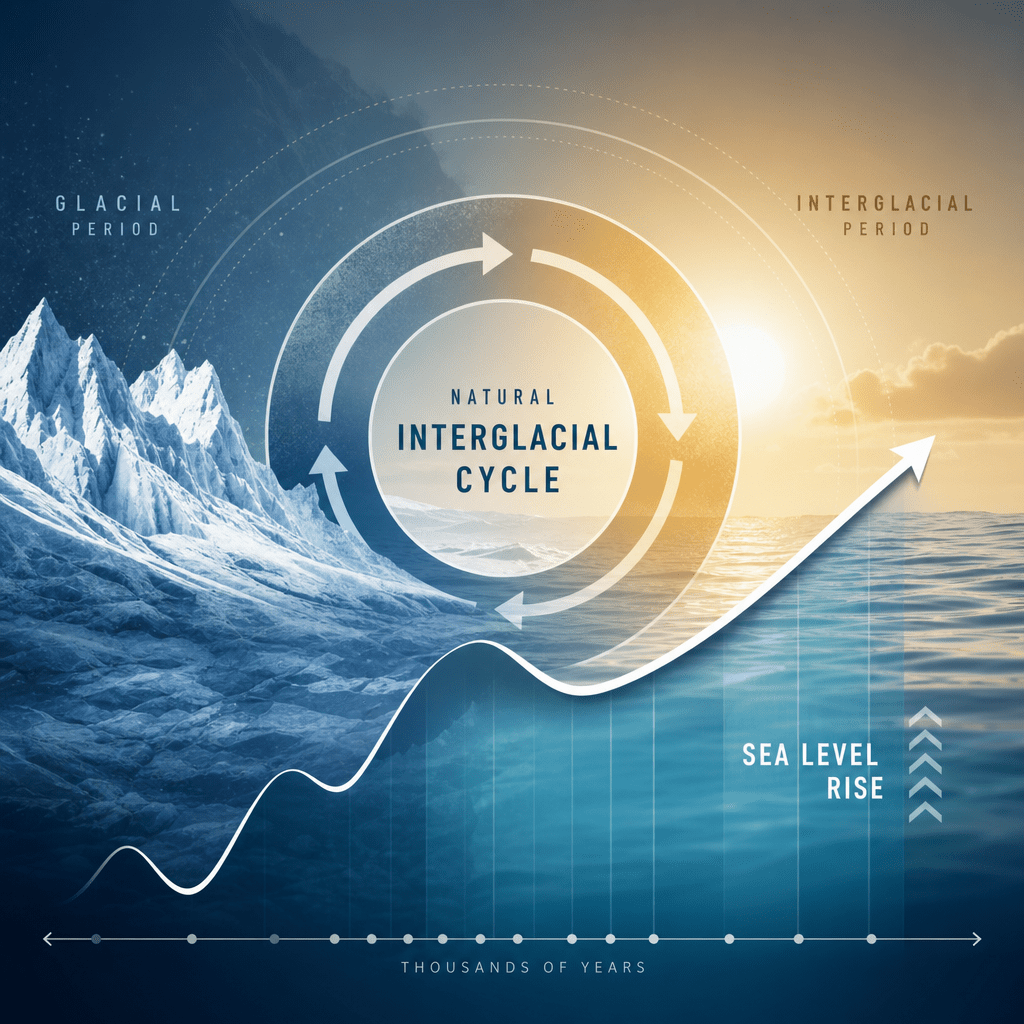
The natural interglacial cycle is the long rhythm of ice ages and warm peaks that has shaped Earth for millions of years. We are living during one of those warm phases, and the planet is still moving toward its interglacial maximum. That matters because the effects are not abstract or distant. They are already showing up in heat, water, food, and coastlines.
This is a scientific pattern, not a short-term anomaly. As Earth continues its natural climb, human populations are increasingly exposed to conditions that were once rare in many inhabited regions. The same warming trend also makes Sea Level Rise a slow but unavoidable part of the story.
Table of Contents
- Earth’s Warm Climb and What It Means for People
- Heat Is Rising Faster in the Interior
- Water Systems Are Becoming Less Reliable
- Food Production Faces Growing Stress
- Sea Level Rise Will Reshape Coasts
- The Bigger Picture: A Planet in Motion
- Adapting to the Warm Peak
- Natural Interglacial Cycle and human populations
Earth’s Warm Climb and What It Means for People
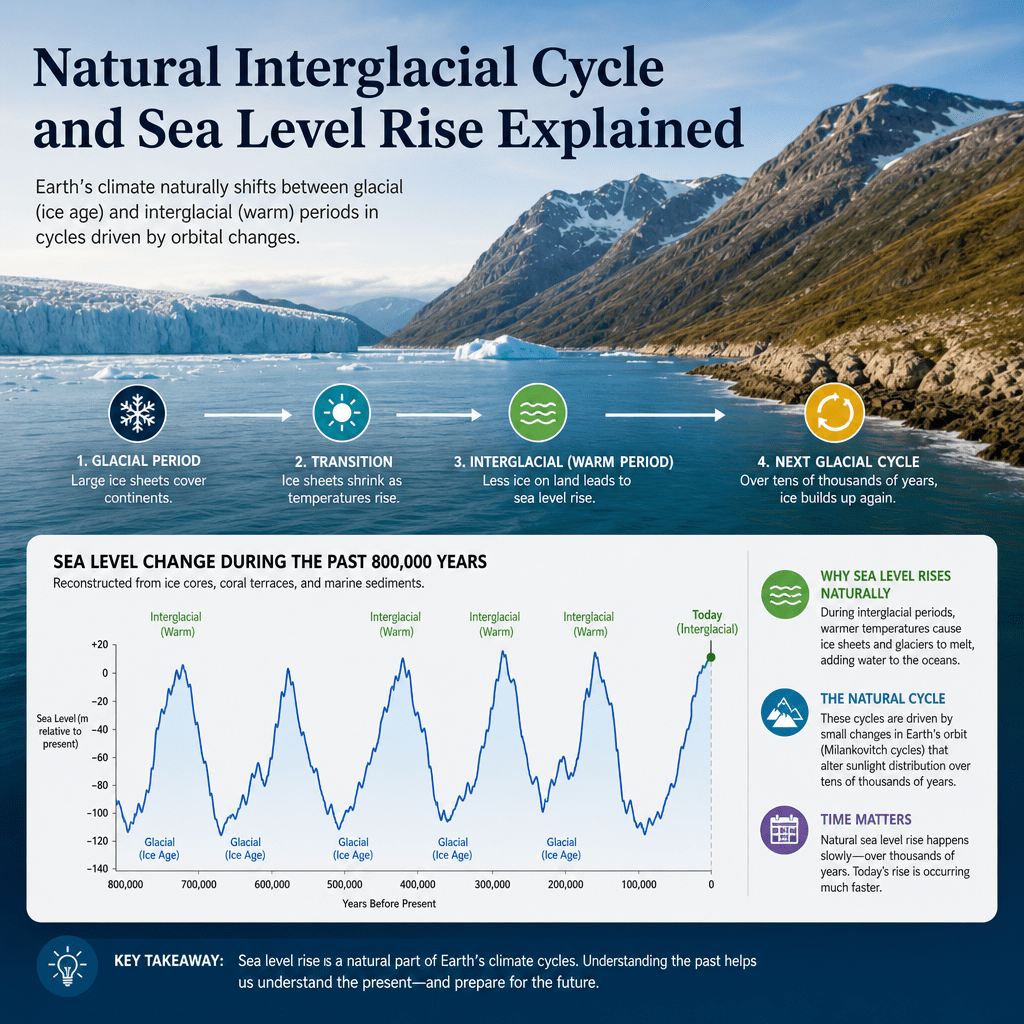
The natural interglacial cycle is the long rhythm of ice ages and warm peaks that has shaped Earth for millions of years. We are living during one of those warm phases, and the planet is still moving toward its interglacial maximum. That matters because the effects are not abstract or distant. They are already showing up in heat, water, food, and coastlines.
This is a scientific pattern, not a short-term anomaly. As Earth continues its natural climb, human populations are increasingly exposed to conditions that were once rare in many inhabited regions. The same warming trend also makes Sea Level Rise a slow but unavoidable part of the story.
To understand why, it helps to look at the physical systems involved. Ice responds slowly, oceans respond steadily, and the atmosphere carries the consequences into daily life. A useful overview of these background cycles can be found in Earth’s glacial cycles explained, which places the warming phase in the context of the larger ice-age pattern.
For readers who want the broader climate timing, the scientific discussion of interglacial maximum effects on human populations connects these long changes to the real-world pressures now emerging across multiple regions.
Heat Is Rising Faster in the Interior
One of the clearest signs of the warming phase is rising heat. Continental interiors tend to warm faster than coastal zones, and that means places in the central United States, the Plains, and parts of the Midwest can experience extreme summer conditions that were once more typical of tropical regions.
Warm air also holds more moisture. As temperatures rise, humidity from the Gulf can reach farther inland, creating dangerous combinations of heat and dampness. When this happens, the body’s main cooling system—sweating and evaporation—stops working efficiently.
That is why the natural interglacial cycle is not just a distant geologic idea. It affects the human body directly by pushing some places closer to dangerous wet-bulb conditions. These are not only uncomfortable conditions; they can become life-threatening during prolonged exposure.
As the natural interglacial cycle advances, the margin for safe outdoor activity shrinks in more places. Heat that once felt seasonal can become persistent, and a stretch of hot nights can be as dangerous as the daytime peak. The natural interglacial cycle does not create these risks evenly; it intensifies them where geography already favors heat buildup.
In practical terms, the natural interglacial cycle can turn routine summer weather into a public-health issue. The body needs a nightly cooling window, and when that window disappears, heat stress rises quickly. That is especially true in dense urban areas where pavement, buildings, and limited shade trap warmth long after sunset.
Why humidity makes heat more dangerous
- Sweat cannot evaporate as easily
- Core body temperature rises more quickly
- Outdoor work becomes harder or impossible
- Wet-bulb conditions can become life-threatening
These conditions are not just uncomfortable. They can become physically dangerous even for healthy people.
As summers intensify, the practical result is a growing burden on labor, public health, and infrastructure. Air conditioning can reduce risk indoors, but it does not solve the outdoor problem. In places where power grids are strained, the danger becomes even greater because the period of greatest heat is often also the period when cooling demand peaks.
Heat stress also compounds over time. A single hot day can be managed more easily than a long sequence of oppressive days and nights, especially if the air stays warm after sunset. Nighttime relief matters because the human body needs a cooling window. When that window disappears, the danger increases sharply.
The physical pattern is simple: as the atmosphere warms, it can transport more moisture. That increases the odds that hot weather becomes humid heat, and humid heat is harder for the body to tolerate. The result is a more difficult environment for workers, athletes, older adults, and anyone without consistent access to cooling.
Water Systems Are Becoming Less Reliable
The warming phase of the natural interglacial cycle also changes how water moves through the landscape. Snowpack melts earlier, glaciers retreat, and rivers fed by mountain ice become less dependable. Lakes lose water faster to evaporation. Rainfall patterns shift, making some places wetter and others drier.
This creates long-term pressure on freshwater supplies.
For cities, farms, and industries, water stability is essential. When the timing of snowmelt changes or river flow becomes less predictable, the impact spreads across entire regions. What once looked like a stable water source can become a seasonal or even uncertain one.
Many communities depend on mountain snowpack as a natural reservoir. Snow accumulates in winter and releases meltwater in spring and summer, when demand is high. As warming reduces that storage, downstream systems lose a critical buffer. Reservoirs can help, but they do not fully replace the timing and scale of a mountain snowpack.
Glaciers matter in a similar way. They release water gradually, but as they shrink, the flow changes. First there can be a period of unusually high melt, followed by a longer decline as the ice reserve disappears. That means some places face a brief surge and then a deeper shortage. The pattern is uneven, but the direction is consistent.
Water scarcity does not always mean total absence of water. It often means the wrong water at the wrong time. A region may receive too much rainfall in one season and too little in another. Flood risk and drought risk can rise together, creating instability for planning, insurance, agriculture, and public works.
These shifts also affect water quality. Lower river flow can concentrate pollutants, warmer water can stress ecosystems, and saltwater can move inland where sea level rise reaches estuaries and aquifers. In other words, the issue is not just quantity. It is also reliability and quality.
In practical terms, the natural interglacial cycle puts pressure on every part of the water system at once: storage, timing, distribution, and quality. That is why water planning becomes one of the most important adaptation challenges during a warm peak.
Food Production Faces Growing Stress
Food systems are tightly linked to temperature and water. Crops grow within specific heat limits, and many major farming regions already operate close to those limits during summer. As the planet continues warming toward its natural peak, those limits will be tested more often.
Agriculture becomes more volatile when:
- heat shortens growing seasons
- rainfall becomes less reliable
- irrigation demand rises
- soil moisture evaporates faster
Some regions may adapt with technology, new crops, or controlled-environment farming. But the overall pressure on food systems increases as the warm phase advances. In earlier interglacial periods, ecosystems shifted northward or upslope. Today, farmland cannot move so easily.
The main challenge is that modern agriculture is highly specialized. Large areas are planted with crops optimized for current temperature bands, current soil conditions, and current seasonal timing. When heat arrives earlier or lingers longer, yields can fall. When rainfall patterns move away from their historical norms, planting schedules and harvest windows become harder to predict.
Livestock also feel the strain. Animals can suffer from heat stress, reduced forage quality, and water shortages. That affects weight gain, milk production, reproduction, and disease risk. The result is a broader food-system impact than crop loss alone.
Soil health matters too. Higher heat can dry soils faster, making them more vulnerable to erosion and reducing microbial activity that supports fertility. In dry regions, a small change in temperature can trigger a large change in moisture retention. In wetter regions, intense rainfall can wash nutrients away before plants can use them.
These are exactly the sorts of pressures that build as the natural interglacial cycle advances. The cycle does not merely raise average temperature. It reshapes the whole set of growing conditions that agriculture depends on.
Some observers focus only on short-term production gains in cooler places, but that misses the larger point. A shift in one region does not cancel losses in another, especially when global markets, transport systems, and food prices are interconnected. Stability matters as much as output.
Sea Level Rise Will Reshape Coasts
Another unavoidable result of warming is Sea Level Rise. As glaciers and ice sheets lose mass and oceans expand with heat, coastlines gradually change. In past interglacials, sea levels eventually rose far above modern levels.
That process takes time, but the direction is clear.
Even a modest rise can have major effects:
- flooding in low-lying cities
- saltwater intrusion into groundwater
- loss of coastal infrastructure
- pressure for inland migration
Sea level change is one of the most permanent signs of the planet’s warm climb. Once land is lost to the ocean, it is not easily recovered.
Coastal risk does not come only from major storms. As sea level rises, ordinary high tides begin to reach farther inland. Storm surges then ride on top of a higher baseline, which means the same storm can do more damage than it would have done in the past. Drainage systems also become less effective when the sea sits higher than the land’s historical design assumptions.
Ports, roads, rail lines, wastewater systems, and housing all sit within the reach of this slow change. The result is not dramatic overnight transformation but accumulating pressure. Maintenance costs rise first, then repairs become more frequent, and eventually some locations become too expensive or too exposed to sustain in their current form.
Coastal aquifers face a related issue. When salty water intrudes into freshwater supplies, wells can become unusable or require costly treatment. This is one reason sea level change matters far beyond the shoreline itself. It reaches inland through groundwater and infrastructure.
If you want a broader discussion of the physical and social implications of extreme warming, Warm Peak of Earth: Preparing Civilization for Extreme Heat offers a useful companion perspective on the same long-term transition.
The Bigger Picture: A Planet in Motion
The key point is that none of these changes are random. They fit the broader structure of the natural interglacial cycle. Earth warms, ice retreats, seas rise, and climates shift. Then, eventually, the long cycle reverses. This has happened many times before.
What is different today is population density. Billions of people now live in regions that were once sparsely inhabited or not used at all during earlier warm peaks. That makes the modern response more complex, even though the underlying physics are the same.
The scientific picture is not built on a single indicator. It is built on many signals that move together: heat, moisture, snow loss, glacier retreat, river instability, shifting rainfall, and shoreline change. When those signals line up, they describe a planet in motion rather than a stable background.
That is why the current warming phase is better understood as a long transition than as a series of unrelated events. A hotter summer, a lower snowpack, and a flooded coastal street may look separate at first. In a geologic context, they are connected parts of the same cycle.
For readers interested in the ocean and atmosphere mechanisms behind these shifts, climate researchers often point to circulation patterns such as the Atlantic Meridional Overturning Circulation. The National Oceanic and Atmospheric Administration has a clear educational overview of the AMOC and its role in moving heat through the ocean: NOAA’s AMOC explanation.
That broader circulation context matters because ocean motion can amplify or modify the effects of warming on specific regions. The climate system is not a set of isolated parts. It is a linked system in which the atmosphere, ocean, ice, and land all influence one another.
Adapting to the Warm Peak
The climb toward the interglacial maximum does not mean immediate collapse. It means adjustment over time. People will continue to adapt with engineering, migration, agriculture, and urban planning. But the baseline conditions are changing.
Societies built around relatively mild climate, stable seasons, and predictable water will have to cope with:
- hotter summers
- more frequent extreme heat
- shifting rainfall
- reduced snow and ice storage
- long-term Sea Level Rise
These are the practical realities of a warming planet moving through its natural cycle.
Adaptation will not look the same everywhere. Some regions will invest in cooling infrastructure, shaded public spaces, and improved building design. Others will adjust irrigation systems, planting dates, or water-sharing arrangements. Coastal areas may raise defenses, redesign drainage, or gradually relocate critical assets. Each response reflects the same underlying fact: the environment is changing on a timescale that matters for human planning.
There is also a social dimension. When heat, drought, or flooding affects livelihoods, migration often increases. Some people move temporarily; others move permanently. That movement can place new demands on housing, transportation, schools, and health care in the receiving areas. Long-term adaptation therefore requires not just technical solutions, but coordinated regional planning.
Public understanding matters too. People are more likely to prepare when they recognize that these changes are part of a coherent physical pattern rather than isolated bad luck. That is why it helps to describe the issue clearly: the natural interglacial cycle is advancing, and the consequences are now visible in everyday life.
Natural Interglacial Cycle and human populations
For human populations, the combined effects of rising heat, shifting water systems, declining food stability, sea-level rise, and potential circulation disruption create a world that becomes progressively harder to live in as the interglacial maximum approaches. This does not mean humanity will disappear. It means that the conditions under which civilization developed — mild temperatures, stable seasons, predictable water, and low sea levels — will not exist in the same form.
People will adapt, move, rebuild, and innovate, just as life has always done during past interglacial peaks. But the scale of modern population makes the transition more challenging than anything seen in earlier cycles.
A person alive today will witness the early stages of this natural transformation. They will see hotter summers, more extreme weather, shifting coastlines, and growing pressure on water and food systems. These changes are not signs of a temporary trend. They are the beginning of the planet’s climb toward the warmest part of its natural cycle — a climb that has repeated many times before and will repeat again long after humanity is gone.
This is the scientific foundation for understanding the effects of the natural interglacial cycle on human populations. It explains what happens to heat, water, food, coastlines, and weather as Earth moves toward its natural warm peak. It also shows why sea level and heat must be discussed together rather than as separate topics, because both are part of the same long transition.
For a related discussion of coastal change and long-range risk, see Interglacial Maximum: Stunning Best Effects on Humanity. That article expands the human side of the story while this one focuses on the physical structure behind it.
The question, then, is not whether the cycle exists. It does. The question is how societies choose to prepare for its effects while the warm phase continues to unfold.
Conclusion
The future shaped by the natural interglacial cycle is one of rising heat, changing water systems, unstable agriculture, and advancing Sea Level Rise. None of these trends are speculative. They are the expected outcomes of Earth’s movement toward its warm maximum.
For human populations, the challenge is not whether the cycle exists, but how to live through its effects.
That is why the current era deserves attention: not because it is unprecedented, but because it is part of a known natural pattern now intersecting with a densely populated world. Understanding the pattern is the first step toward responding wisely to it. As the natural interglacial cycle continues, the practical goal is to plan for heat, water, food, and Sea Level Rise together instead of treating them as separate problems.
Seen in that light, the natural interglacial cycle is not just background geology. It is a present-tense framework for the heat, water, and coastal changes already unfolding around us. The sooner those changes are understood together, the better prepared human populations can be for the long rise ahead.