
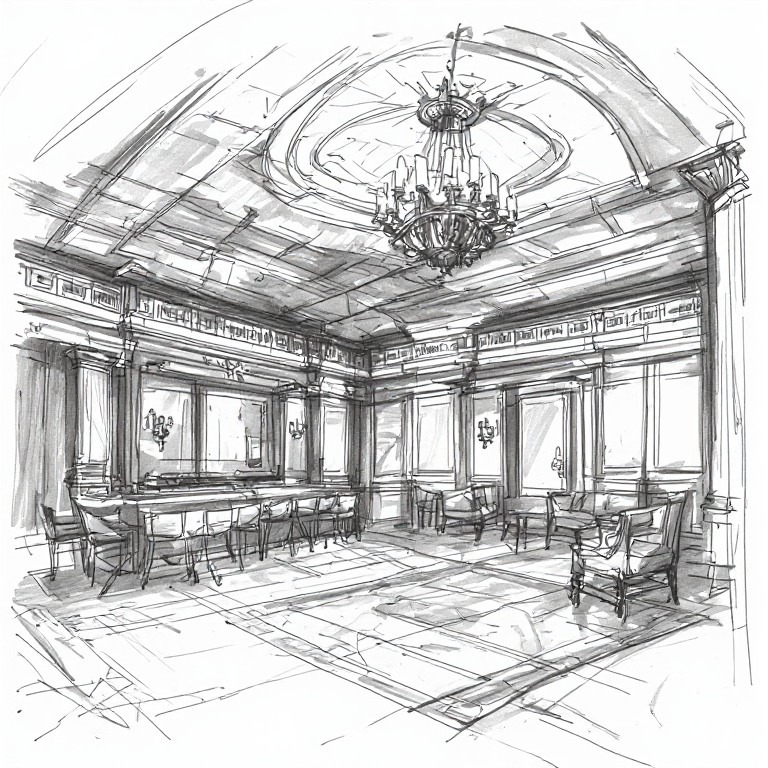
The Ballroom Becomes the Battlefield: How a Security Crisis Turned a Construction Project Into a Constitutional Test
The fight over the White House ballroom is no longer just a story about architecture, funding, or even presidential taste. It has become a test of power: who gets to decide when the executive branch can act, how much Congress can do once the work has already begun, and whether a security crisis can transform a construction project into a constitutional fait accompli.
What makes this controversy so consequential is not the ballroom itself, but the sequence of events surrounding it. The East Wing has already been demolished. Construction has already started. Private donors have already committed money. And now Congress is being asked to react to a project that exists not as a proposal, but as a physical reality on White House grounds. That is the central problem. The law tends to move through hearings, debates, appropriations, and court review. The executive branch, by contrast, can move through machinery, demolition crews, and security justifications. By the time the formal process catches up, the building may already be too far along to stop.
The White House ballroom and the Federal Project Inflation Cycle
Yesterday’s analysis argued that private funding allowed the White House ballroom to bypass what might be called the Federal Project Inflation Cycle: the familiar system in which public construction becomes slow, expensive, and politically mediated through layers of agencies, contractors, consultants, and congressional oversight. That argument still matters. Private money short-circuits the normal incentives that make federal projects so cumbersome. It reduces the number of gatekeepers, weakens the role of appropriators, and deprives lawmakers of the leverage that comes from controlling the purse strings.
Today’s developments deepen that argument. The project has not merely escaped the usual federal machinery; it has entered a new phase in which security concerns are being used to justify speed. The ballroom is no longer described only as a venue. It is now being framed as a hardened asset, something closer to a protective structure than a ceremonial one. That reframing matters because it changes the political language around the project. Once national security enters the conversation, the burden of opposition rises sharply.
Security crisis as political accelerant
The assassination attempt at the Hilton is now the key event shaping the debate. According to the DOJ complaint, the attacker was armed, mobile, and dangerously close to the room where the president, vice president, and speaker were seated. That detail is being used to recast the ballroom project as a response to a real vulnerability. In effect, the crisis becomes the justification for the construction, and the construction becomes a remedy for the crisis.
This is how urgency functions in Washington. A project that might otherwise be slowed by review suddenly gains momentum because it can be described as necessary for protection. The security narrative does not automatically settle the legal questions, but it changes the political atmosphere in which those questions are asked. It gives the administration and its allies a powerful argument: delay is no longer neutral; delay is risk.
That is why the controversy has become so much larger than a building project. It is now a test of whether a security crisis can be used to outrun the normal constitutional process.
The White House ballroom and the question of congressional authority
The Republican response reveals the extent of the fracture. Some senators, including Lindsey Graham, are open to using taxpayer funds to harden the ballroom and treat it as a genuine security facility. Others want to keep the project privately funded and avoid making Congress formally responsible for it. That split is not really about whether security matters. It is about who gets to control the project and at what stage Congress can assert itself.
If Congress funds the ballroom, it regains some authority over the project. If private donors keep paying, Congress remains on the sidelines. And that is precisely why the disagreement is so sharp. Legislators are not merely debating a structure; they are debating whether they still have leverage over a project that has already broken free of ordinary federal controls.
Democrats have responded by condemning the demolition as unauthorized and warning that private funding “invites corruption.” But that phrase also reveals something else: a loss of influence. When Democrats say private funding invites corruption, they are not only raising ethical concerns. They are also admitting that private financing bypasses the channels through which Congress normally exerts power—appropriations, oversight hearings, procurement rules, and the network of contractors and intermediaries that thrive on federal spending. In other words, private funding removes the toll booths.
The constitutional gray zone
This is where the deeper constitutional issue emerges. Senator Hawley’s comment that there is a “legal question” about whether Congress must authorize major reconstruction on White House property points to a real ambiguity. The White House is federal property, but it is also the President’s residence and operational headquarters. It sits in a gray zone where property law, executive authority, security doctrine, and congressional oversight overlap without ever fully resolving one another.
That ambiguity matters because the executive branch can act first. A judge may issue an order. Congress may debate a resolution. But neither can easily undo a demolition once it has happened. The law may still define the boundaries of authority, but the physical world often decides the practical outcome.
National security intensifies this dynamic. The Secret Service has broad responsibility for protecting the President and the line of succession, and courts are generally reluctant to second-guess operational security judgments. Not because judges lack power in theory, but because they rarely have the institutional footing to overrule an agency saying a change is needed for protection. The assassination attempt only strengthens that tendency. It does not create new legal authority for the President, but it does create a stronger practical case for swift action and a stronger reluctance from other branches to intervene.
Why the ballroom has become a constitutional test
The result is a textbook example of a fait accompli. Congress is not being asked whether to start a project. It is being asked how to respond to a project that is already underway and already physically altering the White House grounds. That distinction is everything.
Once the East Wing is gone and construction is visible, the debate shifts. Opposition becomes harder to sustain because the project is no longer hypothetical. Supporters can point to sunk costs, security concerns, and the obvious difficulty of reversing a half-finished structure. Critics are left arguing about process after the process has already been bypassed.
This is the real constitutional lesson of the ballroom controversy. The executive branch does not need to win every legal argument in advance if it can move quickly enough to create irreversible facts on the ground. Private funding helps by speeding the project and reducing congressional control. A security crisis helps by supplying urgency and moral force. Together, they convert a construction plan into a constitutional test.
The ballroom is therefore more than a room, more than a renovation, and more than a political symbol. It is a case study in how modern executive power operates: through speed, through narrative, through security framing, and through the strategic use of physical reality. The building is not just the story. The building is the leverage.
And that is why this dispute matters far beyond one wing of the White House. It shows how quickly a privately funded project, once wrapped in the language of national security, can become difficult for Congress to control and even harder for the courts to unwind. The ballroom has become the battlefield because the broader question is not about design. It is about authority, timing, and whether the Constitution can keep pace once the bulldozers have already done their work.