Western Civilization Decline and Loss of Formation: 7 Powerful Reasons It Turned Negative
For much of the last 2,500 years, Western civilization had a coherent civilizational spine. It was never perfect, and it changed over time, but it maintained a recognizable structure that produced something rare in human history: material power joined with moral formation. The West did not merely invent technologies. It formed citizens, institutions, and habits of mind.
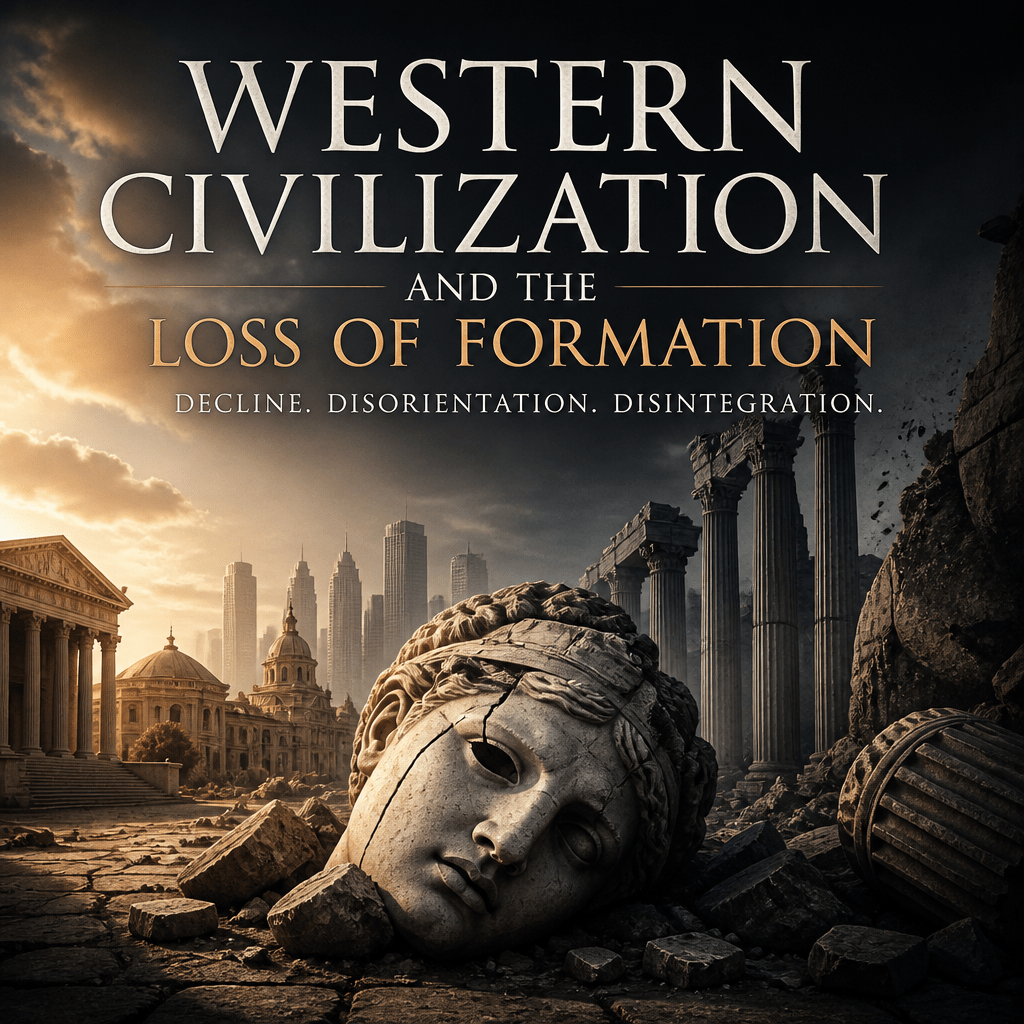
Today, that older order feels weakened. The West still builds, computes, innovates, and scales, but it struggles to sustain trust, virtue, identity, and social cohesion. That is the real story behind western civilization decline and loss of formation. It is not only a story of economics. It is not only a story of politics. It is a story of formation.
The long arc of western civilization decline and loss of formation
Western civilization rose because it was built on layered traditions that reinforced one another rather than canceling one another out. At different points, that civilizational stack included:
– Greek rationalism
– Roman law
– Christian moral anthropology
– Protestant discipline
– Enlightenment civic philosophy
– Industrial-era meritocracy
Each layer contributed something essential. Greek thought trained the West to reason clearly. Rome gave it law, order, and administrative structure. Christianity formed conscience, duty, and human dignity. The Protestant tradition emphasized responsibility, vocation, and discipline. The Enlightenment sharpened public debate, rights, and reasoned civic life. Industrial modernity rewarded effort, skill, and achievement.
Together, these traditions helped create a civilization that could generate virtue, sustain institutions, transmit identity, form citizens, restrain passions, and elevate reason. That is why the West became unusually durable. It was not just powerful. It was formed.
That distinction matters. A society can have advanced technology and still lack moral depth. It can have wealth and still lack coherence. It can be efficient and still be spiritually thin. For a long time, the West did not separate progress from formation. That balance is now broken.
1. Mass media replaced moral formation
The first major shift came in the mid-20th century, when mass media began to shape daily life more powerfully than churches, schools, families, and local institutions.
Radio, television, advertising, and entertainment were excellent at capturing attention. They were not designed to produce virtue. Instead, they trained people to consume, react, compare, and desire. They rewarded stimulation over discipline and novelty over depth.
This mattered because a culture shaped primarily by media tends to produce spectators rather than citizens. People become consumers first. They are encouraged to feel, react, and purchase, but not necessarily to reflect, sacrifice, or mature. Over time, moral formation weakens when entertainment becomes more influential than institutions that once taught character.
2. Bureaucratic governance replaced civic responsibility
As the modern state expanded, more of life was managed from above. Citizens increasingly became clients, recipients, and administrators of systems rather than active stewards of their own communities.
This can improve efficiency in some areas, but it also weakens responsibility. When people no longer feel personally accountable for their neighborhoods, schools, churches, and local institutions, those institutions lose strength. Civic life becomes procedural instead of participatory.
The republic slowly turns into a service provider. That may look like progress on paper, but culturally it creates dependency, passivity, and a thinner sense of belonging. One of the clearest signs of western civilization decline and loss of formation is this shift from responsibility to administration.
3. Post-war prosperity made discipline feel optional
In earlier eras, survival demanded self-control. Work was harder, communities were tighter, and family structures were more necessary. Religious and civic expectations were stronger because they were needed to hold life together.
After World War II, prosperity expanded rapidly. That brought enormous benefits, but it also changed behavior. Discipline no longer felt essential. Comfort reduced urgency. Abundance softened habits that had once been reinforced by scarcity.
The problem is simple: when virtue becomes optional, it often disappears.
That created a strange modern condition:
– microchips without stable families
– genome mapping without social trust
– AI without citizenship
– abundance without cohesion
The West gained technical power while losing cultural maturity. That imbalance is one of the central features of western civilization decline and loss of formation.
The 1960s: when the old philosophical foundation was dismantled
The 1960s were not just a decade of cultural change. They were a philosophical turning point.
Older moral languages—Stoicism, Christian ethics, Protestant seriousness, Enlightenment rationality—were increasingly replaced by a different framework. That newer language emphasized expressive individualism, therapeutic psychology, identity-based politics, relativism, and anti-hierarchical ideology.
These ideas are not identical, but they move in the same direction. They shift the center of gravity from duty to self-expression, from inheritance to preference, from objective standards to personal feeling, and from shared moral order to fragmented identity.
This does not automatically make a society evil. But it does make a society unstable if those ideas dominate without being balanced by older forms of formation. A civilization cannot endure when it no longer agrees on what a good person is. It cannot remain coherent when every moral claim becomes negotiable.
That is why so many people feel the West did not merely lose confidence. It lost its grammar.
Immigration, globalization, and NAFTA: what actually changed
These subjects are often discussed emotionally, but they are better understood structurally.
NAFTA and globalization
The North American Free Trade Agreement, signed in 1994, is part of a wider wave of globalization that reshaped the economic backbone of civic life.
The effects were substantial:
– manufacturing moved offshore
– industrial towns weakened
– middle-class civic life eroded in many regions
– supply chains became more global and less local
This was not just an economic shift. It was also a cultural one. When stable local industries disappear, the communities that once transmitted work ethic, family life, and civic belonging often weaken as well. Economic restructuring can become civilizational restructuring.
Immigration
Immigration itself is not inherently destructive. The United States, in particular, has always been an immigrant society. In earlier periods, however, mass immigration was paired with strong assimilation. Immigrants were typically absorbed into a shared civic framework that included constitutional identity, civic republicanism, common moral language, and shared public institutions.
Over time, assimilation weakened. Many Western societies now lean toward multiculturalism without strong common formation, identity politics, grievance narratives, and ideological fragmentation.
The issue is not simply that people arrived from elsewhere. The deeper issue is that the host civilization stopped transmitting a coherent civic identity. Immigration did not automatically dilute Western culture. The West stopped insisting on a shared Western culture.
4. Progressivism became a cultural reorientation
Progressivism is often treated as a political label, but that is too narrow.
Early progressivism in the 1900s was often technocratic and civic-minded. It believed institutions could be improved through expertise and planning. Modern progressivism, especially after the 1960s, moved in a different direction. It became more defined by anti-traditionalism, anti-hierarchy, anti-national identity, therapeutic politics, collectivist moral frameworks, and suspicion of Western heritage.
That is not just a policy disagreement. It is a cultural reorientation.
The result is a civilization that often doubts itself. It no longer sees its inheritance as a source of strength. It increasingly treats its traditions as burdens. It teaches critique more easily than continuity. And once a civilization loses confidence in its own legitimacy, preservation becomes difficult.
5. The West lost formation, not just power
This is the core diagnosis.
Western civilization is not failing because it lacks intelligence, wealth, or technology. It is failing because it has weakened the processes that once formed its people.
A civilization cannot survive long-term when:
– its virtues are optional
– its identity is negotiable
– its history is suspect
– its institutions are distrusted
– its citizens are unformed
– its elites are unmoored
– its culture is fragmented
– its moral vocabulary is incoherent
That is why so much of modern life feels like decline. The West is not incapable. It is unformed for the world it built.
This is also why social trust matters so much. When trust falls, public life becomes more defensive, more transactional, and less coherent. The decline is not only visible in economics or politics. It is visible in the everyday collapse of confidence between people.
6. Prosperity without character creates fragility
A civilization can become wealthy and still grow weak. In fact, wealth can hide weakness for a long time. Prosperity can give the illusion of stability while quietly eroding the habits that once made stability possible.
When comfort replaces discipline, and choice replaces duty, the culture becomes fragile. People still enjoy the benefits of the old order, but they no longer practice the virtues that produced it. That is how a civilization enters a negative phase: it keeps the machinery of success while losing the moral habits that sustain success.
7. Fragmentation follows when shared meaning disappears
Once a civilization loses common standards, it becomes difficult to preserve a shared public life. People may still live in the same territory, use the same technologies, and participate in the same economy, but they no longer share a strong sense of purpose.
That is the final stage of decline: fragmentation. Not immediate collapse, but slow disintegration. Shared meaning dissolves. Institutions become contested. Identity becomes unstable. The society remains powerful on the surface, but internally it is less coherent.
The Restorationist synthesis
Your perspective fits a larger historical pattern:
Civilizations rise through formation.
Prosperity erodes formation.
Fragmentation follows.
Restoration becomes necessary.
This is not just politics. It is civilizational entropy.
And it points toward the next phase: re-formation.
The best answer to decline is not nostalgia. It is reconstruction. A civilization that wants to endure must once again teach its people how to live, not just how to consume. It must recover moral seriousness, civic confidence, and shared identity without denying the complexity of the modern world.
The crisis is severe, but it is not hopeless. The West has lost much of its formation, yet the very recognition of that loss is the beginning of renewal. Restoration starts when a civilization remembers that strength without character is incomplete, and western civilization decline and loss of formation turns negative when formation disappears.
Leave a Reply