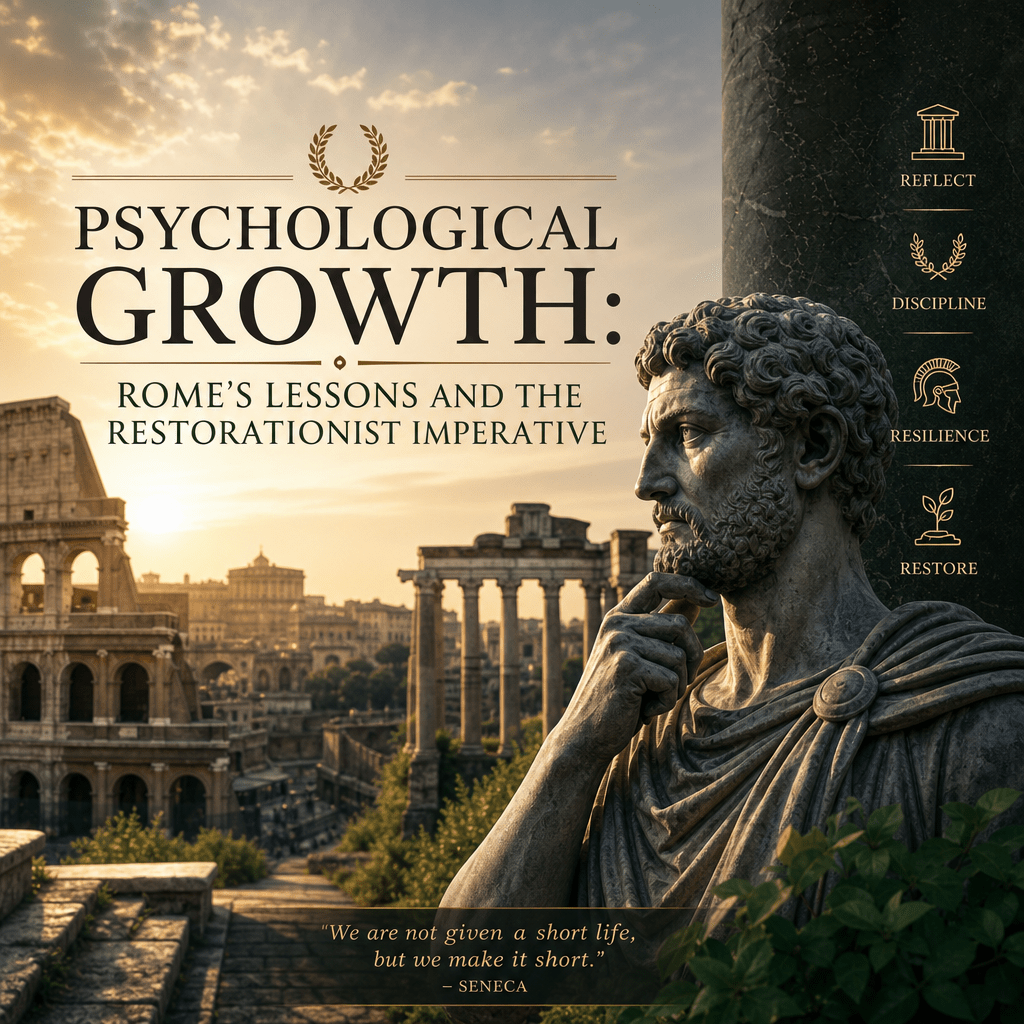
We like to talk about psychological growth as though it were the natural destiny of the human person. With enough education, enough therapy, enough technology, enough opportunity, we tell ourselves, people will become wiser, kinder, and more self-governing. There is truth in that hope. Human beings can grow. We can become more honest, more disciplined, more compassionate, and more capable of carrying life’s burdens without being broken by them.
But there are limits to psychological growth, and civilization ignores those limits at its peril.
The deepest question is not whether people can improve. They can. The question is how many can do so, how far, and under what conditions. A mature culture begins with a sober answer: most people do not become saints, sages, or philosophers, and no system can reliably manufacture them. If we want to build anything durable, we have to build it with human nature as it is, not as we wish it to be.
For a closely related reflection on how societies contract when inner discipline weakens, see Psychological Limits and the Lessons of Rome.
The Modern Faith in Improvement
Modern life rests on a powerful assumption: that human beings are indefinitely improvable if only the right structures are in place. Better schools, better messaging, better incentives, better access to care, better governance — the list goes on. These things matter. But they do not transform ordinary human nature in the way our culture often imagines.
This belief is not simply optimistic. It is morally seductive. It lets us believe that the main obstacle to human flourishing is external, not internal. If people are anxious, alienated, angry, addicted, envious, or cruel, then the answer is usually presumed to be better conditions. Change the environment, and the person will follow.
Sometimes that is true. Often it is not.
A more unsettling reality is that human beings carry enduring tendencies toward self-interest, status-seeking, tribal loyalty, denial, and comfort-seeking. These are not accidental flaws that vanish when a society becomes more educated. They are part of the basic furniture of the species. Any serious account of psychological growth must begin here.
That is why the conversation matters beyond the self-help aisle. Psychological growth is not only a private achievement; it is a civic requirement. The degree to which persons can govern themselves shapes the degree to which a free society can remain free.
Rome as a Warning
The fall of Rome remains one of the clearest historical warnings about what happens when a civilization preserves its institutions after it has lost its inner discipline.
By the third century AD, Rome still possessed roads, laws, armies, trade networks, and administrative sophistication. In many ways, it remained an astonishing civilizational achievement. But beneath the surface, the moral and civic energies that had once sustained it were weakening. Elite classes became increasingly detached from public responsibility. Loyalty became transactional. Bureaucracy expanded. Formal institutions survived even as the habits of sacrifice, duty, and shared purpose thinned out.
That pattern should feel familiar. A society can appear stable while its interior life erodes. It can keep the shell of order while losing the habits that make order trustworthy. Psychological growth, understood at scale, is inseparable from that problem.
Civilizations do not usually collapse because they suddenly run out of laws or offices or experts. They collapse when the people inside those systems are no longer capable of sustaining them. The machinery remains, but the moral substance drains away. What was once animated by character is now managed by procedure.
For a concise historical overview of the third-century crisis, see the Encyclopaedia Britannica’s account of the Crisis of the 3rd Century.
This is one reason Rome still matters. It reminds us that a society can look strong long after it has begun to hollow out. And it reminds us that psychological growth, however important, is never just a personal matter. It is tied to the long-term quality of the people who carry institutions forward.
The Limits of Psychological Growth
Psychological growth is real, but it is not limitless. That is an uncomfortable truth in an age that prizes self-transformation.
A person can learn emotional regulation, become less reactive, develop empathy, and become more capable of truthfulness. But growth is usually slow, costly, and uneven. It depends on habits, relationships, institutions, and repeated acts of self-confrontation. It cannot be mass-produced on demand.
There are at least four hard limits worth acknowledging.
1. Growth requires effort, not exposure
People are often exposed to good ideas without becoming better people. They may know the language of mental health, virtue, self-awareness, or resilience and still remain governed by the same instincts they had before.
Knowing what is good is not the same as becoming good. A person may understand the need for patience and still snap under pressure. They may value honesty and still lie to protect their image. They may endorse compassion and still withhold it from outsiders.
Psychological growth requires practice, not just information. It also requires friction. Without resistance, the person remains mostly theoretical. Real change comes when a person repeatedly chooses the harder good over the easier impulse.
2. Growth is unevenly distributed
Some people change dramatically. Others change only a little. Most change selectively — they improve in one area while remaining stubbornly immature in another. A person may become more articulate but not more humble, more informed but not more truthful, more polished but not more integrated.
This unevenness matters because civilizations are often built on the mistaken assumption that raising the general level of education will automatically raise the general level of wisdom. It won’t.
Psychological growth is not evenly distributed because the costs of growth are not evenly borne. Some people can survive confrontation, correction, and delay better than others. Some environments reward maturity; others punish it. The result is a world where development is possible but never guaranteed.
3. Growth is constrained by character formation in youth
What happens early in life matters enormously. Habits of attention, discipline, reverence, responsibility, and self-command are formed over years, not weeks. Once adults are deeply habituated to distraction or impulsiveness, later change is possible but difficult. We can never assume that a society can endlessly repair the deficits it has allowed to accumulate.
Parents, teachers, mentors, and communities therefore matter in a way our public rhetoric often understates. Early formation does not just produce competent adults; it creates the interior conditions for psychological growth later on. Where those conditions are absent, adult reform is harder and civilization becomes more brittle.
4. Growth is easily mimicked
Perhaps the most dangerous limit is that psychological growth can be performed without being real. People learn to speak the vocabulary of maturity, resilience, justice, and healing while remaining unchanged at the level of instinct and behavior. A society full of performances of virtue can look enlightened while actually becoming more brittle.
That is one of the central dangers of modern public life: the ability to appear evolved without being transformed.
We should be wary of any culture that treats fluency as depth. The sound of wisdom is not wisdom. The language of psychological growth is easy to borrow; the discipline of psychological growth is harder to live.
What Evolution Leaves Us With
Evolutionary psychology offers a sobering frame for understanding these limits. Human beings did not emerge as clean rational agents waiting to be educated into morality. We emerged as social mammals shaped by survival pressures: loyalty to our own group, sensitivity to status, fear of exclusion, hunger for recognition, quick emotional judgments, and a tendency to prefer short-term safety over long-term truth.
These tendencies are not moral failings in the first instance. They are inherited features of the mind. But they make genuine growth hard.
When we ask people to become wise, we are asking them to work against the grain of their default inclinations. That takes more than policy. It takes formation.
This is why every serious tradition of moral development — religious, philosophical, or civic — has emphasized practices over abstractions. Ritual, discipline, confession, apprenticeship, humility, memory, service, and repetition are not decorative extras. They are the means by which human beings rise above the merely reactive self.
Psychological growth therefore has a biological burden as well as a moral one. We inherit drives that helped our ancestors survive, but those same drives can distort judgment in contexts they were never designed for. A civilization that forgets this will overestimate what education can do and underestimate what formation must do.
The Rarity of Real Maturity
The most difficult truth is that mature persons are rare.
They are not absent, and they are not always visible, but they are not the norm. A mature person is not simply someone who is educated, successful, or emotionally articulate. A mature person can bear reality without constantly fleeing into fantasy, tribalism, or self-protection. They can endure suffering without immediately making it someone else’s fault. They can disagree without reducing the other person to an enemy. They can admit fault without collapsing into shame.
That kind of person is not produced automatically by modern institutions.
In fact, many institutions reward the opposite traits. Markets reward performance over substance. Politics rewards mobilization over truth. Entertainment rewards stimulation over contemplation. Social media rewards impulsive expression over disciplined reflection. In each case, the more visible part of the self is strengthened while the interior life is neglected.
The result is a society full of people who know how to signal maturity without necessarily possessing it. And when that happens, psychological growth becomes more theatrical than real.
Real maturity is costly because it requires limits. It asks a person to accept correction, to submit appetite to principle, and to live with the fact that not every desire deserves fulfillment. That is why it is rare, and why any serious social project must take its rarity into account.
That is also why What Ancient Philosophers Knew of Limbic First Thinking remains such a useful companion piece to this argument: it reminds us how old, how stubborn, and how manageable our reflexive nature really is.
Why Restoration Matters
If this diagnosis is even partly true, then the obvious question is what comes next. The answer is not despair, and it is not naive progressivism. It is restoration.
Restoration does not mean pretending the past was perfect. It was not. Every age has its blindnesses and injustices. Restoration also does not mean trying to resurrect outdated forms just because they are old. That would be nostalgia, not wisdom.
Restoration means recovering what is durable, truthful, and humanly forming from the traditions, disciplines, and institutions we have inherited — and then adapting them with seriousness to the present.
That might sound abstract, but it has practical implications.
Restoration means local responsibility
Large systems cannot form the soul. Neighborhoods, congregations, schools, families, and small communities can. Real character is usually built where people are known, accountable, and remembered.
This is why the local scale matters so much. Psychological growth tends to happen best where expectations are clear and relationships are enduring. People become more honest when their lies have consequences in a living community. They become more dependable when their commitments matter to people they will continue to see.
Local life also resists abstraction. It forces contact with reality, which is one of the oldest medicines for self-deception.
Restoration means habits, not slogans
A culture is changed less by declarations than by repeated acts. People become honest by practicing honesty. They become patient by enduring inconvenience. They become courageous by facing discomfort. They become wise by being corrected.
Psychological growth follows the same law. It is less a sudden insight than a long apprenticeship in a better way of being. Slogans may inspire, but habits transform.
Restoration means honoring moral seriousness
Not every opinion deserves equal weight. Not every mode of life is equally generative. A culture survives when it recognizes that virtue, discipline, and truthfulness are not private preferences but public goods.
That recognition is unpopular because it sounds exclusive. In practice, though, it is simply realistic. If psychological growth is difficult, then a society that wants more of it must honor the conditions that make it possible.
One of those conditions is seriousness itself: the willingness to treat the soul as something worth attending to, not just something to be entertained or optimized.
Restoration means historical memory
History is not a museum of trivia. It is a record of what human beings have repeatedly done when power, fear, vanity, or hope were placed in front of them. A society that forgets history becomes easy prey to illusion.
Psychological growth also depends on memory. People who cannot remember where they came from cannot easily judge where they are going. Communities that remember what once formed them are better positioned to recover it. Communities that forget are left with nothing but improvisation.
History gives us calibration. It reminds us that progress is never automatic, that decline often arrives quietly, and that human beings remain recognizably human across centuries. That continuity is sobering, but it is also useful.
For a classical account of education and moral formation, Plato’s overview of Plato’s ethics and politics is a helpful scholarly starting point.
Psychological Growth and Civilizational Health
The link between the individual and the civilization is more intimate than we often admit. A society cannot be healthier than the average moral and psychological capacity of the people who sustain it.
This does not mean we should abandon institutions or politics. It means we should stop pretending they are enough. If a culture depends on citizens who are self-governing, truthful, patient, and capable of sacrifice, then it must ask how those citizens are formed.
That is the real civilizational problem. Not whether we can design better systems in the abstract, but whether our systems are producing the kind of persons who can carry freedom without destroying it.
When they do not, the signs are predictable: institutional overreach, moral confusion, performative virtue, public cynicism, and increasing dependence on bureaucracy. The forms of order remain, but the spirit that once made them trustworthy is gone.
Psychological growth matters here because it is one of the few ways persons can rise above the reflexes that make civilizational decline more likely. A mature citizen is harder to manipulate, harder to flatter, and less likely to confuse impulse with principle. A culture with more such people has a better chance of remaining free.
But no civilization can assume that this maturity will emerge by accident. It must be cultivated, protected, and transmitted. That is the work of families, schools, churches, associations, and all the small institutions that shape persons before public life does.
Conclusion
The weight of what we are cannot be wished away. Human beings are capable of genuine psychological growth, but that growth has limits, and those limits shape the fate of civilizations. Rome teaches us that a society can remain impressive long after its inner life has begun to decay. Modern psychology and evolutionary biology teach us that improvement is real but slow, uneven, and fragile.
The proper response is not despair. It is seriousness.
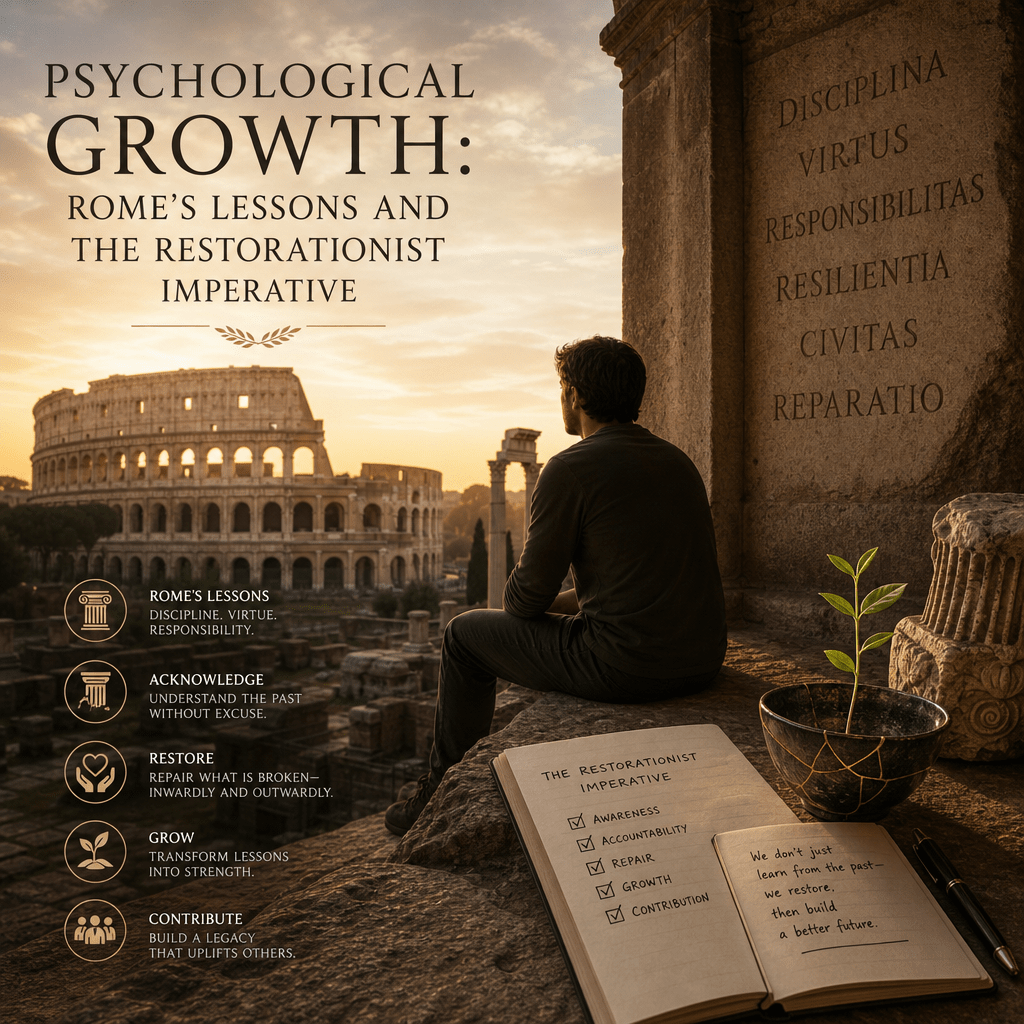
If we want a livable future, we must recover the practices that form mature people: local commitment, disciplined habits, historical memory, moral clarity, and a willingness to tell the truth about human nature. That is the restorationist imperative — not a dream of perfection, but a commitment to building, preserving, and transmitting what is still worth saving.
Psychological growth is worth pursuing precisely because it is difficult. The path is narrow. But it is the only one that leads anywhere durable.
And if we are honest, that narrowness is not a defect in the human condition. It is the condition itself — the hard and hopeful ground on which any serious civilization must stand.