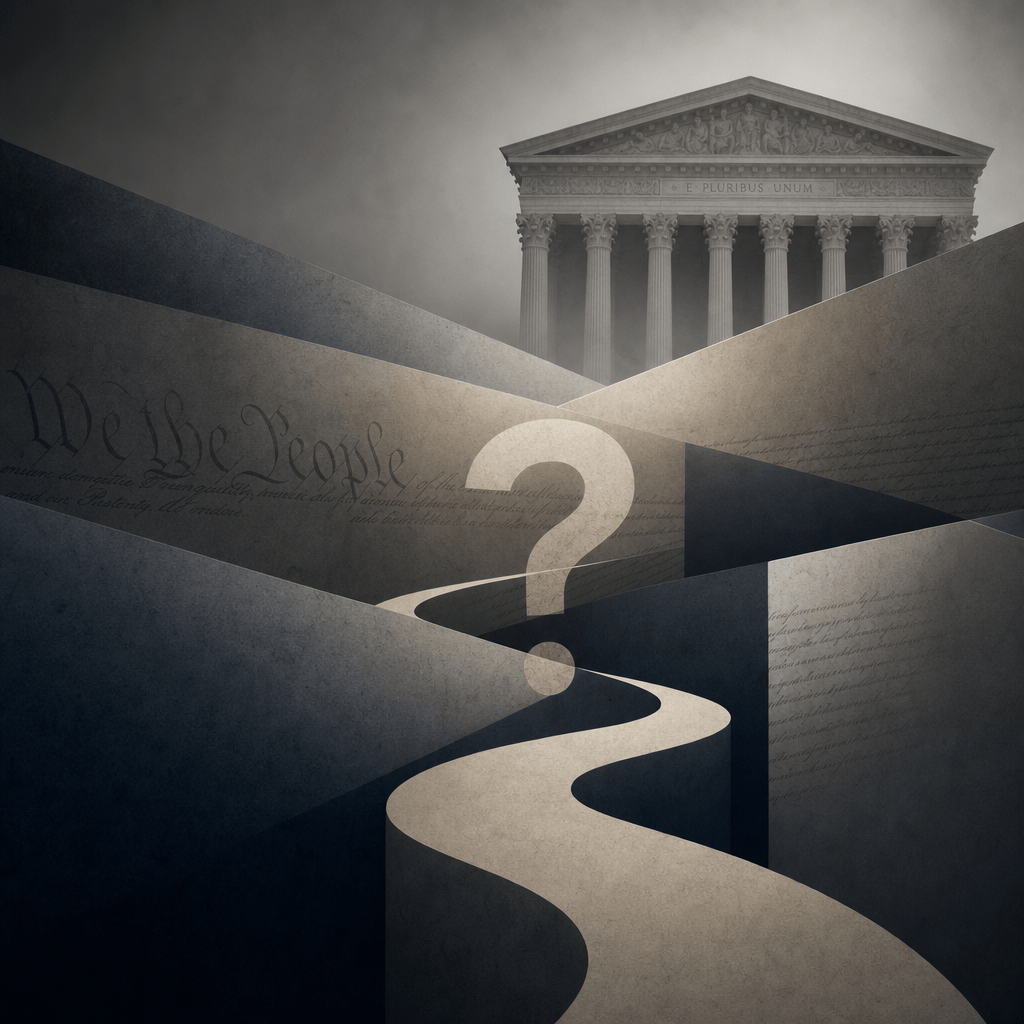
The Roberts Court has developed a habit that is increasingly hard to ignore. In major constitutional disputes, it often sidesteps structural questions instead of resolving them. From a distance, that may look like restraint. In practice, it creates something far more dangerous: constitutional Ambiguity.
Ambiguity does not calm a republic. It leaves the public uncertain, divided, and vulnerable to distrust. When the Court declines to clarify core constitutional meaning, it does not settle disputes. It preserves them. And in preserving them, it ensures that the same conflicts return again and again, often with greater intensity.
Constitutional Ambiguity and the Roberts Court
The central problem is not that the Roberts Court always reaches the wrong result. The deeper failure is that it often refuses to say what the Constitution means when the answer matters most. That reluctance may protect the Court’s short-term institutional comfort, but it weakens the republic’s long-term confidence in the law.
Constitutional ambiguity is not a neutral condition. It is a force multiplier for suspicion. If the public cannot tell where constitutional lines are drawn, every political dispute becomes a test of power rather than a question of law. That is why a court’s refusal to resolve important issues is not a minor procedural choice. It is a structural failure.
Deferral Is Not Resolution
One of the clearest examples is the Court’s treatment of Birthright Citizenship. Rather than directly confronting the historical meaning of the Fourteenth Amendment, the Court has often treated the issue as effectively settled without truly settling it.
That approach may preserve institutional peace in the short term. But it leaves the central constitutional question untouched. The controversy does not disappear. It simply waits.
This is the first flaw in the Roberts Court’s method: it confuses deferral with resolution. A question that is postponed is still a question, and unresolved constitutional conflict has a way of returning with more force later. For readers interested in a broader examination of the Court’s structural hesitations, Robert’s Court: Constitutional Ambiguity makes the same point in another register.
That tendency matters because constitutional ambiguity rarely stays contained. It leaks into public debate, legislative strategy, and litigation planning. The longer a question remains open, the more each side assumes the next court will either rescue its position or entrench the other side’s. That is not a recipe for durable order. It is a recipe for recurring conflict.
And once a conflict becomes recurring, the Court can no longer pretend that silence is neutral.
The issue is not only whether the Court reaches the “right” answer in a narrow case. It is whether the Court provides a reasoned answer at all. A ruling that sidesteps the true constitutional question may end a docket entry, but it does not end the controversy. In practice, it often guarantees a more confused dispute later, when uncertainty has hardened into factions.
That is why deferral is so costly. It gives the appearance of restraint while leaving the republic with the same unresolved fault line.
Election Day Becomes Election Week
The same pattern appears in the Court’s election jurisprudence. The Constitution establishes a single Election Day, and Congress has authority under Article I, Section 4 to regulate the manner of federal elections. States administer those elections, but they do so within a federal framework.
Yet the Court has often tolerated the expansion of ballot receipt and counting beyond Election Day under the banner of administrative flexibility.
That may sound practical. It may even be convenient. But practical rules can still create constitutional strain when they blur boundaries the Constitution is meant to fix.
A process can be technically lawful and still appear compromised to the public. That is not a minor concern. In a republic, public confidence is part of constitutional legitimacy.
When citizens believe the rules are shifting after the fact, suspicion grows. And once suspicion spreads, it is difficult to contain.
The problem is not limited to whether ballots are counted correctly. It also involves whether the count occurs within a framework the public can recognize as stable. That is why this debate has never been merely administrative. It is constitutional.
Election rules are supposed to be knowable in advance. If the public sees the process stretch beyond what ordinary language would call Election Day, the law may remain formal, but legitimacy begins to fray.
This is where constitutional ambiguity becomes politically explosive. It creates room for every losing side to claim the rules were bent and every winning side to claim the rules were merely interpreted. Once that happens, the public no longer sees a clean legal framework. It sees a contest over who gets to define the framework after the fact.
That perception alone can destabilize a system, even if no statute is openly violated.
Why Appearance Matters
Legitimacy depends on more than technical compliance. It also depends on the public belief that rules are fixed, fair, and uniformly enforced.
When the Court minimizes appearance-based concerns, it overlooks a basic truth: most citizens do not experience elections as legal theory. They experience them as trust.
And trust disappears quickly when procedures look elastic.
That is why constitutional Ambiguity is so damaging. It does not merely leave scholars with open questions. It leaves the public with doubt.
The same legal structure that looks manageable to judges can look improvised to voters. That gap between doctrinal confidence and public confidence is one of the most dangerous gaps in modern constitutional life. It allows institutions to congratulate themselves on technical elegance while the public loses faith in the system’s integrity.
If the Court wants respect, it cannot rely on the assumption that the public will always separate legality from legitimacy. Most people do not. They judge by whether the rules feel stable and transparent.
For a useful institutional comparison, see the Court’s broader posture toward Institutional Ambiguity. The phrase captures how avoidable uncertainty can become a governing style rather than a temporary defect.
The result is not stability. It is uncertainty.
And uncertainty in constitutional matters is not harmless. It invites strategic behavior. It encourages litigants to test the boundary again and again. It teaches political actors that the best path is often not to persuade the country of a rule’s legitimacy, but to exploit the fact that the rule has never been made fully clear.
That is how procedural ambiguity becomes constitutional weakness.
Texas v. Pennsylvania and Judicial Avoidance
The clearest example of avoidance came in Texas v. Pennsylvania. Texas argued that several states changed election rules outside their legislatures, violating their own constitutions and affecting the lawful votes of other states.
One can dispute the merits of that claim. But the constitutional question was real. It was structural. It was national.
The Court refused to hear the case, dismissing it on standing grounds and saying Texas had no judicially cognizable interest in how other states conducted federal elections.
That reasoning may have been convenient. It was also unsatisfying. The Court did not resolve the constitutional conflict. It stepped around it.
And by stepping around it, the Court left the public to infer meaning from silence.
The problem with that kind of silence is that it does not stay silent for long. Partisans fill the vacuum. Commentators fill the vacuum. Future litigants fill the vacuum. The lack of a ruling becomes its own message, and every side reads the message differently.
If the Court believed the claim failed on jurisdictional grounds, it still had to recognize the deeper consequence: the public was left without a clear statement of the limits of state authority in federal elections. That is precisely the kind of unresolved structural issue that should concern anyone who cares about constitutional order.
Judicial avoidance can be tempting because it prevents immediate institutional backlash. But avoidance does not eliminate constitutional conflict. It simply transfers the conflict to the next election cycle, the next emergency order, or the next crisis headline.
For another example of a structurally contested issue in the same institutional orbit, consider Tariffs at SCOTUS: Stunning Best Legal Showdown, which shows how major constitutional and statutory disputes often turn on the Court’s willingness to engage the full question rather than the most convenient one.
When the judiciary steps aside too often, the public learns that structural conflict can be postponed indefinitely instead of resolved. That lesson is corrosive because it turns each future dispute into a test of whether the Court will finally speak with clarity or repeat the same pattern of avoidance.
The Cost of Constitutional Ambiguity
This is the recurring flaw in the Roberts Court’s approach: constitutional Ambiguity becomes a substitute for judgment.
That is a serious institutional mistake. Ambiguity does not hold the system together. It allows the most controversial questions to drift unresolved until they return in a more hostile form.
When the Court refuses to define the limits of state authority, refuses to clarify the meaning of Election Day, and refuses to address interstate harm in federal elections, it does not preserve legitimacy. It weakens it.
Political actors notice. The public notices. And both sides learn the same lesson: the Court will often avoid the decisive ruling when it matters most.
Once that lesson takes hold, the judicial branch begins to lose its special role as a final interpreter of law. It becomes another venue for delay, tactical maneuvering, and managed ambiguity. That may preserve short-term calm, but it diminishes the Court’s long-term authority.
A constitutional system cannot thrive when its most important questions are repeatedly left hanging. Ambiguity invites improvisation, and improvisation in constitutional law can quickly become a substitute for democratic consent. If people cannot tell what the rules are, they begin to suspect that the rules are simply whatever the strongest actors can get away with in the moment.
That is how confidence collapses.
And once confidence collapses, every future decision arrives under a cloud.
That is why the phrase constitutional Ambiguity matters here. It describes more than a temporary doctrinal gap. It describes a pattern of governance through unresolved questions. The Court may think it is preserving space for future decision-making, but the public experiences the same pattern as refusal.
Refusal breeds resentment. Resentment breeds cynicism. Cynicism makes it harder for constitutional rules to command respect even when they are finally stated clearly.
In that sense, every avoided decision carries a hidden cost.
And the longer the cost is ignored, the more expensive clarity becomes.
The constitutional order is strongest when its rules are legible before a crisis, not rewritten emotionally after one. That is why the Court’s reluctance to settle recurring structural disputes matters so much: it invites the next crisis to arrive with the same uncertainty already built in.
What a Restorationist Court Would Do
A different judicial philosophy would begin with a simple principle: legitimacy requires clarity.
A Restorationist Court would not treat controversy as something to evade. It would treat structural uncertainty as something to fix.
That means:
– confronting constitutional meaning directly
– resolving ambiguities before they harden into distrust
– recognizing that judicial silence can be as destabilizing as judicial error
The point is not that every hard case has an easy answer. The point is that the Court’s responsibility is not merely to protect its own image. It is to give the Constitution clear and durable meaning.
That approach would require more courage than the Court often displays. It would require accepting that clarity can provoke disagreement without fearing that disagreement alone proves the Court has erred. A court committed to constitutional restoration would understand that avoiding conflict is not the same as preserving order.
Sometimes order is preserved only by deciding the issue that everyone else hopes will remain unresolved.
That is especially true when the problem is structural. Structural problems do not disappear because the Court refuses to name them. They continue shaping incentives, institutions, and expectations beneath the surface.
A Restorationist Court would also understand that some legal disputes are not merely disputes about outcomes. They are disputes about the rules that make democratic outcomes legitimate in the first place. In those cases, delay can be more corrosive than error because delay leaves the architecture of the system exposed to permanent doubt.
That is why clarity is not a luxury. It is a constitutional duty.
Courts do not build legitimacy by hiding from tension. They build it by explaining, consistently and publicly, why constitutional lines exist and how those lines should be enforced. When a court does that well, even losing parties can see the rule as real, not arbitrary.
That is the kind of discipline the present moment demands.
The Real Failure of the Roberts Court
The Roberts Court has not failed because it always ruled the wrong way. It has failed because it too often refused to rule decisively when the republic needed clarity most.
On Birthright Citizenship, it preserved ambiguity.
On Election Day procedures, it tolerated doubt.
On interstate election disputes, it avoided the core issue.
That is not constitutional stewardship. It is institutional hesitation.
And hesitation, when repeated across the most important structural questions, becomes a governing philosophy.
The country does not need a Court that simply avoids conflict. It needs a Court willing to resolve it. Until that changes, constitutional Ambiguity will continue to spread where constitutional clarity should stand.
The answer is not reckless judicial activism. It is disciplined constitutional interpretation that tells the public where the lines are and why they matter. Without that, the Court invites the very instability it claims to prevent.
If the Roberts Court wants to be remembered as a stabilizing institution, it will need to do more than decline the hardest questions. It will need to answer them with clarity, consistency, and courage. That is the only path away from constitutional Ambiguity and toward genuine constitutional order.
For readers interested in related constitutional tensions, the broader debate over a more durable legal framework also appears in Article I of the U.S. Constitution, which defines Congress’s role in federal election regulation and helps explain why procedural clarity matters so much in the first place.
In the end, the lesson is simple. A court can survive disagreement. It cannot survive permanent uncertainty. The republic needs the Constitution to mean something more than whatever can be left unsaid.
That is why constitutional Ambiguity is not stability.
It is the opposite of stability, because it leaves citizens guessing about the rules that govern them. And once guessing becomes the normal state of public life, constitutional meaning begins to lose its force.




Leave a Reply