
There is a moment familiar to anyone who has prayed with seriousness: the world thins, the noise recedes, and something inside shifts. It can feel like a quiet settling, a deepened awareness, or a sudden clarity that was not there before. Scripture calls it renewal. Modern neuroscience calls it structural change.
A Restorationist reading of the evidence leads to a radical but simple claim: Prayer is not merely something we do while waiting for transformation. Prayer is part of the transformation itself.
The Brain Was Designed to Change
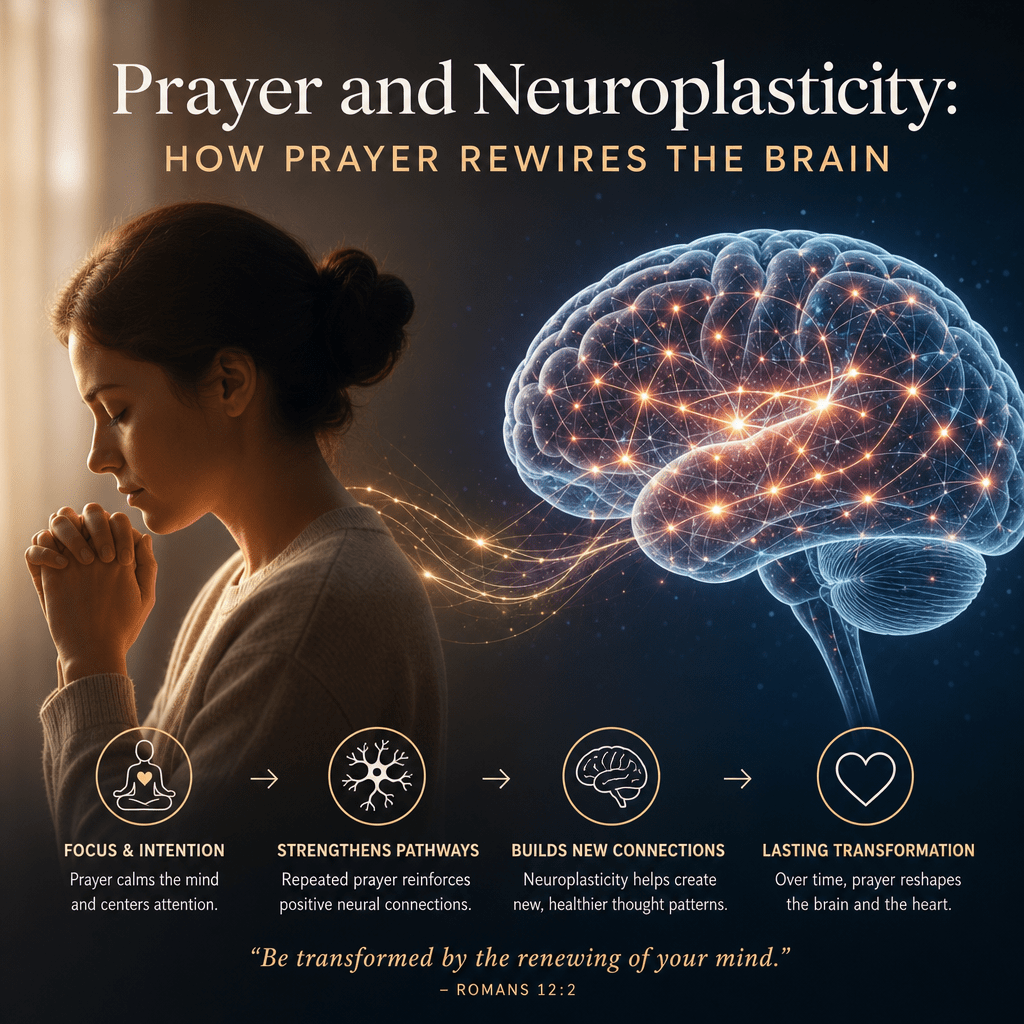
For much of modern history, scientists believed the adult brain was fixed. That idea has now collapsed. We know the brain retains the ability to form new neural connections throughout life. This discovery, known as neuroplasticity, is more than a scientific update. It is a theological confirmation.
Romans 12:2 says, “Be transformed by the renewal of your mind.” That is not just a spiritual metaphor. It describes real change in the mind’s structure and habits. The brain was made to be renewed.
What Neuroplasticity Means for Faith
Neuroplasticity shows that repeated thoughts, actions, and emotions shape the brain over time. In other words:
- what we practice becomes easier
- what we repeat becomes stronger
- what we ignore weakens
That means spiritual formation is not abstract. It is embodied. The mind can be retrained, and Prayer is one of the primary ways that happens.
In practical terms, this means the habits of the inner life matter. Attention, repetition, and surrender are not just devotional themes; they are the ingredients of change. The same principle appears in learning, recovery, and skill development: the brain strengthens what it repeatedly practices. A life of prayer gives that principle a holy direction.
For a broader Restorationist account of how disciplined formation shapes the whole person, see Prayer Reshapes the Mind: Stunning Best Guide.
Prayer as Directed Neurological Work
Prayer does more than calm the soul. It changes the brain’s activity, chemistry, and wiring.
When a person prays regularly, several things happen:
- The prefrontal cortex strengthens
This region supports self-control, moral reasoning, and intentional choice. - The amygdala quiets
Fear, anger, and chronic stress lose some of their hold. - The default mode network settles
Rumination, self-focus, and inner replay are reduced. - Neurochemicals shift
Prayer is associated with increases in calm, bonding, and emotional stability.
This is not a substitute for spiritual meaning. It is the physical expression of spiritual formation. Prayer is active, not passive. It is training.
Researchers and clinicians often describe these effects in terms of stress regulation, attention control, and emotional regulation. A useful overview of how the nervous system responds to stress and calm can be found in the National Institute of Mental Health’s stress resources. That scientific framework does not replace theology, but it helps explain why the spiritual discipline of prayer can feel so integrative at the level of mind and body.
The important point is not that prayer is a trick for producing a mood. It is a response to reality. The person who prays is not merely trying to feel better; he or she is learning to think, attend, and trust in a new way. That is why sustained prayer can become a form of formation as concrete as study, therapy, or rehearsal.
We can also say this more directly: a life of prayer changes the inner default. It teaches the nervous system that God is present, that fear does not get the final word, and that the soul need not live at the mercy of impulse. Over time, that training becomes visible in patience, steadiness, and a greater capacity for obedience.
Across time and tradition, believers have recognized that repeated devotion shapes the whole person. The language may differ, but the pattern remains the same: attention forms desire, desire forms behavior, and behavior forms character. Prayer sits at the center of that chain because it trains the heart to return to what is highest rather than to whatever is loudest.
That is why prayer can feel subtle while producing profound effects. A short prayer may not seem dramatic in the moment, yet it still redirects the mind. The small act of turning toward God interrupts the momentum of distraction. Over weeks and months, those interruptions accumulate into a different inner life. The brain learns a new route; the soul learns a new reflex.
How Prayer Dismantles Sin
Sin is not only a moral problem. It becomes a pattern. Over time, repeated choices create deep grooves in the mind.
That is why repentance matters so much. It interrupts those grooves.
Prayer rewrites the pattern
- Confession breaks denial and self-deception
- Repentance redirects attention and behavior
- Gratitude weakens anxiety and scarcity thinking
- Forgiveness loosens resentment and bitterness
- Scripture-shaped prayer trains the mind toward truth
This is where neuroplasticity becomes deeply relevant to discipleship. What is repeatedly rehearsed becomes reinforced. Prayer breaks the cycle by making room for a new one.
Philippians 4:8 is not merely encouragement to “think positive.” It is a directive for mental and spiritual formation. The mind becomes what it repeatedly contemplates.
Habitual sin often relies on speed. A temptation appears, the mind reacts, the body follows, and the pattern completes itself before reflection has time to intervene. Prayer slows that cycle. It creates a gap between stimulus and response. In that gap, grace can work. The person learns to name the temptation, place it before God, and choose a different path.
That is not abstract moralism. It is how patterns weaken. The old route loses strength when it is not constantly traveled. In that sense, even brief but faithful prayer can serve as an interruption that begins to loosen the grip of destructive instincts. Over time, the soul becomes less automatic in its vices and more responsive to truth.
Confession is especially important because sin thrives in secrecy. Naming failure before God brings the hidden into the light. What is exposed can be healed. What is examined can be changed. That is why prayer is not only comforting; it is confrontational in the best sense. It tells the truth about the heart, and truth is where renewal starts.
Repentance, then, is not merely regret. It is reorientation. It involves an actual turning of attention, desire, and action. The person who repents is not simply feeling bad about the past; he or she is beginning to inhabit a different future. In that way, prayer participates in the dismantling of sin by replacing one practiced pattern with another, healthier and holier one.
Over time, this repeated return to God can weaken specific habits that once seemed immovable. Anger becomes less immediate. Lust becomes less persuasive. Pride becomes easier to recognize. The change may be gradual, but it is real. Sin loses some of its familiarity, and that loss matters. What once felt normal begins to feel foreign.
Prayer and the Renewal of Perception
Prayer does not only change how we feel. It changes what we notice.
When we pray with intention, our attention is trained. We become more aware of provision, conviction, and the quiet work of God already present in daily life. Fear narrows perception. Trust widens it.
This is why focused Prayer matters. It aligns the heart with God’s purposes and tunes the mind to reality as God defines it, not as anxiety distorts it.
A renewed perception looks like this
- less panic
- more clarity
- less self-preoccupation
- more compassion
- less reactivity
- more discernment
That is the practical fruit of a changed mind.
Many readers recognize this shift from experience before they can explain it. The same circumstances remain, but the interior lens changes. Problems are not denied; they are placed within a larger frame. That is one reason prayer can be so stabilizing under pressure. It restores proportion. It reminds the believer that anxiety is not omniscient and that the present moment is not the totality of reality.
In that sense, prayer does for perception what education does for understanding: it enlarges the field of awareness. Yet prayer goes further because it is not only informative but relational. It does not simply teach the mind what to think; it teaches the heart whom to trust.
Prayer also gives memory a new shape. A person who prays regularly begins to remember God’s faithfulness in a more organized way. Prior mercies become easier to recall. Past deliverances become part of the present framework. That memory matters because fear is often sustained by forgetfulness. When the mind rehearses God’s care, the imagination is less likely to collapse into catastrophe.
This renewal of perception can be seen in ordinary life as well. A conversation that once triggered defensiveness may now invite patience. A delay that once felt threatening may now be received with trust. A difficulty that once swallowed the whole horizon may now be understood as one part of a larger story. These are not small changes. They are signs that the soul is learning to see differently.
The Restorationist Pattern of Daily Formation
Restorationist theology has always emphasized that formation is ordinary, repeated, and embodied. It does not depend on spiritual fireworks. It depends on faithful practice over time. The logic is simple: if the brain is shaped by repetition, then the disciplines of the Christian life must be lived repeatedly, not occasionally.
That is why daily prayer should be treated with seriousness rather than sentimentality. A steady rhythm of morning reflection, confession, thanksgiving, and petition trains the person to begin with God rather than with distraction. Over time, that beginning matters. The first words of the day often set the tone for the rest of it.
In this way, a Christian rule of life becomes more than a schedule. It becomes a framework for neurological and spiritual consistency. The body learns when to pause. The mind learns where to turn. The will learns that it is not alone.
Consistency is the hidden power of formation. Most people expect change to arrive in dramatic bursts, but the deepest changes often happen through repetition. A daily prayer at dawn, a short confession at midday, a quiet thanksgiving at night: these are the kinds of practices that seem small and yet slowly reorient the entire person. The ordinary becomes holy by being returned to again and again.
This pattern also helps explain why Christian maturity cannot be reduced to insight alone. Insight matters, but it must be embodied in rhythm. A person may understand the need for peace, humility, or courage and still remain unchanged unless that understanding is lived. Prayer is one of the places where understanding becomes habit. It turns conviction into cadence.
For that reason, the goal is not to produce occasional spiritual intensity. The goal is to become someone whose life is increasingly patterned by attention to God. Formation is less like a lightning strike and more like a pathway worn through repeated walking. Each return deepens the route. Each prayer strengthens the direction.
The Practice of Intentional Prayer
The Restorationist tradition has always emphasized disciplined daily formation. Neuroscience now helps explain why that tradition works.
Consistency matters more than intensity. A single powerful prayer can inspire, but repeated Prayer reshapes the mind.
Practices that strengthen formation
- Morning prayer to set the day’s direction
- Specific prayer instead of vague generalities
- Silence to reduce mental noise
- Confession to clear spiritual clutter
- Journaling to reinforce attention and memory
- Gratitude to retrain expectation
These practices recruit different parts of the mind and help build durable spiritual habits. Over time, the brain learns a new way of being.
The word “specific” matters here. General prayer has its place, but specific prayer helps the mind organize reality. When a believer names a fear, a hope, a decision, or a need, the act of naming itself creates clarity. Vague concern diffuses attention; specific petition gathers it. That is one reason structured prayer can be so transformative. It prevents the heart from drifting in general anxiety and teaches it to speak honestly before God.
Journaling can also deepen this work. Written prayer slows the mind long enough for patterns to become visible. A person may begin to notice recurring temptations, repeated mercies, or the way certain fears lose power when brought into the light. Silence does similar work by revealing how noisy the soul can be. In both cases, the aim is not performance but honesty. Formation begins when the inner life is no longer hidden from itself.
Morning priority deserves special attention because the waking mind is still forming its orientation for the day. Beginning with prayer can establish a trajectory before distraction takes over. Even a short, sincere time of prayer can orient thought, emotion, and intention toward obedience. In that sense, the first hour is not magic; it is formative. What comes first often shapes what follows.
That is also why prayer works best when it is habitual. Repetition does not make it empty; repetition makes it reliable. As with music practice, language learning, or physical training, the mind deepens through faithful return. The believer who returns daily to God is not merely repeating words. He or she is being trained in attention, humility, and endurance.
It also helps to remember that intentional prayer is not limited to one style. Some prayers are spoken aloud, others are quiet and inward. Some are structured around Scripture, others around confession or intercession. What matters is not performance but faithful attention. The form should serve the formation, and the formation should serve love of God and neighbor.
That is why the healthiest prayer life often combines structure with openness. A planned pattern gives stability, while room for silence and listening keeps the heart responsive. Together, they protect prayer from becoming either mechanical or aimless. One anchors it; the other deepens it.
The Sanctified Mind
The goal is not merely emotional relief. The goal is a sanctified mind.
That means a mind where peace becomes the baseline, truth becomes the reflex, and love becomes the natural response. It is a mind shaped so deeply by God that it begins to reflect Him more consistently.
This is what Prayer does over time. It does not bypass the brain. It works through it. The mind God designed can change, and that change is part of the Christian life.
In that sense, Prayer is not what happens before transformation. It is one of the means by which God transforms us.
A sanctified mind does not mean the absence of struggle. It means a reordered center. The old reflexes still appear, but they no longer rule uncontested. The person learns to return to God more quickly, to recover more readily, and to resist more steadily. This kind of maturity is not dramatic from the outside, but it is profound. It shows up in patience, gentleness, courage, and truthfulness under pressure.
At its best, this is not self-improvement in the modern sense. It is participation in divine life. The believer does not rewire the soul by sheer effort alone; the believer cooperates with grace through practice. That is why prayer is so important. It is both surrender and work, receptivity and discipline.
Over time, a sanctified mind becomes easier to recognize in ordinary situations. It pauses before speaking. It listens before judging. It forgives more readily and resists panic more quickly. It is not immune to suffering, but it is less ruled by it. That steadiness is itself a witness. It shows that grace is not merely an idea but a lived reality with visible effects.
Such a mind is also marked by truthfulness. Because prayer keeps returning the believer to God, self-deception loses some of its power. The person becomes more willing to admit weakness without despair and more willing to receive correction without defensiveness. That combination of humility and stability is one of the clearest signs of mature discipleship.
How the Wider Restorationist Vision Fits Here
This subject belongs to a larger pattern of thought already explored in the Restorationist project. Human beings are not merely products of instinct. They are formed by what they attend to, rehearse, and worship. For a companion reflection on the limits of reflexive living, see The Reflexive Mind: How Evolution Misleads Us in the 21st Century.
That broader frame matters because it keeps the discussion from becoming too narrow. Prayer is not just an isolated spiritual exercise. It is part of a larger war over attention, interpretation, and allegiance. The mind can be trained by fear, habit, culture, and appetite, or it can be trained by truth, gratitude, and worship. Nothing in modern life leaves the mind untouched. The question is not whether the brain is being formed, but what is forming it.
That is why prayer is not a private luxury for the especially devout. It is a practical discipline for anyone who wants a more truthful, stable, and God-centered life. If the mind is constantly being shaped by something, then the wise response is not to resist formation altogether but to submit to the right kind of formation.
For readers interested in the relationship between contemplative practice and a more examined life, The Restorationist Project • Education Series offers another helpful entry point into the same larger vision of disciplined renewal.
This wider restoration also helps answer a common objection: if prayer changes us, does that mean faith is merely self-modification? The answer is no. Prayer is relational before it is therapeutic. The changes that follow are real, but they flow from communion with God rather than from technique alone. The believer is not manipulating the mind into a new state. The believer is responding to divine presence, and that response itself becomes formative.
Seen this way, prayer is one of the most human things we can do. It joins thought, desire, memory, body, and trust into a single act of attention. It reminds us that we are not closed systems. We are creatures made to receive, to respond, and to be renewed.
Conclusion
The evidence points to a remarkable truth: Prayer and neuroplasticity belong together. The spiritual life is not detached from the brain, and the brain is not separate from discipleship.
When we pray, we are not simply speaking into the air. We are participating in renewal. We are cooperating with the God who made the mind to be reshaped.
So pray with seriousness. Pray with gratitude. Pray consistently.
Every prayer is an act of formation, and every act of formation is a step toward the renewed mind in Christ.
The promise is not that every struggle disappears overnight. The promise is that the person who returns faithfully to God is not left unchanged. The mind can be renewed. Fear can be quieted. Sinful patterns can weaken. Trust can deepen. Over time, prayer becomes more than a habit of faith. It becomes a means by which God restores the whole person.
That is why prayer should not be treated as an accessory to Christian life. It is central to it. It shapes perception, steadies emotion, strengthens obedience, and trains the heart to live in reality. The brain was designed to change, and prayer is one of the great means by which that change unfolds.