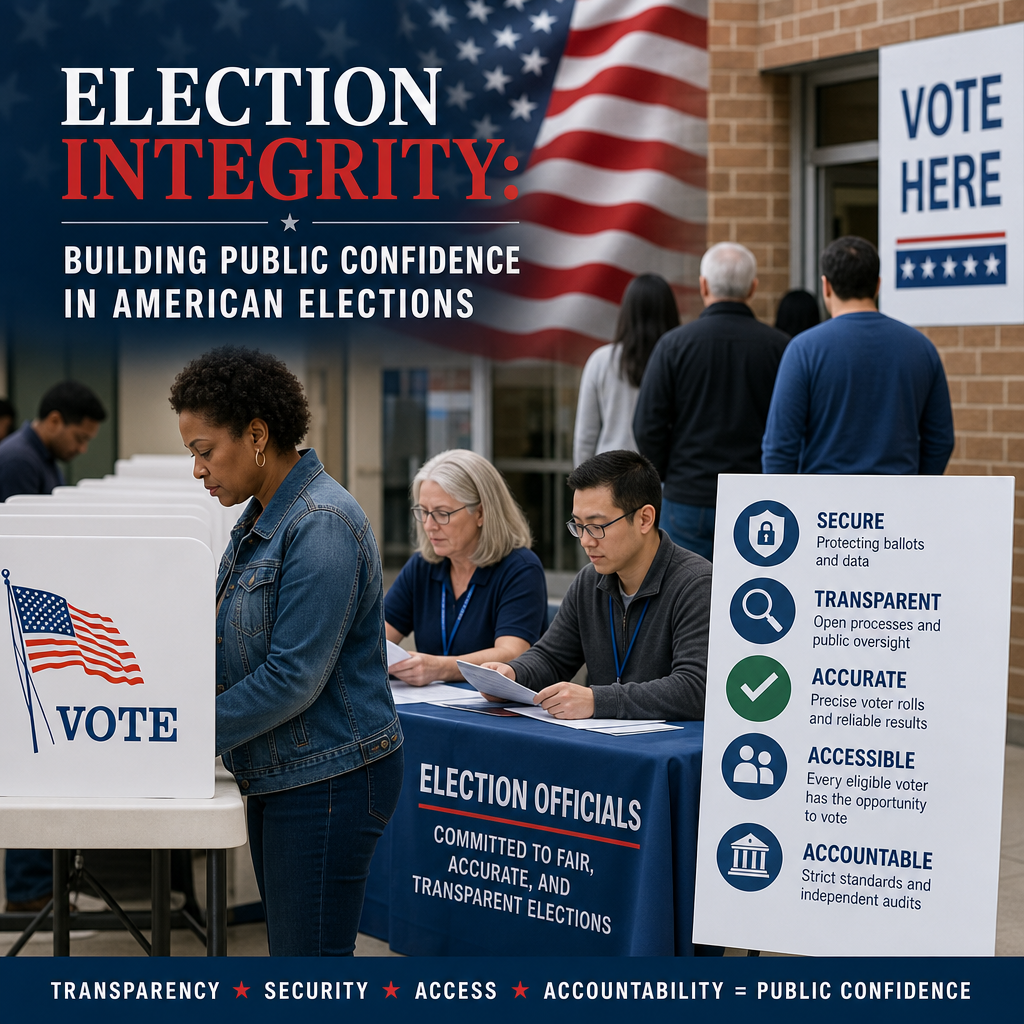
Election Integrity is about much more than catching fraud after an election is over. It is about building a process that ordinary citizens can trust without hesitation. In a healthy democracy, Election Integrity means elections should be beyond reproach: free not only from actual manipulation, but also from any reasonable appearance of error, bias, or impropriety.
That standard matters because legitimacy depends on confidence. If voters believe the system is fair, they are far more likely to accept the outcome, even when their preferred candidate loses. If they do not, every election becomes a source of suspicion. Once suspicion takes hold, even accurate results can be questioned for years.
That is why Election Integrity should be understood as a public trust issue, not just a legal or technical one. The machinery of voting has to work, but it also has to be visible, understandable, and credible to the people who rely on it. A democracy cannot survive on outcomes alone; it needs confidence in the process that produces them.
Why Election Integrity Matters More Than Most People Realize
It is easy to define Election Integrity narrowly as preventing fraud. But that misses a crucial part of the challenge. A process can be technically lawful and still look compromised to the public.
A confusing ballot system, inaccurate voter rolls, or sloppy administration can weaken trust even if no criminal conduct occurred. That is why strong election systems aim for both substance and appearance. The process must be correct, but it must also look correct to ordinary voters.
A credible election process should include accurate voter registration records, transparent counting procedures, clear rules that are consistently applied, timely public reporting, and independent oversight. The goal is not merely to avoid wrongdoing. It is to eliminate doubts before they spread.
When voters can see how decisions are made, they are less likely to assume hidden manipulation. That is one reason election administration should not be treated as a narrow technical issue reserved for experts alone. It affects the public’s willingness to accept the result.
In that sense, Election Integrity is closely tied to civic stability. If the process is understandable, visible, and orderly, it becomes easier for citizens on all sides to view the outcome as legitimate. If it is opaque or inconsistent, even routine mistakes can look like evidence of something worse.
That is also why election officials must think beyond the minimum legal threshold. A system can comply with the law and still frustrate voters if the steps are hard to follow or the records are obviously outdated. For public confidence, administrative quality matters as much as statutory compliance.
For a broader civic perspective on trust and institutions, see On Restoring Civic Trust. The same principles of clarity, consistency, and credibility apply across many public institutions, not just elections.
Election Integrity and Public Perception
Perception matters almost as much as reality in any election. Citizens do not experience election administration as an abstract policy debate; they experience it through ballots, polling places, news coverage, wait times, explanations from officials, and the behavior of political leaders.
That means Election Integrity is partly a communications challenge. If the public is not told what is happening, or if procedures are explained poorly, people may fill in the gaps with their own assumptions. And once people assume a process is secretive or tilted, trust becomes much harder to rebuild.
This is why public confidence does not come from slogans. It comes from repeatable practices that voters can observe and understand. If ballots are handled carefully, if registration systems are kept accurate, and if disputes are resolved through transparent procedures, citizens have a stronger basis for accepting the outcome.
Confidence is also cumulative. A single confusing election may not destroy trust, but repeated problems can. If voters see the same administrative weaknesses year after year, they may begin to assume the process is unreliable even when the final tally is accurate.
That is why Election Integrity should be treated as an ongoing discipline rather than a reaction to one controversy. The work begins long before Election Day and continues after the last ballot is counted.
Good systems also make it easier to distinguish between real problems and partisan spin. When procedures are clear, election officials can explain what happened instead of leaving the public to guess. That clarity is one of the strongest protections against misinformation.
Trump’s Claims and the Debate They Sparked
Donald Trump repeatedly asserted that the 2020 election was rigged or fraudulent. Those claims became a central feature of his post-election messaging and continue to shape the public debate around American elections.
At the same time, those allegations were heavily disputed and rejected in court. For supporters, Trump’s claims reflected a broader frustration with electoral rules, media coverage, and institutional trust. For critics, they represented a dangerous attempt to delegitimize a lawful outcome without persuasive evidence.
However one views those arguments, they reveal a deeper issue: once public trust erodes, even settled results can remain contested in the public mind.
That is why Election Integrity cannot be treated as a purely partisan talking point. It is a civic requirement. Elections must be administered in a way that gives voters no reason to believe the process was tilted, hidden, or manipulated.
The debate also shows how easily the public conversation can collapse into competing narratives. One side emphasizes the dangers of false claims; the other emphasizes the dangers of weak procedures and uneven oversight. Both concerns matter. A durable system must be able to withstand accusations and also prevent the kinds of administrative errors that make those accusations more believable.
When trust is already weak, any unusual delay or inconsistency can become the basis for a larger theory. That does not mean every criticism is valid. It does mean that public institutions have an obligation to anticipate how their actions will be interpreted.
Ty Cobb, Trump, and the Larger Media Dynamic
Ty Cobb’s warnings about Trump’s efforts to influence election-related institutions added another layer to the conversation. His criticism focused attention on the risk that powerful actors might pressure systems meant to remain neutral. That concern deserves serious consideration.
But it is also worth noting the broader political and media dynamic surrounding these debates. Commentators often spotlight controversy because controversy draws attention. A dramatic accusation or warning may dominate headlines, while less visible structural issues receive far less scrutiny.
That imbalance matters. Election Integrity is not only about dramatic disputes over candidates and outcomes. It is also about the quieter, more technical work that keeps elections credible: maintaining accurate voter rolls, removing ineligible registrations, ensuring ballot access is both fair and secure, protecting chain-of-custody procedures, and making election administration transparent to the public.
These are not flashy topics, but they are the foundation of public confidence. In many cases, the difference between trust and distrust is not a major scandal. It is whether election officials can explain their procedures clearly and apply them consistently.
Independent oversight also matters. Bipartisan observation, public reporting, and regular verification can help reduce suspicion before it hardens into cynicism. Those safeguards do not solve every problem, but they make it harder for rumors to flourish unchecked.
For a useful institutional contrast, see the U.S. Election Assistance Commission, which provides federal guidance and resources related to election administration, voting system standards, and election management practices. It is a practical example of the kind of public-facing transparency voters often expect.
Media coverage can also shape public expectations in ways that are not always healthy. When the loudest stories focus on conflict rather than process, the public may come away believing that elections are defined mainly by accusations. Better civic reporting would place more emphasis on how the system actually works.
What Real Reform Should Focus On
If someone is genuinely concerned about Election Integrity, the discussion should start with concrete safeguards. It is easy to argue about rhetoric and motives. It is harder, but far more useful, to ask whether election systems are properly maintained.
The most credible reforms are the ones that reduce both actual risk and public suspicion. They should be practical, measurable, and easy for the public to understand. The purpose is not to create perfect systems, because no large public process is perfect. The purpose is to make systems strong enough that isolated mistakes do not undermine confidence in the whole.
It also helps to remember that reform is not one single fix. It is a set of habits and procedures that support reliability at each stage of the process. The more those safeguards reinforce one another, the less room there is for confusion or doubt.
Accurate voter rolls
States should regularly update registration records to remove duplicate, outdated, or ineligible entries while preserving lawful registrations. Clean rolls help ensure that each eligible voter is counted correctly and that the system appears orderly and reliable.
When voter data is incomplete or outdated, people begin to wonder whether the machinery of the election is functioning properly. Those questions may be unfair in a given case, but they are predictable. That is why maintenance matters so much.
Regular maintenance is also a sign of respect for the electorate. Voters should not have to wonder whether their information is current or whether basic records are being checked carefully.
Removal of ineligible registrations
When records contain deceased voters, people who have moved, or otherwise ineligible registrations, the system loses credibility. Even if these records do not lead to fraud, they create an opening for doubt.
That doubt can be costly. Public confidence is cumulative. If citizens repeatedly hear about bad records, administrative delays, or confusing procedures, they may conclude that the process is less trustworthy than it really is. Good stewardship means reducing those openings wherever possible.
This is not a partisan preference. It is basic housekeeping. A well-run election system should be able to account for who is eligible, who is not, and what happens when records change.
Transparent election administration
Transparent procedures help voters see that ballots are handled carefully and consistently. Publicly accessible rules, bipartisan observation, and clear reporting reduce the sense that anything is hidden.
Transparent election administration should include clear deadlines, understandable ballot rules, and open explanations of how votes are counted and verified. When people can follow the process from registration to certification, they are less likely to assume the worst.
In practice, transparency is one of the most effective public confidence tools available. It does not require dramatic rhetoric. It requires institutions that are willing to show their work.
It also means admitting what a system can and cannot do. Honest explanations about election procedures usually build more trust than polished talking points. Citizens are more forgiving of complexity than they are of evasiveness.
Strong audit and verification practices
Recounts, audits, and verification procedures are not signs of weakness. They are signs of seriousness. When handled properly, they reassure the public that the system can detect mistakes and correct them.
This is one of the most important points in any discussion of Election Integrity. Verification is not an admission that the system failed. It is evidence that the system takes accuracy seriously enough to check itself.
Post-election reviews also help distinguish between rumor and reality. If an audit confirms the result, that outcome can strengthen confidence rather than weaken it. If an error is discovered, the public can see that the system is capable of correction. Either way, verification supports legitimacy.
Audits are especially useful because they answer a practical question: can the final tally be supported by records that can be reviewed independently? That kind of check is valuable in any large-scale public process.
Administrative competence as a democratic safeguard
Election disputes often focus on headline issues, but competent administration matters just as much as partisan debate. Training poll workers, standardizing procedures, and communicating rules clearly can prevent many small problems from becoming larger controversies.
Even simple administrative choices can shape perception. Long lines, inconsistent instructions, or unclear ballot handling may not prove misconduct, but they do create frustration. The best-run elections reduce that friction wherever possible.
This is why election policy should be judged not only by intent, but by execution. Good intentions without reliable procedures are not enough. Voters experience the process as it is carried out, not as it is described in theory.
Administrative competence also matters because it limits the number of issues that can be misread later. If the process is orderly from the start, there is less room for post-election confusion.
Public education and voter confidence
Another overlooked part of Election Integrity is education. Citizens are more likely to trust a system they understand. That means election officials, civic groups, and public institutions should explain how voter registration works, how ballots are verified, and what happens when a dispute arises.
When people do not understand a procedure, they may interpret routine steps as suspicious. Better explanations can prevent that problem. Public confidence often improves when the rules are simple enough to follow and widely communicated in advance.
Education also helps separate legitimate concerns from misunderstandings. Not every delay, correction, or audit indicates wrongdoing. Informed voters are better able to tell the difference.
That is especially important in close elections, when tensions are highest. Clear public education before and after the vote can reduce panic and keep debate focused on evidence rather than assumptions.
Election Integrity in Practice: Transparency, Access, and Verification
In practical terms, Election Integrity rests on a balance of transparency, access, and verification. Transparency lets the public see the process. Access ensures that eligible voters can participate without unnecessary barriers. Verification confirms that the outcome matches the records.
When one of these elements is missing, the system becomes harder to trust. Too little access can make the process feel exclusionary. Too little transparency can make it seem secretive. Too little verification can leave unanswered questions about whether the count is accurate.
The best election systems aim to keep all three elements in view at the same time. That is not easy, but it is necessary. A trustworthy process is one that welcomes participation while still protecting the integrity of the count.
States and local jurisdictions can also strengthen confidence by publishing clear explanations of their procedures well before Election Day. When the public knows how ballots are processed, how discrepancies are handled, and how results are certified, there is less room for speculation.
Small improvements often matter more than dramatic reforms. Better training, cleaner records, clearer communication, and stronger audit trails can have a significant effect on how elections are experienced by the public.
Legitimacy Requires More Than No Wrongdoing
The central point is simple: Election Integrity is not satisfied by the absence of proven fraud alone. It requires systems that are so well designed, so transparent, and so carefully administered that they do not invite reasonable suspicion.
That is why legitimacy depends on more than avoiding misconduct. It depends on eliminating the appearance of irregularity and preserving confidence that every lawful vote is counted properly.
American elections should meet that standard every time. Not because suspicion is inevitable, but because trust is essential.
That standard also places responsibilities on everyone involved in civic life. Election officials must maintain reliable procedures. Political leaders should avoid making claims they cannot support. Journalists should distinguish between evidence and speculation. And citizens should demand both accuracy and transparency without turning every disagreement into a crisis.
That balance is difficult, but it is necessary. A democracy cannot function well if half the country assumes the other half is cheating, and it also cannot function well if real administrative weaknesses are ignored because they are politically inconvenient. The answer is not blind faith or permanent suspicion. The answer is a system that earns confidence through visible competence.
In that sense, Election Integrity is not a slogan. It is a standard of governance. It asks whether the process is fair in fact, clear in practice, and credible in the minds of the people it serves. When those conditions are met, elections can do what they are meant to do: resolve conflict peacefully and preserve democratic legitimacy.
That is the real test. A trustworthy election does not merely produce a winner. It produces an outcome that the public can accept because the process behind it was open, careful, and worthy of confidence.



Leave a Reply